Why pray the Rosary every day for a year?


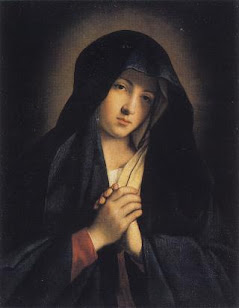
Each time the Blessed Virgin has appeared-- whether it be to Saint Bernadette Soubirous at Lourdes; to Lucia, Jacinta, and Francisco at Fatima; or to Mariette Beco at Banneux-- she has asserted the importance, saving grace, and power of praying the Holy Rosary on a daily basis. Based upon her words, the Rosary is penance and conversion for sinners, a pathway to peace, an end to war, and a powerful act of faith in Jesus Christ. Pope Paul VI presented the Rosary as a powerful means to reach Christ "not merely with Mary but indeed, insofar as this is possible to us, in the same way as Mary, who is certainly the one who thought about Him more than anyone else has ever done."

To show us how this is done, perhaps no one has been more eloquent than the great Cardinal Newman, who wrote: "The great power of the Rosary consists in the fact that it translates the Creed into Prayer. Of course, the Creed is already in a certain sense a prayer and a great act of homage towards God, but the Rosary brings us to meditate again on the great truth of His life and death, and brings this truth close to our hearts. Even Christians, although they know God, usually fear rather than love Him. The strength of the Rosary lies in the particular manner in which it considers these mysteries, since all our thinking about Christ is intertwined with the thought of His Mother, in the relations between Mother and Son; the Holy Family is presented to us, the home in which God lived His infinite love."


As Mary said at Fatima, "Jesus wants to use you to make Me known and loved. He wishes to establish the devotion to My Immaculate Heart throughout the world. I promise salvation to whoever embraces it; these souls will be dear to God, like flowers put by Me to adorn his throne."


March 22, 2013: Saint Nicholas Owen

Posted by Jacob

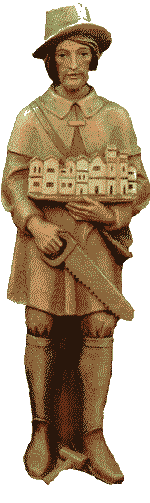
Today, March 22, we celebrate the feast day of Saint Nicholas Owen (born, unknown; died 1606). Born into a poor, but devout Catholic family in England in the late 16th century, Nicholas worked tirelessly throughout his life as a skilled carpenter, building hiding places throughout the region to protect priests and religious from persecution. Despite the active persecution of the Church under the reign of Queen Elizabeth I, two of Nicholas’ brothers became Catholic priests, one printed and distributed Catholic literature. Nicholas, drawing upon his skills, aiding the survival of the faith in another way.


While little is known about his life, other than his works, it is clear that Nicholas never took formal vows. However, during his work for first Saint Edmund Campion, and later Fathers Garnet and Gerard, Nicholas was schooled in the Jesuit traditions. He was made a lay brother of the order in 1577, and served both priests throughout his life.

Saint Nicholas first drew the attention of the authorities following the martyrdom of Saint Edmund. He spoke out adamantly about the treatment that Edmund had received, as well as the atrocity his death. As a result, he was imprisoned, but released shortly afterwards. Prior to his death, Saint Edmund had initiated the work that would occupy Nicholas through most of his life. By day, he would build, repair, and undertake “legitimate” construction on the large homes that housed the religious, and by night would craft secret rooms and hiding places, finding and reinforcing subterranean passages, small spaces between walls, impenetrable recesses. He always worked alone, and no records were kept of his constructions. So intricate and creative were the designs, it is likely that some have never been discovered to this day. His gift of design and construction was such that he even assisted in the escape of two Jesuit priests, Fathers Garnet and Gerard, from the Tower of London, assumed to be impenetrable.
Father Garnet, who himself had employed Nicholas in building hiding places, described him in 1596 as “a carpenter of singular faithfulness and skill who has traveled through almost the entire kingdom and, without charge, has made for Catholic priests hiding places where they might shelter the fury of heretical searchers. If money is offered him by way of payment he gives it to his two brothers; one of them is a priest, the other a layman in prison for his faith.”

At some point, although it is unclear when, the anti-Catholic authorities discovered one of his secret hiding places, but did not know who had constructed them. Nicholas was arrested on more than one occasion, but always let go, as he refused to give up the names of his Catholic brethren, and his simple and humble demeanor suggested he couldn’t be the “mastermind” responsible. Eventually, however, Nicholas himself was taken to the Tower of London, and mercilessly tortured for days. With chains around his wrists, heavy weights were attached to his feet, and he was hoisted off the ground. A man of short stature, who had a pre-existing hernia due to the heavy work he undertook each day, Nicholas’ stomach split open after many days of hanging, his intestines spilling to the floor. He died after several more hours of excruciating pain, without ever having given up the names of those he protected.

Father Gerard wrote of him, "I verily think no man can be said to have done more good of all those who labored in the English vineyard. He was the immediate occasion of saving the lives of many hundreds of persons, both ecclesiastical and secular."

Saint Nicholas Owen was a brave and humble man. He recognized that the Lord gives us each a special gift. For Nicholas’ brothers, it was preaching, writing, and printing. But Nicholas embarked on a different path, looking to his hands graced by God, and courageously utilizing them to safeguard His Church. We are reminded by Nicholas Owen that we all possess different abilities, that these abilities all come from the same God, and He is pleased when we use them to honor Him. What are your gifts from God? How often do we recognize these gifts, offer praise and thanksgiving for them, and consciously lift our actions in prayer to the Lord who made us? During this Lenten season, we might pause for reflection, acknowledging our human frailty, and thanking God for all the many blessings He has bestowed upon us.


Prayer Requests: Week 11

During this week, the most holiest of weeks, please join me in lifting the following intentions  submitted through this blog, to Our Lord and Savior, through the intercession of Our Blessed Mother:


End to loneliness, renewed relationship with God (G, United Kingdom);  Successful employment for a husband (S, USA-NM); Successful employment for a son (J, India);  For resolution to difficulties at work for daughter (B, Ireland); Healing of relationships, justice (J, Australia); Healing for a brother-in-law (D, United Arab Emirates); Successful employment for a son (D, USA-MA); Successful academic studies and examinations (L, India); Stable employment, end to suffering, healing, family strength, financial security (S, South Africa); Blessings upon a family, health for a newborn daughter, employment for husband (M, India); For the prayers of the faithful (L, Canada); Financial security, blessings upon a family (A, India); Healing of a father (J, USA-IN); Healing of a father (N, Australia); Blessings upon a suffering world (J, USA-CA); Healing of a friend with cancer (C, USA-GA);  Healing (M, USA-OH);  Healing of a friend (J, USA-CA); Successful employment for one who is struggling (D, India); Safety of those serving overseas, strength in relationships, health of those who are pregnant (C, USA-FL); Successful employment, financial security (S, USA-KS); For an improved relationship with God (C, Nigeria); Resolution to difficult legal situation, finding joy in work, end to depression (J, USA-MO); Blessings upon a sister (E, Nigeria); Successful employment (L, USA-LA).

March 17, 2013: Saint Patrick, Apostle of Ireland

Posted by Jacob

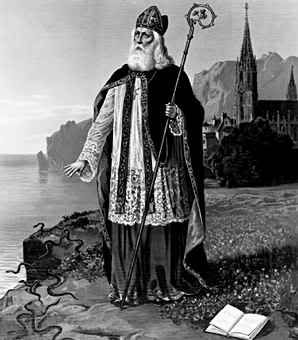
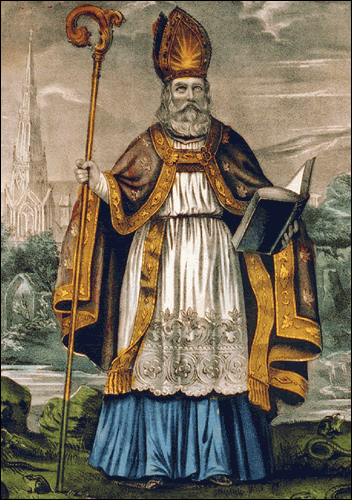
March 17 is one of the most widely recognized feast days throughout the Church, the feast of Saint Patrick (387-493), patron saint of Ireland. Many myths and legends have arisen regarding the life of Saint Patrick, some culturally-based in Celtic oral storytelling, and some much more modern in support of non-spiritual celebrations. Church historians have compiled the basic facts of Saint Patrick’s life from letters and Confessions that he wrote while alive, as well as survey of the political and historical landscapes of the time. Many of the legendary miracles reported to have been performed by Saint Patrick remain unverified by history, but for many verified by faith in the gentle man responsible for bringing Catholicism to Ireland.


Saint Patrick was born in Kilpatrick, Scotland, where he lived the first 14 years of his life with his family, Christians, although not overly devout. In late adolescence, Patrick was captured from his family’s home by Irish raiders, and taken back to Ireland as a slave. There, he would spend the next six years in captivity, learning Celtic customs and language, and spending significant periods of time alone, tending sheep in the fields. It was here that Patrick’s’ love of God deepened and his faith took root and bloomed. He prayed incessantly, writing, “the love of God, and His fear increased in me more and more, and the faith grew in me, and the spirit was roused, so that, in a single day, I have said as many as a hundred prayers, and in the night nearly the same, so that whilst in the woods and on the mountain, even before the dawn, I was roused to prayer and felt no hurt from it, whether there was snow or ice or rain; nor was there any slothfulness in me, such as I see now, because the spirit was then fervent within me.”

After six years of contemplation, Patrick was visited by an angel who encouraged him to return home to Scotland by escaping his slavery and walking 200 miles to the coast where he would find a ship awaiting him. Patrick did as instructed, finding the crew of s ship willing to take him to Scotland, and returned home to his grateful family. After a few years, Patrick experienced a second call from God, this time in the form of a visitor from Ireland. In his Confessions, he wrote:

I saw a man coming, as it were from Ireland. His name was Victoricus, and he carried many letters, and he gave me one of them. I read the heading: "The Voice of the Irish". As I began the letter, I imagined in that moment that I heard the voice of those very people who were near the wood of Foclut, which is beside the western sea—and they cried out, as with one voice: "We appeal to you, holy servant boy, to come and walk among us!

Patrick felt called to return to Ireland, but wished to be ordained prior to his departure. He undertook rigorous religious study, lasting approximately 14 years, during which time he was first ordained a priest, and later a bishop. Only upon becoming bishop did Patrick feel prepared to return to Ireland. While some legend suggests that Saint Patrick introduced Christianity to Ireland, it is far more likely that some small Christian communities existed before his second arrival. His dual mission was that of ministering to the existing Christian communities and converting others to the faith.

Saint Patrick had great success on both accounts, drawing from his familiarity of Celtic and Druid religious beliefs and language. He introduced natural elements into his teaching, including placing the sun on the Celtic Cross as symbolization of the Godhead, illustrating the Resurrection of Christ through the use of bonfires (symbols familiar to the Druids), and most famously, explaining the Holy Trinity through comparison to the shamrock.

Many were converted by his works, and monasteries and convents established (although their formal structure and organization would not be complete until centuries after his death). During his ministry in Ireland, Saint Patrick lived a poor and austere life, accepting only what he needed to live. He was repeatedly arrested and imprisoned, threatened and attacked by chieftains of warring tribes, and suffered great peril. Throughout all struggles, he remained fearless, looking to the Lord for guidance and comfort, and demonstrating great love, humility, and charity towards all he encountered. Numerous miracles and intercessions are reported in his name.

Saint Patrick’s ministry in Ireland spanned over 40 years, during which he laid the foundation for the seat of the Church during the Dark Ages, when Christianity survived in Irish monasteries. He died in Saul, Ireland, where he is believed to be buried. He is reported to have composed the following prayer, referred to as “Saint Patrick’s Breastplate:”

I bind to myself today
The strong virtue of the Invocation of the Trinity:
I believe the Trinity in the Unity
The Creator of the Universe.


I bind to myself today
The virtue of the Incarnation of Christ with His Baptism,
The virtue of His crucifixion with His burial,
The virtue of His Resurrection with His Ascension,
The virtue of His coming on the Judgment Day.


I bind to myself today
The virtue of the love of seraphim,
In the obedience of angels,
In the hope of resurrection unto reward,
In prayers of Patriarchs,
In predictions of Prophets,
In preaching of Apostles,
In faith of Confessors,
In purity of holy Virgins,
In deeds of righteous men.
I bind to myself today
The power of Heaven,
The light of the sun,
The brightness of the moon,
The splendor of fire,
The flashing of lightning,
The swiftness of wind,
The depth of sea,
The stability of earth,
The compactness of rocks.


I bind to myself today
God's Power to guide me,
God's Might to uphold me,
God's Wisdom to teach me,
God's Eye to watch over me,
God's Ear to hear me,
God's Word to give me speech,
God's Hand to guide me,
God's Way to lie before me,
God's Shield to shelter me,
God's Host to secure me,
Against the snares of demons,
Against the seductions of vices,
Against the lusts of nature,
Against everyone who meditates injury to me,
Whether far or near,
Whether few or with many.


I invoke today all these virtues
Against every hostile merciless power
Which may assail my body and my soul,
Against the incantations of false prophets,
Against the black laws of heathenism,
Against the false laws of heresy,
Against the deceits of idolatry,
Against the spells of women, and smiths, and druids,
Against every knowledge that binds the soul of man.


Christ, protect me today
Against every poison, against burning,
Against drowning, against death-wound,
That I may receive abundant reward.


Christ with me, Christ before me,
Christ behind me, Christ within me,
Christ beneath me, Christ above me,
Christ at my right, Christ at my left,
Christ in the fort,
Christ in the chariot seat,
Christ in the deck of ships,
Christ in the heart of everyone who thinks of me,
Christ in the mouth of everyone who speaks to me,
Christ in every eye that sees me,
Christ in every ear that hears me.


I bind to myself today
The strong virtue of an invocation of the Trinity:
I believe the Trinity in the Unity
The Creator of the Universe.

March 13, 2013: Saint Leander of Seville

Posted by Jacob

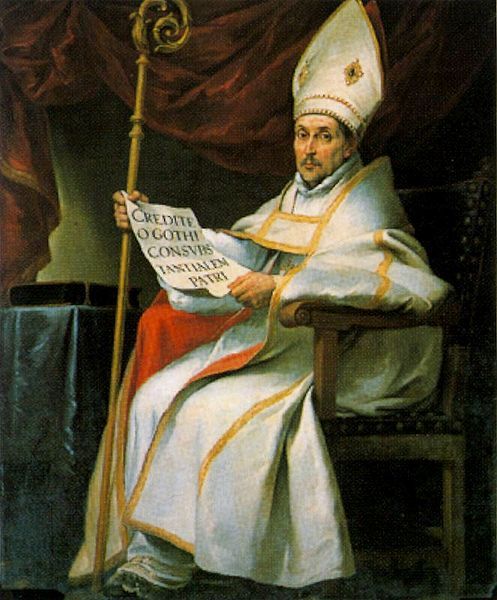
Today, March 13, we celebrate the feast of Saint Leander of Seville (534-600), bishop and confessor of the faith, apostle of Spain, and Doctor of the Church. Saint Leander, as bishop, instituted the practice of praying the Nicene Creed during Mass—a practice which continues today. He viewed the Creed as a manner in which to proclaim the divinity of Christ at a time when the Church suffered attack from various heresies, as well as an opportunity to reinforce the faith of the people. Through his diligent work, Saint Leander saw Catholicism flourish in Spain at a time of great political and religious uncertainty.


Leander was born in Cartagena, Spain to pious parents, Severianus and Theodora. He was the eldest of four children, his younger brothers and sisters being Saint Isidore of Seville (who would succeed him as Bishop of Seville), Saint Fulgentius of Ecija (who became bishop of Cartagena), and Saint Florentina of Cartagena. (who would become an Abbess). The children spent their youth in pious and humble pursuits, and upon reaching the age of consent, Saint Leander entered a Benedictine monastery in Seville. There, he became a model of learning and piety, and as a monk earned the respect of both the religious and lay communities alike. In 579 he was elected Bishop of Seville, which he accepted, although continued to practice his life of austerity and penance, rather than adopt the more comfortable lifestyle of a bishop.

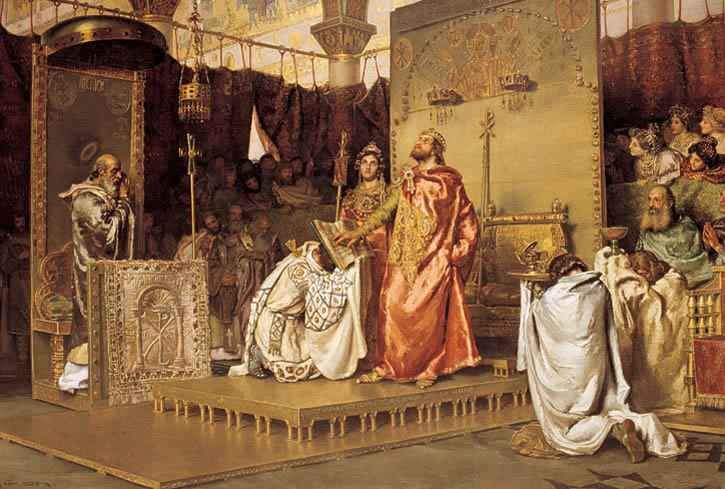
Spain, at that time in history, was experiencing considerable political upheaval, with the Visogoths dominating part of the territory. Not only had this invading force captured much of the land, their rulers had also spread the Arian heresy amongst the people, with many of the congregations and bishops accepting this affront to the divinity of Christ. Upon his election as bishop, Saint Leander immediately began to combat this heresy with all his strength, relying on the Lord, and seeing almost immediately the fruits of his labor. The heresy began to lose hold over the people, including the two sons of the Visogothic King Leovigild, Hermenegild and Reccared. These conversions angered the king considerably, and Leander was exiled to Constantinople.

In Constantinople, Leander met and became close friends with the Papal Legate stationed there, the future Pope Saint Gregory the Great. This action earned him the king's wrath and exile to Constantinople, where he met and became close friends of the Papal Legate, the future Pope Gregory the Great. Saint Leander served as a contemporary and advisor to Saint Gregory, encouraging him to write his famous commentary on the Book of Job entitled the “Moralia.”

After some time, King Leovigild summoned Leander back to Seville. Having experienced a change of heart, he wished for Leander to instruct his son Reccared—who would inherit the throne—in the ways of the faith. Through Leander’s instruction and model, the people of Spain were converted. He presided over the third Council of Toledo, which upheld the consubstantiality of the Trinity, and brought about many moral reforms in the Church. Saint Leader further wrote an influential Rule for Spanish nuns and introduced the practice of praying the Nicene Creed at Mass. A prolific writer, unfortunately most of his works have been lost to history, although much of the correspondence written by Gregory the Great to his attention remains extant.

King Leovigild rejects Arianism and embraces the true faith in front of Saint Leander

After a long life of fighting heresies and preaching the truth, Saint Leander died around the year 600. He was succeeded by his brother, Isidore, who said of him: "This man of suave eloquence and eminent talent shone as brightly by his virtues as by his doctrine. By his faith and zeal the Gothic people have been converted from Arianism to the Catholic faith"

Saint Leander held to the truth of the faith, despite overwhelming opposition and exile. Not only did he believe the truth, he sought to bring others to the light of the faith through tireless work. As modern Christians, we rarely consider the work of these early defenders of the faith, who lived their lives in constant proclamation of the Kingdom of Heaven. We might, during this Lenten season, take a lesson from these holy men and women, not only believing our faith, but living it visibly as witness to others!


Saint Leander, pray for us that we will always seek truth, and never shy away from defending it. In Christ’s Name, we pray. Amen


March 13, 2013: Blessed Agnellus of Pisa & Saint Euphrasia

Posted by Jacob

Today, March 13, we remember two lesser-known holy servants of God: Blessed Agnellus of Pisa (1195-1236) and Saint Euphrasia (380-420). Both Agnellus and Euphrasia, while very different from each other, possessed hearts of service and sacrifice for the Lord, committing their lives to the Gospel, and working to spread the Christian faith with profound humility and meekness.


Blessed Agnellus of Pisa is remembered as the founder of the English Franciscan province, credited with bringing the Franciscan rule to Great Britain in 1224. Admitted into the Order by Saint Francis himself, Agnellus was a tireless missionary of God’s love, going wherever he was asked, enduring harsh and inhospitable conditions.

Born in Pisa of noble family, as a youth he encountered Saint Francis, and was admitted directly into the Seraphic Order, where he became known for his pursuit of holy perfection. Saint Francis, recognizing in this young man not only zeal for God’s law, but also the meekness and humility required to counsel great leaders, mediate misunderstandings, and secure the spread of the order. Saint Francis first dispatched Agnellus to Paris, where he erected a convent, and upon success was ordered to England to establish the province. Along with nine companions, Agnellus traveled to Dover in the winter of 1224, subsisting on the alms and kindness of those they encountered, truly living the rule of poverty. They survived the winter, eating little but bread and fermented beer. Within months, Agnellus had secured a house in Oxford, which eventually became the examplar for all Franciscan provinces. Agnellus, despite his lack of personal schooling, established a school for friars at Oxford, which led to the development of the university there.

Blessed Agnellus sent his brothers across the region, and throughout Europe, spreading the word of God. He was counselor to Kings and Prices, and worked tirelessly to assist these leaders in finding political options in avoidance of war and suffering. Given his strict observance of the rule of poverty, his frequent fasting and mortification, and his travels, is was not surprising when he contracted a fatal disease. Upon returning to Oxford, he eagerly awaited death, crying out repeatedly for three days, “Come, Sweetest Jesus, Come!” His body, incorrupt, was buried in Oxford.


Saint Euphrasia was born into Roman nobility, the daughter of Antigonus, Senator of Constantinople, and cousin to Roman emperor Theodosius I who finished the conversion of Rome to a Christian state. When her father died, while Euphrasia was still very young, she and her mother became members of the emperor’s court. Euphrasia’s mother was a woman of great faith, and upon becoming a widow, consecrated her remaining years to God. With her young daughter, she moved to Egypt, where she owned an estate, and attached herself to a convent there. She would visit the sisters in faith each day, bringing young Euphrasia with her. At approximately age 7, Euphrasia requested that she be allowed to enter the convent, which her mother joyously allowed, saying, "Lord Jesus Christ, receive this child under Your special protection. It is You alone whom she loves and seeks; to You she recommends herself.”

Euphrasia moved into the convent, and her holy mother died a few years later, leaving her with these parting instructions: “"Fear God, honor your sisters, and serve them with humility. Never think of what you have been, nor say to yourself that you are of royal extraction. Be humble and poor on earth, that you may be rich in heaven." Upon her mother’s death, Euphrasia was recalled to Constantinople by the Emperor, as he had arranged a political marriage for her. Euphrasia was not to give up her vow of virginity and consecration to the Lord, however, and wrote the Emperor explaining as much. She further requested that all of her land and estates be sold, with the money used charitably to aid the poor. In her own words:
"Invincible emperor, having consecrated myself to Christ in perpetual chastity, I cannot be false to my engagement, and marry a mortal man, who will shortly be the food of worms. For the sake of my parents, be pleased to distribute their estates among the poor, the orphans, and the church. Set all my slaves at liberty, and discharge my vassals and servants, giving them whatever is their due. Order my father's stewards to acquit my farmers of all they owe since his death, that I may serve God without let or hindrance, and may stand before him without the solicitude of temporal affairs. Pray for me, you, and your empress, that I may be made worthy to serve Christ."

The emperor, moved by her faith, executed all her wishes before his death in 395.

Saint Euphrasia exemplified humility, meekness, and charity. She was frequently tormented by temptation, which upon guidance from the abbess, she overcame through physical and oftentimes exhausting penitential labors. In one case, as recorded in her life, she repeatedly moved a pile of heavy and painful stones from one place to another for thirty days, at which time, the temptations she struggled with left her.

She was known for driving demons out of those possessed, as well as miraculous cures, saying, “May He who created you, heal you!” Euphrasia lived an austere life, relishing with holy ardor the love of the Lord. She persisted in self-imposed fasting nearly every day, spent much of her time in prayer, and yet was often times treated poorly due to her status as a foreigner in Egypt. Even in moments of mockery and humiliation, she remained humble and meek, oftentimes falling at the feet of her accusers, and begging that they pray for her. She died peacefully at age 40.

Blessed Agnellus and Saint Euphrasia were confronted with multiple obstacles and ridicule in their lives, but through their humility and meekness were able not only to overcome these obstacles, but witness to the love of Christ in the process. The exhibited that special quality, the quality that made those who encountered them wonder about what made them different from others? We know the answer is the grace of God, the identification with, and living of, the Christian life we are all called to. How often are our lives, our behaviors, witness of that call to others? How often, when we meet someone, do they wonder what makes us different, special, grace-filled, at peace?


March 8, 2013: Saint John of God

Posted by Jacob

Today, March 8, we celebrate the feast day of Saint John of God (1495-1550). John of God would today be called impulsive—he would likely be medicated for it! But during his lifetime, he followed the innermost longing of his heart, oftentimes to the glory of the Lord, and sometimes to the detriment of the man. He was willful, quick to action, and committed to those in need. By the end of his life, Saint John of God had established an order of religious servants to the sick and poor, and through his model, had opened the doors of Christian charity and love to those in need. But his early life was marked by wandering and impetuousness, all of which eventually led him to Granada, Spain.


Saint John was born in Portugal, the child of devout Catholic parents. At age eight, after hearing a priest touring through the area deliver a homily, John left his parents in the middle of the night, following the priest, and becoming his servant. They lived an austere live, begging, and surviving on the kindness of strangers, until the lifestyle left John sick and weak. The priest, continuing his travels, left John in the care of a wealthy family with a large estate, and John eventually became the herder for their animals. He worked at this post for nearly 20 years, until the age of 27, his time in the mountains with only the sheep creating a broad space for him to pray and contemplate the glories of the Lord. He grew in faith, the Holy Spirit moving within in.

At approximately age 27, John joined the Spanish army in their war against France, leaving the fields to become a soldier. He quickly succumbed to the soldier’s life, engaging in gambling, drinking, pillaging, and other sinful ways. It was not until he was knocked from his horse—much like Saint Paul—and left by his battalion behind enemy lines that he felt a call to true conversion. John changed his ways, turning away from the sinful behaviors he had enjoyed, and devoting himself to God.

Returning to his shepherding job, he again listened to his heart and was moved to sail to Africa to assist Christian martyrs and those being held in captivity there. Joining himself to an exiled family, he sailed from Gibraltar. Upon arriving in Africa, he was appalled by the treatment of local peoples by the Christians, who worked them mercilessly, relying on the whip and beatings to increase performance. John spoke out against such injustices, and was encouraged, for his own safety to return to Spain.

He did so, and set out on a journey to find his birth parents. Unfortunately, upon arrival in his hometown, he found they had both died in his long absence. John, filled with regret, began walking back to Spain, determined to return to his foster family and their sheep. While on this journey, holy tradition tells us that he found a small child on the roadside, dressed in rags and crippled. The boy asked John to carry him part of his way, which John did without a moment’s hesitation. The child, however, grew heavy, and John, after years of begging and poverty, was not very strong. When the pair reached a place to get a drink of water, John proposed to the child that they should stop and rest. The child came down from his shoulders and was transformed into the likeness of the child Jesus. "John of God," He said, "Granada shall be your cross," and immediately disappeared.

Saint John set out for Granada, where he would live the remainder of his years. In Granada he worked back-breaking manual jobs, carrying stone, selling firewood, unloading ships at the docks, and construction, the money from which he gave to the poor. Reading holy books at night, in the safety of the local church, became his refuge. Again, following the yearnings of his heart, John bought a small bookstore with which to share his love of reading with the world. Following a sermon of repentance of Saint John of Avila—the man who would become John of God’s spiritual advisor and mentor-- he ransacked his own store, destroying the secular books he was selling, leaving only those that would bring readers to God.

Those who knew him assumed he was mad, and had him institutionalized at the Royal Hospital asylum. There he spent forty days, tied to his bed (as was the custom at the time), and receiving daily whippings as treatment. On the fortieth day, Saint John of Avila visited, informing him that he had suffered enough, completed enough penance (like the time of Jesus in the desert), and had him released to a more favorable part of the hospital.

It was here, in the Royal Hospital, that John of God declared his intention to start his own hospital, after seeing the way in which patients were treated. Returning to the streets, he again sold firewood and worked menial jobs, giving all that he had to the homeless poor and sick. Eventually, he acquired a small home for the lodging of these forgotten members of society, and a few years later was able to move into a larger space, an abandoned convent. During this time, he established the Order of the Brothers Hospitallers of St. John of God, dedicated to medical service of the poor and indigent.

During this time, seeking clarification of his vocation, John traveled to the shrine of Our Lady of Guadalupe, where he received a vision of Our Lord, Jesus Christ, Our Lady, and Saint John while praying before a crucifix. The Blessed Virgin presented him with a crown of thorns, and pressed it hard upon his head. "John," the Holy Mother said, "it is by thorns and sufferings that you must win the crown my Son has waiting for you in heaven." Although Saint John could feel the thorns piercing his brain, he replied, "From your hand, Lady, thorns and sufferings are welcome. They are my flowers and my roses."

Returning to Granada, Saint John of God worked tirelessly for the poor and sick. He is reported to have worked miracles, including rescuing many from the Royal Hospital when it caught fire. Remembering that patients were tied to their beds, and witnessing others standing and watching them burn from a safe distance, John ran into the burning building, carrying and leading the patients to safety. He then climbed to the roof, removing the burning portions by hand with an axe, so as to prevent having to destroy the entire building to prevent the fire from spreading. Despite falling through the burning room, he emerged unscathed, having saved both the hospital and the lives of countless patients.

Years of hard work, poverty, and hunger took their toll on John, and he fell ill with pneumonia at age 55. Sensing that his time on earth was close to over, he requested the Last Sacraments, and was visited by the bishop himself. When the bishop asked if he had anything left on his mind, Saint John of God responded with a characteristically practical answer, his mind still focused on charity.

"There are three things that make me uneasy," he said. "The first is that I have received so many graces from God, and have not recognized them, and have repaid them with so little of my own. The second is that after I am dead, I fear lest the poor women I have rescued, and the poor sinners I have reclaimed, may be treated badly. The third is that those who have trusted me with money, and whom I have not fully repaid, may suffer loss on my account."

He then asked to be left alone, and kneeling before a crucifix, he died shortly thereafter, his face resting on the feet of Our Lord. He was buried in Granada, with the magistrates and government providing a pomp and lavish funeral, so was he loved by the citizens of the city.

The life of Saint John of God is inspirational in so many ways. His service to those in need reminds us of our Christian call to serve—those who are hungry, thirsty, homeless, unclothed. More than that, his willingness to listen to the Holy Spirit, to let it fill his heart, and to follow those yearnings with abandon serve as a model for us. All too often we live in our heads, rather than our hearts. How many times have we been moved to help others in our hearts, but then listened to the thoughts of our head—it will be too hard, it won’t make any difference, what will people think?, or it’s not practical. How might we better serve our communities, like Saint John of God, if we opened ourselves to the call of the Holy Spirit—a loving and charitable force already residing within us!