Why pray the Rosary every day for a year?


Each time the Blessed Virgin has appeared-- whether it be to Saint Bernadette Soubirous at Lourdes; to Lucia, Jacinta, and Francisco at Fatima; or to Mariette Beco at Banneux-- she has asserted the importance, saving grace, and power of praying the Holy Rosary on a daily basis. Based upon her words, the Rosary is penance and conversion for sinners, a pathway to peace, an end to war, and a powerful act of faith in Jesus Christ. Pope Paul VI presented the Rosary as a powerful means to reach Christ "not merely with Mary but indeed, insofar as this is possible to us, in the same way as Mary, who is certainly the one who thought about Him more than anyone else has ever done."

To show us how this is done, perhaps no one has been more eloquent than the great Cardinal Newman, who wrote: "The great power of the Rosary consists in the fact that it translates the Creed into Prayer. Of course, the Creed is already in a certain sense a prayer and a great act of homage towards God, but the Rosary brings us to meditate again on the great truth of His life and death, and brings this truth close to our hearts. Even Christians, although they know God, usually fear rather than love Him. The strength of the Rosary lies in the particular manner in which it considers these mysteries, since all our thinking about Christ is intertwined with the thought of His Mother, in the relations between Mother and Son; the Holy Family is presented to us, the home in which God lived His infinite love."


As Mary said at Fatima, "Jesus wants to use you to make Me known and loved. He wishes to establish the devotion to My Immaculate Heart throughout the world. I promise salvation to whoever embraces it; these souls will be dear to God, like flowers put by Me to adorn his throne."


May 8, 2013: Saint Victor Maurus (Victor the Moor)

Posted by Jacob


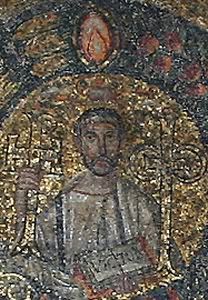
May 8 marks the feast day of Saint Victor Maurus, also known as Victor the Moor (died 303), saint and martyr of the early Church. Little is known about the majority of Saint Victor’s life, but much is known about his passion and martyrdom, given a well-recorded account included below, believed to be written by Saint Gregory of Tours. It is firsthand accounts such as this which the Church maintains and utilizes in the beatification and canonization process.


Saint Victor was born and raised in Mauretania in a Christian household. He is reported to have served in the Roman Army throughout his life, likely as a praetorian guard. Though he was a practicing Christian throughout the time of persecution, he was not discovered until late in life, when he is believed to have been quite elderly, following his destruction of several pagan alters. As his passion describes, he was arrested, brutally tortured—including being basted with molten lead—imprisoned, and eventually decaptitated for his faith. Throughout, he steadfastly refused to sacrifice to pagan gods, asserting his belief in the one true faith—a faith he was happy to confess he had practiced since his youth, stating: "I certainly am a Christian, and I adore Jesus Christ the Son of the Living God who was born of the Virgin Mary. I believe in my heart, and I never stop praising him with my mouth."
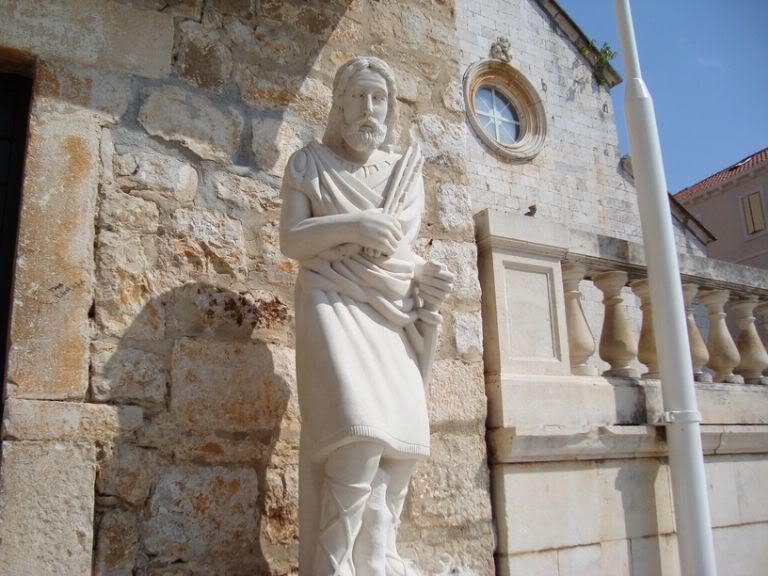
The Emperor, Maximianus, knew Victor, as he had served long in the guard. He gave him every opportunity to recant his faith, hoping that torture would at long last convince him. In the midst of his pain—being stretched on the rack, beaten, having molten lead poured on his body—Victor held true to his belief in Christ. He stated, "Christ is my salvation and my strength. I am nourished by the spirit of him who I have received into my body." The Emperor, not giving up, offered Saint Victor status and riches, should he sacrifice to the pagan gods, similar to the temptations of Jesus by the Devil in the desert. Victor replied, "All the gods of the nations are demons, but our God made the heavens: if, therefore, they are called demons from the start, how will I worship them? I have already said, and will say it again: I will not sacrifice to the demons but I offer myself as a sacrifice of praise to God: because it is written ‘everyone who sacrifices to demons and not to God willbe destroyed.’ I do not accept the rewards promised by you, but I accept strength from my God every day."

Unable to convince him, Victor was beheaded on May 8. The local bishop received permission to bury the body, which remained guarded by wild beasts for 6 days until he could retrieve it. Later a church was erected over his grave. According to St. Gregory of Tours, many miracles occurred at the shrine. In 1576, Victor's relics were transferred to a new church in Milan established by the Olivetan monks. The church still bears Saint Victor's name today.

The life of Saint Victor Maurus is remarkable in its simplicity. He was a lay person—a soldier—who held fast to his faith throughout his life, during a time of growing distrust and eventual persecution of Christians. His death, in contrast, is remarkable for its solidarity with heaven. Saint Victor, at the end of his days, did not fear torture and death, but welcomed it willingly as a testament to his faith and confidence in the Lord. He endured six days of inhuman pain, never losing sight of the glory of God and the love and grace of Our Blessed Mother. His steadfast faith reminds us of how easily distracted we are today, in our own lives, from our faith by seemingly trivial matters. Imagine our response to torture and pain for our beliefs, for the Lord. How might we incorporate Saint Victor Maurus’ single-minded focus on Christ into our daily lives?


The Passion of St. Victor

 
1. When the impious Maximianus was ruling as emperor there was a great persecution of Christians in the city of Milan. There was there a certain soldier by the name of Victor, Moorish by race, who was very well known to the emperor. Then his ministers made a report to the emperor saying, "O Most Clement Lord and Emperor, Victor the Moor has become a Christian and blasphemes against our gods, saying that they are demons. The emperor was angered and ordered that Victor be brought before him; and he said to him, "Victor my soldier, what do you think that you are lacking that you have become a Christian?" Victor responded, "I have not become a Christian just recently, but have been one since my youth." The emperor Maximianus said, "You are a Christian, then, so you clearly say?" Victor replied, "I certainly am a Christian, and I adore Jesus Christ the Son of the Living God who was born of the Virgin Mary. I believe in my heart, and I never stop praising him with my mouth." Then the emperor Maximianus was filled with anger and ordered that he be thrown into the prison which was near the Circus and on the route to the Ticinese Gate, and that he be closely guarded, saying to him, "Go Victor, think to yourself how you can escape those terrible tortures which will viciously rip you unless you offer sacrifice". Thus he was sent to prison and spent six days there, and the emperor ordered that neither bread nor water were to be given to him. On the seventh day the emperor Maximianus ordered a platform to be readied for him in the hippodrome of the Circus, and that Saint Victor be brought to him. He said to him, "What is it, Victor, what have you decided about your salvation?" Saint Victor replied, "Christ is my salvation and my strength. I am nourished by the spirit of him who I have received into my body."


2. Then the emperor Maximianus was filled with anger and ordered that clubs be brought, and that Victor be stretched out in his sight and beaten. He commanded that the torturers should go beyond the third mark of the rack, and should shout at him, "Sacrifice to the Gods whom the emperor and everyone worship." When Victor had been beaten the emperor ordered that he be set up straight, and said to him, "Victor, hear my advice, yield to and serve those gods: because no-one can better serve them than you, especially since you are distinguished by your grey hairs". Saint Victor replied, "Blessed David, king and prophet, teaches, "All the gods of the nations are demons, but our God made the heavens: if, therefore, they are called demons from the start, how will I worship them?" Then the emperor Maximianus said to him, "Behold I give to you the rank of magister militum, much gold and silver, retinues and property, only sacrifice to the gods whom we worship". Victor replied, "I have already said, and will say it again: I will not sacrifice to the demons but I offer myself as a sacrifice of praise to God: because it is written "everyone who sacrifices to demons and not to God will be destroyed."" The emperor's consiliarius Anolinus said, "Victor, rewards have been promised to you by the most clement emperor: why don't you sacrifice to the gods whom the emperor adores, those to whom he bows his neck?" Saint Victor replied, "I do not accept the rewards promised by you, but I accept strength from my God every- day."


3. Then, angered, the emperor Maximianus ordered that he be thrown into prison again, the prison near the Roman Gate. When he was there for three days the emperor ordered that he be brought forth from the prison, and said to him, "Victor, sacrifice to those gods whose real divinity proves them to be gods". Saint Victor replied, "I do not sacrifice to the gods of the pagans: for it would be shameful for me to desert what I learned in the sanctification of my baptism, even if in a situation of necessity and under the compulsion of an evil man, you. I will not. Do what you will do, for I know that he who fights on my behalf is stronger than you." Then the emperor Maximianus and his Consiliarius Anolinus ordered clubs to be brought, and Victor to be stretched out. They ordered that the torturers should go beyond the fifth mark of the rack, and should shout at him, "Sacrifice to the gods whom the emperor and everyone worship." Then Saint Victor, although he was in the middle of his punishment, did not show any feeling of pain but prayed thus to the Lord, saying, "Lord Jesus Christ by whose bread I am nourished today, my king and my God, help me in the midst of these tortures." Then the emperor Maximianus said to him, "Victor, take thought for your life and sacrifice to the gods whom all adore. For I swear by the gods, by my welfare and by the government of the state, that unless you sacrifice through various punishments I will make you breathe your last breath. And do not hope that if you are punished by me that the Christians will make my servant one of their martyrs: for I will order that you be flung where your body will never be found." Saint Victor replied, "I am not sacrificing: do what seems best to you: you will not make a servant of yours breathe his last as you said, but a servant of Christ." Then the emperor Maximianus, angered because Victor had replied in this manner, ordered that he be thrown into the prison near the Roman Gate again, and that his legs be stretched apart on a slab.


4. When Victor had been let out from there, the Consiliarius Anolinus sent messengers to him saying, "Go and say to Victor "Fellow, you have badly given up hope of your life, take thought for your safety, and do not further provoke your emperor to anger. Hear my advice, sacrifice to our gods and seek from the emperor whatever honour you wish: for by the gods and the welfare of the emperor you are readying many torments for yourself."" Saint Victor said to those who came to him, "Go and tell Anolinus. I do not sacrifice to the gods of the pagans because scripture teaches us that all those who worship idols and glory in their statues will be destroyed. I worship the living and true God that I may live forever." When this had been reported to Anolinus it was reported to the emperor also. Both were extremely angry. On the next day the emperor Maximianus ordered him to be led out of prison, and Anolinus said to him, "Is your heart so stubborn that you will not listen to the commands of the emperor and sacrifice?" Saint Victor replied, "I do not sacrifice to gods which are unclean and senseless. "Then the emperor ordered that all kinds of instruments of torture be brought before him, and he said to him, "Do you see, Victor, what great torments await you if you do not sacrifice?" Saint Victor replied, "Those torments which you wish to inflict upon me are nothing: but greater torments will be prepared for you by my god on the day of righteous judgement." Then the emperor Maximianus, taking it badly that Victor had openly insulted him, ordered lead to be brought forward, melted, and poured over the whole of Victor's body. And when he was being covered in this way, Victor prayed thus to the Lord, saying, "O Lord Jesus Christ, for whose name I endure these things, help me and free me, just as you freed unharmed the three boys from the midst of the burning furnace, and confounded the tyrant: send an aide now in that manner, and free your servant to the embarrassment of Maximianus and his lackeys." And there immediately appeared an angel of the Lord who made the lead as cold as springwater and it did not burn any part of Victor's body. Then, stretching out his hands, Blessed Victor gave thanks to the Lord, saying, "I thank you, Jesus Christ, Son of the Living God, that you deigned to pity your servant, and sent your holy angel who cooled the lead and soothed with the ointment of your mercy the wounds which the wicked Maximianus inflicted upon me." Then Maximianus and all those who were present were amazed that Victor's body had not been burned. Then Saint Victor said, "I thank you, Lord God, Father of Our Lord Jesus Christ, you who cooled the lead and enabled me to overcome the terrible tortures; do not allow me, I beg you, to be overcome by those men."


5. Then the emperor Maximianus ordered that he be led to the Vercelline Gate: and while they awaited the emperor's commands they paused there. Then the soldiers who were guarding Saint Victor fell asleep, and rising Victor fled and hid himself in a stable in front of the theatre. Then the soldiers rose and pursued him, and finding a lone woman they questioned her, asking, "Did you not see a white-haired man with torn clothing come this way?" The woman replied, and said, "I did see a white-haired man with torn clothing flee this way." Then the soldiers continued their pursuit along the road which was named after the stables, and they arrived in front of the theatre; and entering the stables they found Saint Victor hidden in front of the horses. Then the soldiers assaulted him and brought him outside. When Maximianus heard that Victor had fled he was furious with his soldiers, and he ordered other soldiers to take them outside the city to a place called the Garden of Philippus. The emperor himself strolled about in the hippodrome of the circus, and sent runners to Victor, saying "Go and tell Victor "you have despaired for your life, and you are not willing to offer sacrifice: by the gods, if you do not sacrifice I will sentence you to capital punishment."" To these Victor replied, "Go and tell your emperor "do quickly what you are about to do because I want to receive my reward from God, the reward for which I suffer these things, and because it is time: if it should please him who has given me my soul and spirit."" Then the emperor Maximianus ordered his servants to be called, and he told them that Victor was to be led to a small wood named The Elms, where he the emperor had a garden, and that he was to be beheaded there. And when Saint Victor was being brought there, he said to the soldiers who were bringing him, "Tell the emperor Maximianus that he will die this year, and that when he is dead no grave will accept him unless his legs are broken." When he had said these things they reached the place, and Victor made a speech, saying, "I thank you, Lord Jesus Christ, that you have not separated me from your saints, my fellow citizens, Nabor and Felix. I bless and thank you forever. Amen." When the speech was complete his head was cut off by a servant.


6. Then the emperor ordered that no one should bury his body in order that it might be eaten by the wild animals. And after six days the emperor sent his quaestor with soldiers in order to see if it had been eaten by the beasts and serpents. They went and found Victor's body intact, in no part damaged, and two beasts guarding it, one at his head and the other at his feet. They returned and reported to the emperor. Then the emperor ordered that the body should be buried. After permission had been given to bury the martyr the saintly and most blessed bishop Maternus went for it, and found two beasts, one guarding his head and the other guarding his feet. The body itself was as it had been left at the very hour of execution. But the beasts, when they saw the saintly bishop Maternus, gave way; as long as they had stood there the body had been protected. Maternus wrapped the corpse in linen, brought it not far from the little wood, and buried it in peace. Then Anolinus the consiliarius ordered all the exceptores in the palace to beseized, and made them swear by their gods that if any of them had any written record no one would conceal it. Then they all swore by the gods and by the safety of the emperor that no one would conceal such, and all the papers were brought forward, and Anolinus had them burned before him by a servant. This greatly pleased the emperor. Saint Victor was beheaded on 8 May, and buried by the bishop Saint Maternus on 14 May, during the reign of Our Lord Jesus Christ with the Father and the Holy Spirit, forever and ever. Amen. (Act. Sanct. Mai II, 288-90)

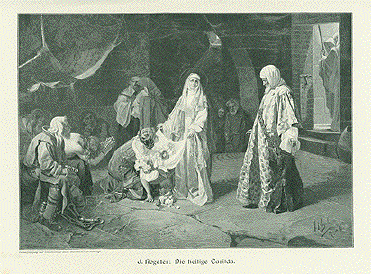


April 9, 2013: Saint Casilda of Toledo

Posted by Jacob

Today, April 9, we celebrate he feast day of Saint Casilda of Toledo (approximately 950-1050). While little is known about Saint Casilda, what we do know is inspirational—especially at a time when both inter and intra-religion conflicts continue to exist. The life of Saint Casilda reminds us that the Lord calls us to love and acceptance of all people, and challenges us to open our hearts to those we disagree with or do not understand.

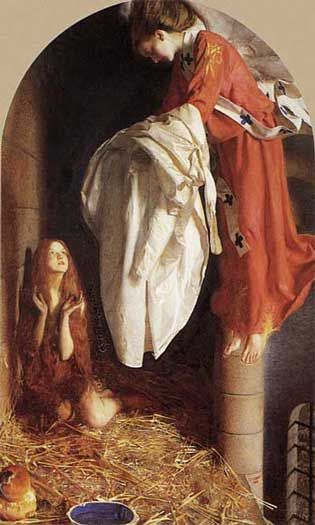
Saint Casilda was born the daughter of a Muslim king in Toledo, Spain. Raised Muslim, she embraced her faith and felt a strong desire to help others—including the many Christian prisoners detained in Spanish prisons. In her kindness, against the orders of her father, Casilda often visited the prisoners, smuggling in food and bread for them in the folds of her dress. As holy legend recounts, on one occasion Casilda was stopped by prison guards who demanded she disclose what she was hiding in her clothing. Upon revealing the folds of her skirt, the bread she carried miraculously transformed into roses. Saint Casilda is oftentimes depicted in religious art carrying a basket or bunch of roses of this reason.

As a young woman, Saint Casilda fell ill, likely from a hemorrhagic fever common at the time, for which there was no cure. She refused the assistance of the best Muslim physicians, and instead, traveled down the Iberian Peninsula to the Shrine of San Vicente, known for it’s healing waters and miraculous cures. There, through her faith and holiness, she was cured of her illness, and later baptized into Christianity.

Saint Casilda lived the remainder of her life as an anchoress (until she reached the age of 100!) in quiet penance and solitude, contemplating the wonder of God, and praying for those on earth. She died peacefully, having served her creator well while practicing two faiths on earth.
Saint Casilda reminds us of the divides that exist between religions today (as well as within our own Church), and models for us the simple love and acceptance of others that the Lord calls us to. Rather than judge the imprisoned Christians, she brought them food. Rather than return to her family and argue with them about their faith, she chose to avoid the conflict, praying for them from afar. How often do we seek our arguments? How often do we judge members of our own and other faith communities? How might we better serve the Lord and draw others to Him through the practice of love, charity, and acceptance?


Prayer Requests: April

During this week, please join me in lifting the following intentions  submitted through this blog, to Our Lord and Savior, through the intercession of Our Blessed Mother:


Healing of a husband with severe anxiety (M, USA-MA);  Safe and affordable housing, financial freedom (K, USA-MD); Healing of a husband and son, protection for a family (M, USA-ME);  End to depression (K, USA-FL); Protection of those in danger, blessings upon family and friends (J, Spain); Security in employment (M, USA-WA); Blessings upon estranged couple, healing after separation (S, India); For continued success as a tutor (E, Malaysia); Healing of a relationship (P, USA-WA); Healing of a family (M, USA-CA); True conversion, hearts of love and support for those we don’t understand (P, USA-OH); To find a God-given partner (N, India); Blessings upon a marriage (K, Australia); Financial security (D, Bulgaria); Return of a family to the Catholic Church (P, Botswana); Success of a seminarian (S, Uganda); Healing of a brother, financial security (C, USA-IL); For occupational success, for health, for the grace of a God-given partner (K, USA-CA); Healing of a family, end to addiction, conversion of faith (C, Australia);  Financial security (P, India); For a grandson’s successful employment and financial security, peace within a family (J, USA-PA); God-fearing partner, health, financial security (C, Philippines); Successful employment (J, United Arab Emirates); Successful employment (R, USA-CA); Blessings and protection upon a family, successful employment (R, USA-NY); Academic success, passing of examinations (M, Germany); Healing (R, USA-NM); Successful conception (C, United Arab Emirates); Daughter’s academic success (L, USA-FL); Blessings, healing, and strength (G, Nepal); Blessings, healing, and protection upon a family (J, India); Successful employment (Y, Philippines); Successful employment, end to depression (C, Hong Kong); Financial security (P, Australia).


March 22, 2013: Saint Nicholas Owen

Posted by Jacob

Today, March 22, we celebrate the feast day of Saint Nicholas Owen (born, unknown; died 1606). Born into a poor, but devout Catholic family in England in the late 16th century, Nicholas worked tirelessly throughout his life as a skilled carpenter, building hiding places throughout the region to protect priests and religious from persecution. Despite the active persecution of the Church under the reign of Queen Elizabeth I, two of Nicholas’ brothers became Catholic priests, one printed and distributed Catholic literature. Nicholas, drawing upon his skills, aiding the survival of the faith in another way.


While little is known about his life, other than his works, it is clear that Nicholas never took formal vows. However, during his work for first Saint Edmund Campion, and later Fathers Garnet and Gerard, Nicholas was schooled in the Jesuit traditions. He was made a lay brother of the order in 1577, and served both priests throughout his life.

Saint Nicholas first drew the attention of the authorities following the martyrdom of Saint Edmund. He spoke out adamantly about the treatment that Edmund had received, as well as the atrocity his death. As a result, he was imprisoned, but released shortly afterwards. Prior to his death, Saint Edmund had initiated the work that would occupy Nicholas through most of his life. By day, he would build, repair, and undertake “legitimate” construction on the large homes that housed the religious, and by night would craft secret rooms and hiding places, finding and reinforcing subterranean passages, small spaces between walls, impenetrable recesses. He always worked alone, and no records were kept of his constructions. So intricate and creative were the designs, it is likely that some have never been discovered to this day. His gift of design and construction was such that he even assisted in the escape of two Jesuit priests, Fathers Garnet and Gerard, from the Tower of London, assumed to be impenetrable.
Father Garnet, who himself had employed Nicholas in building hiding places, described him in 1596 as “a carpenter of singular faithfulness and skill who has traveled through almost the entire kingdom and, without charge, has made for Catholic priests hiding places where they might shelter the fury of heretical searchers. If money is offered him by way of payment he gives it to his two brothers; one of them is a priest, the other a layman in prison for his faith.”

At some point, although it is unclear when, the anti-Catholic authorities discovered one of his secret hiding places, but did not know who had constructed them. Nicholas was arrested on more than one occasion, but always let go, as he refused to give up the names of his Catholic brethren, and his simple and humble demeanor suggested he couldn’t be the “mastermind” responsible. Eventually, however, Nicholas himself was taken to the Tower of London, and mercilessly tortured for days. With chains around his wrists, heavy weights were attached to his feet, and he was hoisted off the ground. A man of short stature, who had a pre-existing hernia due to the heavy work he undertook each day, Nicholas’ stomach split open after many days of hanging, his intestines spilling to the floor. He died after several more hours of excruciating pain, without ever having given up the names of those he protected.

Father Gerard wrote of him, "I verily think no man can be said to have done more good of all those who labored in the English vineyard. He was the immediate occasion of saving the lives of many hundreds of persons, both ecclesiastical and secular."

Saint Nicholas Owen was a brave and humble man. He recognized that the Lord gives us each a special gift. For Nicholas’ brothers, it was preaching, writing, and printing. But Nicholas embarked on a different path, looking to his hands graced by God, and courageously utilizing them to safeguard His Church. We are reminded by Nicholas Owen that we all possess different abilities, that these abilities all come from the same God, and He is pleased when we use them to honor Him. What are your gifts from God? How often do we recognize these gifts, offer praise and thanksgiving for them, and consciously lift our actions in prayer to the Lord who made us? During this Lenten season, we might pause for reflection, acknowledging our human frailty, and thanking God for all the many blessings He has bestowed upon us.


Prayer Requests: Week 11

During this week, the most holiest of weeks, please join me in lifting the following intentions  submitted through this blog, to Our Lord and Savior, through the intercession of Our Blessed Mother:


End to loneliness, renewed relationship with God (G, United Kingdom);  Successful employment for a husband (S, USA-NM); Successful employment for a son (J, India);  For resolution to difficulties at work for daughter (B, Ireland); Healing of relationships, justice (J, Australia); Healing for a brother-in-law (D, United Arab Emirates); Successful employment for a son (D, USA-MA); Successful academic studies and examinations (L, India); Stable employment, end to suffering, healing, family strength, financial security (S, South Africa); Blessings upon a family, health for a newborn daughter, employment for husband (M, India); For the prayers of the faithful (L, Canada); Financial security, blessings upon a family (A, India); Healing of a father (J, USA-IN); Healing of a father (N, Australia); Blessings upon a suffering world (J, USA-CA); Healing of a friend with cancer (C, USA-GA);  Healing (M, USA-OH);  Healing of a friend (J, USA-CA); Successful employment for one who is struggling (D, India); Safety of those serving overseas, strength in relationships, health of those who are pregnant (C, USA-FL); Successful employment, financial security (S, USA-KS); For an improved relationship with God (C, Nigeria); Resolution to difficult legal situation, finding joy in work, end to depression (J, USA-MO); Blessings upon a sister (E, Nigeria); Successful employment (L, USA-LA).

March 17, 2013: Saint Patrick, Apostle of Ireland

Posted by Jacob

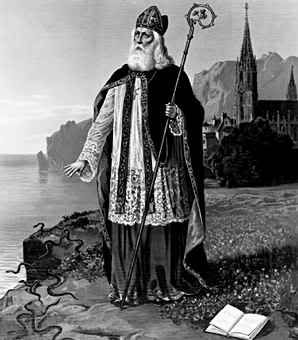
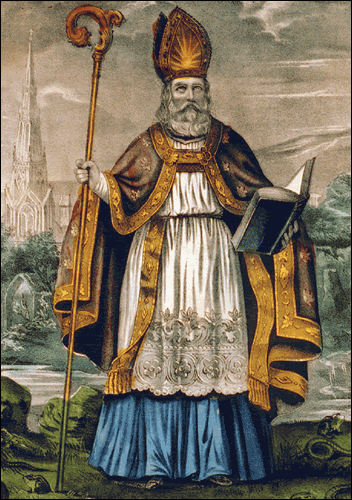
March 17 is one of the most widely recognized feast days throughout the Church, the feast of Saint Patrick (387-493), patron saint of Ireland. Many myths and legends have arisen regarding the life of Saint Patrick, some culturally-based in Celtic oral storytelling, and some much more modern in support of non-spiritual celebrations. Church historians have compiled the basic facts of Saint Patrick’s life from letters and Confessions that he wrote while alive, as well as survey of the political and historical landscapes of the time. Many of the legendary miracles reported to have been performed by Saint Patrick remain unverified by history, but for many verified by faith in the gentle man responsible for bringing Catholicism to Ireland.


Saint Patrick was born in Kilpatrick, Scotland, where he lived the first 14 years of his life with his family, Christians, although not overly devout. In late adolescence, Patrick was captured from his family’s home by Irish raiders, and taken back to Ireland as a slave. There, he would spend the next six years in captivity, learning Celtic customs and language, and spending significant periods of time alone, tending sheep in the fields. It was here that Patrick’s’ love of God deepened and his faith took root and bloomed. He prayed incessantly, writing, “the love of God, and His fear increased in me more and more, and the faith grew in me, and the spirit was roused, so that, in a single day, I have said as many as a hundred prayers, and in the night nearly the same, so that whilst in the woods and on the mountain, even before the dawn, I was roused to prayer and felt no hurt from it, whether there was snow or ice or rain; nor was there any slothfulness in me, such as I see now, because the spirit was then fervent within me.”

After six years of contemplation, Patrick was visited by an angel who encouraged him to return home to Scotland by escaping his slavery and walking 200 miles to the coast where he would find a ship awaiting him. Patrick did as instructed, finding the crew of s ship willing to take him to Scotland, and returned home to his grateful family. After a few years, Patrick experienced a second call from God, this time in the form of a visitor from Ireland. In his Confessions, he wrote:

I saw a man coming, as it were from Ireland. His name was Victoricus, and he carried many letters, and he gave me one of them. I read the heading: "The Voice of the Irish". As I began the letter, I imagined in that moment that I heard the voice of those very people who were near the wood of Foclut, which is beside the western sea—and they cried out, as with one voice: "We appeal to you, holy servant boy, to come and walk among us!

Patrick felt called to return to Ireland, but wished to be ordained prior to his departure. He undertook rigorous religious study, lasting approximately 14 years, during which time he was first ordained a priest, and later a bishop. Only upon becoming bishop did Patrick feel prepared to return to Ireland. While some legend suggests that Saint Patrick introduced Christianity to Ireland, it is far more likely that some small Christian communities existed before his second arrival. His dual mission was that of ministering to the existing Christian communities and converting others to the faith.

Saint Patrick had great success on both accounts, drawing from his familiarity of Celtic and Druid religious beliefs and language. He introduced natural elements into his teaching, including placing the sun on the Celtic Cross as symbolization of the Godhead, illustrating the Resurrection of Christ through the use of bonfires (symbols familiar to the Druids), and most famously, explaining the Holy Trinity through comparison to the shamrock.

Many were converted by his works, and monasteries and convents established (although their formal structure and organization would not be complete until centuries after his death). During his ministry in Ireland, Saint Patrick lived a poor and austere life, accepting only what he needed to live. He was repeatedly arrested and imprisoned, threatened and attacked by chieftains of warring tribes, and suffered great peril. Throughout all struggles, he remained fearless, looking to the Lord for guidance and comfort, and demonstrating great love, humility, and charity towards all he encountered. Numerous miracles and intercessions are reported in his name.

Saint Patrick’s ministry in Ireland spanned over 40 years, during which he laid the foundation for the seat of the Church during the Dark Ages, when Christianity survived in Irish monasteries. He died in Saul, Ireland, where he is believed to be buried. He is reported to have composed the following prayer, referred to as “Saint Patrick’s Breastplate:”

I bind to myself today
The strong virtue of the Invocation of the Trinity:
I believe the Trinity in the Unity
The Creator of the Universe.


I bind to myself today
The virtue of the Incarnation of Christ with His Baptism,
The virtue of His crucifixion with His burial,
The virtue of His Resurrection with His Ascension,
The virtue of His coming on the Judgment Day.


I bind to myself today
The virtue of the love of seraphim,
In the obedience of angels,
In the hope of resurrection unto reward,
In prayers of Patriarchs,
In predictions of Prophets,
In preaching of Apostles,
In faith of Confessors,
In purity of holy Virgins,
In deeds of righteous men.
I bind to myself today
The power of Heaven,
The light of the sun,
The brightness of the moon,
The splendor of fire,
The flashing of lightning,
The swiftness of wind,
The depth of sea,
The stability of earth,
The compactness of rocks.


I bind to myself today
God's Power to guide me,
God's Might to uphold me,
God's Wisdom to teach me,
God's Eye to watch over me,
God's Ear to hear me,
God's Word to give me speech,
God's Hand to guide me,
God's Way to lie before me,
God's Shield to shelter me,
God's Host to secure me,
Against the snares of demons,
Against the seductions of vices,
Against the lusts of nature,
Against everyone who meditates injury to me,
Whether far or near,
Whether few or with many.


I invoke today all these virtues
Against every hostile merciless power
Which may assail my body and my soul,
Against the incantations of false prophets,
Against the black laws of heathenism,
Against the false laws of heresy,
Against the deceits of idolatry,
Against the spells of women, and smiths, and druids,
Against every knowledge that binds the soul of man.


Christ, protect me today
Against every poison, against burning,
Against drowning, against death-wound,
That I may receive abundant reward.


Christ with me, Christ before me,
Christ behind me, Christ within me,
Christ beneath me, Christ above me,
Christ at my right, Christ at my left,
Christ in the fort,
Christ in the chariot seat,
Christ in the deck of ships,
Christ in the heart of everyone who thinks of me,
Christ in the mouth of everyone who speaks to me,
Christ in every eye that sees me,
Christ in every ear that hears me.


I bind to myself today
The strong virtue of an invocation of the Trinity:
I believe the Trinity in the Unity
The Creator of the Universe.

March 7, 2013: Saints Felicity and Perpetua

Posted by Jacob


Today, March 7, we celebrate the feast day of Saints Perpetua and Felicity, two young women who were martyred for Christ in 203 A.D. Perpetua and Felicity were as different as could be, one a noble woman of wealth and privilege, the other a pregnant slave. But they were united in their courage and love of the Lord, and a faith which they would not renounce, even under torture and death. The martyrdom of Saints Perpetua and Felicity survives in writing, largely due to the personal diaries of Saint Perpetua. This account, The Passion of Saints Perpetua and Felicity, is one of the earliest writings of the Church, the earliest historical writing by a Christian woman, and a telling firsthand account of the suffering and torture endured by the martyrs during a time of great persecution.


Saint Perpetua was only 22 when she was martyred. The daughter of nobility, she was well-educated and by all accounts, high-spirited and firm in her opinions. She had given birth to a son, but subsequently had lost her husband. A widow and new mother, she lived with her father in Carthage. Perpetua converted to Christianity, much against her father’s will. He tried in vain to convince her otherwise, given justified concerns regarding the persecution of Christians at that time under the reign of Emperor Septimus.

Upon repeated questioning from her father, and threats of beating, he continued to defy his wishes. Her words, recorded in writing in her diary during subsequent imprisonment, are simple and profound. She pointed to a clay water urn, and said to her father, “See that pot lying there? Can you call it by any other name than what it is?” Her father answered quickly, “of course not,” and she responded, “Neither can I call myself any other name than what I am- a Christian.” Along with two of her brothers, Perpetua converted and was baptized into the faith. Following their argument, her father beat her, but then left her company, as described in the passion. Her time without him, while a reprieve from his anger, led to her arrest and imprisonment: “Then my father angry with this word came upon me to tear out my eyes; but he only vexed me, and he departed vanquished, he and the arguments of the devil. Then because I was without my father for a few days I gave thanks unto the Lord; and I was comforted because of his absence. In this same space of a few days we were baptized, and the Spirit declared to me, I must pray for nothing else after that water save only endurance of the flesh. After a few days we were taken into prison, and I was much afraid because I had never known such darkness. O bitter day! There was a great heat because of the press, there was cruel handling of the soldiers. Lastly I was tormented there by care for the child.”

Perpetua was imprisoned in a small cell with five others, including the slave girl, Felicity who was pregnant and nearing her delivery date. Along with them, another slave named Revocatus and two free men, Saturninus and Secundulus were imprisoned. Their catechise, Saturnus, joined them days later by choice, keeping their faith strong until death. The conditions were extremely hot and uncomfortably crowded, with Saint Felicity experiencing the conditions for the worst, given her pregnancy. While imprisoned, they hoped for deliverance, praying for freedom and safety. But upon uring from her brother, Perpetua prayed for a vision, some knowledge that their lives would be spared, or they would undergo a passion similar to that of Christ, dying for their faith. In her tiny cell, Perpetua received such a vision, which she recounted in vivid detail:

“I beheld a ladder of bronze, marvelously great, reaching up to heaven; and it was narrow, so that not more than one might go up at one time. And in the sides of the ladder were planted all manner of things of iron. There were swords there, spears, hooks, and knives; so that if any that went up took not good heed or looked not upward, he would be torn and his flesh cling to the iron. And there was right at the ladder's foot a serpent lying, marvelously great, which lay in wait for those that would go up, and frightened them that they might not go up. Now Saturus went up first (who afterwards had of his own free will given up himself for our -sakes, because it was he who had edified us; and when we were taken he had not been there). And he came to the ladder's head; and he turned and said: Perpetua, I await you; but see that serpent bite you not. And I said: it shall not hurt me, in the name of Jesus Christ. And from beneath the ladder, as though it feared me, it softly put forth its head; and as though I trod on the first step I trod on its head. And I went up, and I saw a very great space of garden, and in the midst a man sitting, white-headed, in shepherd's clothing, tall milking his sheep; and standing around in white were many thousands. And he raised his head and beheld me and said to me: Welcome, child. And he cried to me, and from the curd he had from the milk he gave me as it were a morsel; and I took it with joined hands and ate it up; and all that stood around said, Amen. And at the sound of that word I awoke, yet eating I know not what of sweet.


And at once I told my brother, and we knew it should be a passion; and we began to have no hope any longer in this world.”

Throughout her lenghty imprisonment, Perpetua would receive further vision—visions that informed her of the state of her fellow prisoners, including her brother who had been separated from the group, and visions of the glory of the Lord. Each of these visions she recounted to the group, forming a particular bond of Christian love with the slave, Felicity, despite their economic and class differences. To these brave young women, the love of the Lord knew no prejudice! Her last vision, described in her last diary entry on the night before her martyrdom is one of hope and eternal life:
“The day before we fought, I saw in a vision that Pomponius the deacon had come hither to the door of the prison, and knocked hard upon it. And I went out to him and opened to him; he was clothed in a white robe ungirdled, having shoes curiously wrought. And he said to me: Perpetua, we await you; come. And he took my hand, and we began to go through rugged and winding places. At last with much breathing hard we came to the amphitheatre, and he led me into the midst of the arena. And he said to me: Be not afraid; I am here with you and labor together with you. And he went away. And I saw much people watching closely. And because I knew that I was condemned to the beasts I marveled that beasts were not sent out against me. And there came out against me a certain ill-favored Egyptian with his helpers, to fight with me. Also there came to me comely young men, my helpers and aiders. And I was stripped naked, and I became a man. And my helpers began to rub me with oil as their custom is for a contest; and over against me saw that Egyptian wallowing in the dust. And there came forth a man of very great stature, so that he overpassed the very top of the amphitheatre, wearing a robe ungirdled, and beneath it between the two stripes over the breast a robe of purple; having also shoes curiously wrought in gold and silver; bearing a rod like a master of gladiators, and a green branch whereon were golden apples. And he besought silence and said: The Egyptian, if shall conquer this woman, shall slay her with the sword; and if she shall conquer him, she shall receive this branch. And he went away. And we came nigh to each other, and began to buffet one another. He tried to trip up my feet, but I with my heels smote upon his face. And I rose up into the air and began so to smite him as though I trod not the earth. But when I saw that there was yet delay, I joined my hands, setting finger against finger of them. And I caught his head, and he fell upon his face; and I trod upon his head. And the people began to shout, and my helpers began to sing. And I went up to the master of gladiators and received the branch. And he kissed me and said to me: Daughter, peace be with you. And I began to go with glory to the gate called the Gate of Life.


And I awoke; and I understood that I should fight, not with beasts but against the devil; but I knew that mine was the victory.


Thus far I have written this, till the day before the games; but the deed of the games themselves let him write who will.”

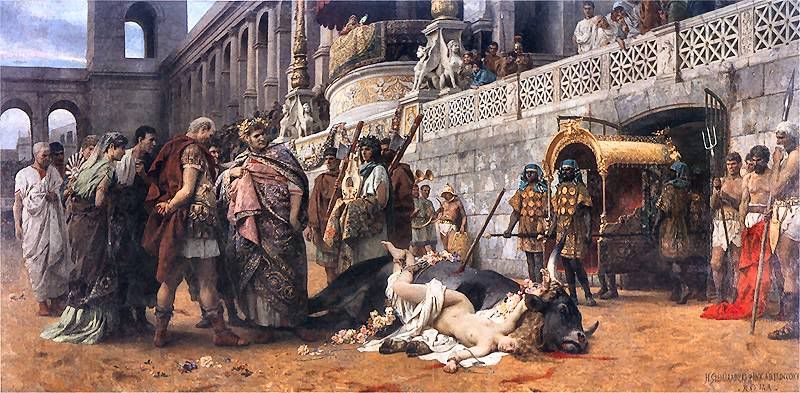
The martyrdom of these five, as recounted in the passion, is both greusome and glorifying to the Lord. The trial of the six soon-to-be martyrs took place before the Procurator Hilarianus. Upon questioning, each of them stood resolutely in the faith of Christ, confessing their faith to all who would listen. Perpetua’s father, carrying her infant boy from who she had been separated in prison, followed her, attempting to convince her to renounce God for her baby. The Procurator, taking pity upon her, encouraged her to do the same, but she was not to be swayed. Perpetua, with Felicity who had given birth only the day before, by her side, refused to make offerings to the pagan gods, and was therefore sentenced to death in the arena—deaths referred to as “games” by most of the spectators. During these events, Christians and common criminals were stripped naked and thrown into the arena filled with hungry and wild animals. Their deaths were often horrific, violent, and extremely painful.

Despite their sentencing, the six praised the Lord, giving thanks for His love and mercy.

“Now dawned the day of their victory, and they went forth from the prison into the amphitheatre as it were into heaven, cheerful and bright of countenance; if they trembled at all, it was for joy, not for fear. Perpetua followed behind, glorious of presence, as a true spouse of Christ and darling of God; at whose piercing look all cast down their eyes. Felicity likewise, rejoicing that she had borne a child in safety, that she might fight with the beasts, came now from blood to blood, from the midwife to the gladiator, to wash after her travail in a second baptism. And when they had been brought to the gate and were being compelled to put on, the men the dress of the priests of Saturn, the women the dress of the priestesses of Ceres, the noble Perpetua remained of like firmness to the end, and would not. For she said: For this cause came we willingly unto this, that our liberty might not be obscured. For this cause have we devoted our lives, that we might do no such thing as this; this we agreed with you. Injustice acknowledged justice; the tribune suffered that they should be brought forth as they were, without more ado. Perpetua began to sing, as already treading on the Egyptian's head. Revocatus and Saturninus and Saturus threatened the people as they gazed. Then when they came into Hilarian's sight, they began to say to Hilarian, stretching forth their hands and nodding their heads: You judge us, they said, and God you. At this the people being enraged besought that they should be vexed with scourges before the line of gladiators (those namely who fought with beasts). Then truly they gave thanks because they had received somewhat of the sufferings of the Lord.”

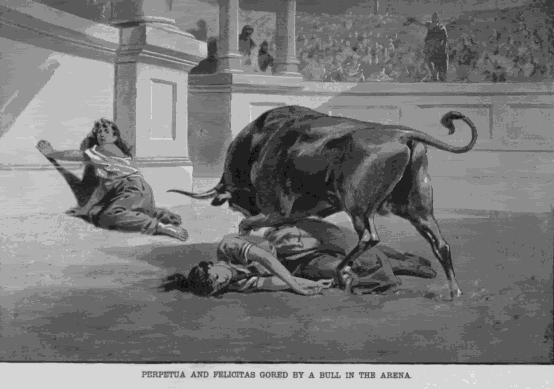
The martyrs were stripped naked, but the crowd was so disturbed by the site of the young girl and the woman who had just given birth, that they were again clothed in loose robes. At the demand of the crowd they were first scourged, which they endured with patient and joyful suffering. The men were first attached by a boar, a bear, and a leopard, whereas Saints Perpetua and Felicity endured the terror of a wild bull. Bruised and broken, the martyrs were lined up, and as Perpetua helped Felicity up, giving her a “kiss of peace,” each of the martrys had their throats slit. Perpetua’s last words prior to her death were, “Stand fast in the faith and love one another.”

While the crowd had called for the execution, and mocked and jeered the martyrs during their trials, many were moved by the bravery of the young women especially, and many converted that same day.

Little is known about the lives of Saints Perpetua and Felicity, although much is known about their deaths. We see, in their martyrdom, that the love of the Lord knows no bounds. It does not discern between rich and poor, noble and slave, man or woman. The Lord cares not about race or other categorizations that we create on earth. Rather, we each are called to His great love, and we each have an opportunity to answer. Perpetua and Felicity formed an unlikely friendship, becoming true sisters in Christ. We look to their bravery as martyrs, their faith in the Lord, and their acceptance of others despite their differences. We are challenged to confront our own prejudices and judgments—whether they be based upon religious affiliation, race, ethnicity, gender, appearance, disability, sexual orientation, or any other manner in which we makes others “different” from ourselves—and to extend the love of the Lord to all people we encounter. We are challenged to “Stand fast in the faith and love one another.”


February 12, 2013: Saint Febronia, Virgin Martyr

Posted by Jacob


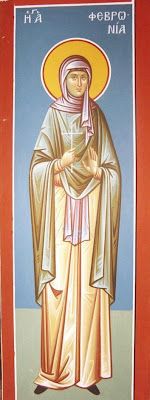
Today, February 12, we celebrate the feast day of Saint Febronia of Nisibis (also know as Febronia of Sebapte, 284-305).  There is much confusion regarding the life of Saint Febronia, with her feast celebrated by some on February 12, by others on June 25.  Her life and acts were recorded by a fellow nun, Thomais, but many believe these acts to be works of holy legend, rather than accurate recounting of a saintly life. Whatever the case, we look to the story of Saint Febronia today, to inspire us with courage and fortitude at a time of change within our Church.

Febronia was raised at a monastery in the city of Sivapolis in Assyria.  Her aunt, Brvaena, was the abbess of the abbey, and committed to raising her niece in holiness, imposed a stricter rule upon her than the others.  Febronia took to the rules with grace, and soon, news of her piety spread throughout the land.

Around that time, Emperor Diocletian launched a persecution against Christians, fearing the faith would topple the Roman Empire.  Diocletian sent a detachment of soldiers to Assyria to destroy the Christian community developing there. Upon their approach to the convent, the inhabitants hid, with the exception of abbess Brvaena, Tomais, and Saint Febronia who was ill.

The three were seized by the soldiers, but they did not fear.  Rather, they entrusted themselves to the Lord.  Febronia was chained by the neck and led to the commander of the soldiers.  There, he urged her to renounce her faith, promising her honors, rewards, riches, and marriage.  But she refused, fearlessly proclaiming the Word of God, and declaring Christ as her groom.  She was subjected to horrible torture, but only prayed in response: “My Savior, do not abandon me in this terrible hour!”

Saint Febronia was beaten and bloody, but would not yield.  She was then tied to a tree, which was lit on fire.  She failed to confess any treason or renounce her faith, and the crowd gathered began to beg for the inhumane tortures to end.  Eventually, she became silent, too ill to speak.  Angered, the captain of the soldiers ordered her tongue cut out, her teeth smashed, and her hands and feet removed.  This was done.  Finally, she was beheaded.  The treatment of Febronia brought many to Christ that day, the crowds dispersing, cursing the pagan gods for their cruelty.

One of the soldiers, who had been raised by a Christian mother, built a coffin and placed the holy virgin martyr’s body in it.  He brought it to the convent, where it was buried.  The convent gates were opened, and the populace came to venerate and pray for intercession from the holy martyr.  Even the soldiers were converted.  Numerous miracles were reported at her tomb.

In 363, the relics of Saint Febronia were translated to Constantinople.  Saint Febronia is one of the 140 saints who are placed on the columns at Saint Peter’s Basilica.

The virgin Febronia, confesses Christ
Before judgment standing, bloody and pale.
As a palm branch, the young Febronia.
From beautiful fruit, a branch became heavy,
And to Silenus she speaks: “A Bridegroom, have I,
And no type of honor, from you do I accept,
Christ is my glory, Christ is my pride,
O yes, the beautiful countenance of my Bridegroom!
Cut off, cut off my feet – paths they have traveled!
Cut off, cut off my hands – work they have completed!
Cut out, cut out my tongue – with my heart I will pray!
Smash, smash my mouth – with my heart, I will speak!
Whip, crush the body – why do I need the body?
A more beautiful garment, the Bridegroom has prepared,
Among many holy ones, in the heavens above,
Among the angels, in sweet Paradise.
Do not think Silenus, that when I depart,
That the fury of your life will die.
But hear me and remember: behold the same day
Before the Living God, together we will go:
You as a torturer and I, tortured by you,
Each, his deeds, will bring with him.


Please join me in lifting these intentions to Our Lord, through the intercession of Our Blessed Mother.

Prayer requests, 2013: Week 6:

Completion of studies and successful employment for niece (D, India);  Blessings upon ministries and their missions (A, Philippines); Successful employment, renewed personal relationships, financial security (M, Philippines); For strength and courage (P, United Arab Emirates); Health for a friend (N, Ireland); Reconciliation of a relationship, health, financial security (W, USA-IL); Blessings upon a family, for a daughter’s career (J, Singapore); Personal intentions (C, United Kingdom); Health and blessings upon a family, for a sad and lonely daughter (A, USA-VA); Repose of departed souls (P, India); Successful business and financial security (M, Sri Lanka); Vocations, financial assistance (H, India); Successful employment for husband, health benefits (M, USA-CA); Renewal of faith in family (P, Australia); Blessings and health upon a family (B, Canada); Successful employment, financial security (K, Netherlands); Successful examinations, renewal of a relationship (M, Germany); Recovery from depression (B, United Kingdom); Personal relationships with Christ for family, successful employment for son (D, USA-MN); Successful employment (M, USA-WA); End to legal difficulties, successful employment (B, Philippines); For a sick husband, for blessings upon a family (S, India); Renewal of relationship with Christ via the Rosary (B, USA-MA); True conversion, successful employment, healing of mental illness (R, USA-CA); Healing of a relationship (V, Australia); Good health for a couple (P, Kuwait); Healing of a sick mother, financial security, patience (M, Philippines); Prosperity, love, health, forgiveness (D, Bulgaria); Successful examinations (J, Ghana).

January 30, 2013: Saint Martina of Rome

Posted by Jacob


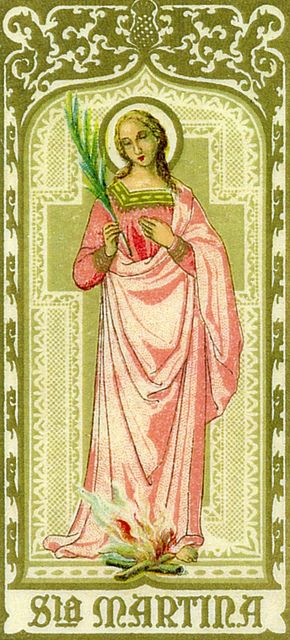
Today, January 30, we celebrate the feast day of Saint Martina of Rome (died 226), virgin martyr, and model of charity for the poor.  Saint Martina was martyred for her refusal to renounce Christ and sacrifice to the pagan gods.  Martina’s witness, made all the more powerful by her youth, is said to have inspired miraculous conversions similar to that experienced by Saint Paul.  Her faith and conviction inspires us today.

Born into the family of a wealthy and noble consul in Rome, Saint Martina grew up with the luxuries and privileges reserved for the wealthy at that time.  Nonetheless, she shied away from vain pursuits, and instead offered her time (and her family’s wealth) in service to the poor.  While still young, both of Saint Martina’s parents died, and she was left with a sizable inheritance.  For the love of Christ, she distributed all that she had to the poor and needy of Rome.  This she did to sever her ties with the world, that she might be more ready for martyrdom, should she fall victim to the Christian persecution sweeping the city.

This persecution, under the direction of Emperor Alexander Severus, had begun in attempts to rid the city of the Christian faith, a faith that was deemed threatening to the Roman Empire.  Similar persecution swept throughout the land, but was most pronounced in Rome.  One afternoon, Martina was discovered praying in a church.  She readily accompanied the three officers who arrested her, begging them politely to let her finish her prayers and speak with her bishop.  This they did, triumphantly returning her to the emperor, certain that she would renounce the faith and serve as an example to other Christians.  However, when ordered to speak, Saint Martina asserted that she would never sacrifice to the pagan gods, and certainly never to idols—the handiwork of men.  She proclaimed the truth of the one true God, and was sentenced to torture.

Martina was raked with iron hooks across her body, but in the process, her torturers were thrown to the ground by a powerful shaking of the earth accompanied by a bright light.  Within this light, Saint Martina prayed for their souls, and when they arose, they had been converted, similar to Saint Paul’s experience on the road.

Not to be embarrassed, the emperor ordered her tortured again.  This time, she was tied by her hands and feet to posts in the ground and cruelly scourged.  She was allowed to rest one day, assuming this torture (and the threat of more) would change her mind.  When brought to the temple of Diana the next day to offer sacrifice, fire fell from the heavens and burnt the temple, crushing and killing many pagan priests and worshipers.

Additional torture attempts were tried, including being thrown to a lion (who lost interest in her and failed to attack) and being placed in a fiery furnace (which failed to even singe her clothing).   Eventually, Saint Martina was beheaded, her head displayed as a warning to Christians.

Saint Martina’s relics were discovered during the papacy of Pope Urban VIII, in 1634.  Along with the relics of several other martyrs, she was placed in a beautiful church located in the Roman Forum.  This church was dedicated in her honor, and hymns were written in her honor.   

Saint Martina’s life reminds us that each of us—however small—can effect great change in our communities with the help of the Lord. All we need do is ask, through prayer, and the Lord’s light will shine upon us and throughout our world. 


Hymn of Praise to Saint Martina of Rome
Written by Pope Urban VIII

Citizens of Rome! sing to the celebrated name of the glorious Martina. Sing the praises of this admirable Virgin and Martyr of Christ.

She was born of noble parents, and was brought up in every delicacy, surrounded by all that could pamper nature, and with riches of a princely house at her command.

But she spurns these luxuries, dedicates herself to the Creator of all things, and with a liberal hand distributes her riches to the poor of Christ, that she may gain the riches of heaven.

She shrinks not at the torturing hook, the wild beasts, or the cruel wound-inflicting rods. Angels descend from heaven, comforting her with divine food.

The very lions lose their fierceness, and tamely come crouching at her feet. The sword, Martina 1 gave thee the wished-for death, and death united thee to the choirs of heaven.

Our ceaseless prayers mount up to thee from thine altar, where clouds of incense shroud devotion's love; and thy blessed name banishes that of the false deity Mars.

Do thou protect thy fatherland, and give to Christian countries the rest of holy peace, driving unto Thracian coasts the din of arms and war.

Marshal the armies of princes under the banner of the Cross, deliver Jerusalem from her chains. Avenge innocent blood, and once for all crush down the Turkish foe.

O thou our Patron, and our City's Saint I see this homage of our loving hearts. Hear the prayers of thy Rome, which on this festive day offers thee its hymns and reveres thy name.

O God, whose arm protects the Martyrs, take from us the pleasures which would make us fall. O Triune God I give to thy servants the blessed light, wherewith thy mercy crowns the soul with bliss.

Amen.

January 21, 2013: Saint Agnes of Rome

Posted by Jacob

“Christ made my soul beautiful with the jewels of grace and virtue. I belong to Him whom the angels serve.”

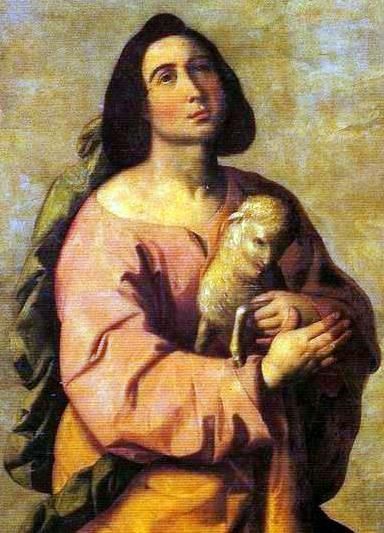
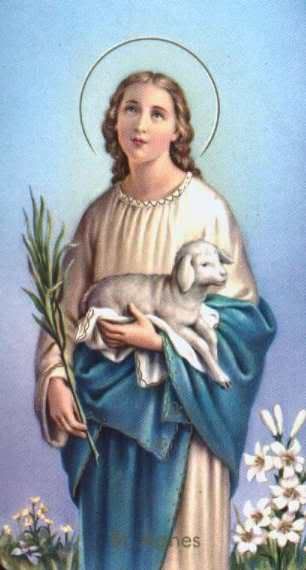
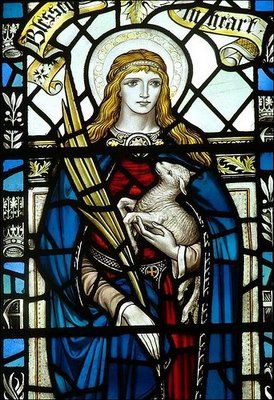
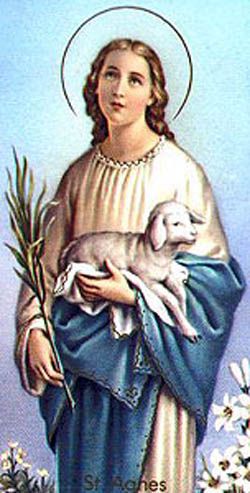
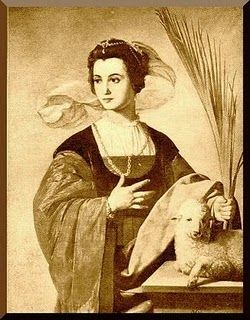
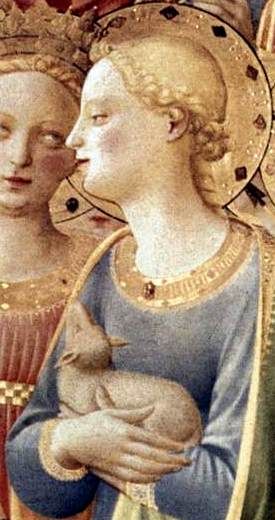
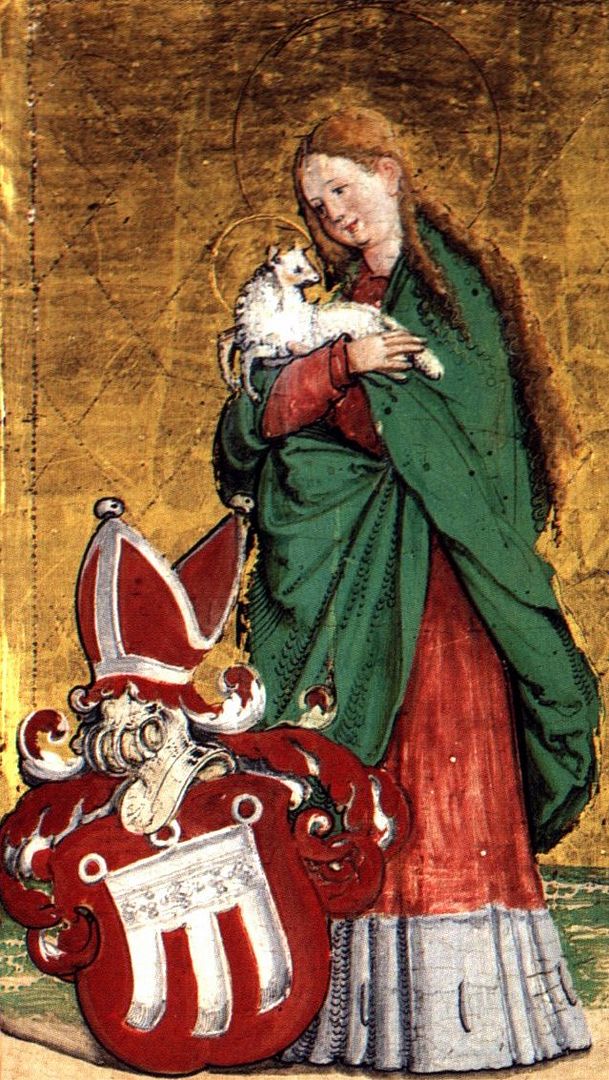
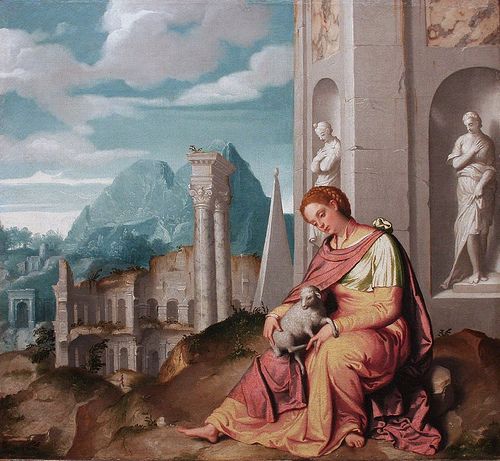
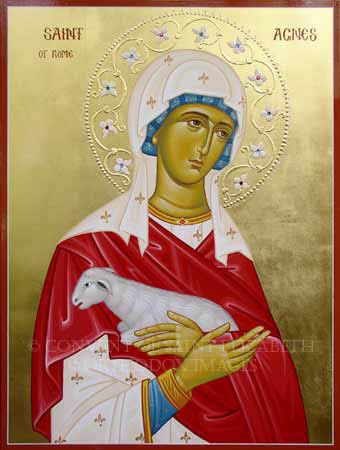
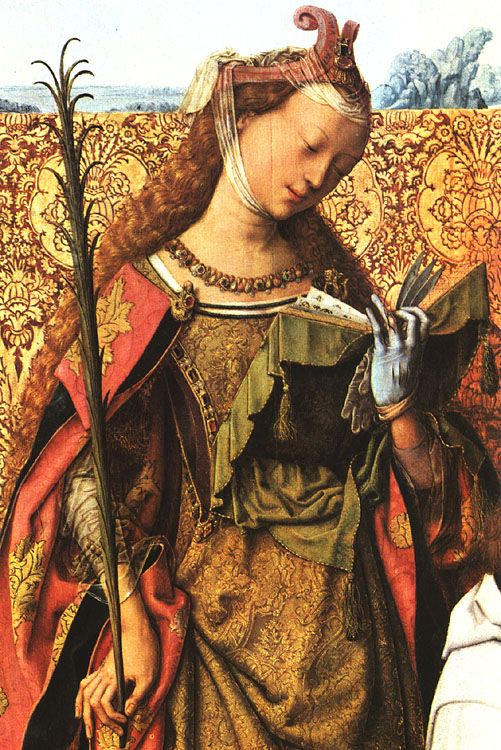
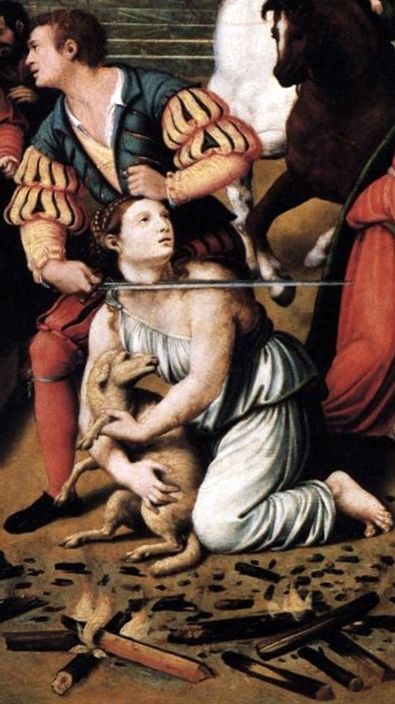
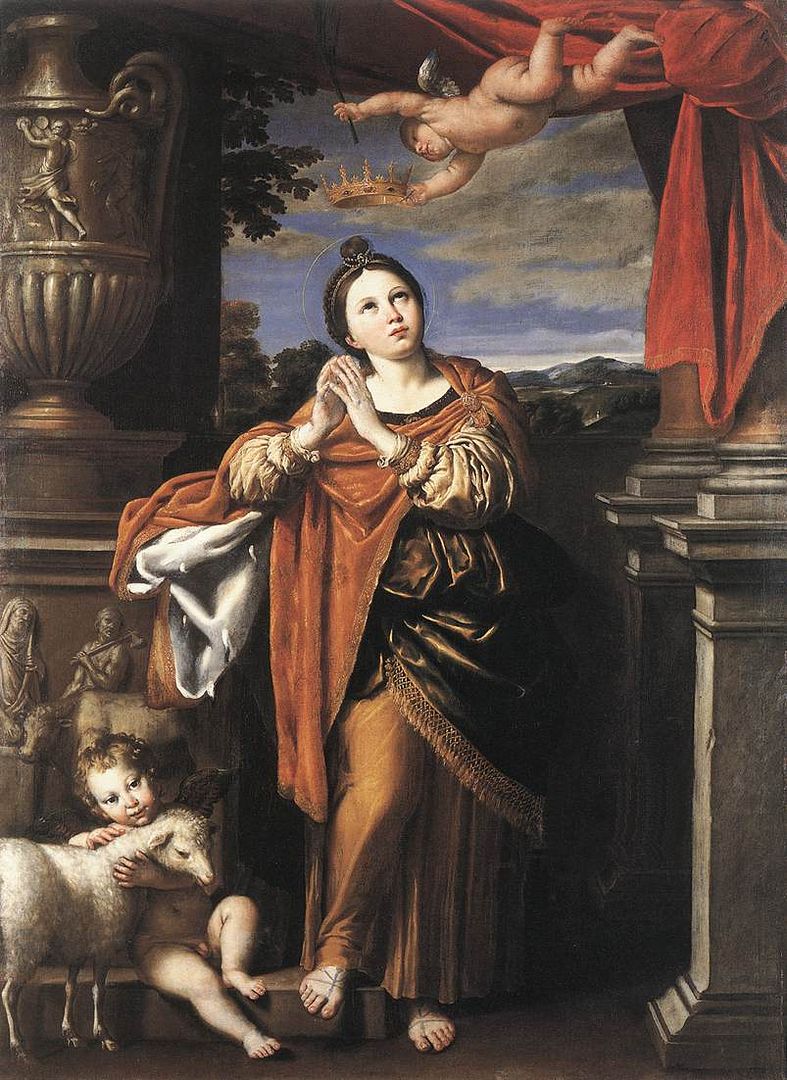
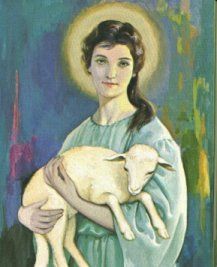
Today, January 21, we celebrate the feast of Saint Agnes of Rome, Virgin and Martyr of the Church. Saint Agnes maintained her faith, despite her young age (she was only around 12 years old!), consecrating herself to the Lord, defying the emperor, and earning the crown of Martyrdom! Honored as one of the four great virgin martyrs of the Church, Agnes is the patron saint of young women, chastity, and victims of sexual assault. Martyred at age twelve or thirteen, Agnes was one of the first women to be deemed a saint by the Church, and one of only seven women to be, excluding our Blessed Mother, to be commemorated by name in the Canon of the Mass. Her name, Agnes, translated from the Greek, means “chaste, pure, sacred.” She is generally depicted in art holding a palm leaf, heralding the arrival of Christ, and a lamb, as Christ is the “Lamb of God” who takes away the sins of the world.

Born into a wealthy Roman family during the reign of Emperor Diocletian, Agnes dedicated her young life to Christ, refusing suitors, and spurning worldly marriage. Given her grace and beauty, many wealthy and powerful families were interested in betrothing their sons to Agnes, but she remained chaste and focused only on her relationship with Christ, her “husband,” and the husband of the Church.

White some details are unclear regarding Agnes’ short life, tradition holds that a young Roman, likely the son of high-ranking prefect of Rom (either Maximum Herculeus or Sempronius), wanted to marry Agnes. Upon this request being made, Agnes is reported to have replied, ”The one to whom I am betrothed is Christ, whom the angels serve." With that, as Christians were forbidden to practice the faith at that time, under order of Emperor Diocletian, Agnes was forcibly removed from her home and brought before a judge to stand trial.

Saint Agnes was then subjected to various tortures and threats of torture, during which she never renounced her faith. The judges, losing patience, asked her to offer incense to the pagan god Minerva, which she refused. During the trial, a large crowd gathered, and one judge, taking pity on her and attempting to prevent her execution, offered her hand in marriage to the men in the crowd. Agnes adamantly refused, stating, "It is wrong for the bride to keep the bridegroom waiting. He who chose me first shall be the only one to have me. What are you waiting for, executioner? Destroy this body, for unwanted eyes may desire it." As such, a young man in the crowd who looked at Agnes lustfully was struck blind.

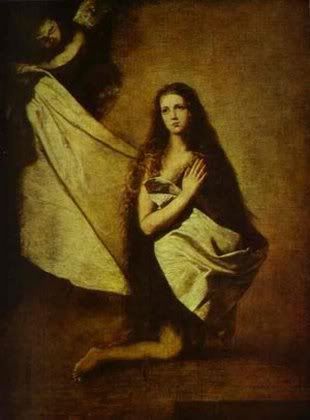
The judges ordered Agnes stripped naked and dragged through the streets of Rome to a brother, where she would be forced to lose her virginity. During the trip, Agnes’ hair miraculously grew, covering her body, and maintaining her chastity and purity. Pleading to Christ for aid, Agnes was left miraculously unharmed during this torment.

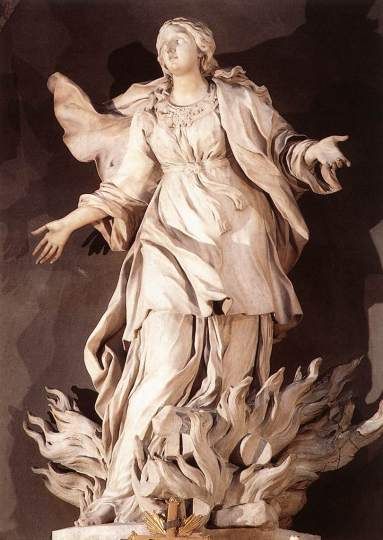
Having failed to convince Agnes to renounce Christ, she was sentenced to death. Agnes went to her death cheerfully, at peace, ready to be reunited with Christ. As her wrists were too small for shackles, she willingly accompanied her persecutors without restraints. At first, Agnes was tied to a pyre to be burnt alive, but the wood reportedly would not catch fire. She was then stabbed in the throat, a death considered “gentle,” and reserved for women at that time. Tradition suggests that her blood did not soak into the ground, but remained, and was later removed by Christians using clean white woolen cloths.

Two days later, Agnes’ foster sister (the daughter of her wet nurse), Emerentiana, visited Agnes’ grave to pray for her soul. Discovered by a group of Roman citizens, Emerentiana was stoned to death, a martyr for her faith, and later canonized by the Church. Her feast day is January 23.

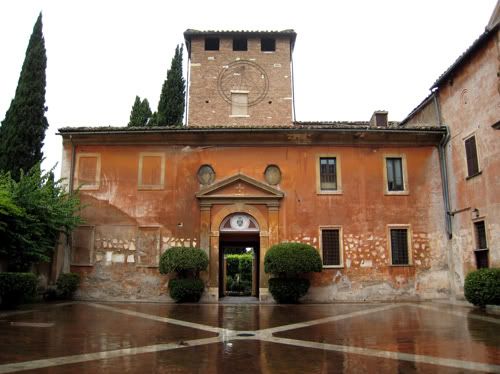
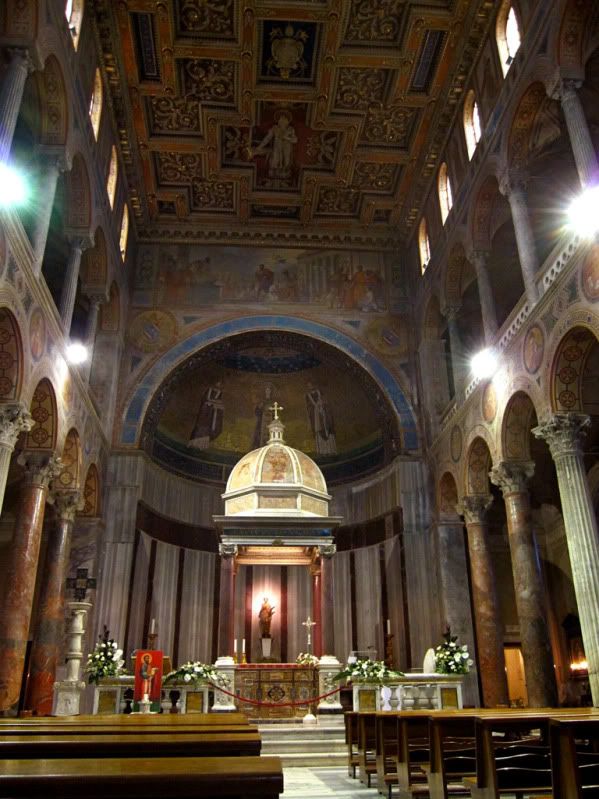
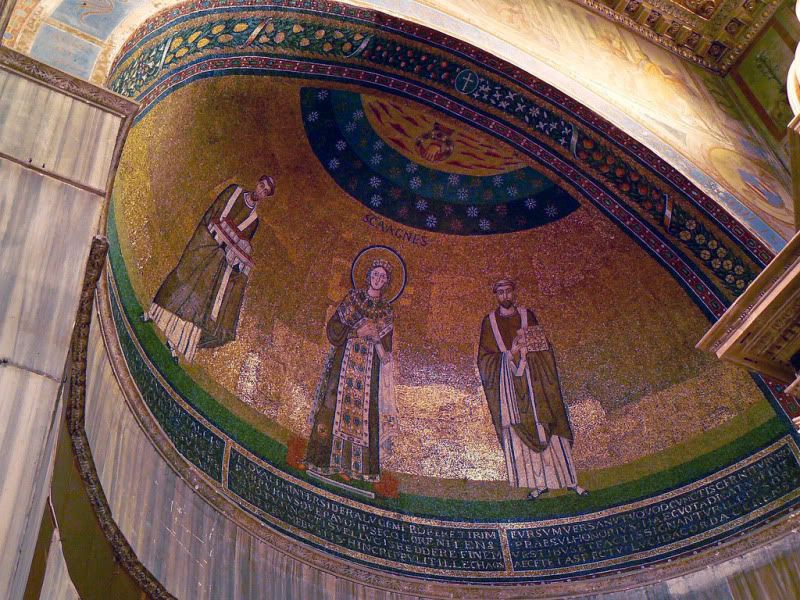
Agnes body was buried outside the city of Rome, rather than being thrown into the River Tiber as was common at the time. Her parents, who visited the grave via an underground tunnel, reported seeing a vision of Agnes, surrounded by other virgins, with a lamb at her side. Years later, during the reign of Constantine (when Christianity was again acceptable), his daughter Constantina was miraculously cured of leprosy after visiting the grave of Saint Agnes. Following that miracle, a great basilica was built in her honor, known as Sant'Agnese Fuori la Mura (The Basilica of St. Agnes Outside the Wall).


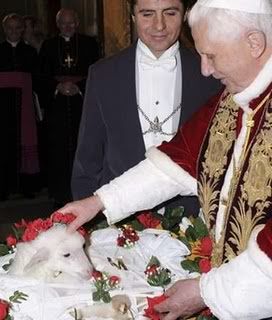
Each year, in honor of Agnes’ purity, a solemn feast day Mass is held. During that Mass, two young lambs from the fold raised by Trappist monks of the Tre Fontane Monastery are crowned and placed in straw baskets, decorated with red and white flowers and streamers. The red represents the martyrdom of Saint Agnes, while the white represents her purity. Shortly after the feast day Mass, held at the Basilica of Saint Agnes, a procession composed of young girls in white dresses and veils, carrying the lambs upon their shoulders, occurs. The lambs are ceremoniously incensed and blessed before being brought to the Pope at the Vatican who also blessed them. The lambs are raised under the care of the Benedictine Nuns of Santa Cecilia until Maundy Thursday, at which time they are sheared. From the wool, pallia, embroidered white stoles adorned with six small crosses, are woven. These stoles are bestowed on archbishops by the Pope, their unique shape and custom representing the union of the Church with Christ, the Good Shepherd.

The brief life of Saint Agnes teaches us important lessons about faith, conviction, and courage. Even at such a young age, Agnes withstood torture, pressure from adults, peers, and family, and eventual death for her beliefs. She valued her chastity and purity above all else, so as to be ready for perfect union with Christ in heaven. We look to Saint Agnes as inspiration during our daily lives, as we make decisions that may compromise our chastity and purity. We remember Agnes as we strive toward a more pure relationship with our Lord.

On a personal note, as a child psychologist, my general worldview includes the belief that we can learn alot about from the youth of our world.  Children and adolescents never fail to surprise us with their insights and courage-- and if we look around the world today, we see examples of that.  So it is with the young Catholic saints who continue to inspire us-- saints like Saint Agnes and Saint Agatha, Saint Pancras and Saint Germaine, Saints Jacinta and Francisco Marto.

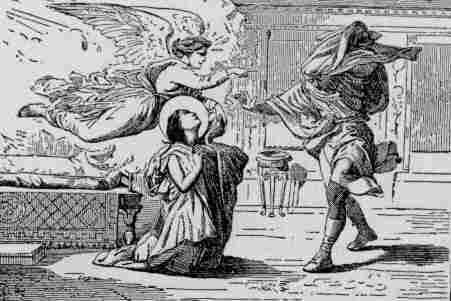
Saint Ambrose of Milan wrote of Saint Agnes: “Today is the birthday of a virgin; let us imitate her purity. It is the birthday of a martyr; let us offer ourselves in sacrifice. It is the birthday of Saint Agnes, who is said to have suffered martyrdom at the age of twelve. There was little or no room in that small body for a wound. Yet she shows no fear of the blood-stained hands of her executioners. She offers her whole body to be put to the sword by fierce soldiers. She is too young to know of death, yet is ready to face it. Dragged against her will to the altars, she stretches out her hands to the Lord in the midst of the flames, making the triumphant sign of Christ the victor on the altars of sacrilege. She puts her neck and hands in iron chains, but no chain can hold fast her tiny limbs. In the midst of tears, she sheds no tears herself. She stood still, she prayed, she offered her neck. You could see fear in the eyes of the executioner, as if he were the one condemned. His right hand trembled, his face grew pale as he saw the girl’s peril, while she had no fear for herself. One victim, but a twin martyrdom, to modesty and religion; Agnes preserved her virginity and gained a martyr’s crown.”


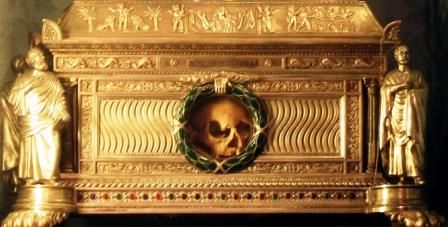
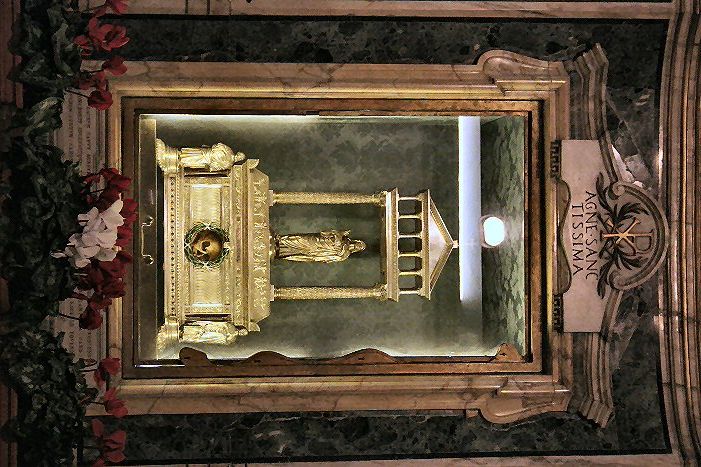
Saint Agnes' relics are conserved in the church of Sant'Agnese fuori le mura (Saint Agnes Outside the Walls) in Rome, which was constructed atop the catacomb that housed Agnes' tomb. Her skull is preserved in a side chapel in the church of Sant'Agnese in Agone in Rome's Piazza Navona.


Prudentius, the fourth century Christian poet and hymnographer wrote the following hymn of praise in honor of Saint Agnes of Rome:

THE PASSION OF AGNES


The native home of Romulus now enshrines
The tomb of Agnes, virgin and martyr blest.
Reposing there in sight of its lofty towers,
The maiden watches over the sons of Rome,
And pilgrims, too, enjoy here protecting care,
Who pray to her with pure and believing hearts.
With splendid twofold diadem she is crowned:
Virginity unmarred by the stain of sin
And glory won by freely embracing death.


That maiden, they relate, who was not yet ripe
For marriage vows and still but a child in years,
Her soul aflame with rapturous love of Christ,
Withstood the impious edict to sacrifice
To idols and abandon her holy Faith.


Assailed at first by every art and wile,
Now by the coaxing words of a fawning judge,
Now by the butcher's sinister threats of doom,
Dauntless she stood, nor shrank from her stern resolve,
Willing to give her body to torments sore,
Nor quailing from the threat of a cruel death.


Then spoke the angry tyrant: 'If she can face
The thought of grinding torture and woeful pangs,
And sets at naught her life as of little worth,
Her consecrated chastity she holds dear.
Into a common den of impurity
I am resolved to cast her unless she bows
Before Minerva's altar and begs her grace,
That virgin she, a virgin, has dared despise.
There all the youths in wanton delight will rush,
To seek this newest slave of their lustful sport.


Then Agnes answered: 'Never will Christ forget
His own nor let our precious virginity
Be snatched from us. He will not abandon us.
He ever shields the chaste and will not permit
The gift of holy purity to be soiled.
My blood may dye your sword, if it is your will,
But never will my body be stained with lust.


So spoke the maid; the prefect then gave command
That she should stand exposed in the public square.
As there she stood, the pitying throngs fell back 40
And turned their eyes away in respectful awe,
None daring to regard her with brazen look.


It chanced that one was forward enough to fix
His gaze upon the maiden and did not fear
To look with lustful eye on her sacred form,
But lo, a flame as swift as a lightning flash
Quick struck his wanton eyes with its trembling dart.
The youth fell down and, blinded by glaring light,
Lay panting in the dust of the crowded street.
His fellows lifted him from the ground, half-dead,
Bewailing him with clamorous words and tears.


The virgin went forth singing a hymn of praise
In thanks to God the Father and Christ, His Son,
That when exposed to peril of vilest stain,
Her chastity had triumphed, and she had found
The den of squalid infamy clean and pure.
Some tell that Agnes, asked to implore of Christ
That He restore the sight of the guilty wretch,
Poured forth a fervent prayer, and the prostrate youth
Regained the breath of life and his vision whole.


In her ascent to heaven the saint had passed
But the first step; a second was yet to come.
The bloody tyrant burned with revengeful ire.
'I am outdone,' he groaned. 'Go, unsheathe your sword,
You soldier there, and carry into effect
The laws our prince and sovereign lord decreed.


When Agnes saw the furious headsman stand
With weapon drawn, in transports of joy she cried:
Tar happier am I that a swordsman comes,
A wild uncouth barbarian, fierce and grim,
Than that a languid suitor pays court to me,
A lovesick creature, scented with rare perfumes,
Who would destroy my soul with my chastity.
This butcher is the lover who pleases me:
His bold advances I shall go forth to meet
And will not try to hinder his ardent suit.
I gladly bare my breast to his cruel steel
And deep into my heart I will draw his blade.
Thus as the bride of Christ I shall mount above
The darkness of the world to the realms of light.


Eternal King, unfasten the gates of heaven
That till of late were closed to the sons of earth,
And call Thy virgin spouse to Thyself, O Christ,
A victim to the Father now sacrificed.
As Agnes spoke these words, she inclined her head
In humble prayer to Christ, that her gentle neck
Might readier be to suffer the threatened wound.
Thus was her ardent longing fulfilled at last,
For with one blow the soldier struck off her head
And speedy death prevented all sense of pain.


Then putting off the garment of flesh, her soul
Flies forth and speeds untrammeled into the skies,
Her shining path surrounded by angel choirs.
In wonder she looks down on the world below;
On high she views the darkness beneath her feet,
And at the circling wheel of the sun she laughs
As round its orb the heavenly spheres revolve.


She sees the raging whirlwind of human life
And all the vanities of the fickle world:
Despots and kings, imperial power and rank,
The pageantry of honor and foolish pride,
The thirst for gold and silver, which all men seek
And gain by every species of wickedness,
The stately palaces with their gilded walls,
The vain display of richly embroidered robes,
The hatreds, fears, desires and impending woes,

The long enduring griefs and the fleeting joys,
Black envy with its smoking firebrands that blight
The hopes of men and tarnish all human fame,
And last, but worse than every other ill,
The sordid clouds and darkness of pagan rites.


All these things Agnes tramples beneath her feet,
And with her heel she crushes the dragon's head,
That monster vile who poisons all things of time
And plunges them into the infernal pit.
But vanquished now and under the virgin's foot
He lies crestfallen, prone in the dust of earth,
His fiery head not daring to lift again.
Meanwhile the virgin martyr's unsullied brow
God circles with a glorious twofold crown:
One glowing with the rays of eternal light,
A sixty-fold reward, and the other fruit,
Increased a hundred-fold, of celestial grace.


O happy virgin, glory but lately dawned,
O noble dweller in the celestial courts,
Adorned with thy resplendent twin diadem,
Deign now to turn thy face on our miseries.
To thee alone the Father of all has given
Power to make pure the dwelling of sin itself.
I, too, shall be made clean by thy radiant glance
If thou wilt fill my heart with its gracious light.
All is pure where thou deignest in love to dwell,
Or where thine own immaculate foot may tread.


Almighty and everlasting God, who choose those whom the world deems powerless to put the powerful to shame: Grant us so to cherish the memory of your youthful martyr Agnes, that we may share her pure and steadfast faith in you; through Jesus Christ our Lord, who lives and reigns with you and the Holy Spirit, one God, for ever and ever. Amen.