Let nothing disturb you.
Let nothing make you afraid.
All things are passing.
God alone never changes.
Patience gains all things.
If you have God you will want for nothing.
God alone suffices.
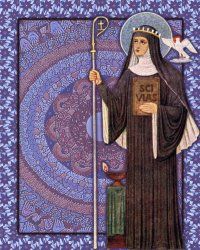
Today, October 15 we celebrate the feast day of Saint Teresa of Avila (also known as Saint Teresa of Jesus, 1515-1582), Virgin, mystic, reformer of the Carmelite Order, and Doctor of the Church. Throughout her life, Saint Teresa was graced with mystical visions and ecstasies, through which she embraced the suffering of Christ. The fruits which remain of the life, labors and prayer of Saint Teresa of Avila bear to her virtue a living and enduring testimony which none can refuse to admit. Her numerous writings remain extant, inspiring the faithful to deeper communion with the Lord today.
Born Teresa Sánchez de Cepeda y Ahumada in the kingdom of Castile in Spain, Teresa was the youngest child of a virtuous nobleman. When she was just seven years old, Teresa fled from her home with one of her younger brothers, hoping to join a missionary trip to Africa, and there earn the crown of martyrdom. Discovered, and returned home, Teresa proclaimed to her angry father, “I want to see God, and I must die before I can see Him.”
Not to be dissuaded, Teresa thereafter began construction of a hermitage for she and her brother in the family garden. At age 12, her mother died, and Teresa’s father, wishing pious instruction for her, placed her in a boarding convent. There, Teresa initially struggled, rebelling against the convent lifestyle, and disobediently pursuing the frivolities of the world. Over time, however, she was filled with the grace of the Holy Spirit, through the careful guidance of the Carmelite Sisters, and decided to enter the religious life. Upon reaching age of consent, Teresa entered the Carmelite monastery of the Incarnation in Avila.
Again, Teresa struggled upon formally entering the religious order, and found herself easily distracted from the Lord. She started to learn and practice mental prayer, in which she "tried as hard as I could to keep Jesus Christ present within me....My imagination is so dull that I had no talent for imagining or coming up with great theological thoughts." Teresa prayed in this manner—unsuccessfully-- off and on for eighteen years without feeling that she was getting results. She still felt distant from the Lord, partly due to the fact that the convent was quite relaxed. The sisters received visitors—including eligible men—and the rigors of the religious life were not enforced. Because Teresa herself was so charming, she attracted many followers who visited the monastery for “spiritual guidance.” However, over time, Teresa came to realize that she was enjoying the flattery, gifts, and compliments she received from her visitors, and the sinfulness of these relationships were keeping her from the Lord.
At approximately age 30, Teresa fell seriously ill with malaria. She was plagued by seizures, and her sisters became so convinced that she was to die that when her fever broke four days later, Teresa found that her grave had already been dug. While she recovered, Teresa was paralyzed for three years, and was never again completely free from pain or suffering. Teresa struggled through her suffering to develop her interior prayer life, but viewed herself as such a sinner, she thought herself too wicked to pray. Eventually, she found her way, proclaiming, "Prayer is an act of love, words are not needed. Even if sickness distracts from thoughts, all that is needed is the will to love."
It was not until her 30s that Teresa broke free from her self-doubt, into the freedom of a relationship with the Lord. She began experiencing powerful visions and ecstasies, first of the suffering Christ, and later of hell. It was following her mystical vision of a place in hell being reserved for her due to her faults, that she devoted herself entirely to God. From that moment, Teresa’s every thought was of heaven and the Lord, but at a price. She lived in constant distrust of herself, fearing her worldly and frivolous ways would lead her away from God. Teresa enacted severe penances and bodily mortifications, fasting and praying constantly. Upon being named Prioress of the monastery (quite against her will), she placed a statue of Our Blessed Mother in the governing seat, offering the guidance of the community to her grace, and winning the hearts and obedience of all the sisters.
Having struggled with her own prayer life for so long, Teresa instructed her sisters, and provided them with encouragement. She wrote, "For mental prayer in my opinion is nothing else than an intimate sharing between friends; it means taking time frequently to be alone with him who we know loves us. The important thing is not to think much but to love much and so do that which best stirs you to love. Love is not great delight but desire to please God in everything."
As her prayer deepened, Teresa was graced with numerous mystical and ecstatic experiences: the prayer of quiet where God's presence overwhelmed her senses, raptures where God overcame her with glorious foolishness, prayer of union where she felt God melt her soul away. Sometimes her whole body was raised from the ground. If she felt God was going to levitate her body, she stretched out on the floor and called the nuns to sit on her and hold her down. Far from being excited about these events, she "begged God very much not to give me any more favors in public."
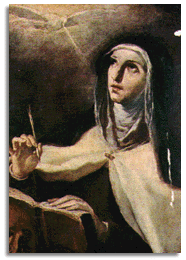
Teresa’s friends, to whom she was very attached, became worried that her visions and ecstasies were diabolical in nature, coming not from God, but from the devil. A Jesuit was sent to examine her, who confirmed that the spiritual gifts were divine in nature. Teresa felt that the best evidence that her delights came from God was that the experiences gave her peace, inspiration, and encouragement. "If these effects are not present I would greatly doubt that the raptures come from God; on the contrary I would fear lest they be caused by rabies."
Saint Teresa’s visions of the bodily Christ continued for almost two years. During these visions, she spoke with Jesus, at one point remarking about the persecution and doubt she was suffering at the hands of her friends. Jesus told her: "Teresa, that's how I treat my friends," and she reportedly responded, "No wonder you have so few friends."
In another vision—one of her most famous-- a seraph drove the fiery point of a golden lance repeatedly through her heart, causing an ineffable spiritual-bodily pain. She wrote “I saw in his hand a long spear of gold, and at the iron's point there seemed to be a little fire. He appeared to me to be thrusting it at times into my heart, and to pierce my very entrails; when he drew it out, he seemed to draw them out also, and to leave me all on fire with a great love of God. The pain was so great, that it made me moan; and yet so surpassing was the sweetness of this excessive pain, that I could not wish to be rid of it...”
Saint Teresa came to view Christ as “her closest friend,” and wished to found a convent that restored the basics of the contemplative life: a simple order devoted entirely to poverty, contemplation, and prayer. Teresa’s plans only got her into worldly trouble, she faced legal persecution, was threatened with the Inquisition, and basically instructed to remain at her present convent and not make trouble. Instead, Teresa placed her life in God’s hands, and continued with her plan, saying, “May God protect me from gloomy saints.”
Over time, through her intimate conversations with Jesus, Teresa changed her manner of running her convents. To her, spiritual life was an attitude of love, not a rule. Although she proclaimed poverty, she believed in work, not in begging. She believed in obedience to God more than penance. She instructed her sisters, if you do something wrong, don't punish yourself -- change. When someone felt depressed, her advice was that she go some place where she could see the sky and take a walk. When someone was shocked that she was going to eat well, she answered, "There's a time for partridge and a time for penance."
Having successfully reformed her convent, Teresa set out at age 51 to reform others. She was denounced by her religious brethren as "a restless disobedient gadabout who has gone about teaching as though she were a professor.” She was excommunicated, and physically barred from entering convents. Her writings were brought before the Inquisition (and cleared). The other religious orders opposed her wherever she went. She often had to enter a town secretly in the middle of the night to avoid causing a riot.
Teresa looked on these difficulties as good publicity. Soon she had postulants clamoring to get into her reform convents. Many people thought about what she said and wanted to learn about prayer from her. Soon her ideas about prayer swept not only through Spain but all of Europe. In time, Teresa founded seventeen convents for the Discalced Carmelite Sisters, and fifteen others for the Fathers of the Reform were established during her lifetime, with the aid of Saint John of the Cross. To the end of her life she acted only under obedience to her confessors, and this practice both made her strong and preserved her from error.
Saint Teresa died while traveling to found another convent, working for the Lord until the hour of her death. Her last words were: "My Lord, it is time to move on. Well then, may your will be done. O my Lord and my Spouse, the hour that I have longed for has come. It is time to meet one another.” She is only the second woman to be declared a Doctor of the Church. Saint Teresa’s relics remain incorrupt to this day, marked by the heavenly perfume of the holy. Her heart, which was removed, bears unmistakable marks of the Transverberation (the spiritual-bodily piercing Saint Teresa experienced in her ecstatic visions).
A Prayer after Individual Confession (written by Saint Teresa of Avila)
Although I have often abandoned you, O Lord, you have never abandoned me. Your hand of love is always outstretched towards me, even when I stubbornly look the other way. And your gentle voice constantly calls me, even when I obstinately refuse to listen. When the sins in my soul are increasing, I lose the taste for virtuous things. Yet, even at such moments, Lord, I know I am failing you and failing myself. You alone can restore my taste for virtue. There are so many false friends willing to encourage sin. But your friendship alone can give the strength of mind to resist and defeat sin.
What a good friend you are, Lord! You are so patient, willing to wait as long as necessary for me to turn to you. You rejoice at the times when I love you, but you do not hold against me the times when I ignore you. Your patience is beyond my understanding. Even when I pray, my mind fills with worldly concerns and vain daydreams. Yet you are happy if I give only a single second of honest prayer, turning that second into a seed of love.
Oh Lord, I enjoy your friendship so much, why is it not possible for me to think of you constantly?
A Prayer for Virtue (written by Saint Teresa of Avila)
Lord,
Thou knowest better than I myself
that I am growing older and will someday be old.
Keep me from the fatal habit of thinking
I must say something on every subject and on every occasion.
Release me from craving to
straighten out everybody’s affairs.
Make me thoughtful but not moody;
helpful but not bossy.
With my vast store of wisdom,
it seems a pity not to use it all;
but Thou knowest, Lord,
that I want a few friends at the end.
Keep my mind free from the recital of endless details;
give me wings to get to the point.
Seal my lips on my aches and pains;
they are increasing, and love of rehearsing them
is becoming sweeter as the years go by.
I dare not ask for improved memory,
but for a growing humility and a lessening cock-sureness
when my memory seems to clash with the memories of others.
Teach me the glorious lesson that occasionally I may be mistaken.
Keep me reasonably sweet, for a sour old person
is one of the crowning works of the devil.
Give me the ability to see good things in unexpected places
and talents in unexpected people;
and give, O Lord, the grace to tell them so.
Amen.
God, You raised up Saint Teresa
by Your Spirit so that she could manifest to the Church the way to perfection.
Nourish us with the food of Heaven,
and fire us with a desire for holiness.
Amen.
Year 2: Day 288 of 365
Prayer Intentions: Deeper prayer life with Christ; Love before all things
Requested Intentions: Successful work placement, continued health (A); Grace and healing for a family (P); Healing of a father (M); Academic success for son, employment for husband and brother (B); Freedom from anxiety and panic attacks (R); Health and healing in preparation for surgery (C); Healing of a chronic illness (P); Safety of a family during storms (A); Successful home ownership (P); Healing of a marriage (M); Employment for a husband, blessings for a marriage (E); Successful examinations for a daughter, healing of a relationships (V); Blessing for a family (V); Healing of baby girl M and all children suffering (M); Special intentions (R); Business success, peace, health (E); Conversion and deliverance of those who suffer, increase in vocations (M); Financial security and safe housing (M); For a daughter (K); Conversion of a family, deliverance of the souls in Purgatory (S); Successful marriage (A); Health, safety, grace, success of a building project (A); Successful treatment and recovery from cancer (D); Clear speech for a child (C); Conversion of a family (A); Successful employment (S); For the healing of impaired vision (F); For a couple experiencing difficulties (L); Successful employment after finishing college (M); Mother’s health (A); Financial security, freedom from anxiety (S).
Why pray the Rosary every day for a year?
Each time the Blessed Virgin has appeared-- whether it be to Saint Bernadette Soubirous at Lourdes; to Lucia, Jacinta, and Francisco at Fatima; or to Mariette Beco at Banneux-- she has asserted the importance, saving grace, and power of praying the Holy Rosary on a daily basis. Based upon her words, the Rosary is penance and conversion for sinners, a pathway to peace, an end to war, and a powerful act of faith in Jesus Christ. Pope Paul VI presented the Rosary as a powerful means to reach Christ "not merely with Mary but indeed, insofar as this is possible to us, in the same way as Mary, who is certainly the one who thought about Him more than anyone else has ever done."
To show us how this is done, perhaps no one has been more eloquent than the great Cardinal Newman, who wrote: "The great power of the Rosary consists in the fact that it translates the Creed into Prayer. Of course, the Creed is already in a certain sense a prayer and a great act of homage towards God, but the Rosary brings us to meditate again on the great truth of His life and death, and brings this truth close to our hearts. Even Christians, although they know God, usually fear rather than love Him. The strength of the Rosary lies in the particular manner in which it considers these mysteries, since all our thinking about Christ is intertwined with the thought of His Mother, in the relations between Mother and Son; the Holy Family is presented to us, the home in which God lived His infinite love."
As Mary said at Fatima, "Jesus wants to use you to make Me known and loved. He wishes to establish the devotion to My Immaculate Heart throughout the world. I promise salvation to whoever embraces it; these souls will be dear to God, like flowers put by Me to adorn his throne."
O greening branch!
You stand in your nobility
Like the rising dawn.
Rejoice now and exult
And deign to free the fools we are.
From our long slavery to evil
And hold out your hand
To raise us up.
Spirited light! on the edge
of the Presence your yearning
burns in the secret darkness,
O angels, insatiably
into God’s gaze.
Perversity
could not touch your beauty;
you are essential joy.
But your lost companion,
angel of the crooked
wings – he sought the summit,
shot down the depths of God
and plummeted past Adam –
that a mud – bound
spirit might soar.
You, all-accomplishing
Word of the Father
are the light of primordial
daybreak over the spheres.
You, the foreknowing
mind of divinity,
foresaw all your works
as you willed them,
your prescience hidden
in the heart of your power,
your power like a wheel
A round the world,
whose circling never began
and never slides to an end.
No creature has meaning
without the Word of God.
God's Word is in all creation,
Visible and invisible.
The Word is living Being, Spirit,
all verdant greening,
all creativity.
This Word flashes
out in every creature.
This is how the Spirit
is in the flesh~~
the Word is
indivisible from God
Poem by Saint Hildegarde
Today, September 17, we celebrate the feast day of Saint Hildegarde von Bingen (1098-1179), mystic, anchorite, and Benedictine abbotess. Saint Hildegarde was a preacher at a time when women were forbidden to preach, a named composer when most music was anonymous, a visionary, a theologian, a writer, an artist, a hagiographer, a prolific letter-writer and an early scientist, botanist, herbalist, physician and healer. She even invented her own coded language. Saint Hildegarde accomplished these things through a mystic connection to the Lord, especially impressive given that she lived her youth and half of her adulthood enclosed in her cell, with her only contact to the outside world through a tiny window! When few women were respected, she was consulted by and advised bishops, popes, and kings. She founded a vibrant convent, where her musical plays were performed.
The life of Hildegarde as child, was an extraordinary one. The tenth child born to her aristocratic parents in Bockelheim, Germany, she demonstrated visionary gifts and abilities from an early age, although mostly kept these to herself. Left much to herself on account of her ill health, she led an interior life, trying to make use of everything for her own sanctification. She wrote of herself:
"Up to my fifteenth year I saw much, and related some of the things seen to others, who would inquire with astonishment, whence such things might come. I also wondered and during my sickness I asked one of my nurses whether she also saw similar things. When she answered no, a great fear befell me. Frequently, in my conversation, I would relate future things, which I saw as if present, but, noting the amazement of my listeners, I became more reticent."
At age eight, Hildegarde’s parents gave her, as a tithe, to the Church, dedicating her completely to the service of God. She was sent to live with an anchoress, Jutta of Sponheim, in a small cottage next to the monastery of Saint Disibod. There, she received a basic religious education, although she never overcame her feelings of inadequacy for not having received formal education. While she became fluent in Latin, she required the assistance of secretaries later in life to record her visions and writing. However, Hildegarde demonstrated an intuitive grasp of languages, creating her own, and writing complex and challenging statements which captured the mysticism and depth of the contemplative faith.
As a young anchoress herself, Hildegarde could hear the Benedictine Masses being celebrated at the nearby monastery, and she began composing her own music to praise and contemplate the Lord. Her compositions, ethereal and somewhat mournful, are receiving a resurgence of interest today.
Hildegarde lived in seclusion until the age of 38 when her spiritual director, Jutta, died. At that time, she was elected the superior of a religious community which had developed around her anchorage. A convent was constructed, and Hildegarde—who prior to the construction had offered advice and direction to those who sought her through letters and the tiny window in her cell—was free to interact more directly with her charges.
During the years with Jutta, Hildegarde confided of her visions only to Jutta and a monk named Volmar, who was to become her lifelong secretary. Hildegarde had experienced visions from her early childhood, and reported to Jutta and Volmar that she could see things that were invisible to those around her, foretold the future, and her vision was filled with a strange luminosity which she later came to call 'the reflection of the Living Light'.
Upon becoming superior of the new order, Hildegarde became convinced she should no longer remain silent about what she experienced in the Living Light. She heard a mystic voice that addressed her:
"0 frail human formed from the dust of the earth, ashes from ashes,cry out and proclaim the beginning of undefiled salvation! Let those who see the inner meaning of Scripture, yet do not wish to proclaim or preach it, take instruction, for they are lukewarm and sluggish.... Therefore pour out a fountain of abundance, over-flow with mysterious learning, so that those who want you to be despicable on account of Eve's transgression may be overwhelmed by the flood of your profusion."
She was further gifted, several years later, with a vision of God which gave Hildegarde instant understanding of the meaning of religious texts. He commanded her to write down everything she would observe in her visions, which she did with the aid of Volmar.
"And it came to pass…when I was 42 years and 7 months old, that the heavens were opened and a blinding light of exceptional brilliance flowed through my entire brain. And so it kindled my whole heart and breast like a flame, not burning but warming…and suddenly I understood of the meaning of expositions of the books…"
Yet, Hildegarde was frequently ill, experienced horrible migraines and auras, and was frequently incapacitated by the power of her visions.She was also overwhelmed by feelings of inadequacy and hesitated to act upon the instructions she received from the Lord at times:
"But although I heard and saw these things, because of doubt and low opinion of myself and because of diverse sayings of men, I refused for a long time a call to write, not out of stubbornness but out of humility, until weighed down by a scourge of god, I fell onto a bed of sickness."
Saint Hildegarde never doubted that her visions came from the Lord, bought sought papal approval. Eventually she received this, following the publication of her first visionary work, and her fame spread throughout Germany (and then beyond). Hildegarde went on to write prolifically, on many subjects, including: commentaries on the Gospels, the Athanasian Creed, and the Rule of St. Benedict, as well as Lives of the Saints and a medical work on the well-being of the body. Based upon her writings, artwork, musical composition, and poetry, she is regarded as one of the greatest figures of the 12th century-- the first of the great German mystics (as well as poet, physician, moralist, and prophet). She has been compared to Dante and to William Blake.
Saint Hildegarde died at the age of 81, with numerous miracles reported at her death, and many more later reported at her grave. She was proclaimed as a Saint by the multitudes. She has long been venerated as a saint but has never been formally canonized. But miracles at her grave and her presence in the Roman Martyrology attest to her holiness and the validity of her visions. Of them Hildegarde said, “These visions which I saw I beheld neither in sleep nor dreaming nor in madness nor with my bodily eyes or ears, nor in hidden places; but I saw them in full view and according to God’s will, when I was wakeful and alert, with the eyes of the spirit and the inward ears.”
O God, by whose grace your servant Hildegarde, kindled with the Fire of your love, became a burning and shining light in your Church: Grant that we also may be aflame with the spirit of love and discipline, and walk before you as children of light; through Jesus Christ our Lord, who lives and reigns with you, in the unity of the Holy Spirit, one God, now and for ever. Amen.
Year 2: Day 258 of 365
Prayer Intentions: Sincere spirits of repentance and conversion
Requested Intentions: Clear speech for a child (C); Conversion of a family (A); Successful employment (S); For the healing of impaired vision (F); For a couple experiencing difficulties (L); Successful employment after finishing college (M); Mother’s health (A); Financial security, freedom from anxiety (S); For a son and cousins (L); Peace and civility (B); Successful examination results (D); Safety of family, strength, courage, wisdom (C); For the souls of a departed father and brother, finding of a suitable marriage partner (R); Successful pilgrimage, deepening of prayer life (R); Restoration of health (J); Restoration of health (S); Freedom from pride (A); For children and marriage (M); For the birth of a healthy baby (Y); For personal family intentions, for the sick, poor, hungry, and homeless (G); Financial security and peace (J); Grace, peace, and obedience to the will of God in a marriage (H); Successful and blessed marriage for sin, freedom from anxiety for husband, spiritual contentedness for family (N); Employment and health for a husband (B); Recovery and health of a mother (J); For a family to grow closer to the Church, salvation for all children (D); Successful employment (L); Successful employment (S); Renewal of faith life (A); Support for an intended marriage, health for friend and aunt (J); Mental health assistance for son (G); Freedom from illness (S); Successful employment (C).
You stand in your nobility
Like the rising dawn.
Rejoice now and exult
And deign to free the fools we are.
From our long slavery to evil
And hold out your hand
To raise us up.
Spirited light! on the edge
of the Presence your yearning
burns in the secret darkness,
O angels, insatiably
into God’s gaze.
Perversity
could not touch your beauty;
you are essential joy.
But your lost companion,
angel of the crooked
wings – he sought the summit,
shot down the depths of God
and plummeted past Adam –
that a mud – bound
spirit might soar.
You, all-accomplishing
Word of the Father
are the light of primordial
daybreak over the spheres.
You, the foreknowing
mind of divinity,
foresaw all your works
as you willed them,
your prescience hidden
in the heart of your power,
your power like a wheel
A round the world,
whose circling never began
and never slides to an end.
No creature has meaning
without the Word of God.
God's Word is in all creation,
Visible and invisible.
The Word is living Being, Spirit,
all verdant greening,
all creativity.
This Word flashes
out in every creature.
This is how the Spirit
is in the flesh~~
the Word is
indivisible from God
Poem by Saint Hildegarde
Today, September 17, we celebrate the feast day of Saint Hildegarde von Bingen (1098-1179), mystic, anchorite, and Benedictine abbotess. Saint Hildegarde was a preacher at a time when women were forbidden to preach, a named composer when most music was anonymous, a visionary, a theologian, a writer, an artist, a hagiographer, a prolific letter-writer and an early scientist, botanist, herbalist, physician and healer. She even invented her own coded language. Saint Hildegarde accomplished these things through a mystic connection to the Lord, especially impressive given that she lived her youth and half of her adulthood enclosed in her cell, with her only contact to the outside world through a tiny window! When few women were respected, she was consulted by and advised bishops, popes, and kings. She founded a vibrant convent, where her musical plays were performed.
The life of Hildegarde as child, was an extraordinary one. The tenth child born to her aristocratic parents in Bockelheim, Germany, she demonstrated visionary gifts and abilities from an early age, although mostly kept these to herself. Left much to herself on account of her ill health, she led an interior life, trying to make use of everything for her own sanctification. She wrote of herself:
"Up to my fifteenth year I saw much, and related some of the things seen to others, who would inquire with astonishment, whence such things might come. I also wondered and during my sickness I asked one of my nurses whether she also saw similar things. When she answered no, a great fear befell me. Frequently, in my conversation, I would relate future things, which I saw as if present, but, noting the amazement of my listeners, I became more reticent."
At age eight, Hildegarde’s parents gave her, as a tithe, to the Church, dedicating her completely to the service of God. She was sent to live with an anchoress, Jutta of Sponheim, in a small cottage next to the monastery of Saint Disibod. There, she received a basic religious education, although she never overcame her feelings of inadequacy for not having received formal education. While she became fluent in Latin, she required the assistance of secretaries later in life to record her visions and writing. However, Hildegarde demonstrated an intuitive grasp of languages, creating her own, and writing complex and challenging statements which captured the mysticism and depth of the contemplative faith.
As a young anchoress herself, Hildegarde could hear the Benedictine Masses being celebrated at the nearby monastery, and she began composing her own music to praise and contemplate the Lord. Her compositions, ethereal and somewhat mournful, are receiving a resurgence of interest today.
Hildegarde lived in seclusion until the age of 38 when her spiritual director, Jutta, died. At that time, she was elected the superior of a religious community which had developed around her anchorage. A convent was constructed, and Hildegarde—who prior to the construction had offered advice and direction to those who sought her through letters and the tiny window in her cell—was free to interact more directly with her charges.
During the years with Jutta, Hildegarde confided of her visions only to Jutta and a monk named Volmar, who was to become her lifelong secretary. Hildegarde had experienced visions from her early childhood, and reported to Jutta and Volmar that she could see things that were invisible to those around her, foretold the future, and her vision was filled with a strange luminosity which she later came to call 'the reflection of the Living Light'.
Upon becoming superior of the new order, Hildegarde became convinced she should no longer remain silent about what she experienced in the Living Light. She heard a mystic voice that addressed her:
"0 frail human formed from the dust of the earth, ashes from ashes,cry out and proclaim the beginning of undefiled salvation! Let those who see the inner meaning of Scripture, yet do not wish to proclaim or preach it, take instruction, for they are lukewarm and sluggish.... Therefore pour out a fountain of abundance, over-flow with mysterious learning, so that those who want you to be despicable on account of Eve's transgression may be overwhelmed by the flood of your profusion."
She was further gifted, several years later, with a vision of God which gave Hildegarde instant understanding of the meaning of religious texts. He commanded her to write down everything she would observe in her visions, which she did with the aid of Volmar.
"And it came to pass…when I was 42 years and 7 months old, that the heavens were opened and a blinding light of exceptional brilliance flowed through my entire brain. And so it kindled my whole heart and breast like a flame, not burning but warming…and suddenly I understood of the meaning of expositions of the books…"
Yet, Hildegarde was frequently ill, experienced horrible migraines and auras, and was frequently incapacitated by the power of her visions.She was also overwhelmed by feelings of inadequacy and hesitated to act upon the instructions she received from the Lord at times:
"But although I heard and saw these things, because of doubt and low opinion of myself and because of diverse sayings of men, I refused for a long time a call to write, not out of stubbornness but out of humility, until weighed down by a scourge of god, I fell onto a bed of sickness."
Saint Hildegarde never doubted that her visions came from the Lord, bought sought papal approval. Eventually she received this, following the publication of her first visionary work, and her fame spread throughout Germany (and then beyond). Hildegarde went on to write prolifically, on many subjects, including: commentaries on the Gospels, the Athanasian Creed, and the Rule of St. Benedict, as well as Lives of the Saints and a medical work on the well-being of the body. Based upon her writings, artwork, musical composition, and poetry, she is regarded as one of the greatest figures of the 12th century-- the first of the great German mystics (as well as poet, physician, moralist, and prophet). She has been compared to Dante and to William Blake.
![]() |
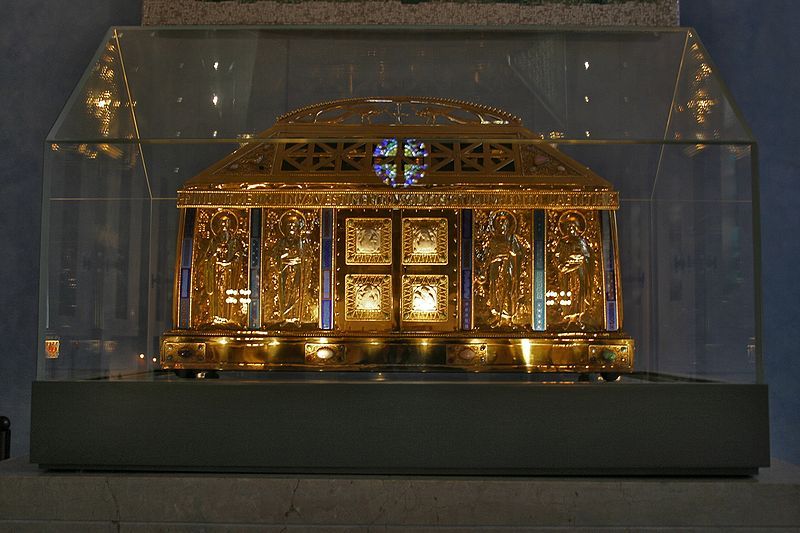
| Reliquary of Saint Hildegarde |
O God, by whose grace your servant Hildegarde, kindled with the Fire of your love, became a burning and shining light in your Church: Grant that we also may be aflame with the spirit of love and discipline, and walk before you as children of light; through Jesus Christ our Lord, who lives and reigns with you, in the unity of the Holy Spirit, one God, now and for ever. Amen.
Year 2: Day 258 of 365
Prayer Intentions: Sincere spirits of repentance and conversion
Requested Intentions: Clear speech for a child (C); Conversion of a family (A); Successful employment (S); For the healing of impaired vision (F); For a couple experiencing difficulties (L); Successful employment after finishing college (M); Mother’s health (A); Financial security, freedom from anxiety (S); For a son and cousins (L); Peace and civility (B); Successful examination results (D); Safety of family, strength, courage, wisdom (C); For the souls of a departed father and brother, finding of a suitable marriage partner (R); Successful pilgrimage, deepening of prayer life (R); Restoration of health (J); Restoration of health (S); Freedom from pride (A); For children and marriage (M); For the birth of a healthy baby (Y); For personal family intentions, for the sick, poor, hungry, and homeless (G); Financial security and peace (J); Grace, peace, and obedience to the will of God in a marriage (H); Successful and blessed marriage for sin, freedom from anxiety for husband, spiritual contentedness for family (N); Employment and health for a husband (B); Recovery and health of a mother (J); For a family to grow closer to the Church, salvation for all children (D); Successful employment (L); Successful employment (S); Renewal of faith life (A); Support for an intended marriage, health for friend and aunt (J); Mental health assistance for son (G); Freedom from illness (S); Successful employment (C).
Today, June 9, we celebrate the feast of Blessed Anna Maria Taigi (1769-1837), an example of a devoted wife, a loving mother, and an accurate and amazing mystic. Blessed Anna Maria was gifted with the supernatural abilities of prophecy, and experienced frequent ecstasies, during which she communed with both Our Lord and Blessed Mother. The prophecies of Blessed Anna Maria are hopeful in many ways, but also serve as a call to repentance and penance—not only for ourselves, but for the sins of the world.
Anne Maria Taigi was born in Siena, Italy to working class parents. Her father was a pharmacist, and despite his training and good reputation, his business went bankrupt when Anna was just five years old. Due to these financial struggles, the family moved from Siena to Rome the following year. Again, despite his training, Anna’s father was unable to find work, and eventually her parents took jobs as household servants.
In Rome, Anna Maria attended school, and was educated by the Filippini Sisters. However, she only attended school for a couple of years prior to finding employment herself, including working as a maid, to assist her parents financially. While employed she met and was eventually married to Dominico Taigi, a butler to a Roman noble family. Together, they produced seven children, although sadly, two died very young.
The marriage of Dominico and Anna was characterized by the highest of Christian principles, and Anna saw that her children were raised piously in the faith. Dominico himself, while pious, was both quick to anger and sometimes difficult, but Anna concentrated on his virtues, praying for his soul over the course of their 49 year marriage. She never complained, rather embracing patience and obedience, and devoting her non-working hours to charitable works.
Anna embraced her role as wife and mother, viewing it as her mission from the Lord to live the sacrament of holy matrimony. Through her devotion, she transformed her home into a Godly place in the world, drawing closer to the Lord through her practice of virtue, diligence, respect, and hard work. Despite the family’s poverty, she donated all she could to those who were less well off. While working full time, she further found time to educate her five children in both spiritual and secular matters.
As Anna aged, she grew closer and closer to the Lord, desiring only to love and serve God in all that she did. She prayed and undertook penances to remove even the slightest of imperfections from her soul. She was greatly devoted to the Holy Eucharist, to the Most Holy Trinity, to the Infant Jesus, to the Sacred Passion of Our Lord, and ever had the tenderest devotion to Our Blessed Mother.
Blessed Anna Maria entered the Third Order of the Most Holy Trinity at the age of 39. God had enriched her with many supernatural gifts, including clairvoyance, the gift of prophecy. Many local leaders (including cardinals, royalty, and three popes) would come to the household of the nobles she and her husband served, but would then seek out Anna for guidance and counsel. The most unusual of Anna’s supernatural gifts was the apparition of a luminous globe like a miniature sun, which shone before her eyes and in which, for forty-seven years, she could see present and future events anywhere in the world as well as the state of grace of individuals, living or dead. She further experienced frequent ecstasies, during which messages and prayers were passed to her.
Blessed Anna Maria Taigi is one of the great mystics of the last century. However, it was not her supernatural gifts that assisted her in achieving sanctification. Rather, Anna’s embracing of the ordinary life of wife and mother, of Christian believer, given to her by the Lord, brought her into holiness. Her daily attendance at Mass, her total surrender to God, her readiness to help anyone in need, and her active membership in the Third Order of the Most Holy Trinity were the sources and the fruits of her intense spiritual life.
Blessed Anna died peacefully in her home, and the Church declared her “Blessed” in testament to her extraordinary approach to life. Her relics have been translated many times from place to place, each time found to be completely incorrupt. They now are venerated in the Chapel of the Madonna in the Basilica of San Crisogono in Rome, Italy.
A description of Blessed Anna, and the recording of some of her prophecies, from “The Reign of Antichrist” by Reverend Gerald Culleton (1951):
"She knew with certainty the fate of the dead. Her gaze traveled to the ends of the earth and discovered there people on whom she had never set eyes, reading them to the depth of their souls. ...The poor, the great of the world, the princesses of the Church came to her for advice or help. They found her in the midst of her household cares and often suffering from illness.
She touched the sick, and they were cured; she warned others of their approaching end, and they died holy deaths. She endured great austerities for the souls of purgatory, and the souls, once set free, came to thank her....She suffered in body and soul... She realized that her role was to expiate the sins of others, that Jesus was associating her with His Sacrifice, and that she was a victim of His company.
To tell the truth, her state of ecstasy was continual because her sense of the presence of God was continual. All pain was sweet to her....She went her way, her feet all bloody; with shining eyes she followed the Royal way."
a) "God will send two punishments; one will be in the form of wars, revolutions and other evils; it shall originate on earth. The other will be sent from Heaven. There shall come over the whole earth an intense darkness lasting three days and three nights. Nothing can be seen, and the air will be laden with pestilence which claim mainly, but not only, the enemies of religion.
It will be impossible to use any man-made lighting during this darkness, except blessed candles. He, who out of curiosity, opens his window to look out, or leaves his home, will fall dead on the spot. During these three days, people should remain in their homes, pray the Rosary and beg God for mercy."
b) "All the enemies of the Church, whether known or unknown, will perish over the whole earth during that universal darkness, with the exception of a few whom God will soon convert. The air shall be infected by demons who will appear under all sorts of hideous forms."
c) "Religion shall be persecuted, and priests massacred. Churches shall be closed, but only for a short time. The Holy Father shall be obliged to leave Rome."
d) "France shall fall into a frightful anarchy. The French shall have a desperate civil war in the course of which even old men will take up arms. The political parties, having exhausted their blood and their rage without being able to arrive at any satisfactory settlement, shall agree at the last extremity to have recourse to the Holy See. Then the Pope shall send to France a special legate....In consequence of the information received, His Holiness himself shall nominate a most Christian King for the government of France."
e) "After the three days of darkness, St. Peter and St. Paul, having come down from Heaven, will preach in the whole world and designate a new Pope. A great light will flash from their bodies and will settle upon the cardinal who is to become Pope. Christianity, then, will spread throughout the world. He is the Holy Pontiff, chosen by God to withstand the storm. At the end, he will have the gift of miracles, and his name shall be praised over the whole earth."
f) "Whole nations will come back to the Church and the face of the earth will be renewed. Russia, England, and China will come into the Church."
g) "During several successive days, Anna Maria beheld a most excessive darkness spreading itself over the whole world. She likewise saw falling ruins of walls, accompanied by much dust, as if a great edifice had tumbled down. This scourge was shown to her on divers occasions. This may indicate the ruins caused by frightful earthquakes, or the destruction effected by the wicked communists. We presume, and assume as pretty certain, that this darkness will be sensible, similar to that of Egypt, mentioned in Exodus, tenth chapter, and that it shall continue during three days.
h) "Religious shall be persecuted, priests shall be massacred, the churches shall be closed, but only for a short time; the Holy Father shall be obliged to abandon Rome.
i) "Our Lord said to her: 'First five big trees must be cut down in order that the triumph of the Church may come. These five trees are five great heresies.' Then the Servant of God said: 'Two hundred years are hardly sufficient that all of this may happen.' And Our Lord replied:’ It won't take as long as you think!'
j) "First, several EARTHLY scourges will come. They are going to be dreadful, but they will be mitigated and shortened by the prayers and the penances of many holy souls. There will be great wars in which millions of people will perish through iron. But, after these earthly scourges will come the HEAVENLY one, which will be directed solely against the impenitent. This scourge will be far more frightful and terrible; it will be mitigated by nothing, but it will take place and act in its full rigor. However, in what this heavenly scourge will consist, God did not reveal to anyone, not even His most intimate friends."
Prayer given by Our Blessed Mother herself to Blessed Anna Maria Taigi
Prostrate at thy feet, O great Queen of Heaven, we venerate thee with the deepest reverence and we confess that thou art the Daughter of the Father, the Mother of the Divine Word, the Spouse of the Holy Ghost. Thou art the store-keeper and the almoner of the Divine Mercies … For this reason, we call thee Mother of Divine Compassion. Behold us here in affliction and anguish! Deign to show us thy true love. We beg thee to ask the Holy Trinity, most fervently, to grant us the grace ever to conquer the devil and the world, and our evil passions; the efficacious grace that sanctifies the just, converts sinners, destroys heresies, enlightens infidels and brings all men to the true Faith.
Obtain for us this great gift that all the world may form but one people united in the One True Church.
Mary, Mother of Holy Hope, pray for us!
O Blessed Anna Maria Taigi, by that humble submission with which you believed in and adored the august mystery of One God in Three Persons, obtain for me from the Most Holy Trinity the favor which I confidently implore.
Blessed Anna Maria Taigi, by the great love and tender pity with which you honored the mysteries in the life of Jesus, obtain for me from Him the favor which I earnestly implore.
O Blessed Anna Maria Taigi, through your filial devotion to the Blessed Virgin, obtain for me from Her the favor which I humbly implore. Amen.
Year 2: Day 160 of 365
Prayer Intentions: Finding and serving the Lord through ordinary activities
Requested Intentions: Restoration of health (D); Successful employment for couple (N); For employment for children (K); For health of friend, for successful relationships for children, for safe pregnancy for daughter (C); For the health of a mother (J); Virtue for daughter (V); Successful acceptance to college for nephew (M); For the health of a cousin (T); Freedom from legal difficulties for husband (S); Husband’s freedom from illness (L); Personal intentions (S); Successful passing of dental board examination (P); Blessings on a family (Z); Successful permanent employment (C); Healing of a son with autism (J); Son’s successful employment (L); For the intentions of family and relatives, for the Carthusian community (T); For personal intentions (A); Restoration of lost hearing (C); Resolution of relational and financial challenges (S); Comfort following loss of husband, security for family, assistance with housing (B); Healing and return of brother (O); Successful hermitage foundation (S); Support from family, permission to marry (H); Recovery of wife following surgery, freedom from depression (W); Protection and recovery of mentally ill daughter (J); Successful resolution to legal proceedings (N); Freedom from worry and successful employment (M); For successful sale of home and freedom from debt (J); Freedom from pain and illness (E).
Anne Maria Taigi was born in Siena, Italy to working class parents. Her father was a pharmacist, and despite his training and good reputation, his business went bankrupt when Anna was just five years old. Due to these financial struggles, the family moved from Siena to Rome the following year. Again, despite his training, Anna’s father was unable to find work, and eventually her parents took jobs as household servants.
In Rome, Anna Maria attended school, and was educated by the Filippini Sisters. However, she only attended school for a couple of years prior to finding employment herself, including working as a maid, to assist her parents financially. While employed she met and was eventually married to Dominico Taigi, a butler to a Roman noble family. Together, they produced seven children, although sadly, two died very young.
The marriage of Dominico and Anna was characterized by the highest of Christian principles, and Anna saw that her children were raised piously in the faith. Dominico himself, while pious, was both quick to anger and sometimes difficult, but Anna concentrated on his virtues, praying for his soul over the course of their 49 year marriage. She never complained, rather embracing patience and obedience, and devoting her non-working hours to charitable works.
Anna embraced her role as wife and mother, viewing it as her mission from the Lord to live the sacrament of holy matrimony. Through her devotion, she transformed her home into a Godly place in the world, drawing closer to the Lord through her practice of virtue, diligence, respect, and hard work. Despite the family’s poverty, she donated all she could to those who were less well off. While working full time, she further found time to educate her five children in both spiritual and secular matters.
As Anna aged, she grew closer and closer to the Lord, desiring only to love and serve God in all that she did. She prayed and undertook penances to remove even the slightest of imperfections from her soul. She was greatly devoted to the Holy Eucharist, to the Most Holy Trinity, to the Infant Jesus, to the Sacred Passion of Our Lord, and ever had the tenderest devotion to Our Blessed Mother.
Blessed Anna Maria entered the Third Order of the Most Holy Trinity at the age of 39. God had enriched her with many supernatural gifts, including clairvoyance, the gift of prophecy. Many local leaders (including cardinals, royalty, and three popes) would come to the household of the nobles she and her husband served, but would then seek out Anna for guidance and counsel. The most unusual of Anna’s supernatural gifts was the apparition of a luminous globe like a miniature sun, which shone before her eyes and in which, for forty-seven years, she could see present and future events anywhere in the world as well as the state of grace of individuals, living or dead. She further experienced frequent ecstasies, during which messages and prayers were passed to her.
Blessed Anna Maria Taigi is one of the great mystics of the last century. However, it was not her supernatural gifts that assisted her in achieving sanctification. Rather, Anna’s embracing of the ordinary life of wife and mother, of Christian believer, given to her by the Lord, brought her into holiness. Her daily attendance at Mass, her total surrender to God, her readiness to help anyone in need, and her active membership in the Third Order of the Most Holy Trinity were the sources and the fruits of her intense spiritual life.
Blessed Anna died peacefully in her home, and the Church declared her “Blessed” in testament to her extraordinary approach to life. Her relics have been translated many times from place to place, each time found to be completely incorrupt. They now are venerated in the Chapel of the Madonna in the Basilica of San Crisogono in Rome, Italy.
A description of Blessed Anna, and the recording of some of her prophecies, from “The Reign of Antichrist” by Reverend Gerald Culleton (1951):
"She knew with certainty the fate of the dead. Her gaze traveled to the ends of the earth and discovered there people on whom she had never set eyes, reading them to the depth of their souls. ...The poor, the great of the world, the princesses of the Church came to her for advice or help. They found her in the midst of her household cares and often suffering from illness.
She touched the sick, and they were cured; she warned others of their approaching end, and they died holy deaths. She endured great austerities for the souls of purgatory, and the souls, once set free, came to thank her....She suffered in body and soul... She realized that her role was to expiate the sins of others, that Jesus was associating her with His Sacrifice, and that she was a victim of His company.
To tell the truth, her state of ecstasy was continual because her sense of the presence of God was continual. All pain was sweet to her....She went her way, her feet all bloody; with shining eyes she followed the Royal way."
a) "God will send two punishments; one will be in the form of wars, revolutions and other evils; it shall originate on earth. The other will be sent from Heaven. There shall come over the whole earth an intense darkness lasting three days and three nights. Nothing can be seen, and the air will be laden with pestilence which claim mainly, but not only, the enemies of religion.
It will be impossible to use any man-made lighting during this darkness, except blessed candles. He, who out of curiosity, opens his window to look out, or leaves his home, will fall dead on the spot. During these three days, people should remain in their homes, pray the Rosary and beg God for mercy."
b) "All the enemies of the Church, whether known or unknown, will perish over the whole earth during that universal darkness, with the exception of a few whom God will soon convert. The air shall be infected by demons who will appear under all sorts of hideous forms."
c) "Religion shall be persecuted, and priests massacred. Churches shall be closed, but only for a short time. The Holy Father shall be obliged to leave Rome."
d) "France shall fall into a frightful anarchy. The French shall have a desperate civil war in the course of which even old men will take up arms. The political parties, having exhausted their blood and their rage without being able to arrive at any satisfactory settlement, shall agree at the last extremity to have recourse to the Holy See. Then the Pope shall send to France a special legate....In consequence of the information received, His Holiness himself shall nominate a most Christian King for the government of France."
e) "After the three days of darkness, St. Peter and St. Paul, having come down from Heaven, will preach in the whole world and designate a new Pope. A great light will flash from their bodies and will settle upon the cardinal who is to become Pope. Christianity, then, will spread throughout the world. He is the Holy Pontiff, chosen by God to withstand the storm. At the end, he will have the gift of miracles, and his name shall be praised over the whole earth."
f) "Whole nations will come back to the Church and the face of the earth will be renewed. Russia, England, and China will come into the Church."
g) "During several successive days, Anna Maria beheld a most excessive darkness spreading itself over the whole world. She likewise saw falling ruins of walls, accompanied by much dust, as if a great edifice had tumbled down. This scourge was shown to her on divers occasions. This may indicate the ruins caused by frightful earthquakes, or the destruction effected by the wicked communists. We presume, and assume as pretty certain, that this darkness will be sensible, similar to that of Egypt, mentioned in Exodus, tenth chapter, and that it shall continue during three days.
h) "Religious shall be persecuted, priests shall be massacred, the churches shall be closed, but only for a short time; the Holy Father shall be obliged to abandon Rome.
i) "Our Lord said to her: 'First five big trees must be cut down in order that the triumph of the Church may come. These five trees are five great heresies.' Then the Servant of God said: 'Two hundred years are hardly sufficient that all of this may happen.' And Our Lord replied:’ It won't take as long as you think!'
j) "First, several EARTHLY scourges will come. They are going to be dreadful, but they will be mitigated and shortened by the prayers and the penances of many holy souls. There will be great wars in which millions of people will perish through iron. But, after these earthly scourges will come the HEAVENLY one, which will be directed solely against the impenitent. This scourge will be far more frightful and terrible; it will be mitigated by nothing, but it will take place and act in its full rigor. However, in what this heavenly scourge will consist, God did not reveal to anyone, not even His most intimate friends."
Prayer given by Our Blessed Mother herself to Blessed Anna Maria Taigi
Prostrate at thy feet, O great Queen of Heaven, we venerate thee with the deepest reverence and we confess that thou art the Daughter of the Father, the Mother of the Divine Word, the Spouse of the Holy Ghost. Thou art the store-keeper and the almoner of the Divine Mercies … For this reason, we call thee Mother of Divine Compassion. Behold us here in affliction and anguish! Deign to show us thy true love. We beg thee to ask the Holy Trinity, most fervently, to grant us the grace ever to conquer the devil and the world, and our evil passions; the efficacious grace that sanctifies the just, converts sinners, destroys heresies, enlightens infidels and brings all men to the true Faith.
Obtain for us this great gift that all the world may form but one people united in the One True Church.
Mary, Mother of Holy Hope, pray for us!
O Blessed Anna Maria Taigi, by that humble submission with which you believed in and adored the august mystery of One God in Three Persons, obtain for me from the Most Holy Trinity the favor which I confidently implore.
Blessed Anna Maria Taigi, by the great love and tender pity with which you honored the mysteries in the life of Jesus, obtain for me from Him the favor which I earnestly implore.
O Blessed Anna Maria Taigi, through your filial devotion to the Blessed Virgin, obtain for me from Her the favor which I humbly implore. Amen.
Year 2: Day 160 of 365
Prayer Intentions: Finding and serving the Lord through ordinary activities
Requested Intentions: Restoration of health (D); Successful employment for couple (N); For employment for children (K); For health of friend, for successful relationships for children, for safe pregnancy for daughter (C); For the health of a mother (J); Virtue for daughter (V); Successful acceptance to college for nephew (M); For the health of a cousin (T); Freedom from legal difficulties for husband (S); Husband’s freedom from illness (L); Personal intentions (S); Successful passing of dental board examination (P); Blessings on a family (Z); Successful permanent employment (C); Healing of a son with autism (J); Son’s successful employment (L); For the intentions of family and relatives, for the Carthusian community (T); For personal intentions (A); Restoration of lost hearing (C); Resolution of relational and financial challenges (S); Comfort following loss of husband, security for family, assistance with housing (B); Healing and return of brother (O); Successful hermitage foundation (S); Support from family, permission to marry (H); Recovery of wife following surgery, freedom from depression (W); Protection and recovery of mentally ill daughter (J); Successful resolution to legal proceedings (N); Freedom from worry and successful employment (M); For successful sale of home and freedom from debt (J); Freedom from pain and illness (E).
Subscribe to:
Posts (Atom)