Why pray the Rosary every day for a year?


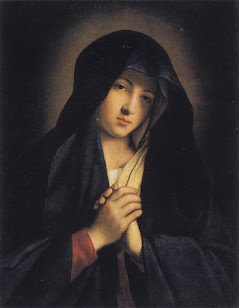
Each time the Blessed Virgin has appeared-- whether it be to Saint Bernadette Soubirous at Lourdes; to Lucia, Jacinta, and Francisco at Fatima; or to Mariette Beco at Banneux-- she has asserted the importance, saving grace, and power of praying the Holy Rosary on a daily basis. Based upon her words, the Rosary is penance and conversion for sinners, a pathway to peace, an end to war, and a powerful act of faith in Jesus Christ. Pope Paul VI presented the Rosary as a powerful means to reach Christ "not merely with Mary but indeed, insofar as this is possible to us, in the same way as Mary, who is certainly the one who thought about Him more than anyone else has ever done."

To show us how this is done, perhaps no one has been more eloquent than the great Cardinal Newman, who wrote: "The great power of the Rosary consists in the fact that it translates the Creed into Prayer. Of course, the Creed is already in a certain sense a prayer and a great act of homage towards God, but the Rosary brings us to meditate again on the great truth of His life and death, and brings this truth close to our hearts. Even Christians, although they know God, usually fear rather than love Him. The strength of the Rosary lies in the particular manner in which it considers these mysteries, since all our thinking about Christ is intertwined with the thought of His Mother, in the relations between Mother and Son; the Holy Family is presented to us, the home in which God lived His infinite love."


As Mary said at Fatima, "Jesus wants to use you to make Me known and loved. He wishes to establish the devotion to My Immaculate Heart throughout the world. I promise salvation to whoever embraces it; these souls will be dear to God, like flowers put by Me to adorn his throne."


November 15: Saint Albert the Great

Posted by Jacob

“It is by the path of love, which is charity, that God draws near to man, and man to God. But where charity is not found, God cannot dwell. If, then, we possess charity, we possess God, for ‘God is Charity.’”

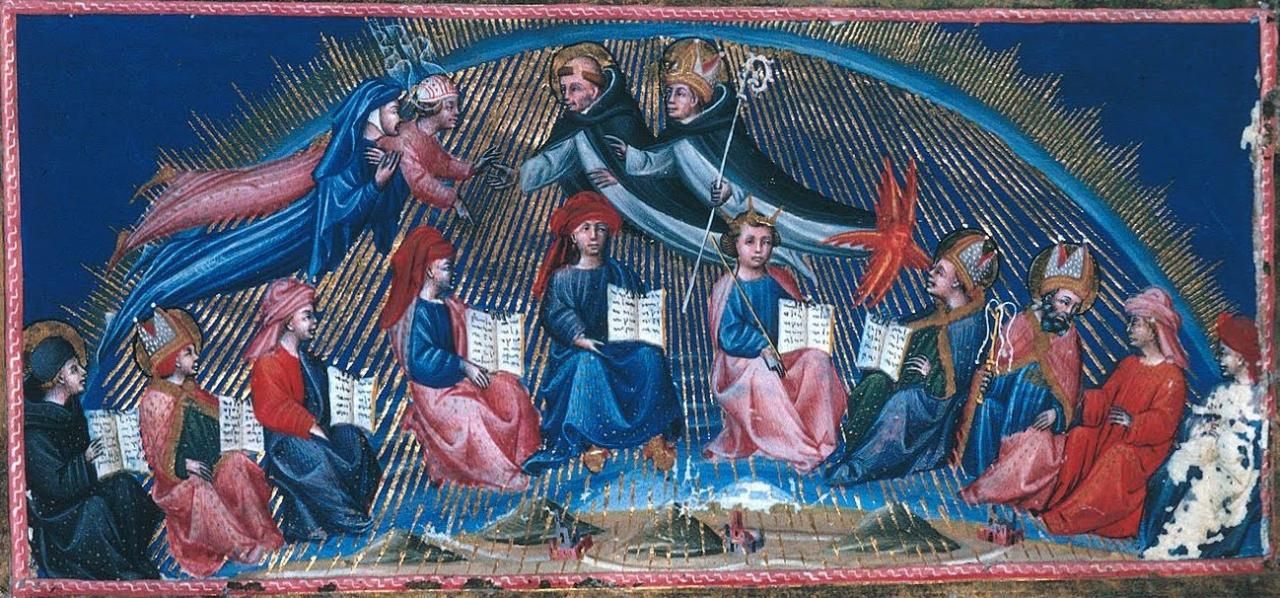
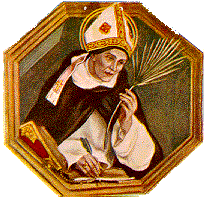
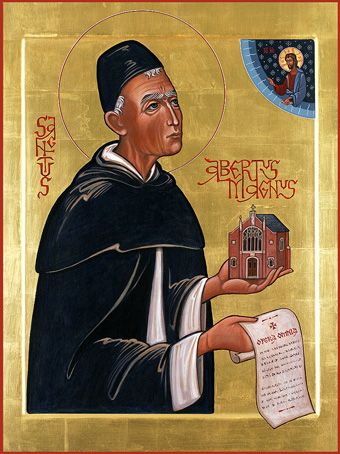
Today, November 15, we celebrate the feast day of Saint Albert the Great (1206-1280), Doctor of the Church, bishop, teacher, theologian, and one of the Church’s greatest intellects. Widely admired for his wisdom and learning, he was known as “Albertus Magnus” to his contemporaries (“Albert the Great”), and by those who came after him as “Doctor universalis” (“Teacher of all that there is to know”). Saint Albert is the patron saint of scientists. His works constantly remind us of the importance of both faith and reason, and that there can be no separation between these—in fact, faith and reason reinforce and sustain each other.
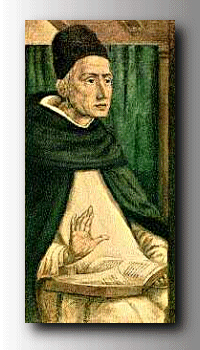
Albert was born the son of a military Lord in service to Emperor Frederick II. The family lived in Lauingen on the Danube, near Ulm, Germany. His parents were wealthy, which afforded him the finest education. Also quite pious, they instructed him in the ways of the faith. As a child, he was drawn to scientific pursuits, and demonstrated an unexpected aptitude for reasoning given his age. So advanced was his thinking, he began studying humanities and natural sciences at the university of Bologna at just 15. The university, closely associated with the Dominican Order, drew Albert closer to his commitment to serving the Lord. This was further fired by the arrival of Blessed Reginald of Orleans, a Dominican preacher and former professor in Paris, who arrived at the college to preach.

Not long after, a second Dominican, Blessed Jordan of Saxony, arrived in Padua. An eloquent preacher, he drew many—including young Albert—toward religious life. Albert’s family was opposed to his entering the Order, given his youth and exceptional scientific prowess, but Albert was torn. One night, in his dreams, he saw himself entering the order, only to depart soon afterwards. The very next day, he heard Blessed Jordan preach, specifically about how the Devil turns those who would enter religious orders away from their calling through dreams and false promises. After Mass, Albert found Blessed Jordan, inquiring: “Master, who revealed my heart to you?” He subsequently entered the Order that summer, at the age of 16.

As a Dominican, Albert continued his studies, earning a Doctorate in theology. He obediently taught, wherever he was sent, traveling to Cologne, Padua, Bologna, Saxony, Fribourg, Ratisbonne, and Strasbourg. In each of these places he attracted numerous disciples, some of them destined for illustrious careers. However, Albert himself remained humble and focused only o the Lord.
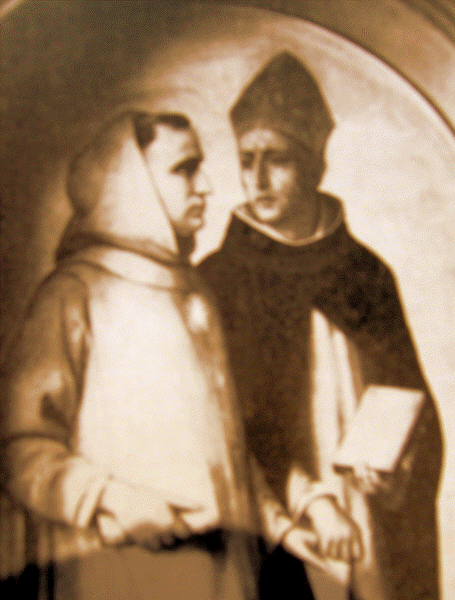
When Blessed Jordan died in 1237, Albert assumed his duties as General until his successor was elected. At that point, he returned to Cologne, where he was to meet his most illustrious disciple, Saint Thomas Aquinas. While his classmates saw Thomas as a mute and unlearned man, Albert recognized in him the grace and glory of the Lord. Together, they traveled to the University of Paris, where Saint Albert’s theology and philosophy blossomed and changed the manner in which the world thought. While he wrote many scientific works, he was, first and foremost, a Catholic. Gifted with encyclopedic knowledge, he used this gift in service to the Church. He used his reason and thinking diligently. He was a brilliant scholar, student and seeker for truth. His writings fill thirty-eight volumes. His explanations on vast subjects took twenty years to complete. Albert possessed boundless writing energies and wrote exclusively on natural science, logic, rhetoric, mathematics, astronomy, ethics, economics, politics, metaphysics, physics, mineralogy, chemistry, biology, botany and human/animal physiology.

While Saint Albert would have been quite content to remain in Paris, writing and teaching, obedience to his Order bade him travel back to Germany when he was elected Provincial. He thereafter served his community, traveling to all the monasteries in his jurisdiction by foot, without any money, across long distances—Austria, Bavaria, Saxony, and Holland. In 1260, he was appointed bishop of Regensberg. After three years, he was permitted to resign, but was subsequently called to be an adviser to the pope and was sent on several diplomatic missions. Amid his journeys and works of zeal, Saint Albert found the time to write his thirty-eight volumes on the natural sciences, philosophy and theology.

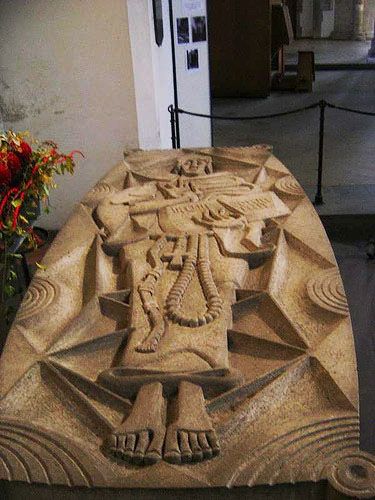
Saint Albert died, apparently of fatigue, at the age of seventy-three. His body was buried at the Dominican Church, Saint Andrea’s, in Cologne. Three years after his death, his body was in a state of perfect preservation and his body exuded the delightful fragrance or sanctity recorded at the graves of many saints. Miraculous healings were reported at his tomb side. Others received visions that were recorded due to Albert's intercession. His relics continue to be venerated there today.

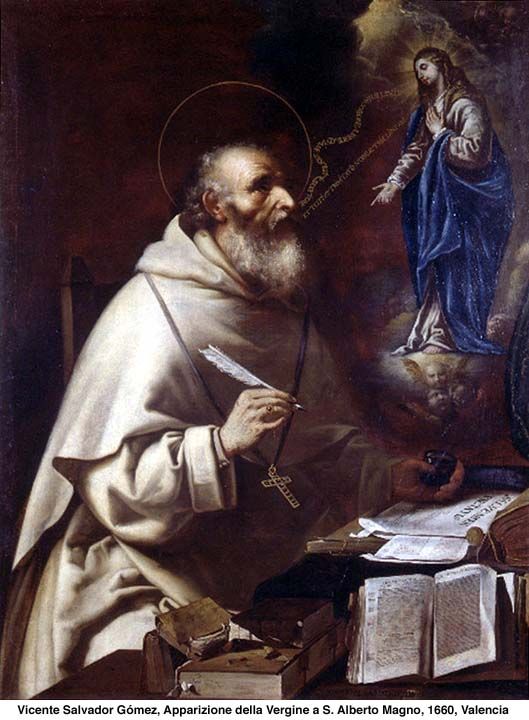
It is often said of Saint Albert the Great: "He was great in science, greater in philosophy, greatest in theology." He discovered a science above all other sciences—the knowledge that only God can impart, a heavenly wisdom that comes when reason and faith are joined together in charity towards others in prayer and action. Saint Albert reminds us not to rely on anything or trust anyone more than God. In this trust, faith and reason unite, leading us toward a greater knowledge of eternity.

Marian Prayer of Saint Albert the Great:

“Do not be afraid, Mary,
for you have found favor with God.”
For note, Mary,
for you have found grace,
not taken it as Lucifer tried to so.
You have found grace,
not lost it as Adam did.
You have found favor with God
because you desired and sought it.
You have found uncreated Grace,
that is, God himself became your Son,
and with the Grace
you have found and obtained every uncreated good.”


Selected Quotation from Saint Albert the Great:

"There are some people who attribute all these things to divine order and say that we must not consider in them any other cause but the will of God. This in part we can agree to. Yet we do not say that he does this because of a natural cause of which he is the first mover, since he is the cause of all movement; for we are not seeking a reason or explanation of the divine will but rather investigating natural causes which are as instruments through which God's will is manifested. It is not sufficient to know these things in a general sort of way; what we are looking for is the cause of each individual thing according to the nature belonging to it. This is the best and most perfect kind of knowledge."


God Our Father,
you endowed St. Albert with the talent
of combining human wisdom with divine faith.
Keep us true to his teachings
that the advance of human knowledge
may deepen our knowledge and love of you.
Grant this through our Lord Jesus Christ, your Son,
who lives and reigns with you and the Holy Spirit,
one God, for ever and ever. Amen.


Year 2: Day 319 of 365
Prayer Intentions: Trust in the Lord
Requested Intentions: Blessings on overseas employment (M); Healing of mother (L); Successful employment for husband (G); Successful employment, personal fulfillment (C); Health and recovery of ill sister (A);  Resolution of legal issues; Grace and protection (E); Successful and meaningful employment (S); Restoration of a marriage (A); Peace and tolerance in a family, support for those with Parkinson’s Disease (M); For the restoration of a daughter’s marriage, end to debt (S); Employment and continued strength (K); Successful examinations for a son (J); Employment and blessings of a child (S); Employment and financial security (F); Successful work placement, continued health (A); Grace and healing for a family (P); Healing of a father (M); Academic success for son, employment for husband and brother (B); Freedom from anxiety and panic attacks (R); Health and healing in preparation for surgery (C); Healing of a chronic illness (P); Safety of a family during storms (A); Successful home ownership (P); Healing of a marriage (M); Employment for a husband, blessings for a marriage (E); Successful examinations for a daughter, healing of a relationships (V).

November 8: Blessed John Duns Scotus, "the Subtle Doctor"

Posted by Jacob

“It is unreasonable to accept some things of the Canon [of Sacred Scripture] and not some other things; since the Catholic Church, which by believing I receive this Canon, receives the whole [of Sacred Scripture] equally as certain.”


Today, November 8, we celebrate the feast day of Blessed John Duns Scotus (1265-1308), referred to both as the “Subtle Doctor” and the “Marian Doctor.” John Duns is considered one of the greatest masters of Christian theology and is the precursor of the doctrine of the Immaculate Conception. Pope John Paul II beatified him on March 20, 1993 calling him “the bard of the Incarnate Word and defender of the Immaculate conception of Mary.”

John Duns was born in the village of Duns, in the Berwick district of Scotland, the son of a wealthy farmer. His name “Scotus” means “the Scot,” reflecting his birth and upbringing. John’s uncle, Elias, was a Franciscan who encouraged his nephew in the ways of faith, and provided him an education at Oxford. At the young age of 13, John continued his education in philosophy at Oxford, at the Franciscan school. He joined the Franciscans in 1285, at age 19, and after completing his theological studies, was ordained just six years later.

Following his ordination, John remained at the Franciscan school, eager to learn all that he could. He proceeded to become a “Master,” having taken every grade and title offered. This he accomplished at the age of 30, and in recognition, his superiors sent him to Paris University to teach at the prestigious Franciscan School there. John pointed out the richness of the Augustinian-Franciscan tradition, appreciated the wisdom of Aquinas, Aristotle, Saint Augustine, and the Muslim philosophers, and still managed to be an independent thinker. His ideas led to the founding of a school of Scholastic thought called Scotism.

Upon arrival in Paris, however, John found France to be a difficult place for a Catholic theologian at that moment in time. Following a bitter rivalry with Pope Boniface VIII, King Philip the Fair had been excommunicated from the Church. In retaliation, the king ordered all the professors at Paris University to sign a petition calling for the deposing of the pope. John refused to sign, and was immediately exiled from Paris.

He was not without work for long, however, as the Minister General of Spain requested that he teach at University in Spain, and he was restored to his “Master” status. It was in Spain that John became famous for his lectures, namely those defending the privilege of the Immaculate Conception of the Blessed Virgin Mary.

Eventually, John Duns Scotus was transferred to the Franciscan school at Cologne, where he died at age 42He was buried in the Minoritenkirche (church of the Minors) near the famous Cologne cathedral. Pope John Paul II beatified him on March 20, 1993 calling him “the bard of the Incarnate Word and defender of the Immaculate Conception of Mary.”

The theology of John Duns Scotus is that of defense of the doctrine of the Immaculate Conception. His eloquence, reason, and rational thought on the subject—joined with a faithful heart to the doctrine of the Church-- led the Franciscan Pope Sixtus IV to approve the liturgical office of this Marian feast in 1480. In 1854, Blessed Pope Pius IX officially declared a dogma of faith the doctrine on the Immaculate Conception. One of the outstanding figures in the Franciscan Order during the 19th century, the venerable servant of God Gabriele Maria Allegra OFM wrote of John Duns: “I see Scotus as the Doctor of the Immaculate Conception, of Christ as king of the universe, of the Church as the bride of Christ, as a defender of Christ’s vicar on earth, as a theologian of the mystery of the Eucharist.”

Father Charles Balic, OFM., the foremost 20th-century authority on Scotus, has written: "The whole of Scotus's theology is dominated by the notion of love. The characteristic note of this love is its absolute freedom. As love becomes more perfect and intense, freedom becomes more noble and integral both in God and in man." (New Catholic Encyclopaedia, Vol. 4, p. 1105)

John Duns Scotus lived a relatively short life, but during that time, continued the tradition of the Catholic Church as reconciling faith and science, belief and reason. His writings, works, and teachings—now nearly 1000 years old—continue to preach the truth of the faith, and call us to a new manner of thinking and study. We are to turn to Our Blessed Mother, and to her Son, Our Lord, as models of the pure love of Heaven. As Pope Benedict XIV said: “Dear brothers and sisters, Blessed Duns Scotus teaches us that in our life the essential is to believe that God is close to us and loves us in Jesus Christ, and therefore to cultivate a deep love for him and for his Church. We on earth are witnesses of this love. May Mary Most Holy help us to receive this infinite love of God which we will enjoy eternally to the full in Heaven, when our soul is at last united to God for ever in the Communion of Saints.”


Heavenly Father, You filled John Duns Scotus with wisdom, and through his life and teaching gave us a witness of Your Incarnate love. May we come to understand more deeply what he taught so that we may live in ever growing charity. Amen.

Prayer for the Canonization of Blessed John Duns Scotus

O Most High, Almightily and gracious Lord, Who exalts the humble and confounds the proud of heart, grant us the great joy of seeing Blessed John Duns Scotus canonized. He honored Your Son with the most sublime praises; he was the first to successfully defend the Immaculate Conception of the Virgin Mary; he lived in heroic obedience to the Holy Father, to the Church and to the Seraphic Order. O most holy Father, God of infinite love, hear, we beseech You, our humble prayer, thorough the merits of Your Only-Begotten Son and His Mother, the Gate of Heaven and Spouse of the Holy Spirit.


Year 2: Day 312 of 365
Prayer Intentions: Rational and faithful thought; Acceptance of the entirety of the Church’s doctrine.

Requested Intentions: Restoration of a marriage (A); Peace and tolerance in a family, support for those with Parkinson’s Disease (M); For the restoration of a daughter’s marriage, end to debt (S); Employment and continued strength (K); Successful examinations for a son (J); Employment and blessings of a child (S); Employment and financial security (F); Successful work placement, continued health (A); Grace and healing for a family (P); Healing of a father (M); Academic success for son, employment for husband and brother (B); Freedom from anxiety and panic attacks (R); Health and healing in preparation for surgery (C); Healing of a chronic illness (P); Safety of a family during storms (A); Successful home ownership (P); Healing of a marriage (M); Employment for a husband, blessings for a marriage (E); Successful examinations for a daughter, healing of a relationships (V); Blessing for a family (V); Healing of baby girl M and all children suffering (M); Special intentions (R); Business success, peace, health (E); Conversion and deliverance of those who suffer, increase in vocations (M); Financial security and safe housing (M); For a daughter (K).

Pope Benedict XVI: On Saint Albert the Great: "Scientific Study Is Transformed Then Into a Hymn of Praise"

Posted by Jacob

Today, November 15, we celebrate the feast day of Saint Albert the Great (1206-1280), Doctor of the Church, bishop, teacher, theologian, and one of the Church’s greatest intellects. Widely admired for his wisdom and learning, he was known as “Albertus Magnus” to his contemporaries (“Albert the Great”), and by those who came after him as “Doctor universalis” (“Teacher of all that there is to know”). Saint Albert is the patron saint of scientists. His works constantly remind us of the importance of both faith and reason, and that there can be no separation between these—in fact, faith and reason reinforce and sustain each other.


Below, the translated transcript of the General Audience delivered by Pope Benedict XVI in 2010 regarding Saint Albert the Great: "Scientific Study Is Transformed Then Into a Hymn of Praise"


One of the greatest teachers of Medieval theology is St. Albert the Great. The title "great" (magnus) with which he has passed into history, indicates the vastness and depth of his doctrine, which he coupled with holiness of life. But already his contemporaries did not hesitate to attribute excellent titles to him; one of his disciples, Ulrich of Strasbourg, described him as "wonder and miracle of our age."


Born in Germany at the beginning of the 13th century, he was still young when he went to Italy, to Padua, seat of one of the most famous universities of the Middle Ages. He dedicated himself to the study of the so-called liberal arts: grammar, rhetoric, dialectics, arithmetic, geometry, astronomy and music, that is, of the general culture, manifesting that typical interest for the natural sciences, which would soon become the favorite field of his specialization. During his stay in Padua, he frequented the church of the Dominicans, whom he later joined with the profession of religious vows. The hagiographic sources lead one to understand that Albert matured this decision gradually. The intense relationship with God, the example of holiness of the Dominican Friars, the listening of sermons of Blessed Giordano of Saxony, successor of St. Dominic in the leadership of the Order of Preachers, were the decisive factors that helped him to overcome every doubt, overcoming also family resistance. Often, in the years of youth, God speaks to us and indicates the plan of our life. As for Albert, so for all of us, personal prayer nourished by the Word of the Lord, the frequenting of the sacraments and the spiritual guidance of enlightened men are the means to discover and follow the voice of God. He received the religious habit from Blessed Giordano of Saxony.


After his priestly ordination, the superiors sent him to teach in several centers of theological study adjacent to monasteries of the Dominican Fathers. His brilliant intellectual qualities enabled him to perfect the study of theology in the most famous university of the time, that of Paris. From then on St. Albert undertook that extraordinary activity of writer, which he would then follow for his whole life.


He was assigned prestigious tasks. In 1248 he was charged with opening a theological study at Cologne, one of the most important administrative centers of Germany, where he lived in successive stages, and which became his adopted city. From Paris he took with him an exceptional pupil, Thomas Aquinas. The merit would suffice of having been St. Thomas' teacher to foster profound admiration toward St. Albert. Established between these two great theologians was a relationship of mutual esteem and friendship, human attitudes that help much in the development of science. In 1254, Albert was elected Provincial of the "Provincia Teutoniae" -- Teutonic Province -- of the Dominican Fathers, which embraced communities spread over a vast territory in Central and Northern Europe. He distinguished himself for the zeal with which he exercised this ministry, visiting the communities and constantly recalling his fellow brothers to fidelity, to the teachings and examples of St. Dominic.


His gifts did not pass unnoticed and the Pope of that time, Alexander IV, wanted Albert next to him for a certain time in Anagni -- where the Pope frequently went -- in Rome itself and in Viterbo, to make use of his theological counsel. The same Supreme Pontiff appointed him bishop of Regensburg, a great and famous diocese, which was, however, going through a difficult time. From 1260 to 1262 Albert carried out this ministry with tireless dedication, succeeding in taking peace and concord to the city, reorganizing parishes and convents, and giving a new impulse to charitable activities.


In the years 1263-1264 Albert preached in Germany and in Bohemia, charged by Pope Urban IV, to return then to Cologne to take up again his mission of docent, scholar and writer. Being a man of prayer, of learning and of charity, he enjoyed great authoritativeness in his interventions, in several affairs of the Church and of the society of the time. He was above all a man of reconciliation and peace in Cologne, where the archbishop had entered into harsh opposition with the city's institutions; he spent himself during the unfolding of the Second Council of Lyon in 1274, convoked by Pope Gregory X to foster the union between the Latin and Greek Churches, after the separation of the Great Schism of the East of 1054; he clarified the thought of Thomas Aquinas, who was the object of objections and even of wholly unjustified condemnations.


He died in the cell of his monastery of the Holy Cross in Cologne in 1280, and very soon was venerated by his fellow brothers. The Church proposed him to the devotion of the faithful with his beatification in 1622 and his canonization in 1931, when Pope Pius XI proclaimed him Doctor of the Church. It was undoubtedly an appropriate recognition of this great man of God and illustrious scholar not only of the truths of the faith, but of very many other sectors of learning; in fact, glancing at the titles of his very numerous works, we realize that his culture was something prodigious, and that his encyclopedic interest led him to be concerned not only with philosophy and theology, as other contemporaries, but also with every other discipline then known, from physics to chemistry, from astronomy to mineralogy, from botany to zoology. For this reason Pope Pius XII named him patron of cultivators of the natural sciences and he is also called "Doctor universalis" precisely because of the vastness of his interest and learning.


Of course, the scientific methods adopted by St. Albert the Great are not those that were to be affirmed in subsequent centuries. His method consisted simply in observation, description and classification of phenomenons studied, but thus he opened the door for future works.


He still has much to teach us. Above all, St. Albert shows that between faith and science there is no opposition, notwithstanding some episodes of misunderstanding recorded in history. A man of faith and prayer, as St. Albert the Great was, can cultivate serenely the study of the natural sciences and progress in the knowledge of the micro and macro cosmos, discovering the laws proper of matter, because all this concurs to feed the thirst for and love of God. The Bible speaks to us of creation as the first language through which God -- who is supreme intelligence, who is Logos -- reveals to us something of himself. The Book of Wisdom, for example, states that the phenomena of nature, gifted with grandeur and beauty, are as the works of an artist, through which, by analogy, we can know the Author of creation (cf. Wisdom 13:5). With a classic similarity in the Medieval Age and the Renaissance one can compare the natural world with a book written by God, which we read on the basis of several approaches of the sciences (cf. Address to the participants in the Plenary Assembly of the Pontifical Academy of Sciences, Oct. 31, 2008). How many scientists, in fact, in the wake of St. Albert the Great, have carried forward their research inspired by wonder and gratitude before a world that, in the eyes of scholars and believers, seemed and seems the good work of a wise and loving Creator! Scientific study is transformed then into a hymn of praise. It was well understood by a great astrophysicist of our times, whose cause of beatification has been introduced, Enrico Medi, who wrote: "Oh, you mysterious galaxies ... I see you, I calculate you, I understand you, I study you and discover you, I penetrate you and I am immersed in you. From you I take the light and I do science, I take the motion and do science, I take the sparkling of colors and make poetry; I take you stars in my hands, and trembling in the unity of my being I raise you beyond yourselves, and in prayer I hand you to the Creator, that only through me you stars can adore" (The Works. Hymn to Creation).


St. Albert the Great reminds us that between science and faith there is friendship, and that the men of science can undertake, through their vocation to the study of nature, a genuine and fascinating journey of sanctity.


His extraordinary openness of mind is revealed also in a cultural operation that he undertook with success, that is, in the acceptance and evaluation of the thought of Aristotle. Spreading at the time of St. Albert, in fact, was knowledge of numerous works of this great Greek philosopher who lived in the fourth century before Christ, above all in the realm of ethics and metaphysics. They demonstrated the force of reason, explained with lucidity and clarity the meaning and structure of reality, of its intelligibility, the value and end of human actions. St. Albert the Great opened the door for the complete reception of the philosophy of Aristotle in Medieval philosophy and theology, a reception elaborated later in a definitive way by St. Thomas. This reception of a philosophy, let us say, pagan and pre-Christian was an authentic cultural revolution for that time. And yet, many Christian thinkers feared Aristotle's philosophy, non-Christian philosophy, above all because, presented by its Arab commentators, it was interpreted in a way of appearing, at least in some points, as altogether irreconcilable with the Christian faith. Thus a dilemma was posed: are faith and reason in opposition to one another or not?


Here is one of the great merits of St. Albert: with scientific rigor he studied the works of Aristotle, convinced that everything that is rational is compatible with the faith revealed in sacred Scriptures. In other words, St. Albert the Great, thus contributed to the formation of an autonomous philosophy, different from theology and united to it only by the unity of the truth. Thus was born in the 13th century a clear distinction between these two learnings, philosophy and theology, which, in dialogue between them, cooperate harmoniously in the discovery of the authentic vocation of man, thirsty for truth and blessedness: and it is above all theology, defined by St. Albert as "affective science," which indicates to man his call to eternal joy, a joy that gushes from full adherence to the truth.


St. Albert the Great was able to communicate these concepts in a simple and comprehensible way. Authentic son of St. Dominic, he preached willingly to the people of God, which were conquered by his word and the example of his life.


Dear brothers and sisters, let us pray to the Lord so that there will never be lacking in the Holy Church learned, pious and wise theologians like St. Albert the Great and may he help each one of us to make our own the "formula of sanctity" that he followed in his life: "To want everything that I want for the glory of God, to wish and do everything only and always for his glory."

November 15: Saint Albert the Great

Posted by Jacob

“It is by the path of love, which is charity, that God draws near to man, and man to God. But where charity is not found, God cannot dwell. If, then, we possess charity, we possess God, for ‘God is Charity.’”

Today, November 15, we celebrate the feast day of Saint Albert the Great (1206-1280), Doctor of the Church, bishop, teacher, theologian, and one of the Church’s greatest intellects. Widely admired for his wisdom and learning, he was known as “Albertus Magnus” to his contemporaries (“Albert the Great”), and by those who came after him as “Doctor universalis” (“Teacher of all that there is to know”). Saint Albert is the patron saint of scientists. His works constantly remind us of the importance of both faith and reason, and that there can be no separation between these—in fact, faith and reason reinforce and sustain each other.

Albert was born the son of a military Lord in service to Emperor Frederick II. The family lived in Lauingen on the Danube, near Ulm, Germany. His parents were wealthy, which afforded him the finest education. Also quite pious, they instructed him in the ways of the faith. As a child, he was drawn to scientific pursuits, and demonstrated an unexpected aptitude for reasoning given his age. So advanced was his thinking, he began studying humanities and natural sciences at the university of Bologna at just 15. The university, closely associated with the Dominican Order, drew Albert closer to his commitment to serving the Lord. This was further fired by the arrival of Blessed Reginald of Orleans, a Dominican preacher and former professor in Paris, who arrived at the college to preach.

Not long after, a second Dominican, Blessed Jordan of Saxony, arrived in Padua. An eloquent preacher, he drew many—including young Albert—toward religious life. Albert’s family was opposed to his entering the Order, given his youth and exceptional scientific prowess, but Albert was torn. One night, in his dreams, he saw himself entering the order, only to depart soon afterwards. The very next day, he heard Blessed Jordan preach, specifically about how the Devil turns those who would enter religious orders away from their calling through dreams and false promises. After Mass, Albert found Blessed Jordan, inquiring: “Master, who revealed my heart to you?” He subsequently entered the Order that summer, at the age of 16.

As a Dominican, Albert continued his studies, earning a Doctorate in theology. He obediently taught, wherever he was sent, traveling to Cologne, Padua, Bologna, Saxony, Fribourg, Ratisbonne, and Strasbourg. In each of these places he attracted numerous disciples, some of them destined for illustrious careers. However, Albert himself remained humble and focused only o the Lord.

When Blessed Jordan died in 1237, Albert assumed his duties as General until his successor was elected. At that point, he returned to Cologne, where he was to meet his most illustrious disciple, Saint Thomas Aquinas. While his classmates saw Thomas as a mute and unlearned man, Albert recognized in him the grace and glory of the Lord. Together, they traveled to the University of Paris, where Saint Albert’s theology and philosophy blossomed and changed the manner in which the world thought. While he wrote many scientific works, he was, first and foremost, a Catholic. Gifted with encyclopedic knowledge, he used this gift in service to the Church. He used his reason and thinking diligently. He was a brilliant scholar, student and seeker for truth. His writings fill thirty-eight volumes. His explanations on vast subjects took twenty years to complete. Albert possessed boundless writing energies and wrote exclusively on natural science, logic, rhetoric, mathematics, astronomy, ethics, economics, politics, metaphysics, physics, mineralogy, chemistry, biology, botany and human/animal physiology.

While Saint Albert would have been quite content to remain in Paris, writing and teaching, obedience to his Order bade him travel back to Germany when he was elected Provincial. He thereafter served his community, traveling to all the monasteries in his jurisdiction by foot, without any money, across long distances—Austria, Bavaria, Saxony, and Holland. In 1260, he was appointed bishop of Regensberg. After three years, he was permitted to resign, but was subsequently called to be an adviser to the pope and was sent on several diplomatic missions. Amid his journeys and works of zeal, Saint Albert found the time to write his thirty-eight volumes on the natural sciences, philosophy and theology.

Saint Albert died, apparently of fatigue, at the age of seventy-three. His body was buried at the Dominican Church, Saint Andrea’s, in Cologne. Three years after his death, his body was in a state of perfect preservation and his body exuded the delightful fragrance or sanctity recorded at the graves of many saints. Miraculous healings were reported at his tomb side. Others received visions that were recorded due to Albert's intercession. His relics continue to be venerated there today.

It is often said of Saint Albert the Great: "He was great in science, greater in philosophy, greatest in theology." He discovered a science above all other sciences—the knowledge that only God can impart, a heavenly wisdom that comes when reason and faith are joined together in charity towards others in prayer and action. Saint Albert reminds us not to rely on anything or trust anyone more than God. In this trust, faith and reason unite, leading us toward a greater knowledge of eternity.

Marian Prayer of Saint Albert the Great:

“Do not be afraid, Mary,
for you have found favor with God.”
For note, Mary,
for you have found grace,
not taken it as Lucifer tried to so.
You have found grace,
not lost it as Adam did.
You have found favor with God
because you desired and sought it.
You have found uncreated Grace,
that is, God himself became your Son,
and with the Grace
you have found and obtained every uncreated good.”


Selected Quotation from Saint Albert the Great:

"There are some people who attribute all these things to divine order and say that we must not consider in them any other cause but the will of God. This in part we can agree to. Yet we do not say that he does this because of a natural cause of which he is the first mover, since he is the cause of all movement; for we are not seeking a reason or explanation of the divine will but rather investigating natural causes which are as instruments through which God's will is manifested. It is not sufficient to know these things in a general sort of way; what we are looking for is the cause of each individual thing according to the nature belonging to it. This is the best and most perfect kind of knowledge."


God Our Father,
you endowed St. Albert with the talent
of combining human wisdom with divine faith.
Keep us true to his teachings
that the advance of human knowledge
may deepen our knowledge and love of you.
Grant this through our Lord Jesus Christ, your Son,
who lives and reigns with you and the Holy Spirit,
one God, for ever and ever. Amen.


Day 319 of 365
Prayer Intentions: Trust in the Lord
Requested Intentions: For unity between estranged friends (E); For a son, falsely arrested (C); Successful employment (J); Successful employment (L); For a healthy child (L); Recovery from stomach illness of a friend (A); Employment and financial security (E); Conversion of sons (L); Freedom from financial stress, employment (C); Spiritual growth and family peace (A); Freedom to immigrate (D); End to debt (N); Restoration of a marriage (J); Complete recovery of son (P); Recovery of parish priest, health of mother, conversion of son (J); Successful employment, end to depression (J); Successful immigration and employment (S); Conversion of an unloving daughter (M); Recovery of husband, health of mother, economic freedom (R); Freedom from depression, restoration of family relationships (N); Restoration of a relationship (J); Healing of friends from cancer (J); Complete healing of a friend with pancreatic cancer (J); Healing of a father following stroke (S).

Pope Benedict XVI: Blessed John Duns Scotus: A Faithful Scientist

Posted by Jacob

Today, November 8, we celebrate the feast day of Blessed John Duns Scotus (1265-1308), referred to both as the “Subtle Doctor” and the “Marian Doctor.” John Duns is considered one of the greatest masters of Christian theology and is the precursor of the doctrine of the Immaculate Conception. Pope John Paul II beatified him on March 20, 1993 calling him “the bard of the Incarnate Word and defender of the Immaculate conception of Mary.”


Blessed John Duns recognized and preached that the interplay between faith and reason, science and belief, are the foundation of Catholic teaching and doctrine. Pope Benedict XVI wrote the following letter, reflecting that principle, on the celebration of the 700th year of Blessed John’s death:


Rejoice, City of Cologne, which once welcomed within your walls John Duns Scotus, a most learned and devout man, who passed from this life to the heavenly Homeland on 8 November 1308; and, whose remains you preserve with great admiration and veneration.


Our Venerable Predecessors, the Servants of God Paul VI and John Paul II, exalted him with lofty praise; we too would like to surround him with the praise he deserves and invoke his protection.


Thus the seventh centenary of his pious passing is now being celebrated, as is only right. And while articles and entire works in honour of Bl. John Duns Scotus are being published in various parts of the world and congresses are being held, including the solemn Congress currently being prepared that will take place in Cologne from 5 to 9 November 2008, we consider it a duty of our service in this circumstance to say a few words about this most illustrious man who so distinguished himself by contributing to the progress of the doctrine of the Church and of human science.


Indeed, combining piety with scientific research, in accordance with his invocation: "May the First Principle of things grant me to believe, to understand and to reveal what may please his majesty and may raise our minds to contemplate him", with his refined brilliance he penetrated so deeply the secrets of natural and revealed truth, and found in them a doctrine which led him to be called Doctor Ordinis, Doctor Subtilis, and Doctor Marianus, becoming a teacher and guide of the Franciscan School, a light and example to the entire Christian People.


Thus we desire to remind scholars and everyone, believers and non-believers alike, of the path and method that Scotus followed in order to establish harmony between faith and reason, defining in this manner the nature of theology in order constantly to exalt action, influence, practice and love rather than pure speculation; in fulfilling this task he let himself be guided by the Magisterium of the Church and by a sound critical sense regarding growth in knowledge of the truth and was convinced that knowledge is valuable to the extent that it is applied in praxis.


Firmly anchored to the Catholic faith, Duns Scotus strove to understand, explain and defend the truth of the faith in the light of human reason. Thus he strove to do nothing other than show the consonance of all truths, natural and supernatural, that come from one and the same Source.


Alongside Sacred Scripture, divinely inspired, is the authority of the Church. Duns Scotus seems to follow St Augustine's words: "I would not believe the Gospel, except that I [first] believe the Catholic Church". In fact, our Doctor often gives a special emphasis to the supreme authority of the Successor of Peter. As the Blessed said: "Although the Pope cannot dispense with natural and divine law (given that his power is inferior to both), being the Successor of Peter, Prince of the Apostles, he still has the same authority as had Peter".


Therefore, the Catholic Church whose invisible Head is Christ himself, who left as his Vicars the person of Blessed Peter and his Successors guided by the Spirit of truth, is the authentic custodian of the revealed deposit and the rule of faith. The Church is the firm and permanent criterion of the canonical dimension of Sacred Scripture. Indeed, she "established which books of the biblical canon were to be held authentic".


Elsewhere he states that "the Scriptures were revealed in the same Spirit in which they were written, and in this way one must consider that the Catholic Church has presented them in that same Spirit with which the faith has been passed down, guided that is, by the Spirit of truth".


After having proven with various arguments taken from theological reason, the very fact that the Blessed Virgin Mary was preserved from original sin, he was absolutely ready also to reject this conviction should it not be in harmony with the authority of the Church, saying: "We can with probability attribute to Mary all that has the greatest perfection, provided it is not opposed to the authority of the Church or the Scriptures".


The primacy of the will sheds light on the fact that God is charity before all else. This charity, this love, Duns Scotus kept present when he sought to lead theology back to a single expression, that is to practical theology. According to his thought, since God "is formally love and formally charity", with the greatest generosity he radiates his goodness and love beyond himself. And in reality, it is for love that God "chose us in him before the foundation of the world, that we should be holy and blameless before him. He predestined us in love to be his adoptive sons through Jesus Christ" (cf. Eph 1: 4-5).


A faithful disciple of St Francis of Assisi, Bl. John contemplated and preached assiduously the Incarnation and the saving Passion of the Son of God. However, the charity or love of Christ is expressed in a special way not only on Calvary, but also in the most holy Sacrament of the Eucharist, without which "if not for being able to render supreme adoration unto God through the veneration of the same Sacrament every mercy would disappear in the Church". This Sacrament moreover is a sacrament of unity and love; through it we are led to love one another mutually and to love God as a common good and to be loved at the same time by others.


And as this love, this charity, was the origin of all things, so too our eternal happiness will be in love and charity alone: "Eternal life is simply the desire as well as the will to love, blessed and perfect".


Since at the beginning of our ministry we first of all preached love, which is God himself, we see with joy that the unique doctrine of this Blessed keeps a special place for this truth, which we consider principally worthy to be researched and taught in our time. Therefore, willingly complying with the request of our Venerable Brother Cardinal Joachim Meisner, of Holy Roman Church, Archbishop of Cologne, we are sending this Apostolic Letter with which we desire to honour Bl. John Duns Scotus and invoke his heavenly intercession upon us. Lastly, to those who are taking part in any capacity in this International Congress and in other initiatives concerning this outstanding son of St Francis, we cordially impart our Apostolic Blessing.


Given in Rome, at St Peter's on 28 October 2008, the fourth year of our Pontificate.


BENEDICTVS PP. XVI

November 8: Blessed John Duns Scotus, "the Subtle Doctor"

Posted by Jacob

“It is unreasonable to accept some things of the Canon [of Sacred Scripture] and not some other things; since the Catholic Church, which by believing I receive this Canon, receives the whole [of Sacred Scripture] equally as certain.”


Today, November 8, we celebrate the feast day of Blessed John Duns Scotus (1265-1308), referred to both as the “Subtle Doctor” and the “Marian Doctor.” John Duns is considered one of the greatest masters of Christian theology and is the precursor of the doctrine of the Immaculate Conception. Pope John Paul II beatified him on March 20, 1993 calling him “the bard of the Incarnate Word and defender of the Immaculate conception of Mary.”

John Duns was born in the village of Duns, in the Berwick district of Scotland, the son of a wealthy farmer. His name “Scotus” means “the Scot,” reflecting his birth and upbringing. John’s uncle, Elias, was a Franciscan who encouraged his nephew in the ways of faith, and provided him an education at Oxford. At the young age of 13, John continued his education in philosophy at Oxford, at the Franciscan school. He joined the Franciscans in 1285, at age 19, and after completing his theological studies, was ordained just six years later.

Following his ordination, John remained at the Franciscan school, eager to learn all that he could. He proceeded to become a “Master,” having taken every grade and title offered. This he accomplished at the age of 30, and in recognition, his superiors sent him to Paris University to teach at the prestigious Franciscan School there. John pointed out the richness of the Augustinian-Franciscan tradition, appreciated the wisdom of Aquinas, Aristotle, Saint Augustine, and the Muslim philosophers, and still managed to be an independent thinker. His ideas led to the founding of a school of Scholastic thought called Scotism.

Upon arrival in Paris, however, John found France to be a difficult place for a Catholic theologian at that moment in time. Following a bitter rivalry with Pope Boniface VIII, King Philip the Fair had been excommunicated from the Church. In retaliation, the king ordered all the professors at Paris University to sign a petition calling for the deposing of the pope. John refused to sign, and was immediately exiled from Paris.

He was not without work for long, however, as the Minister General of Spain requested that he teach at University in Spain, and he was restored to his “Master” status. It was in Spain that John became famous for his lectures, namely those defending the privilege of the Immaculate Conception of the Blessed Virgin Mary.

Eventually, John Duns Scotus was transferred to the Franciscan school at Cologne, where he died at age 42He was buried in the Minoritenkirche (church of the Minors) near the famous Cologne cathedral. Pope John Paul II beatified him on March 20, 1993 calling him “the bard of the Incarnate Word and defender of the Immaculate Conception of Mary.”

The theology of John Duns Scotus is that of defense of the doctrine of the Immaculate Conception. His eloquence, reason, and rational thought on the subject—joined with a faithful heart to the doctrine of the Church-- led the Franciscan Pope Sixtus IV to approve the liturgical office of this Marian feast in 1480. In 1854, Blessed Pope Pius IX officially declared a dogma of faith the doctrine on the Immaculate Conception. One of the outstanding figures in the Franciscan Order during the 19th century, the venerable servant of God Gabriele Maria Allegra OFM wrote of John Duns: “I see Scotus as the Doctor of the Immaculate Conception, of Christ as king of the universe, of the Church as the bride of Christ, as a defender of Christ’s vicar on earth, as a theologian of the mystery of the Eucharist.”

Father Charles Balic, OFM., the foremost 20th-century authority on Scotus, has written: "The whole of Scotus's theology is dominated by the notion of love. The characteristic note of this love is its absolute freedom. As love becomes more perfect and intense, freedom becomes more noble and integral both in God and in man." (New Catholic Encyclopaedia, Vol. 4, p. 1105)

John Duns Scotus lived a relatively short life, but during that time, continued the tradition of the Catholic Church as reconciling faith and science, belief and reason. His writings, works, and teachings—now nearly 1000 years old—continue to preach the truth of the faith, and call us to a new manner of thinking and study. We are to turn to Our Blessed Mother, and to her Son, Our Lord, as models of the pure love of Heaven. As Pope Benedict XIV said: “Dear brothers and sisters, Blessed Duns Scotus teaches us that in our life the essential is to believe that God is close to us and loves us in Jesus Christ, and therefore to cultivate a deep love for him and for his Church. We on earth are witnesses of this love. May Mary Most Holy help us to receive this infinite love of God which we will enjoy eternally to the full in Heaven, when our soul is at last united to God for ever in the Communion of Saints.”


Heavenly Father, You filled John Duns Scotus with wisdom, and through his life and teaching gave us a witness of Your Incarnate love. May we come to understand more deeply what he taught so that we may live in ever growing charity. Amen.

Prayer for the Canonization of Blessed John Duns Scotus

O Most High, Almightily and gracious Lord, Who exalts the humble and confounds the proud of heart, grant us the great joy of seeing Blessed John Duns Scotus canonized. He honored Your Son with the most sublime praises; he was the first to successfully defend the Immaculate Conception of the Virgin Mary; he lived in heroic obedience to the Holy Father, to the Church and to the Seraphic Order. O most holy Father, God of infinite love, hear, we beseech You, our humble prayer, thorough the merits of Your Only-Begotten Son and His Mother, the Gate of Heaven and Spouse of the Holy Spirit.


Day 312 of 365
Prayer Intentions: Rational and faithful thought; Acceptance of the entirety of the Church’s doctrine.
Requested Intentions: For a healthy child (L); Recovery from stomach illness of a friend (A); Employment and financial security (E); Conversion of sons (L); Freedom from financial stress, employment (C); Spiritual growth and family peace (A); Freedom to immigrate (D); End to debt (N); Restoration of a marriage (J); Complete recovery of son (P); Recovery of parish priest, health of mother, conversion of son (J); Successful employment, end to depression (J); Successful immigration and employment (S); Conversion of an unloving daughter (M); Recovery of husband, health of mother, economic freedom (R); Freedom from depression, restoration of family relationships (N); Restoration of a relationship (J); Healing of friends from cancer (J); Complete healing of a friend with pancreatic cancer (J); Healing of a father following stroke (S).

April 21: Saint Anselm, Doctor of the Church, "Father of Scholasticism"

Posted by Jacob

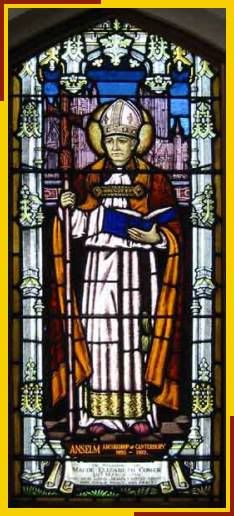
Today, April 21, we celebrate the feast day of Saint Anselm (1034-1109), Doctor of the Church. Like Saint Augustine, Saint Anselm came to the faith later in his life, but through philosophy and reason, catalogued and documented the reasons for our faith in a series of proofs and works. His prolific writing, holiness, and clarity of thought earned him the titles Doctor of the Church, “founder of scholasticism,” and the position of Archbishop of Canterbury. His words remind us today of the core tenets of our faith-- the love of Jesus, the fiat of Mary, the will of God.


Anselm, as a young boy growing up in a noble family of Piedmont, Italy, wanted nothing other than to join a religious order. His mother, a devout Catholic, raised him in the faith and nurtured his desires. Following her death, Anselm’s father forbade him to petition a local monastery for entrance, and subsequent to that, Anselm lost his way for a time, engaging in worldly pleasures and turning from his desire for the Lord. Anselm wandered throughout Europe for eight years, leaving home to escape his harsh father, ending up in Normandy, France. There, his vocation returned to him, and he entered the Benedictine Abbey of Bec at Avranches as a novice.

Over the next decade, Anselm lived in the Abbey of Bec, contemplating the word of God, and developing his philosophical thoughts regarding the teachings of the Church. He is the first to have developed an ontological argument for the existence of God, proving via logical reason that the non-existence of God was impossible (we understand God to be the greatest possible being; but a God who exists only in our minds isn't as great as one who is in our minds and who really exists; and since God is, by definition, the greatest possible being, he must exist in our minds and in reality). During this time, he was unanimously elected as Prior of the abbey.

In the years that followed, the Abbey at Bec became a well-known seat of European scholarly learning, attracting students from across the continent. While, as monks, the Rule of Benedict took priority in guiding their lives, considerable time was spent in scholastic pursuits as they related to theology, philosophy, and religion. Anselm worked tirelessly to ensure that the abbey escaped the oversight and influence of local politics, which was a common problem at the time.

Despite political difficulties, Anselm was appointed Archbishop of Canterbury—a position he reluctantly accepted. Twice during the next 20 years, he would be exiled for asserting the independence of the Church from tyrannical rules imparted by the reigning kings. Anselm continued his mission of Church reform, even while in exile, eventually prevailing and modifying the manner in which Church officials were expected to pay homage to reigning monarchs, obtain approval for Church appointments, and aid in the supplying of soldiers for armies. He further disagreed with leaders of the time on numerous social issues, including the slave trade, which he labeled both degrading and an affront to the sanctity of life. In actively resisting the pressures of reigning monarchs, Saint Anselm preserved and extended the rights and independence of the Church from government influence. He famously said, under pressure from the king, “If any man pretends that I violate my faith to my king because I will not reject the authority of the Holy See of Rome, let him stand, and in the name of God I will answer him as I ought.”

Anselm wrote countless books and proofs through his life, the most well known being Cur Deus Homo ("Why God Became Man"). Additional writings include, “Discourse on the Existence of God,” “On the being of God,” and “On Freedom of Choice, Truth, and the Fall of the Devil.” Saint Anselm was also well-known for his devotion to the Blessed Virgin, writing about her sinlessness, Solemnity, and faith—centuries before the doctrine of the Immaculate Conception was officially established.

The writings of Saint Anselm are inspirational and remind us of the basics of our faith. Selected quotations from his many works follow, including prayers he recorded. What he proved via philosophical logic, may we live in faith each day!

"Jesus, as a mother you gather your people to you: you are gentle with us as a mother with her children; Often you weep over our sins and our pride: tenderly you draw us from hatred and judgment. You comfort us in sorrow and bind up our wounds: in sickness you nurse us, and with pure milk you feed us. Jesus, by your dying we are born to new life: by your anguish and labor we come forth in joy. Despair turns to hope through your sweet goodness: through your gentleness we find comfort in fear. Your warmth gives life to the dead: your touch makes sinners righteous. Lord Jesus, in your mercy heal us: in your love and tenderness remake us. In your compassion bring grace and forgiveness: for the beauty of heaven may your love prepare us."


I acknowledge, Lord, and I give thanks that you have created your image in me, so that I may remember you, think of you, love you. But this image is so obliterated and worn away by wickedness, it is so obscured by the smoke of sins, that it cannot do what it was created to do, unless you renew and reform it. I am not attempting, O Lord, to penetrate your loftiness, for I cannot begin to match my understanding with it, but I desire in some measure to understand your truth, which my heart believes and loves. For I do not seek to understand in order that I may believe, but I believe in order to understand. For this too I believe, that "unless I believe, I shall not understand." (Isaiah 7:9)


"Lord, I do not presume to fathom the depths of your truths, for my understanding is not equal to the task. Nevertheless, I desire to learn Your truths in some measure—those truths that I believe and love. I do not seek to gain knowledge so that I can believe; rather, I believe so that I may gain knowledge. No matter how persistently my soul gazes, it still beholds nothing of Your beauty; my soul listens intently, and yet it hears nothing of the learning of Your Being; my soul wants to breathe in Your fragrance, and yet perceives none of it. What are You, Lord? Under what image can my heart recognize You? Truly, You are life; You are truth; You are Goodness; You are Holiness; You are eternity; You are everything good! O man, why do you roam about so far in search of good things for soul and body? Love the one Good, in whom all goods are contained, and that will satisfy you!"


"From the moment of her fiat Mary began to carry all of us in her womb."


"The Mother of God is our mother. May the good mother ask and beg for us, may she request and obtain what is good for us."


"No one will have any other desire in heaven than what God wills; and the desire of one will be the desire of all; and the desire of all and of each one will also be the desire of God."


My God, I pray that I may so know you and love you that I may rejoice in you. And if I may not do so fully in this life let me go steadily on to the day when I come to that fullness . . . Let me receive That which you promised through your truth, that my joy may be full.


O Lord our God, grant us grace to desire Thee with our whole heart; that, so desiring we may seek, and seeking find Thee; and so finding Thee may love Thee; and loving Thee, may hate those sins from which Thou hast redeemed us.


Day 111 of 365
Prayer Intentions: Faith in our God; Desire for nothing other than God.
Requested Intentions: Financial security and employment (A); For financial security (M); Health and recovery of Cardinal Sean Brady (R); Healing from a chronic illness (J); Deepening of faith and true conversion for a family (J); Successful employment (H); Restoration of a marriage (J); For a friend’s daughter, seeking medical treatment for a blood disorder (D); For the grace and conversion of a loved one (Z); For a beloved son’s return to the faith (A); For the improved health and recovery of a mother (G); For health, blessings, and protection (K); For an improvement in a difficult employment situation (T); For a family member’s recovery from surgery (D); For the victims of an automobile accident (D); For peace of mind and health (J); For the love of a romantic partner (S).