Why pray the Rosary every day for a year?


Each time the Blessed Virgin has appeared-- whether it be to Saint Bernadette Soubirous at Lourdes; to Lucia, Jacinta, and Francisco at Fatima; or to Mariette Beco at Banneux-- she has asserted the importance, saving grace, and power of praying the Holy Rosary on a daily basis. Based upon her words, the Rosary is penance and conversion for sinners, a pathway to peace, an end to war, and a powerful act of faith in Jesus Christ. Pope Paul VI presented the Rosary as a powerful means to reach Christ "not merely with Mary but indeed, insofar as this is possible to us, in the same way as Mary, who is certainly the one who thought about Him more than anyone else has ever done."

To show us how this is done, perhaps no one has been more eloquent than the great Cardinal Newman, who wrote: "The great power of the Rosary consists in the fact that it translates the Creed into Prayer. Of course, the Creed is already in a certain sense a prayer and a great act of homage towards God, but the Rosary brings us to meditate again on the great truth of His life and death, and brings this truth close to our hearts. Even Christians, although they know God, usually fear rather than love Him. The strength of the Rosary lies in the particular manner in which it considers these mysteries, since all our thinking about Christ is intertwined with the thought of His Mother, in the relations between Mother and Son; the Holy Family is presented to us, the home in which God lived His infinite love."


As Mary said at Fatima, "Jesus wants to use you to make Me known and loved. He wishes to establish the devotion to My Immaculate Heart throughout the world. I promise salvation to whoever embraces it; these souls will be dear to God, like flowers put by Me to adorn his throne."


Good Friday: The Passion of Our Lord

Posted by Jacob

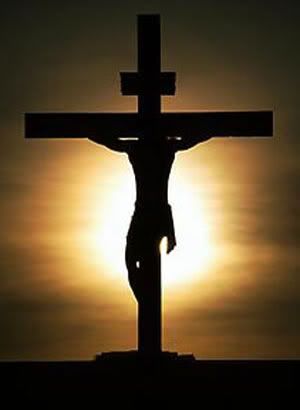
Today, Good Friday, we retrace the Passion and suffering our Our Lord, marking the steps of Jesus’ final act of love and mercy—the act that is completed on the cross when our Lord shouts triumphantly, “It is finished!” Earlier in the evening, on the night of His betrayal, Jesus had gathered the disciples in the Upper Room and celebrated the Passover with them. He had washed their feet, and in an act of love, instituted the Holy Eucharist.

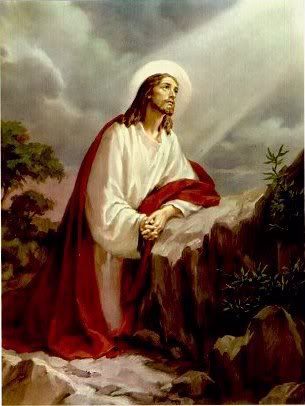
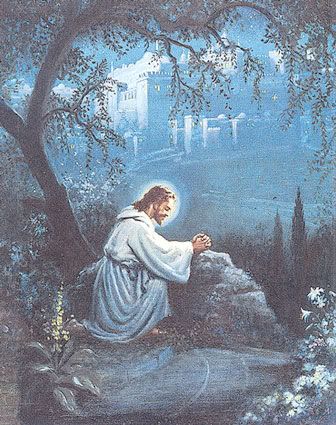
Knowing what was to come, Jesus then departed from the, taking only Peter, James, and John with Him to the garden at Gethsemane. It was there He began His Passion, a journey of suffering remembered and meditated upon during the Five Sorrowful Mysteries of the Holy Rosary. His Agony in the Garden is the first of these mysteries, all of which would occur before three o’clock the following day, Good Friday.
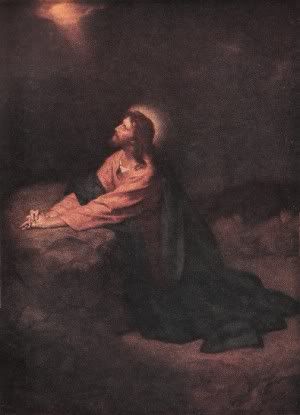
32They went to a place called Gethsemane, and Jesus said to his disciples, "Sit here while I pray." 33He took Peter, James and John along with him, and he began to be deeply distressed and troubled. 34"My soul is overwhelmed with sorrow to the point of death," he said to them. "Stay here and keep watch."


35Going a little farther, he fell to the ground and prayed that if possible the hour might pass from him. 36"Abba, Father," he said, "everything is possible for you. Take this cup from me. Yet not what I will, but what you will."


37Then he returned to his disciples and found them sleeping. "Simon," he said to Peter, "are you asleep? Could you not keep watch for one hour? 38Watch and pray so that you will not fall into temptation. The spirit is willing, but the body is weak."
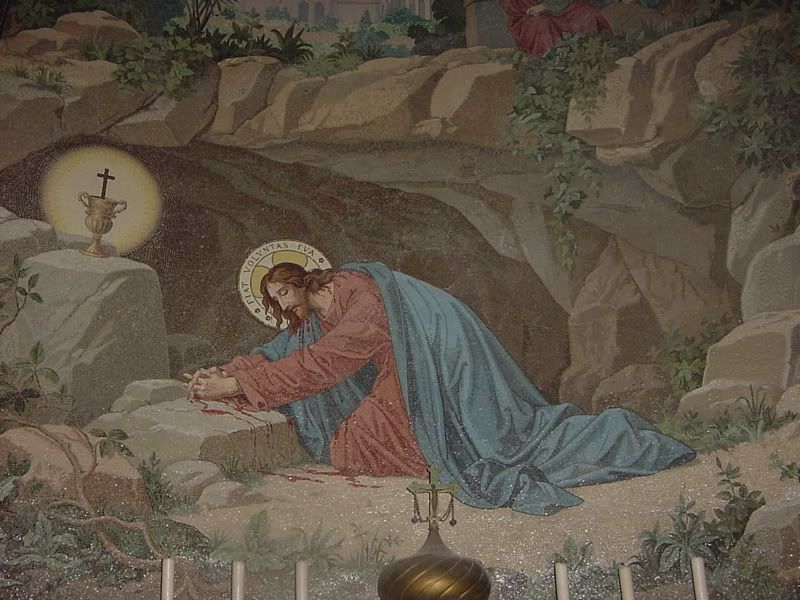

39Once more he went away and prayed the same thing. 40When he came back, he again found them sleeping, because their eyes were heavy. They did not know what to say to him.


41Returning the third time, he said to them, "Are you still sleeping and resting? Enough! The hour has come. Look, the Son of Man is betrayed into the hands of sinners. 42Rise! Let us go! Here comes my betrayer!" (Mark 14: 32-42)
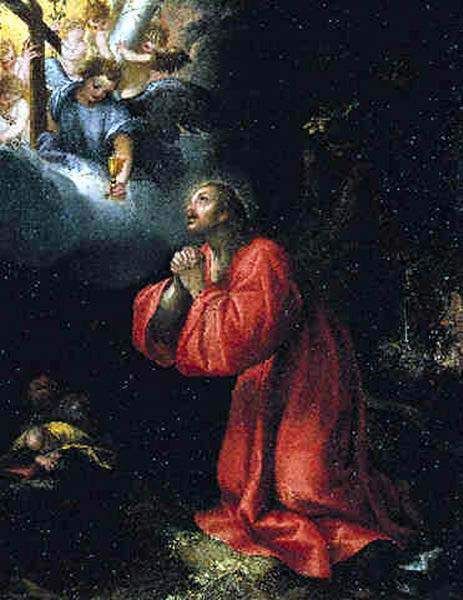

We also read in the Gospel of Luke, the mental suffering of Jesus made physical.

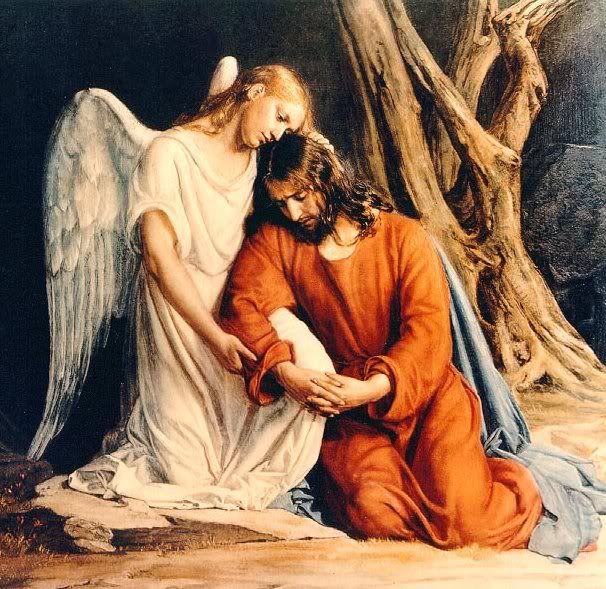
39Jesus went out as usual to the Mount of Olives, and his disciples followed him. 40On reaching the place, he said to them, "Pray that you will not fall into temptation." 41He withdrew about a stone's throw beyond them, knelt down and prayed, 42"Father, if you are willing, take this cup from me; yet not my will, but yours be done." 43An angel from heaven appeared to him and strengthened him. 44And being in anguish, he prayed more earnestly, and his sweat was like drops of blood falling to the ground.


45When he rose from prayer and went back to the disciples, he found them asleep, exhausted from sorrow. 46"Why are you sleeping?" he asked them. "Get up and pray so that you will not fall into temptation.” (Luke 22: 39-46)
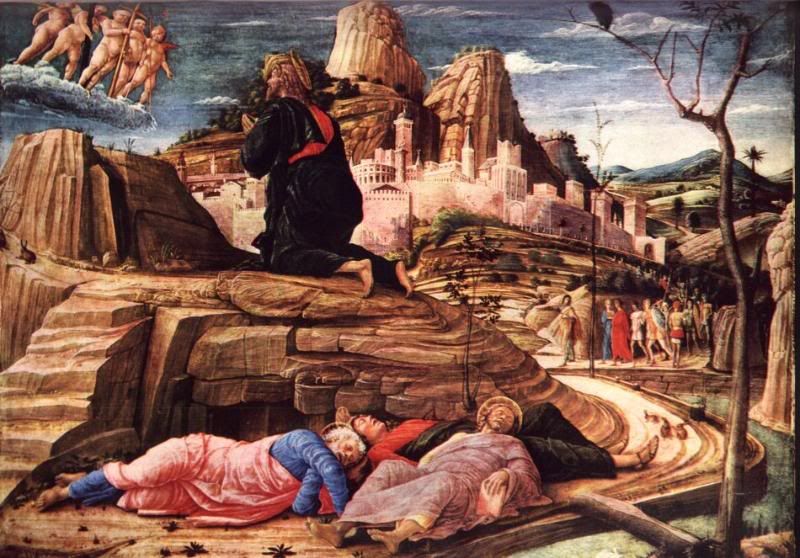
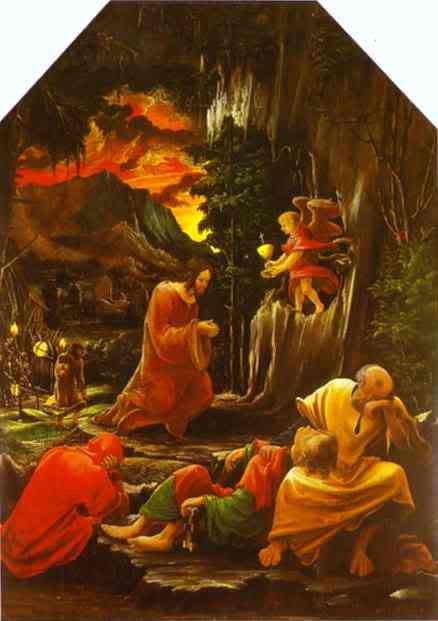
Jesus sweat blood for humanity. This suggests to us the intense physical strain that Our Lord made man was under, in the moments prior to His arrest. He took into Himself all of our sins, which stood in direct opposition to all that He had lived. Sinless on earth, Jesus became the receptacle for sin, and in doing so, experienced the depths of evil that mankind had wrought, experienced the loss of righteousness through His humanity, experienced the desolation of the separation from His Father through the lives of those who had sinned against Him.

As if the realization that He had to die wasn’t enough, He had to die for us, sinners. He had to break the hold of sin on the world and call His people back to the Father. It is nearly incomprehensible, the physical, mental, and spiritual weight that Jesus carried to Calvary. And the anticipation of that act, the agony of waiting, may have been the worst of it. But Jesus remained strong in His faith in His Father, submitting His will to the Lord in perfect obedience. And His faith was rewarded with comfort from an angel, just as our faith is rewarded in the Resurrection.

The agony in the garden, like the remainder of the Sorrowful Mysteries of the Holy Rosary is difficult to write about. It’s difficult to think about. We might prefer to avoid it, falling asleep, pretending it isn't happening.  In contemplating the actions that occur next, we are brought face to face with the worst of that which humanity has to offer. Like Jesus in the garden, we are confronted with the sins of time, and in doing so, are confronted with the fear and realization of our own sinfulness-- a sinfulness which is so brutal, so evil, it threatens to separate us from God.


But the Agony in the Garden is only prelude to greater suffering.  In the morning, Jesus continues His steady march toward death, bringing us ever closer to forgiveness and new life. We all know the story of the mock trial, of Pilate’s pronouncement, of the crowds screaming for the release of Barabas. We know of His condemnation, and we know of His grace and acceptance. At this point, His own desires obedient to His Father, Jesus is ready to finish His mission on earth. All that stands between Him and the eternal comfort of heaven is brutal torture and the weight of the world’s sinfulness. Jesus literally carried the weight of the world with Him to Calvary.

Apart from the humiliation of the trial, the first of these brutal tortures was the Scourging at the Pillar, the Second Sorrowful Mystery of the Rosary.

1Then Pilate took Jesus and had him scourged. (John 19:1)


Historically, at that time, those who were sentenced to crucifixion were first flogged or scourged. They were tied to a low pillar, stripped, generally bent over, and beat mercilessly with a whip, drawing blood, and weakening them so that they could more easily be affixed to their cross. In this way, this initial humiliation was only part and parcel of the final humiliation Christ endured for us in dying like a criminal.

In considering the Passion of Christ, we must be ever aware of the considerable physical, bodily pain that the Lord endured for us in His humanity. But one could guess that this physical pain, felt in every fiber of the Lords’ body, paled in comparison to the mental and spiritual blows being delivered upon Him by our sins.

And yet He continues on, through the mockery and indignation of His “coronation,” trudging up the hill to His crucifixion. We are reminded in our own times of pain that Jesus understands. He has already endured more than we have, can, or could. His suffering was so that we would not have to repeat it. His suffering was pure, in sacrifice for our sins. When we suffer with Him, His purity of intent enters into us, and we are supported, uplifted, renewed.


Following his arrest and torture, Jesus must now endure the mockery and humiliation of the Roman soldiers, drawing upon Himself the vanity, pride, and rebellion hidden in the hearts of all mankind. The Crowning with Thorns is the Third Sorrowful Mystery of the Holy Rosary.
16The soldiers led Jesus away into the palace (that is, the Praetorium) and called together the whole company of soldiers. 17They put a purple robe on him, then twisted together a crown of thorns and set it on him. 18And they began to call out to him, "Hail, king of the Jews!" 19Again and again they struck him on the head with a staff and spit on him. Falling on their knees, they paid homage to him. 20And when they had mocked him, they took off the purple robe and put his own clothes on him. Then they led him out to crucify him. (Mark 15: 16-20)


The crown of thorns may not have physically hurt Jesus—this is something that Biblical scholars disagree on. Some insist that the sharp thorns pierced the scalp (and even the skull) of Our Lord, oftentimes depicted in art. Others suggest that this crown of thorns was, in reality, a decorative garland used in royal ceremonies, and that by the soldiers placing in on the head of Jesus, it was a final act of mockery, degradation, and insult.

Whatever the case, the audience of Jesus in front of the Roman soldiers serves to strip Our Lord of His dignity, to make a farce out of His claims, to nullify the power of God. But we know this not to be the case. As the Roman soldiers judge Him, we know that Jesus sits in judgment of all. As they hurt Him, we know that He is the great healer. As they make Him less than human, we know that He is divine.

The crowning with thorns reminds us of our pride and our vanity. It reminds us that when we judge others, mock others, insult others, degrade others, we are re-enacting the humiliation of the Roman soldiers. We are reminded that the Lord allowed Himself to be brought low for our sins, because He loves us. We are reminded that everything we have belongs to Him and everything we do comes from Him. We are reminded that despite our cruelty, Jesus is Our Lord, and wears not a crown of thorns, but one of radiant light!

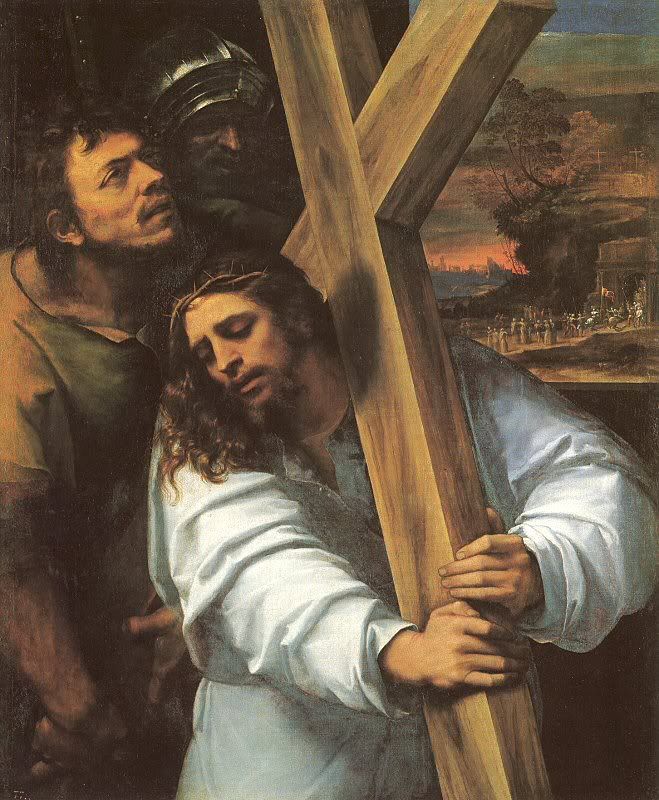
Jesus has been tried and condemned to death. He has been mocked and painfully scourged. He has endured the humiliation of a mock coronation, designed to make Him less than human, but only succeeding in elevating His divinity. And now, He must endure the Way of the Cross, the Fourth Sorrowful Mystery of the Holy Rosary.


16Finally Pilate handed him over to them to be crucified.
So the soldiers took charge of Jesus. 17Carrying his own cross, he went out to the place of the Skull (which in Aramaic is called Golgotha). (John 19: 16-17)


Saint Luke, in his Gospel, tells us a bit more about Jesus' journey along the Via Delarosa.
26As they led him away, they seized Simon from Cyrene, who was on his way in from the country, and put the cross on him and made him carry it behind Jesus. 27A large number of people followed him, including women who mourned and wailed for him. 28Jesus turned and said to them, "Daughters of Jerusalem, do not weep for me; weep for yourselves and for your children. 29For the time will come when you will say, 'Blessed are the barren women, the wombs that never bore and the breasts that never nursed!' 30Then " 'they will say to the mountains, "Fall on us!"
and to the hills, "Cover us!"’ 31For if men do these things when the tree is green, what will happen when it is dry?" (Luke 19: 26-31)

The Way of the Cross, The Way of Sadness, the Via Delarosa.
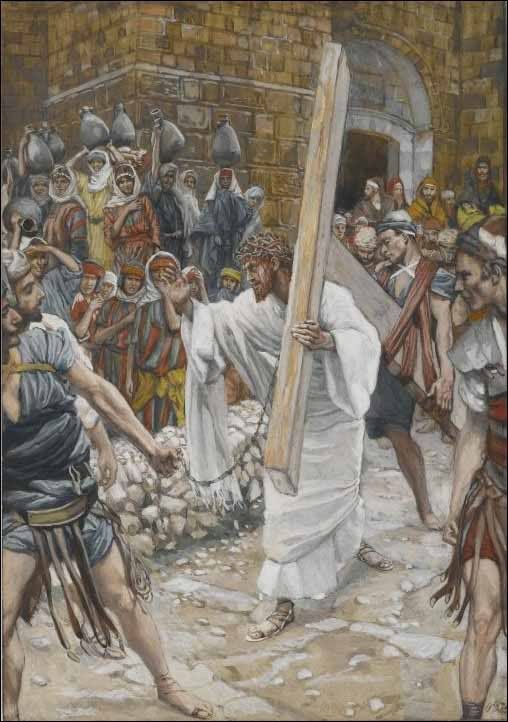
Jesus, taking upon Himself all the sins of the world, all the sadness and pain of those around Him, climbs to Golgotha. His burden is enormous—not the crossbar of the cross, which physically would have been too heavy for Him following the vicious scourging, but the spiritual and emotional burden he bore for us. Everything that Jesus carried up that hill, surrounded by the triumphant Romans, observed by the confused citizens, was marked by the stain of sin—rendered cumbersome, unwieldy, heavy. Too heavy for us. But not too heavy for He who loved us.

We can’t even begin to imagine the heaviness of His burden, or the heaviness of His steps. Each step brought Him closer to His final torment, His final torture, His human death. But each step also brought Him closer to the completion of His mission of love and forgiveness for us. This is clear, that even in the midst of the shadow of pain and sin that hung over Him on his long walk to the cross, He is thinking of us. Jesus stops to comfort the women of Jerusalem. “Weep not for me,” He says, “But for yourselves and your children.” He is predicting the final judgment. He is still, on His way to His death, calling those He is sacrificing for to repentance-- just as He continues to call us to repentance today.
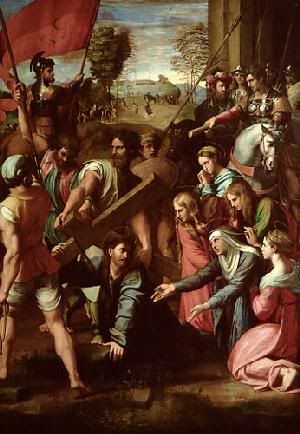
Luke tells us in his Gospel that Jesus had some help. A man from the crowd, who theologians tell us becomes a respected elder in the earliest Christian church along with his sons following the crucifixion, is conscripted to assist Jesus. He lightens the load of Christ in a physical way, even if for just a moment. We are called to do the same for others, in our daily lives. And in doing for others, we are doing for Jesus.


The footsteps of Christ are heavy… And for us, we too dread the final steps of His journey to Golgotha. We walk with Him, on the streets of Jerusalem that are wet with His blood. We know what awaits Him. And we know what awaits us on Good Friday.

And then the hopelessness, desolation, and waiting of Holy Saturday.
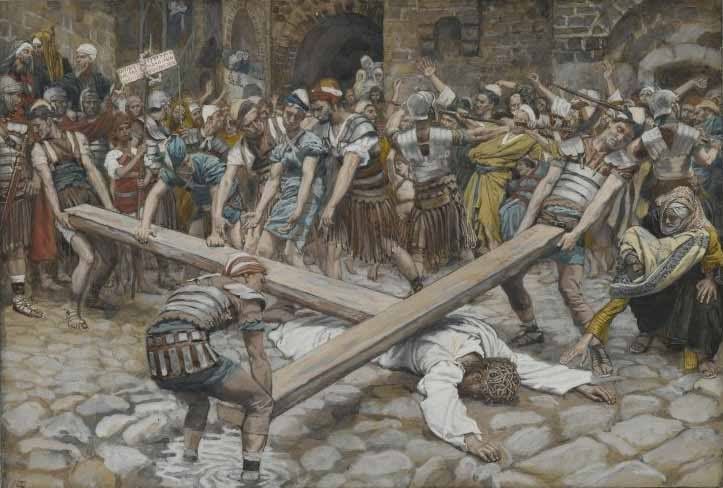
But through our faith, through the love that the Lord has for us, we also know what awaits us on Easter morning. Even as we prepare for the horror of the crucifixion, we set our eyes firmly on the dawn of forgiveness, for that is the only thing that gives us the strength to continue on.


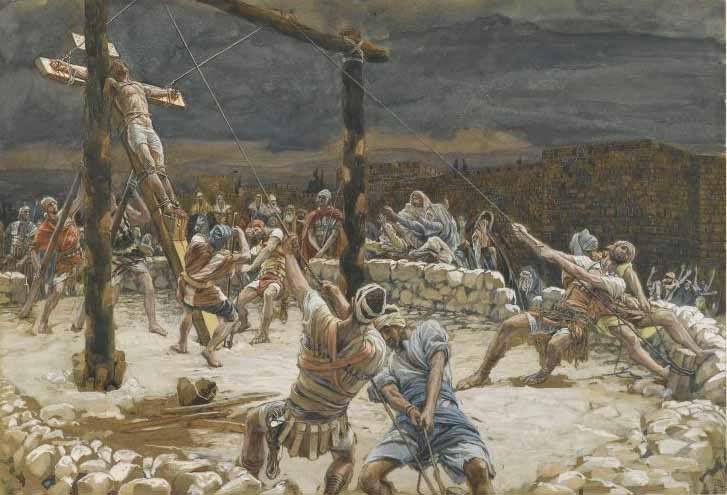
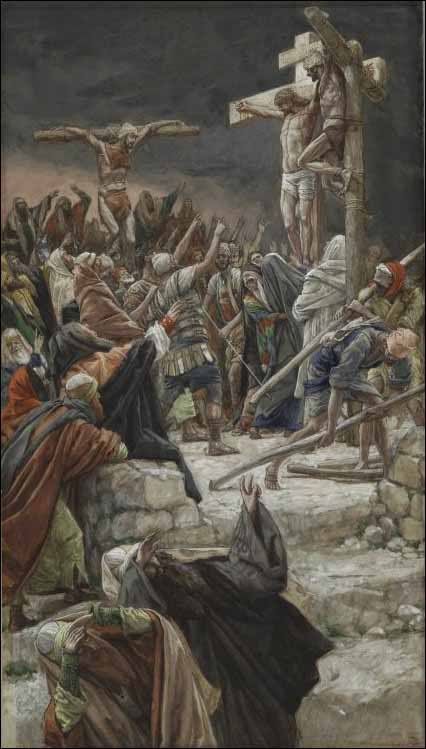
And then Our Lord was crucified.  The Fifth Sorrowful Mystery of the Holy Rosary.
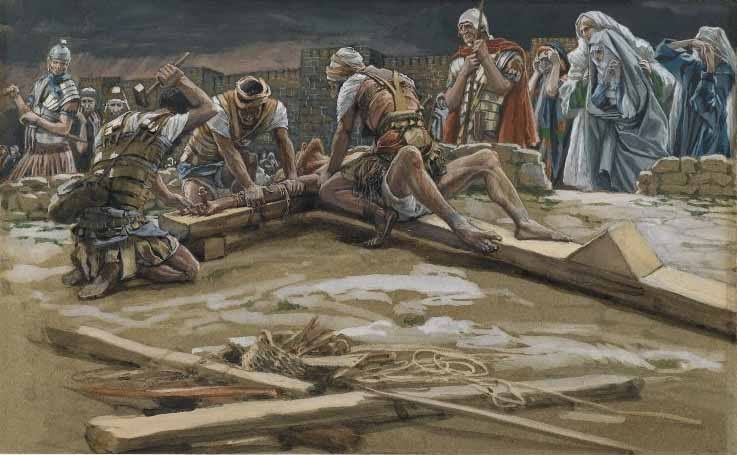

28Later, knowing that all was now completed, and so that the Scripture would be fulfilled, Jesus said, "I am thirsty." 29A jar of wine vinegar was there, so they soaked a sponge in it, put the sponge on a stalk of the hyssop plant, and lifted it to Jesus' lips. 30When he had received the drink, Jesus said, "It is finished." With that, he bowed his head and gave up his spirit.


31Now it was the day of Preparation, and the next day was to be a special Sabbath. Because the Jews did not want the bodies left on the crosses during the Sabbath, they asked Pilate to have the legs broken and the bodies taken down. 32The soldiers therefore came and broke the legs of the first man who had been crucified with Jesus, and then those of the other. 33But when they came to Jesus and found that he was already dead, they did not break his legs. 34Instead, one of the soldiers pierced Jesus' side with a spear, bringing a sudden flow of blood and water. 35The man who saw it has given testimony, and his testimony is true. He knows that he tells the truth, and he testifies so that you also may believe. 36These things happened so that the scripture would be fulfilled: "Not one of his bones will be broken,"37and, as another scripture says, "They will look on the one they have pierced." (John 19: 28-37)


Jesus, in the moments leading up to His death—a death which He clearly died for us—is still thinking of others. He comforts His mother and the disciple whom He loved, he offers redemption to the “good thief,” He draws us all to Himself in His suffering, reaching into the darkest void of sin and death, and converting it to an unending well of grace. In His death, Jesus creates a new world, a reborn world, a world where sin no longer has the power it usurped in the Garden of Eden.

And as the world is reborn, so, too are we. We are freed from the burdens of sin that we carry in our own personal Via Delarosa. We need only look within ourselves, contemplating our own suffering, and we see the joyful sacrifice of the Lord on the cross—He who suffered for us, did so willingly, freely, joyfully. He ransomed us from slavery.

He set us free.


Year 2: Day 112 of 365
Prayer Intentions: Hope in the Risen Lord
Requested Intentions: Successful immigration; for a sister’s career and marriage (F); Financial recovery; Successful ministry (A); Financial ability to send children to school (S); Safe return of a runaway (J); Healing of a family (J); Reconciliation of marriage (S); Healing of a daughter with congenital heart disease (F); Healing and an end to suffering (J); For the children (M); For a son fighting a rare immune system disease (R); Freedom from imprisonment (J); Employment and end to depression (H); Successful employment (A); Health for a soon to be delivered baby (T); Financial security (L); Healing of tooth pain (A); Health of expectant mother and child (R); Purification of the souls in Purgatory (A); Guidance in studies (J); Healing and security for a displaced family (C); Healing of high blood pressure; Recovery of brother following surgery (A); For a sister in trouble, that she may make better decisions in the light of Christ (M); Health of expectant mother and child (R); Attainment of funds for surgery (J).

April 11: Saint Gemma Galgani, "The Gem of Christ"

Posted by Jacob

“If you really want to love Jesus, first learn to suffer, because suffering teaches you to love.”

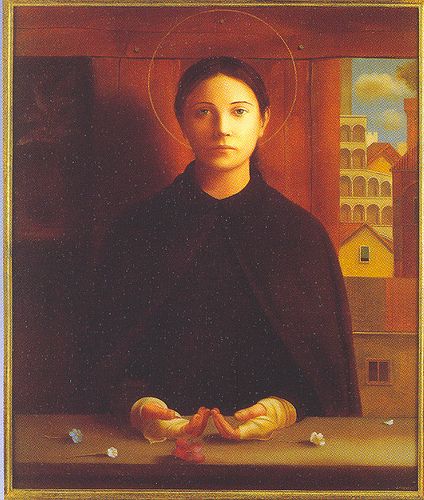
Today, April 11, we celebrate the feast of Saint Gemma Galgani (1878-1903), virgin and mystic of the Church. Saint Gemma suffered throughout her life, and was graced with visions of Christ, earning her the titles “Gem of Christ” and “Passion Flower.” She is considered the Saint of the Passion of Christ, given her mystical ecstasies, suffering, stigmata, and desire to share in the pain of our Lord. As we approach Good Friday, Saint Gemma is a holy woman to both emulate and admire!

Gemma Galgani was born in a small Italian town near Lucca. At a very young age, Gemma developed a love for prayer, and earned a reputation for both piety and humility. She made her First Communion at the age of nine, and continued her schooling at the school run by the Sisters of Saint Zita. There, she was loved by her teachers and peers. She was obedient, diligent, and kind, although quiet, shy, and reserved. It is remarked that Gemma was always smiling, regardless of task or difficulty. Although a good student, her chronic illness (developed as a young child) prevented her from continuing her studies, and she was forced to leave school. Instead, she remained at home and taught and cared for her sisters and brothers.

Gemma lovingly cared for the needs, both spiritual and physical of her family, often at the neglect of herself. She had no use for fancy clothes, and adorned herself in simple, extremely austere black dresses. She nursed her sick father until his death, and spent her free time tending to the poor of the community, giving them all she had despite being quite poor herself. Upon her father’s death, she assumed primary care of her seven younger siblings. Two men sought her hand in marriage—which would have considerably eased the strain of her life—but she refused, reserving herself for the Lord alone. Her sole desire was to pray and be in the presence of Christ.

On one occasion, to please a relative who had given her what she considered lavish gifts, Gemma wore a gold watch and cross while going about her charitable endeavors amongst the poor. Upon returning home, she was visited by her Guardian Angel—the first of many visits she would receive. He scolded her: "Remember, the spouse of the Crucified King should wear no ornaments but thorns and crosses." She immediately pledged never to wear nor speak of things of the world.

She went back to the severity of the clothes she had been wearing, and when she ventured out, she donned a simple black cloak to cover a shapeless black dress and a straw hat. This did not detract from her fine patrician looks, but instead enhanced them.

Her Guardian Angel stressed obedience! He would repeat over and over again: "Obedience! You must obey! You must be like a dead body; whatever is asked of you, you must obey quickly and joyfully!" Gemma was tempted by the world, but turned to prayer and self-denial, listening to her Guardian Angel and growing in both love and service to the Lord.

Throughout her life, Gemma was to be favored with many mystical experiences and special graces. These were often misunderstood by others, causing ridicule. Gemma suffered these heartaches in reparation, remembering that Our Lord Himself had been misunderstood and ridiculed. As a young woman, Gemma fell ill with meningitis, a painful disease of the spine. She was forced to wear a heavy iron brace around the clock that only left her arms free. Rather than feeling sorry for herself, her sole regret was the trouble that she caused her relatives. She demonstrated her care through cheerfulness, by never complaining, and by praying for her caregivers.

Gemma’s illness progressed, curving her spine radically despite the brace she wore. She lost her hearing, and large abscessed developed on her head. Gemma lost her hair, and eventually became paralyzed. The doctors offered no hope, and her condition continued to deteriorate. Throughout all, Gemma turned to the Lord, offering up her pain and suffering to Christ. She wished for nothing more than to become a Passionist nun, but her maladies kept her from doing so.

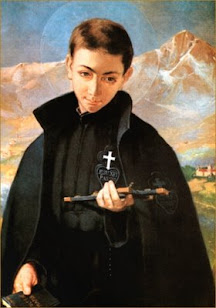
A Sister who attended to her needs knew of Gabriel Possenti, the young Passionist Saint (Saint Gabriel of Our Lady of Sorrows), and to offer consolation to Gemma, gave her a novena card and the life of Gabriel which she read. Gemma began to pray and began a devotion to Gabriel Possenti.. She later wrote regarding Gabriel: “… I grew in admiration of his virtues and his ways. My devotion to him increased. At night I did not sleep without having his picture under my pillow, and after that I began to see him near me. I don’t know how to explain this, but I felt his presence. At all times and in every action Brother Gabriel came to mind.”

One day, Saint Gabriel appeared to her, called her his sister, and told her she would one day wear the same habit he did. He informed her that she would be cured, and that a special grace was being prepared for her. On March 2 1899 she was miraculously cured of all her illnesses. On June 8, 1899, the evening before the Feast of the Sacred Heart, while she was praying the Holy Hour with Jesus in his sufferings, she experienced the deepest love for Him. It was the grace that Gabriel had spoken of. In her own words:. “All of a sudden I felt a piercing sorrow for my sins, grief, love, fear, hope encouragement…I found myself in the presence of my dear heavenly Mother…She opened her mantle and covered me with it. At that moment Jesus appeared with all his wounds open; but from those wounds there no longer came forth blood but flames of fire. In an instant those flames came to touch my hands, my feet and my heart….then I found myself kneeling; but I still felt great pain in my hands, feet and heart. I rose to go to bed and became aware that blood was flowing from those parts where I felt pain. Those pains did not leave me until three o’clock on Friday – the Feast of the Sacred Heart.”

On June 8, Saint Gemma experienced pain in her hands, feet and heart and blood was coming from the places where she had pain. She received the marks of the stigmata. Each Thursday evening from that point forth, Gemma would fall into rapture and the marks would appear. The stigmata remained until Friday afternoon or Saturday morning when the bleeding would stop, the wounds would close, and only white marks would remain in place of the deep gashes. Gemma's stigmata would continue to appear until the last three years of her life, when her confessor forbade her to accept them. Through her prayers, this phenomenon ceased, but the whitish marks remained on her skin until her death. At one time during her sufferings, she was asked: “If Jesus gave you the choice between two alternatives, either going immediately to heaven and having your sufferings disappear, or else remaining here in suffering to procure still more glory for the Lord, which would you choose?” She answered: “I prefer to remain here rather than going to heaven, when it is a question of suffering for Jesus and His glory.”

Gemma was graced by further extraordinary supernatural phenomena — visions, ecstasies, revelations, supernatural knowledge, conversations with her visible Guardian Angel, prophecy and miracles. Her director verified that letters which she wrote and committed to the care of her good Angel were infallibly delivered.

Despite her earlier sickness, Gemma maintained a strict life of penance and austerity, most of which she kept hidden from those who cared for her. In January of 1903, Gemma was diagnosed with tuberculosis. She died quietly in the company of the parish priest, on April 11 at age twenty-five. By his report, "She died with a smile which remained upon her lips, so that I could not convince myself that she was really dead."

Gemma had predicted that the Passionists would establish a monastery at Lucca. This came to pass two years after her death. Today, her relics are still treasured there. The inscription on the marble table that covers her relics reads: “Gemma Galgani from Lucca, most pure virgin, being in her twenty-fifth year, died of consumption, but was more consumed by the fire of divine love than by her wasting disease. On the eleventh of April, 1903, the vigil of Easter, her soul took its flight to the bosom of her heavenly Spouse. O beautiful soul, in the company of the Angels!”


We can learn so much from Saint Gemma, but perhaps the most important thing is the desire to love God with all our hearts. Gemma was not a person of half measures. She loved God with all her being. Her heart was all on fire with the love of God, and God was everything to her. So much did she love the Lord that she shared His wounds and pain, as recorded by Pope Pius XI: “She bore in her flesh the wounds of Christ!”


Selected Quotations by Saint Gemma Galgani:

“If I saw the gates of Hell open and I stood on the brink of the abyss, I should not despair, I should not lose hope of mercy, because I should trust in You, my God.”

“O my soul, bless Jesus. Never forget the many graces He has given thee. Love that God who so loves thee. Lift thyself up to Him, who has lowered Himself for thee; show thyself as He shows Himself with thee; be clean of heart, be pure. Love thy Jesus, who has lifted thee out of so much misery. Love thy God, bless thy Lord

“Oh, if all were to know how beautiful Jesus is, how loving He is! They would all die of love. And yet, how is it that He is so little loved? Oh, it is time lost to be with creatures! Our heart is made to love one thing only, our great God.”

“I am happy in every way that Jesus wills, and if Jesus wants the sacrifice of my life, I give it to Him at once. If He wants anything else, I am ready. One thing alone is enough for me; to be his victim, in order to atone for my innumerable sins, and if possible, for those of the whole world.”

"What happy moments I spent with Jesus! How could I return His affections? With what words could I express His love, and for this poor creature? Yet He did deign to come. It's truly impossible, yes, it is impossible not to love Jesus. How many times He asked me if I love Him and if I truly love Him. And do you still doubt it, my Jesus? So, He unites ever more closely with me, talks to me, says He wants me to be perfect, that He too loves me very much and I should reciprocate."

"Oh, how I love my Mother, Mary! She knows it; and then Jesus Himself gave Her to me, and told me to love Her so much. And what great goodness this Heavenly Mother has always shown me! What would have become of me, if I had not had Her? She has always helped me in my spiritual wants; She has preserved me from countless dangers; She has freed me from the hands of the devil who was ceaselessly com¬ing to molest me; She pleaded my cause with Jesus when I sinned, and She soothed Him when I moved Him to anger by my wicked life; She has taught me to know Him and to love Him, to be good and to please Him. Ah, my dear Mother, I will love Thee always and forever!"

“Is it possible that there are souls who do not understand what the Blessed Eucharist is? Who are insensible to the Divine Presence.....to the mysterious and fervent effusions of the Sacred Heart of my Jesus? O Heart of Jesus! Heart of love!" "Yesterday, in the presence of Jesus in the Blessed Sacrament I felt myself burning so fiercely that I had to go away. I felt stunned that so many could stay so close to Jesus and not be reduced to ashes. I felt that I would be consumed. Jesus is such a sweet and irresistible Lover; how can one fail to love Him with one's whole heart and soul? How can one not wish to be wholly united in Him, and consumed in the flames of His holy love?"

“....Let us go to Jesus. He is all alone and hardly anyone thinks of Him. Poor Jesus!” "....See, oh Jesus, even at night, those hours, those hours! I sleep, but Jesus my heart does not sleep. It watches with Thee at all hours." ".....Can You see that as soon as the day breaks I think of You? As evening comes, I am near You.....I am near You at every moment.......I love You, Jesus....."


Saint Gemma Galgani's Prayer

O my crucified God, behold me at Your feet; do not cast me out, now that I appear before You as a sinner. I have offended You exceedingly in the past, my Jesus, but it shall be so no longer.


Before You, O Lord, I place all my sins; I have now considered Your own sufferings and see how great is the worth of that Precious Blood that flows from Your veins.


O my God, at this hour close Your eyes to my want of merit, and since You have been pleased to die for my sins, grant me forgiveness for them all, that I may no longer feel the burden of my sins, for this burden, Dear Jesus, oppresses me beyond measure.


Assist me, my Jesus, for I desire to become good whatsoever it may cost; take away, destroy, utterly root out all that You find in me contrary to Your holy will. At the same time, I pray You, Lord Jesus, to enlighten me that I may be able to walk in Your holy light. Amen.


All powerful God,
you made Saint Gemma Galgani
a living image of your crucified Son.
Through her prayers,
may we suffer with Christ
and so share in his glory,
for he lives and reigns

with you and the Holy Spirit, one God,
for ever and ever. Amen


Year 2: Day 103 of 365
Prayer Intentions: Faith and consuming love; willingness to suffer and sacrifice for others; To be joined with Christ.
Requested Intentions: Financial ability to send children to school (S); Safe return of a runaway (J); Healing of a family (J); Reconciliation of marriage (S); Healing of a daughter with congenital heart disease (F); Healing and an end to suffering (J); For the children (M); For a son fighting a rare immune system disease (R); Freedom from imprisonment (J); Employment and end to depression (H); Successful employment (A); Health for a soon to be delivered baby (T); Financial security (L); Healing of tooth pain (A); Health of expectant mother and child (R); Purification of the souls in Purgatory (A); Guidance in studies (J); Healing and security for a displaced family (C); Healing of high blood pressure; Recovery of brother following surgery (A); For a sister in trouble, that she may make better decisions in the light of Christ (M); Health of expectant mother and child (R); Attainment of funds for surgery (J); Freedom from financial difficulties (E); For employment and college acceptance (E); Recovery and healing of a friend (C); For successful outcome to surgery (C); Healing for brother (M); Successful employment (C); For the victims of the Japanese tsunami/earthquake (J); Healing (E); For a son struggling with depression (B); Successful conception (M); Freedom from social anxiety; confidence in the Lord (J); Improved success in employment and studies (D); Freedom from illness (T); For a wife’s employment (E); Healing of a husband’s knee (M); Freedom from sickness (R); Healing (C); Restoration of marriage (F); Freedom from medical difficulties, employment, successful relationship (D); Healing of a father following stroke (S).

Saint Alexander of Alexandria: "On the Soul and Body and the Passion of the Lord"

Posted by Jacob

"The one and only Catholic and Apostolic Church can never be destroyed, though all the world should seek to make war against it. It is victorious over every impious revolt of the heretics who rise up against it."


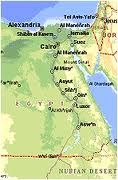
Today, February 26, we celebrate the feast of Saint Alexander of Alexandria (died 328), Patriarch of Constantinople, tireless defender of the Church against heresy, and instructor and mentor to Saint Athanasius. Written at a time when the Catholic Church was under siege from heretical sects, the writings of Saint Alexander reaffirm our faith, reminding us of the truth of the Gospel and the divinity of Christ. Alexander is described by the Roman Catholic Church as "a man held in the highest honor by the people and clergy, magnificent, liberal, eloquent, just, a lover of God and man, devoted to the poor, good and sweet to all, so mortified that he never broke his fast while the sun was in the heavens."

Below, an excerpt from a homily entitled: "On the Soul and Body and the Passion of the Lord."


1. The Word which is ungrudgingly sent down from heaven, is fitted for the irrigation of our hearts, if we have been prepared for His power, not by speaking only, but by listening. For as the rain without the ground does not produce fruit, so neither does the Word fructify without hearing, nor hearing without the Word. Moreover, the Word then becomes fruitful when we pronounce it, and in the same way hearing, when we listen. Therefore since the Word draws forth its power, do you also ungrudgingly lend your ears, and when you come to hear, cleanse yourselves from all ill-will and unbelief. Two very bad things are ill-will and unbelief, both of which are contrary to righteousness; for ill-will is opposed to charity, and unbelief to faith; just in the same way as bitterness is opposed to sweetness, darkness to light, evil to good, death to life, falsehood to truth. Those, therefore, who abound in these vices that are repugnant to virtue, are in a manner dead; for the malignant and the unbelieving hate charity and faith, and they who do this are the enemies of God.


2. Since therefore you know, brethren beloved, that the malignant and the unbelieving are the enemies of righteousness, beware of these, embrace faith and charity, by which all the holy men who have existed from the beginning of the world to this day have attained unto salvation. And show forth the fruit of charity, not in words only, but also in deeds, that is, in all godly patience for God's sake. For, see! The Lord Himself has shown His charity towards us, not only in words but also in deeds, since He has given Himself up as the price of our salvation. Besides, we were not created, like the rest of the world, by word alone, but also by deed. For God made the world to exist by the power of a single word, but us He produced by the efficacy alike of His word and working. For it was not enough for God to say, Let us make man in our image, after our likeness, Genesis 1:26 but deed followed word; for, taking the dust from the ground, He formed man out of it, conformable to His image and similitude, and into him He breathed the breath of life, so that Adam became a living soul.


3. But when man afterwards by his fall had inclined to death, it was necessary that that form should be recreated anew to salvation by the same Artificer. For the form indeed lay rotting in the ground; but that inspiration which had been as the breath of life, was detained separate from the body in a dark place, which is called Hades. There was, therefore, a division of the soul from the body; it was banished ad inferos, while the latter was resolved into dust; and there was a great interval of separation between them; for the body, by the dissolution of the flesh, becomes corrupt; the soul being loosened from it, its action ceases. For as when the king is thrown into chains, the city falls to ruin; or as when the general is taken captive, the army is scattered abroad; or as when the helmsman is shaken off, the vessel is submerged; so when the soul is bound in chains, its body goes to pieces; as the city without its king, so its members are dissolved; as is the case with an army when its general is lost, they are drowned in death, even as happens to a vessel when deprived of its helmsman. The soul, therefore, governed the man, as long as the body survived; even as the king governs the city, the general the army, the helmsman the ship. But it was powerless to rule it, from the time when it was immoveably tied to it, and became immersed in error; therefore it was that it declined from the straight path, and followed tempters, giving heed to fornication, idolatry, and shedding of blood; by which evil deeds it has destroyed the proper manhood. Nay, but itself also being carried at length to the lower regions, it was there detained by the wicked tempter. Else was it wont, as the king restores the ruined city, the general collects the dispersed army, the sailor repairs the broken ship, even so, I say, the soul used to minister supplies to the body before that the body was dissolved in the dust, being not as yet itself bound fast with fetters. But after that the soul became bound, not with material fetters but with sins, and thus was rendered impotent to act, then it left its body in the ground, and being cast down to the lower regions, it was made the footstool of death, and despicable to all.


4. Man went forth from paradise to a region which was the sink of unrighteousness, fornication, adultery, and cruel murder. And there he found his destruction; for all things conspired to his death, and worked the ruin of him who had hardly entered there. Meanwhile man wanted some consolation and assistance and rest. For when was it well with man? In his mother's womb? But when he was shut up there, he differed but little from the dead. When he was nourished with milk from the breast? Not even then, indeed, did he feel any joy. Was it rather while he was coming to maturity? But then, especially, danger's impended over him from his youthful lusts. Was it, lastly, when he grew old? Nay, but then does he begin to groan, being pressed down by the weight of old age, and the expectation of death. For what else is old age but the expectation of death? Verily all the inhabitants of earth do die, young men and old, little children and adults, for no age or bodily stature is exempt from death. Why, then, is man tormented by this exceeding grief? Doubtless the very aspect of death begets sadness; for we behold in a dead man the face changed, the figure dead, the body shrunk up with emaciation, the mouth silent, the skin cold, the carcass prostrate on the ground, the eyes sunken, the limbs immoveable, the flesh wasted away, the veins congealed, the bones whitened, the joints dissolved, all parts of him reduced to dust, and the man no longer existing. What, then, is man? A flower, I say, that is but for a little time, which in his mother's womb is not apparent, in youth flourishes, but which in old age withers and departs in death.


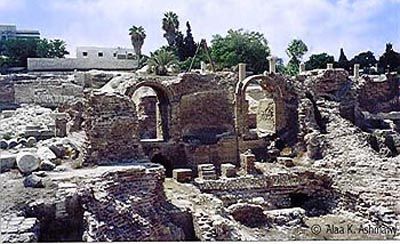
Ruins of Alexandria from the time of Saint Alexander
5. But now, after all this bondage to death and corruption of the manhood, God has visited His creature, which He formed after His own image and similitude; and this He has done that it might not for ever be the sport of death. Therefore God sent down from heaven His incorporeal Son to take flesh upon Him in the Virgin's womb; and thus, equally as you, was He made man; to save lost man, and collect all His scattered members. For Christ, when the joined the manhood to His person, united that which death by the separation of the body had dispersed. Christ suffered that we should live for ever.


For else why should Christ have died? Had He committed anything worthy of death? Why did He clothe Himself in flesh who was invested with glory? And since He was God, why did He become man? And since He reigned in heaven, why did He come down to earth, and become incarnate in the virgin's womb? What necessity, I ask, impelled God to come down to earth, to assume flesh, to be wrapped in swaddling clothes in a manger-cradle, to be nourished with the milk from the breast, to receive baptism from a servant, to be lifted up upon the cross, to be interred in an earthly sepulchre, to rise again the third day from the dead? What necessity, I say, impelled Him to this? It is sufficiently discovered that He suffered shame for man's sake, to set him free from death; and that He exclaimed, as in the words of the prophet, I have endured as a travailing woman. Isaiah 42:14 In very deed did He endure for our sakes sorrow, ignominy, torment, even death itself, and burial. For thus He says Himself by the prophet: I went down into the deep. Jonah 2:4 Who made Him thus to go down? The impious people. Behold, you sons of men, behold what recompense Israel made unto Him! She slew her Benefactor, returning evil for good, affliction for joy, death for life. They slew by nailing to the tree Him who had brought to life their dead, had healed their maimed, had made their lepers clean, had given light to their blind. Behold, you sons of men! Behold, all you people, these new wonders! They suspended Him on the tree, who stretches out the earth; they transfixed Him with nails who laid firm the foundation of the world; they circumscribed Him who circumscribed the heavens; they bound Him who absolves sinners; they gave Him vinegar to drink who has made them to drink of righteousness; they fed Him with gall who has offered to them the Bread of Life; they caused corruption to come upon His hands, and feet who healed their hands and feet; they violently closed His eyes who restored sight to them; they gave Him over to the tomb, who raised their dead to life both in the time before His Passion and also while He was hanging on the tree.


6. For when our Lord was suffering upon the cross, the tombs were burst open, the infernal region was disclosed, the souls leapt forth, the dead returned to life, and many of them were seen in Jerusalem, while the mystery of the cross was being perfected; what time our Lord trampled upon death, dissolved the enmity, bound the strong man, and raised the trophy of the cross, His body being lifted up upon it, that the body might appear on high, and death to be depressed under the foot of flesh. Then the heavenly powers wondered, the angels were astonished, the elements trembled, every creature was shaken while they looked on this new mystery, and the terrific spectacle which was being enacted in the universe. Yet the entire people, as unconscious of the mystery, exulted over Christ in derision; although the earth was rocking, the mountains, the valleys, and the sea were shaken, and every creature of God was smitten with confusion. The lights of heaven were afraid, the sun fled away, the moon disappeared, the stars withdrew their shining, the day came to end; the angel in astonishment departed from the temple after the rending of the veil, and darkness covered the earth on which its Lord had closed His eyes. Meanwhile hell was with light resplendent, for there had the star descended. The Lord, indeed, did not descend into hell in His body but in His Spirit. He forsooth is working everywhere, for while He raised the dead by His body, by His spirit was He liberating their souls. For when the body of the Lord was hung upon the cross, the tombs, as we have said, were opened; hell was unbarred. the dead received their life, the souls were sent back again into the world, and that because the Lord had conquered hell, had trodden down death, had covered the enemy with shame; therefore was it that the souls came forth from Hades, and the dead appeared upon the earth.


7. You see, therefore, how great was the effect of the death of Christ, for no creature endured His fall with equal mind, nor did the elements His Passion, neither did the earth retain His body, nor hell His Spirit. All things were in the Passion of Christ disturbed and convulsed. The Lord exclaimed, as once before to Lazarus, Come forth, you dead, from your tombs and your secret places; for I, the Christ, give unto you resurrection. For then the earth could not long hold the body of our Lord that in it was buried; but it exclaimed, O my Lord, pardon mine iniquities, save me from Your wrath, absolve me from the curse, for I have received the blood of the righteous, and yet I have not covered the bodies of men or Your own body! What is at length this wonderful mystery? Why, O Lord, did You come down to earth, unless it was for man's sake, who has been scattered everywhere: for in every place has Your, fair image been disseminated? Nay! But if you should give but one little word, at the instant all bodies would stand before You. Now, since You have come to earth, and have sought for the members of Your fashioning, undertake for man who is Your own, receive that which is committed to You, recover Your image, Your Adam. Then the Lord, the third day after His death, rose again, thus bringing man to a knowledge of the Trinity. Then all the nations of the human race were saved by Christ. One submitted to the judgment, and many thousands were absolved. Moreover, He being made like to man whom He had saved, ascended to the height of heaven, to offer before His Father, not gold or silver, or precious stones, but the man whom He had formed after His own image and similitude; and the Father, raising Him to His right hand, has seated Him upon a throne on high, and has made Him to be judge of the peoples, the leader of the angelic host, the charioteer of the cherubim, the Son of the true Jerusalem, the Virgin's spouse, and King for ever and ever. Amen.