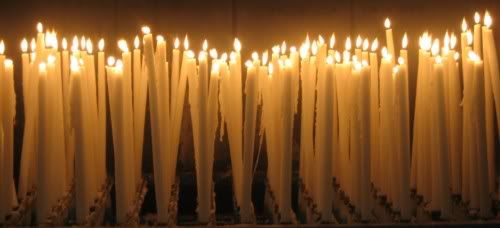
Why pray the Rosary every day for a year?


Each time the Blessed Virgin has appeared-- whether it be to Saint Bernadette Soubirous at Lourdes; to Lucia, Jacinta, and Francisco at Fatima; or to Mariette Beco at Banneux-- she has asserted the importance, saving grace, and power of praying the Holy Rosary on a daily basis. Based upon her words, the Rosary is penance and conversion for sinners, a pathway to peace, an end to war, and a powerful act of faith in Jesus Christ. Pope Paul VI presented the Rosary as a powerful means to reach Christ "not merely with Mary but indeed, insofar as this is possible to us, in the same way as Mary, who is certainly the one who thought about Him more than anyone else has ever done."

To show us how this is done, perhaps no one has been more eloquent than the great Cardinal Newman, who wrote: "The great power of the Rosary consists in the fact that it translates the Creed into Prayer. Of course, the Creed is already in a certain sense a prayer and a great act of homage towards God, but the Rosary brings us to meditate again on the great truth of His life and death, and brings this truth close to our hearts. Even Christians, although they know God, usually fear rather than love Him. The strength of the Rosary lies in the particular manner in which it considers these mysteries, since all our thinking about Christ is intertwined with the thought of His Mother, in the relations between Mother and Son; the Holy Family is presented to us, the home in which God lived His infinite love."


As Mary said at Fatima, "Jesus wants to use you to make Me known and loved. He wishes to establish the devotion to My Immaculate Heart throughout the world. I promise salvation to whoever embraces it; these souls will be dear to God, like flowers put by Me to adorn his throne."


November 14: Saint Laurence O'Toole

Posted by Jacob

He was a hostage to Dermot Mac Murrough,
Mac Murrough na gall.
A brave, fearless boy he was taken
Out from his father's hall


Into the tyrant's keeping
The little hostage went.
So early he knew sorrow
And all that sorrow meant.


Rescued from Mac Murrough
To Glendalough he came.
And, as the years passed slowly
All Ireland learned his name.


Now a great man in Dublin,
Archbishop Laurence saw
The people he loved turned outcast
with neither land nor law.


King Rory in his castle,
The nobles in their forts
had little care for Ireland,
Nor honour in their thoughts.


But Laurence rode throughout the land-
"Unite! Unite!" he cried.
"For Church and Country arm and fight!"
He would not be denied.

A hostage in his boyhood:
A patriot to the end:
A saint who struggled all his days
His country to defend.
(from Knights of God by Patrick Lynch)


Today, November 14, we celebrate the feast day of Saint Laurence O’Toole (Lorcán Ua Tuathail, 1128-1180), Confessor, Archbishop of Dublin, reformer, and peacekeeper.

Laurence, born Lorcán Ua Tuathail, was born in Castledermot, in Kildare County (Ireland). The son of the chieftain of Leinster, his birth caused such great joy to his father, that in thanksgiving, to honor Christ, he pardoned a vassal who was an enemy and even chose him to sponsor the young child. As the family processed to Church for baptism, they were stopped by a man who was regarded as a prophet, and who told them in verse that the child would be magnificent on earth and glorious in heaven, and that his name must be Laurence. Despite plans to name him otherwise, the chieftain bestowed upon his son the name Laurence.

Over the first ten years of Laurence’s life, he was raised in the faith tradition by his mother and father. During that time, his father’s role as chieftain was gradually usurped by a rival family, the MacMurroughs, and eventually, they seized power in the region. To guarantee his loyalty, the former chieftain was forced to deliver young Laurence (just 10 years old) to the MacMurroughs as hostage.

Thus, when only ten years old, Laurence was taken from his home to live as a captive and slave to another family. The MacMurroughs treated the child with great inhumanity, leaving him to suffer hunger and cold and other incommodities until his health was nearly ruined. As this situation was arranged to ensure loyalty and peace, his father, upon hearing of the treatment of Laurence, threatened the opposite, and the MacMurroughs were obliged to place Lawrence under the care of the Bishop of Glendenoch (in County Wicklow). His health restored, the already pious youth continued to grow in the grace of the Lord under the spiritual direction of the good bishop. Reunited with his father, Laurence declared his intent to remain with the bishop, and to commit himself to the Lord, entering the religious life to serve the Church and others. "It is my desire," said Lawrence, "to have for my inheritance the service of God in the Church." His father joyfully gave his permission.

When Laurence was approximately 22, the bishop—who was also the abbot of the monastery in the city—died, and Lawrence was selected to replace him. While young, and doubtful of his own abilities, Laurence soon proved (to others and himself) that he was a capable leader and administrator, spiritual director, and father to the young men in the monastery. With the monies earned by the monastery, he cared for the hungry, poor, and needy—virtually providing food for the entire region during a great famine. Revenue was always directed back to the community, in establishing housing, founding hospitals, providing basic necessities, and repairing ruined or decrepit churches. In ten short years, he transformed the area, and when the see of Glendenoch became vacant, it was Saint Laurence who was chosen to fill it. Not long thereafter, although out of humility he attempted to avoid the honor, he was obliged to become Archbishop of Dublin. Playing to his obedience, he was told that to refuse the honor would be to resist the Will of God. Naturally, Laurence acquiesced and took upon him the care of the city, becoming the first native-born Irishman to hold the position.

As archbishop, Laurence immediately undertook reform of the clergy, instituting the rules of Saint Augustine. He, himself, followed the rules to exacting standards, sharing their table, their prayer and their silence. He also embarked on a spiritual retreat each year, finding a cave (known as Saint Kevin’s Cave) a few miles from the city, and spending forty days there, praying, meditating, and fasting on only bread, water, and vegetables. Upon his return, each year, his sermons were filled with such vigor and zeal against the disorders of the province, many—even the most opposed—were converted! Saint Laurence lived a life of austerity. He constantly wore a hair shirt under his ecclesiastical robes, never ate meat, fasted every Friday, and never drank wine - although he would color his water to make it look like wine and not bring attention to himself at table.

When Laurence was approximately 43 (around the year 1171), it was required of him to go to England to see the king, Henry II, who was then at Canterbury. He was received by the Benedictine monks of Christ Church with the greatest honor and respect, and the following day, performed a miracle before the eyes of many. During Mass, as Laurence was processing to the alter to celebrate, he was struck on the head by a religious zealot, hoping to make a martyr of him. To the consternation of all present, he appeared to be mortally wounded. However, Laurence calmly asked for some water, which he blessed, and then requested that his head be washed with it. As soon as the blessed water touched his wound, the blood stopped flowing, he rose, and celebrated the Mass. Not only did he publicly forgive his attacker, but also obtained pardon from the king for his crime. Word spread of his deeds, and through his model and his prayers, many alienated faithful were returned to the Church.

Saint Laurence returned to Ireland, after stopping in Rome to have audience with the Pope. There he was made legate of the Irish provinces—all of which he then visited to institute reform and discipline throughout the country. Not long thereafter, Laurence died in France while on a peacekeeping mission to King Henry II of England. His body was buried, and so many miracles were recorded in the first five years at his intercession, that it was encased in a crystal coffin and placed beneath the main alter at the Church of the Abby at Eu. Saint Laurence O’Toole was canonized only 45 years after his death.

Saint Laurence O’Toole was drawn to the Lord at an early age. Not even imprisonment and ill-treatment could turn him from his calling. Despite his great humility, he was destined for great things—each of which he accomplished with discipline, obedience, steadfastness, and courage. Saint Laurence realized that the Lord was his strength, instituting austerities and penances to remind himself of his weaknesses, but the power of the Lord. He was a contemplative, a peacekeeper, a confessor, and a miracle-worker—all through the power of God. We pray today that we might embody the trust and courage of Saint Laurence in our daily lives, that we might turn to the Lord in our times of weakness, that we might recognize that God is our rock, our strength.


Prayer of Trust in God's Heavenly Promise


My God, let me know and love you, so that I may find my happiness in you. Since I cannot fully achieve this on earth, help me to improve daily until I may do so to the full Enable me to know you ever more on earth, so that I may know you perfectly in heaven. Enable me to love you ever more on earth, so that I may love you perfectly in heave. In that way my joy may be great on earth, and perfect with you in heaven.


O God of truth, grant me the happiness of heaven so that my joy may be full in accord with your promise. In the meantime let my mind dwell on that happiness, my tongue speak of it, my heart pine for it, my mouth pronounce it, my soul hunger for it, my flesh thirst for it, and my entire being desire it until I enter through death in the joy of my Lord forever. Amen. Saint Augustine of Hippo


Year 2: Day 318 of 365
Prayer Intentions: Discipline; Obedience; Steadfastness; Courage
Requested Intentions: Blessings on overseas employment (M); Healing of mother (L); Successful employment for husband (G); Successful employment, personal fulfillment (C); Health and recovery of ill sister (A);  Resolution of legal issues; Grace and protection (E); Successful and meaningful employment (S); Restoration of a marriage (A); Peace and tolerance in a family, support for those with Parkinson’s Disease (M); For the restoration of a daughter’s marriage, end to debt (S); Employment and continued strength (K); Successful examinations for a son (J); Employment and blessings of a child (S); Employment and financial security (F); Successful work placement, continued health (A); Grace and healing for a family (P); Healing of a father (M); Academic success for son, employment for husband and brother (B); Freedom from anxiety and panic attacks (R); Health and healing in preparation for surgery (C); Healing of a chronic illness (P); Safety of a family during storms (A); Successful home ownership (P); Healing of a marriage (M); Employment for a husband, blessings for a marriage (E); Successful examinations for a daughter, healing of a relationships (V).

May 22: Saint Rita of Cascia

Posted by Jacob

Today, May 22, we celebrate the feast day of Saint Rita of Cascia (1386-1456), the patron saint of impossible causes. Saint Rita’s life was one of hardship, difficulty, and disappointment, but she never lost faith in the Lord, praying ceaselessly throughout what seemed like endless days filled with harsh conditions, and was delivered from them. Known as a “Peacemaker of Jesus” for her charity and love of others, Saint Rita is a model of Christian virtue, obedience, and steadfast endurance.


Born in Rocca Perena, Umbria, Italy, the only child to older parents also known for their charity to those around them, miracles surrounded Saint Rita almost immediately. At her baptism, she was surrounded by a swarm of bees who miraculously covered her body, flying around her face, dropping their honey into her open mouth, without harming her in any way. A local farmer, seeing the swarm of bees, tried to disperse them with his arm that had been deeply wounded by a scythe. His arm stopped bleeding and he was immediately healed. Rita grew in holiness, practicing daily prayer, asking permission from her parents to enter the convent at age 12. However, her parents had arranged a marriage for her, and she obediently followed their wishes.

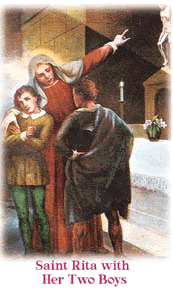
In early adolescence, Rita married the town watchman, with whom her parents had arranged a marriage. Their union was blessed with twin sons, whom Rita loved and raised in the name of Christ. Unfortunately, her husband was an immoral, quick tempered man who was physically and verbally abusive to Rita, and was prone to drinking excessively. She suffered his abuse for eighteen years, never complaining, serving as the model wife and mother. Rita never prayed for her husband to love her, to treat her attentively, to be kind, to cease drinking or being abusive as the result of the drinking, or to remain at home with her and their sons. Rather, she prayed for his soul, unconditionally, that he would give his life over to Jesus and be converted. As her children grew, she could see that they were greatly influenced by their father’s behavior, and like Saint Monica, she prayed for their souls as well. After 16 years of marriage, her prayers were answered and her husband converted, beginning to lead a holy and penitent life. Sadly, just two years later, he was ambushed and stabbed to death by men he had previously wronged. Saint Rita’s now- teenaged sons wished to seek revenge against their father's killers, and Rita tried to discourage them, concerned for their mortal souls. Through her prayers and interventions her sons did not act upon their revenge, both dying of illness, and maintaining their purity in the eyes of the Lord.

Having lost her family, Rita was called back to the religious life. She sought acceptance at the Augustinian Convent of Saint Mary Magdalene, but was refused admission due to her widowed status. Holy legend tells us that Rita was miraculously transported by her patron saints—Saint John the Baptist, Saint Augustine of Hippo, and Saint Nicholas of Tolentino—through the walls of the convent into an empty cell. When the sisters found her inside the walls the next morning, they immediately accepted her into the order.

Blessed Saint Rita lived forty more years as a practicing nun of poverty, committing herself to works of mercy, charity and peace. Such was her vow of poverty, Rita wore the same habit every day-- the habit she was given upon acceptance into the order—until the day she died. And then, she was buried in it. She was known for her extreme acts of self-deprivation, mortification, and penance, and was a model sister and inspiration to those she lived with. However, it wasn't her rigorous mortifications that made her saintly, but rather her desire for total abandonment to the will of God. Through her intercessions, many were healed, freed from demons, and converted to Christ.

Saint Rita, who had known her share of suffering at the hands of her abusive husband, and after the loss of her sons, prayed for more suffering—to be united with Christ in His suffering. One day, as holy legend tells us, Saint Rita was kneeling in prayer before a replica of the Crucified Christ. She implored, "Oh my Jesus, let me share in Thy suffering at least by one of Thy thorns." At that moment, a single thorn from the crown surrounding Jesus' head flew through the air and speared directly into Sister Rita's forehead. This wound bled until the end of her life and caused her considerable pain and suffering. It also emitted a repulsive stench, such that Rita spent the majority of her last 15 years in seclusion.

As Saint Rita aged, she became sick from the toils of her life. The last four years of her life she was confined to bed as an invalid. Saint Rita spent her days teaching the novices, eating little more than the Eucharist to sustain her. Shortly before her death, Saint Rita made one request, that a cousin would bring to her a single rose from her family's estate. It was the middle of January and the cousin thought this to be impossible, but upon arriving at Rita's former home found a single rose in blossom on an otherwise bare bush in the family garden.

There are many stories about Saint Rita’s acts of charity and obedience. One story, which has implications still today, began with the Convent Mother, wishing to test the obedience of Rita, instructing her to water a dead and withered plant from the convent garden every day for a year. Sister Rita, always obedient, did as she was told, wearing the dead plant around her neck every day. At the end of a year, to the great astonishment of all, that dead plant brought forth leaves and flowers and became the most beautiful of all the grape vines in the garden. Today, over 500 hundred years later, that same vine remains bountiful and beautiful. Its leaves are dried and powdered and sent all over the world to people who are suffering, and many cures have been reported. The fruit of the vine is sent to the Pope and to other Dignitaries each year at harvest time.

Saint Rita died peacefully on May 22, 1457, the noxious odor from her head wound changing to the sweet fragrance of holiness which hundreds of years later can still be detected. At the moment of her death, a bright light emanated from the wound in her head, filling the room and dazzling her sisters. Her body, resting in the Basilica of Saint Rita in Cascia, remains incorrupt. Witnesses recount that her body, unaided, is observed in various positions, and has been observed to levitate on her feast day. Following her beatification, her eyes opened and mouth smiled, revealing her teeth. The habit she was buried in—the same habit she wore each day of her religious life—remains similarly preserved. Numerous miracles have been reported at her tomb, from touching the oil that burns beside her body, or from eating the bread baked by her sisters and distributed to visitors. Saint Rita’s tomb has become one of the most visited pilgrimage sites in Italy. Because of her many trials and sacrifices throughout her life Rita the Saint is known as Rita Patron Saint of Impossible Causes and desperate situations. She's often entreated by those suffering the afflictions of abuse, sickness, desperate causes, difficult marriages, widows and wounded people, as well as those suffering from sterility and infertility.


Almost two hundred years after she died, an interesting phenomenon occurred. At the Monastery in Cascia, where Rita had spent the latter half of her life, white bees—similar to those who had swarmed her as an infant-- were observed to came out of the walls of the Monastery during Holy Week of each year. These bees remained until the feast day of Saint Rita on May 22nd, and then returned to hibernation until Holy Week of the following year. Pope Urban VIII, learning of the bees, requested that one of the them be brought to him in Rome. After a careful examination of the bee, he tied a silk thread around it. Setting it free, the bee was later discovered in its hive at the Monastery in Cascia, 138 kilometers away. And so the tradition of the bees began. The holes in the wall where the bees traditionally remain until the following year, are plainly in view for pilgrims journeying even today to the Monastery.

The life of Saint Rita of Cascia reminds us that sometimes life is hard. We may feel as if we cannot handle all the struggle that has been given to us. We may feel like we are alone. We may feel as if we are a lost cause, that holy lives are impossibilities. Yet, we are never alone, and with the Lord, all things are possible. Saint Rita’s forbearance and endurance, her obedience, and her faith all inspire us look to the Lord in our moments of weakness, hopeless, and despair. We are never alone. Nothing is impossible with God.


O Holy St. Rita, exemplary Augustinian Sister, we honor you for your devotion to the Passion of Christ. Although your early life was filled with disappointment, frustration, and unceasing tragedy, you never lost faith and trust in God. For this you are the patroness of the impossible, and our inspiration and advocate in desperate circumstances.


Holy Patroness of those in need, Saint Rita, you were humble, pure and patient. Your pleadings with your divine Spouse are irresistible, so please obtain for me from our risen Jesus the request I make of you. Be kind to me for the greater glory of God, and I shall honor you and sing your praise forever.


Glorious Saint Rita, you miraculously participated in the sorrowful passion of our Lord Jesus Christ. Obtain for me now the grace to suffer with resignation the troubles of this life, and protect me in all my needs.


God, You were pleased to grant to St. Rita the great grace of loving her enemies in very truth, and both in her heart and on her brow to bear the stigmata of Your Passion; grant us, we pray, by her merits and prayers, so to show mercy to our enemies and so to meditate on the pains of Your Passion, as to make our own the blessedness promised to those who are meek and who mourn.


Father of us all, you hold the world in one hand and bless it with the other. You gave Rita the strength to bear her cross after the example of Christ. She found peace in doing your will and was thus enabled to forgive others and bring peace to many.


Give me the strength to accept my sufferings; let me not whimper nor forget the examples of strength that you give me in the lives of your saints. Bring peace to my heart, so that I too may be a peacemaker. For all your gifts let me thank you each day. Amen


Year 2: Day 142 of 365

Prayer Intentions: Trust in the Lord
Requested Intentions: Husband’s freedom from illness (L); Personal intentions (S); Successful passing of dental board examination (P); Blessings on a family (Z); Successful permanent employment (C); Healing of a son with autism (J); Son’s successful employment (L); For the intentions of family and relatives, for the Carthusian community (T); For personal intentions (A); Restoration of lost hearing (C); Resolution of relational and financial challenges (S); Comfort following loss of husband, security for family, assistance with housing (B); Healing and return of brother (O); Successful hermitage foundation (S); Support from family, permission to marry (H); Recovery of wife following surgery, freedom from depression (W); Protection and recovery of mentally ill daughter (J); Successful resolution to legal proceedings (N); Freedom from worry and successful employment (M); For successful sale of home and freedom from debt (J); Freedom from pain and illness (E).

January 3: Saint Genevieve

Posted by Jacob

"Get down on your knees and pray! I know it, I see it. The Huns will not come!"


Today, January 3, we celebrate the feast day of Saint Genevieve (422-512), Patroness of Paris, and Virgin of the Church. Saint Genevieve is credited with preventing Paris from falling to Attila the Hun, as well as miraculous cures during the Plague by her intercession. A woman of great faith, Saint Genevieve was graced with the gift of clairvoyance and miracle-working by the Lord, which she used to increase the devotion of the faithful throughout France.

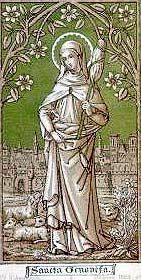
Born of wealthy parents in Gaul (modern France) in the village of Nanterre, near Paris, Genevieve grew up tending her family’s sheep in the fields on Mount Valerien. When Genevieve was approximately seven years old, Saint Germanus of Auxerre, a holy bishop, was passing through the region. Seeing her engaged in her shepherding duties, the holy bishop was graced with a vision of her future sanctity, kissed her on the head, and proceeded to the family’s home. There, he informed her parents that she would become great in the sight of the Lord, and would lead many to salvation through the faith.

As recounted by Saint Germanus:

And the holy man said: “Blessed are you that God hath given you this child. Know you for certain that on the day of her birth the Angels sang and a great feast was made in Heaven. This girl shall be of great merit before the Lord. And from her good life and words many shall take example, that they shall leave the yoke of sin and convert to God.”

Then, he turned toward the child, and she said to him: “Blessed Father, your servant is listening.”

The Bishop asked: “Tell me, and be not embarrassed, if you will consecrate yourself to Christ in purity without stain as His spouse?”

The maid answered: “Blessed be you, my Father. What you ask of me is the most cherished desire of my heart. I ask only that by your prayers, Our Lord will accomplish my desire.”

“Have confidence, my daughter,” said Germanus. “Be firm in your resolution. Prove by your works the good things that you believe in your heart and say with your mouth, and Our Lord shall give you strength as well as virtue.”

After Genevieve told Saint Germanus that she wished to dedicate herself to Christ, he gave her a brass medal with the image of the Cross upon it. She promised to wear it around her neck, and to avoid wearing any other ornaments around her neck or on her fingers.

After the death of her parents, when Genevieve was fifteen years old, she was taken to Paris to enter the monastic life. A model sister, she devoted herself to fasting, prayer, and silent vigil, receiving from the Lord the gifts of clairvoyance and miracle-working. She traveled throughout the city and region, preaching, healing, and bringing many to the faith. She embodied a life of great austerity, practicing penance and charity. However, she was cruelly persecuted, by those both within and from outside the faith. They called her a hypocrite and a charlatan, but she, in humility, continued her good works. Eventually, following receiving some blessed bread from Saint Germanus—as a token of his esteem—the persecution ceased, and she was regarded as a saint while still living.

The miracle that Saint Genevieve is most famously remembered for involves the conquest of Attila the Hun. As he, and his marauding forces were approaching Paris—and all hope was lost as the rest of Europe had fallen before him—Genevieve and her sisters prayed and fasted, entreating God to spare the city. She exhorted the faithful, encouraging them to pray as well, having seen in a vision the saving of the city. Without warning, the barbarian forces turned from Paris, sparing it without conflict.

Similarly, during the siege of Paris by Childeric, king of the Franks, Genevieve went out with a few followers and procured grain for the starving citizens. King Childeric, though a pagan, respected her, and at her request spared the lives of many prisoners.

Saint Genevieve preached the importance of the Saturday night Vigil, comparing it in symbolism to the manner in which the faithful should lead their daily lives. She said: “We must keep vigil in prayer and fasting so that the Lord will find us ready when He comes.” On the way to the Saturday vigil, one cold, dark, and stormy night, she and her traveling companions—nun from the convent—were plunged into darkness as their candles were blown out by the storm. Fearing the darkness and the storm, the nuns determined to return to the monastery, when Saint Genevieve made the Sign of the Cross over her lantern, which miraculously relit. Filled with grace and hope in the Lord, the sisters proceeded to their Mass. In art, Genevieve is often portrayed carrying a lit candle for this reason—she hoped in the light of Christ, even in the most profound moments of darkness!


Saint Genevieve died peacefully in 512, at the age of eight-nine. She was entombed in the Cathedral of Saints Peter and Paul in Paris, although her relics were later translated to the Church of Saint Etienne du Mont. In 1129, when the plague swept through Paris, Saint Genevieve’s relics were processed through the streets. Prior to the procession, 14,000 residents of the city perished, with thousands dying each day. On the day of the procession, only three individuals died, and the following day, the deaths miraculously stopped. Saint Genevieve is credited with this miraculous intercession, and is considered the Patron Saint of Paris.


Saint Genevieve was a simple shepherdess, without formal education. Through the grace of the Lord, and her commitment to Him, she worked grand miracles and brought thousands to the faith through her example. Even in the bleakest of moments—attack, siege, and plague—Saint Genevieve did not fear the darkness. Rather, she held onto hope, placing her trust and her life in the hands of the Lord who never forgot her—just as He never forgets us!


Loving Saint Genevieve, fair patron saint of Paris, lead us in your path of courage and valor. May we fearlessly defend what is right and true, may we turn not away from the fear and anguish of others but stand beside them as you did, and by your holy example help us to find eternal life among the warrior princes of the archangels, and all who serve God and His truth without reservation.


Saint Genevieve, be our beacon and our light in darkness. Amen.

November 14: Saint Laurence O'Toole

Posted by Jacob

He was a hostage to Dermot Mac Murrough,
Mac Murrough na gall.
A brave, fearless boy he was taken
Out from his father's hall


Into the tyrant's keeping
The little hostage went.
So early he knew sorrow
And all that sorrow meant.


Rescued from Mac Murrough
To Glendalough he came.
And, as the years passed slowly
All Ireland learned his name.


Now a great man in Dublin,
Archbishop Laurence saw
The people he loved turned outcast
with neither land nor law.


King Rory in his castle,
The nobles in their forts
had little care for Ireland,
Nor honour in their thoughts.


But Laurence rode throughout the land-
"Unite! Unite!" he cried.
"For Church and Country arm and fight!"
He would not be denied.

A hostage in his boyhood:
A patriot to the end:
A saint who struggled all his days
His country to defend.
(from Knights of God by Patrick Lynch)


Today, November 14, we celebrate the feast day of Saint Laurence O’Toole (Lorcán Ua Tuathail, 1128-1180), Confessor, Archbishop of Dublin, reformer, and peacekeeper.

Laurence, born Lorcán Ua Tuathail, was born in Castledermot, in Kildare County (Ireland). The son of the chieftain of Leinster, his birth caused such great joy to his father, that in thanksgiving, to honor Christ, he pardoned a vassal who was an enemy and even chose him to sponsor the young child. As the family processed to Church for baptism, they were stopped by a man who was regarded as a prophet, and who told them in verse that the child would be magnificent on earth and glorious in heaven, and that his name must be Laurence. Despite plans to name him otherwise, the chieftain bestowed upon his son the name Laurence.

Over the first ten years of Laurence’s life, he was raised in the faith tradition by his mother and father. During that time, his father’s role as chieftain was gradually usurped by a rival family, the MacMurroughs, and eventually, they seized power in the region. To guarantee his loyalty, the former chieftain was forced to deliver young Laurence (just 10 years old) to the MacMurroughs as hostage.

Thus, when only ten years old, Laurence was taken from his home to live as a captive and slave to another family. The MacMurroughs treated the child with great inhumanity, leaving him to suffer hunger and cold and other incommodities until his health was nearly ruined. As this situation was arranged to ensure loyalty and peace, his father, upon hearing of the treatment of Laurence, threatened the opposite, and the MacMurroughs were obliged to place Lawrence under the care of the Bishop of Glendenoch (in County Wicklow). His health restored, the already pious youth continued to grow in the grace of the Lord under the spiritual direction of the good bishop. Reunited with his father, Laurence declared his intent to remain with the bishop, and to commit himself to the Lord, entering the religious life to serve the Church and others. "It is my desire," said Lawrence, "to have for my inheritance the service of God in the Church." His father joyfully gave his permission.

When Laurence was approximately 22, the bishop—who was also the abbot of the monastery in the city—died, and Lawrence was selected to replace him. While young, and doubtful of his own abilities, Laurence soon proved (to others and himself) that he was a capable leader and administrator, spiritual director, and father to the young men in the monastery. With the monies earned by the monastery, he cared for the hungry, poor, and needy—virtually providing food for the entire region during a great famine. Revenue was always directed back to the community, in establishing housing, founding hospitals, providing basic necessities, and repairing ruined or decrepit churches. In ten short years, he transformed the area, and when the see of Glendenoch became vacant, it was Saint Laurence who was chosen to fill it. Not long thereafter, although out of humility he attempted to avoid the honor, he was obliged to become Archbishop of Dublin. Playing to his obedience, he was told that to refuse the honor would be to resist the Will of God. Naturally, Laurence acquiesced and took upon him the care of the city, becoming the first native-born Irishman to hold the position.

As archbishop, Laurence immediately undertook reform of the clergy, instituting the rules of Saint Augustine. He, himself, followed the rules to exacting standards, sharing their table, their prayer and their silence. He also embarked on a spiritual retreat each year, finding a cave (known as Saint Kevin’s Cave) a few miles from the city, and spending forty days there, praying, meditating, and fasting on only bread, water, and vegetables. Upon his return, each year, his sermons were filled with such vigor and zeal against the disorders of the province, many—even the most opposed—were converted! Saint Laurence lived a life of austerity. He constantly wore a hair shirt under his ecclesiastical robes, never ate meat, fasted every Friday, and never drank wine - although he would color his water to make it look like wine and not bring attention to himself at table.

When Laurence was approximately 43 (around the year 1171), it was required of him to go to England to see the king, Henry II, who was then at Canterbury. He was received by the Benedictine monks of Christ Church with the greatest honor and respect, and the following day, performed a miracle before the eyes of many. During Mass, as Laurence was processing to the alter to celebrate, he was struck on the head by a religious zealot, hoping to make a martyr of him. To the consternation of all present, he appeared to be mortally wounded. However, Laurence calmly asked for some water, which he blessed, and then requested that his head be washed with it. As soon as the blessed water touched his wound, the blood stopped flowing, he rose, and celebrated the Mass. Not only did he publicly forgive his attacker, but also obtained pardon from the king for his crime. Word spread of his deeds, and through his model and his prayers, many alienated faithful were returned to the Church.

Saint Laurence returned to Ireland, after stopping in Rome to have audience with the Pope. There he was made legate of the Irish provinces—all of which he then visited to institute reform and discipline throughout the country. Not long thereafter, Laurence died in France while on a peacekeeping mission to King Henry II of England. His body was buried, and so many miracles were recorded in the first five years at his intercession, that it was encased in a crystal coffin and placed beneath the main alter at the Church of the Abby at Eu. Saint Laurence O’Toole was canonized only 45 years after his death.

Saint Laurence O’Toole was drawn to the Lord at an early age. Not even imprisonment and ill-treatment could turn him from his calling. Despite his great humility, he was destined for great things—each of which he accomplished with discipline, obedience, steadfastness, and courage. Saint Laurence realized that the Lord was his strength, instituting austerities and penances to remind himself of his weaknesses, but the power of the Lord. He was a contemplative, a peacekeeper, a confessor, and a miracle-worker—all through the power of God. We pray today that we might embody the trust and courage of Saint Laurence in our daily lives, that we might turn to the Lord in our times of weakness, that we might recognize that God is our rock, our strength.


Prayer of Trust in God's Heavenly Promise


My God, let me know and love you, so that I may find my happiness in you. Since I cannot fully achieve this on earth, help me to improve daily until I may do so to the full Enable me to know you ever more on earth, so that I may know you perfectly in heaven. Enable me to love you ever more on earth, so that I may love you perfectly in heave. In that way my joy may be great on earth, and perfect with you in heaven.


O God of truth, grant me the happiness of heaven so that my joy may be full in accord with your promise. In the meantime let my mind dwell on that happiness, my tongue speak of it, my heart pine for it, my mouth pronounce it, my soul hunger for it, my flesh thirst for it, and my entire being desire it until I enter through death in the joy of my Lord forever. Amen. Saint Augustine of Hippo


Day 318 of 365
Prayer Intentions: Discipline; Obedience; Steadfastness; Courage
Requested Intentions: For a son, falsely arrested (C); Successful employment (J); Successful employment (L); For a healthy child (L); Recovery from stomach illness of a friend (A); Employment and financial security (E); Conversion of sons (L); Freedom from financial stress, employment (C); Spiritual growth and family peace (A); Freedom to immigrate (D); End to debt (N); Restoration of a marriage (J); Complete recovery of son (P); Recovery of parish priest, health of mother, conversion of son (J); Successful employment, end to depression (J); Successful immigration and employment (S); Conversion of an unloving daughter (M); Recovery of husband, health of mother, economic freedom (R); Freedom from depression, restoration of family relationships (N); Restoration of a relationship (J); Healing of friends from cancer (J); Complete healing of a friend with pancreatic cancer (J); Healing of a father following stroke (S).