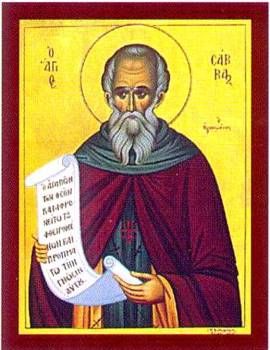
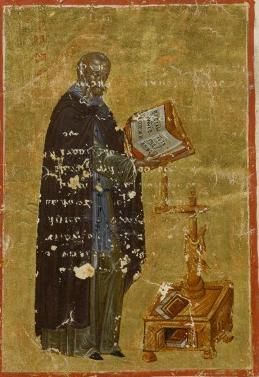
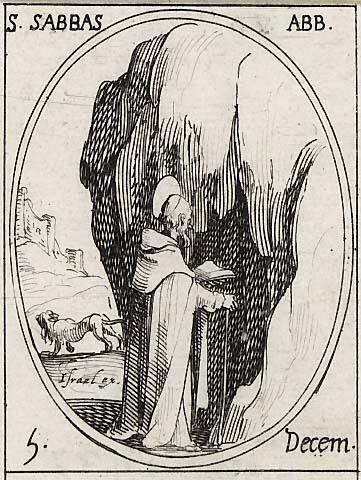
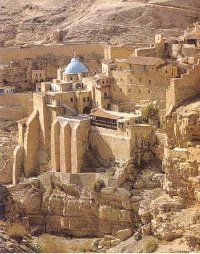
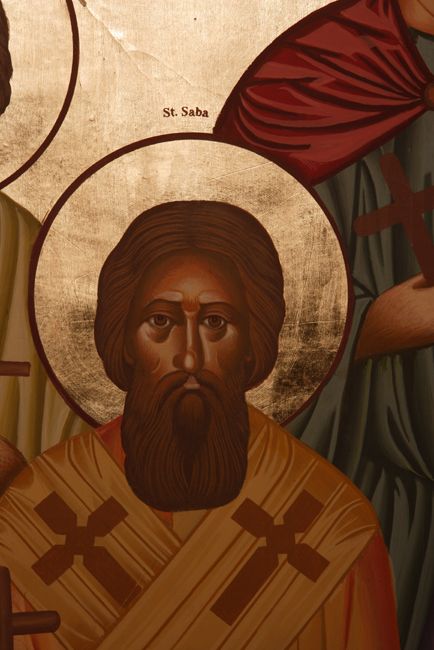
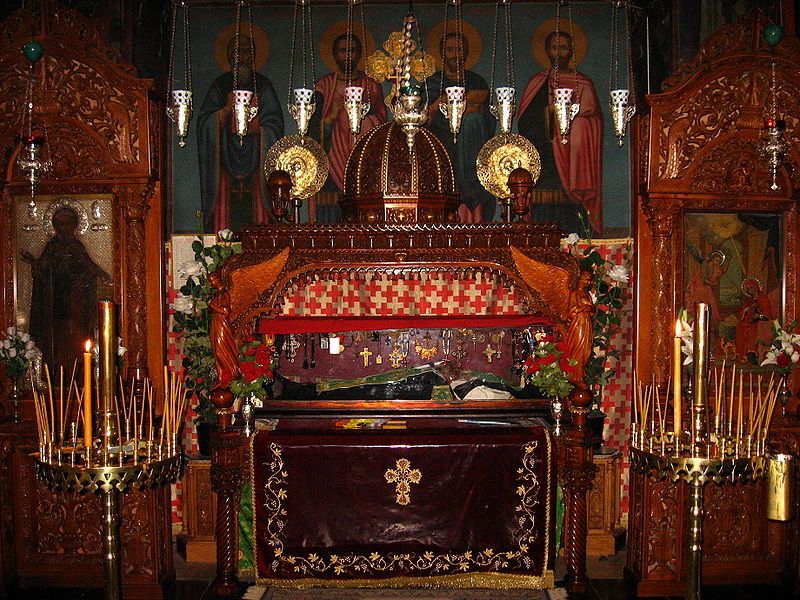
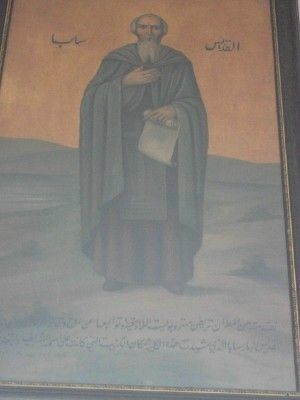
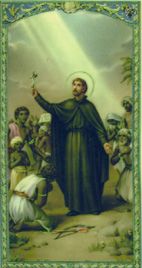
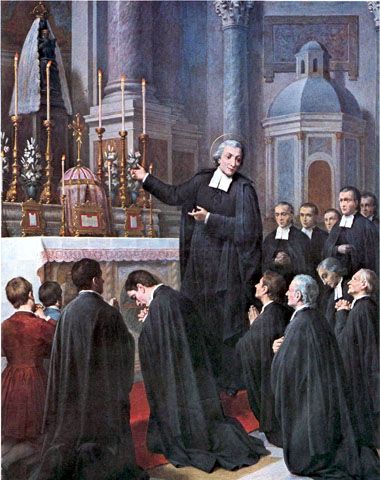
Today, December 5, we celebrate the feast day of Saint Sabas (also known as Sabas the Sanctified, 439-532), one of the most renowned monks of Palestine, and founder of the Monastery at Mar Saba (where Saint John Damascene and Saint Stephen of Mar Saba, among many others, studied).
Sabas was born in Palestine, near Caesarea. As a child he was orphaned, and was sent to live with an uncle who treated him poorly. At the age of fifteen, weary from his strained family relations and mistreatment, Sabas committed himself in service to the Lord, entering a monastery close to his family’s home. Forsaking the world, he spent ten years in religious life, unable to be persuaded to leave. Despite being the youngest of the monks in the monastery, Sabas demonstrated admirable virtue as was looked upon with great respect and love by his brothers. Upon pressure from his remaining family, who continuously besieged him with requests to give up religious life, he asked, “Do you want me to be a deserter, leaving God after placing myself in His service? If those who abandon the militia of earthly kings are severely punished, what chastisement would I not deserve if I abandoned that of the King of heaven?”
As he reached the age of thirty, Saint Sabas desired greater solitude, so that he might more completely contemplate the goodness of the Lord. He left the monastery in Palestine and began dwelling as a hermit, in a cave near Jerusalem. There, he spent his days in prayer, singing Psalms, and weaving baskets from palm branches. His life of quiet contemplation was uninterrupted for nearly 15 years, at which point others living as hermits in the region began seeking him out for spiritual direction. Sabas granted each who arrived a cell nearby to his own, and before long, the largest monastery in Palestine had been built.
Sallustus, the Patriarch of Jerusalem, noting Sabas’ good works, ordained him a priest, so that he might celebrate Mass for those in his direction. He further ordained Sabas Superior of the monasteries of Palestine, and ordered that the monks obey his rules and honor his requests. Some were displeased by these orders, and Sabas, our of humility, retired from the community to a cavern near Scythopolis.
As recorded by of Saint: Euthymius, Sabas went into a great cave to pray, unknowingly entering the cave of a great lion out for the hunt. At midnight the beast returned and finding this guest, dared not touch him, but taking him gently by his garments, plucked him as if it had been to draw him out. “The saint was no ways affrighted or troubled, but began leisurely and with much devotion to recite aloud the midnight psalms. The lion went out, and when the holy man had finished matins, came in again and pulled him by the skirts of his clothes as he had done before.” Sabas spoke to the lion, stating that the cave was large enough to house both of them. The lion at those words departed, and returned no more.
After some time, during which he converted many souls who visited him, he returned to his role as Superior. He was placed over seven monasteries, and began exerting influence not only in Palestine, but in Constantinople as well. Saint Sabas advocated for the Catholics in Constantinople who were suffering greatly under the rule of Emperor Elias. He wrote letter after letter, begging the emperor for fairer treatment of the Church, fewer taxes, and an end to persecution. Eventually, the emperor died and was replaced with Emperor Justin, a pious man who restored the true faith.
When Saint Sabas was ninety-one years old, he made the long journey to Constantinople to ask Emperor Justinian, successor to Justin, not to punish the Palestinians who had revolted against their neighboring Samarians. Impressed by his piety and pleas, the emperor honored his wishes, further offering to endow all the monasteries of Saint Sabas with great wealth. However, Sabas asked instead that the monies be used for several important purposes: to build a hospice for pilgrims in Jerusalem, to decorate the unfinished Church of the Blessed Virgin, to build a fortress where the monks could take refuge when barbarians invaded the land, and to re-establish preaching of the true Faith by edicts proscribing the various errors being propagated. Emperor Justinian honored all the requests of the holy father, who returned to the monastery at Mar Saba—his first monastery. That is where he died, and the age of ninety two. Today the monastery (one of the four oldest in the world) is still inhabited by monks of the Eastern Orthodox Church, and St. Sabas is regarded as one of the most noteworthy figures of early monasticism.
The life of Saint Sabas is one of service, great love for the Lord, and obedience to His commands. Despite a prolonged desire for solitude and contemplation, everywhere Sabas journeyed, he was sought out by those needing his spiritual direction. Realizing the role that the Lord had in store for him, he gave all that he had to those in his charge, leading many future saints to the Lord. Today, on the feast of Saint Sabas, we pray to emulate both his obedience and faith.
A Prayer for the Virtue of Obedience
Jesus, Almighty King of kings, You Who obeyed Your Father to the end, Teach me the meaning of obedience. My soul burns to comply to Your Will, Striving to charm Your Divinity. While my worldly nature seeks one way, My spiritual nature seeks another. Bless me with the strength to obey, That my soul may subdue both natures, Blending them as a fair aromatic bloom. I always seek favour in Your eyes, To always obey You until my last breath! Amen.
Year 2: Day 339 of 365
Prayer Intentions: Obedience and faith.
Requested Intentions: Financial security for a mother (M); Health, finances, successful marriage (A); Successful resolution of court case for son (K); Continued sobriety (N); Healing of a chronic health condition (B); Successful employment (A): Peace in a family, recovery of a niece from substance use (L); Blessings on a marriage, healing of a husband (P); For the health and recovery of sisters (B); For a daughter and granddaughter (D); Blessings on overseas employment (M); Healing of mother (L); Successful employment for husband (G); Successful employment, personal fulfillment (C); Health and recovery of ill sister (A); Resolution of legal issues; Grace and protection (E); Successful and meaningful employment (S); Restoration of a marriage (A); Peace and tolerance in a family, support for those with Parkinson’s Disease (M); For the restoration of a daughter’s marriage, end to debt (S); Employment and continued strength (K); Successful examinations for a son (J); Employment and blessings of a child (S); Employment and financial security (F); Successful work placement, continued health (A); Grace and healing for a family (P); Healing of a father (M).
Why pray the Rosary every day for a year?
Each time the Blessed Virgin has appeared-- whether it be to Saint Bernadette Soubirous at Lourdes; to Lucia, Jacinta, and Francisco at Fatima; or to Mariette Beco at Banneux-- she has asserted the importance, saving grace, and power of praying the Holy Rosary on a daily basis. Based upon her words, the Rosary is penance and conversion for sinners, a pathway to peace, an end to war, and a powerful act of faith in Jesus Christ. Pope Paul VI presented the Rosary as a powerful means to reach Christ "not merely with Mary but indeed, insofar as this is possible to us, in the same way as Mary, who is certainly the one who thought about Him more than anyone else has ever done."
To show us how this is done, perhaps no one has been more eloquent than the great Cardinal Newman, who wrote: "The great power of the Rosary consists in the fact that it translates the Creed into Prayer. Of course, the Creed is already in a certain sense a prayer and a great act of homage towards God, but the Rosary brings us to meditate again on the great truth of His life and death, and brings this truth close to our hearts. Even Christians, although they know God, usually fear rather than love Him. The strength of the Rosary lies in the particular manner in which it considers these mysteries, since all our thinking about Christ is intertwined with the thought of His Mother, in the relations between Mother and Son; the Holy Family is presented to us, the home in which God lived His infinite love."
As Mary said at Fatima, "Jesus wants to use you to make Me known and loved. He wishes to establish the devotion to My Immaculate Heart throughout the world. I promise salvation to whoever embraces it; these souls will be dear to God, like flowers put by Me to adorn his throne."
“The saints must be honored as friends of Christ and children and heirs of God, as John the theologian and evangelist says: ‘But as many as received him, he gave them the power to be made the sons of God....’ Let us carefully observe the manner of life of all the apostles, martyrs, ascetics and just men who announced the coming of the Lord. And let us emulate their faith, charity, hope, zeal, life, patience under suffering, and perseverance unto death, so that we may also share their crowns of glory.”
Today, December 4, we celebrate the feast day of Saint John Damascene (John of Damascus, 676-749), hymn-writer, defender of icons, and Doctor of the Church. Saint John is considered the last of the four fathers of the Eastern Church. He devoted himself to religious poetry, theological arguments in defense of Church doctrine, and refutation of heresies. A prolific writer, many of his works remain, including beautiful canons on the Assumption of Our Blessed Mother, Easter, and the Ascension. His eloquent defense of icons and Christian art earned him the title, “The Doctor of Christian Art.” Saint John is famous for having had said:
”Show me the icons that you venerate, that I may be able to understand your faith.”
John was born in Greece to a Christian family who lived amongst the Saracens. His father was a civil authority who one day stumbled upon a group of Christian captives, sadly sitting in the town square. Among the group was an Italian priest who had been condemned to slavery. John’s father ransomed the priest, employing him as John’s tutor. Almost immediately it was apparent that John was of incredible intellect, and with the guidance of the ransomed priest, made extraordinary progress in his studies. John mastered grammar, philosophy, rhetoric, mathematics, music, poetry, and astronomy. His love, encouraged by both his tutor and his father, however, was theology. John quickly became renowned for his considerable—nearly complete—knowledge of theology and the theological method.
Upon the death of his father, the caliph who had employed him, appointed John as his principle advisor, the Grand Vizier. When his father died, the caliph made of him his principal counselor, his Grand Vizier. Saint John vigorously opposed the ferocious Iconoclast persecution instigated by the Emperor of Constantinople, Leo the Isaurian. He distinguished himself, with Saint Germain, Patriarch of Constantinople, in the defense of the veneration of sacred images, saving many from destruction.
Emperor Leo was unaccustomed to such vocal opposition, and found himself quite irritated with the learned and holy man. The emperor hatched an elaborate plot, which eventually convinced Saint John’s caliph that he was a traitor. It was ordered that his right hand be cut off in the public square, and the severed hand be attached to a post for all to see. This was done without ceremony or complaint by Saint John, who had not been allowed to defend himself against the charges. However, Saint John later acquired the severed hand, and prayed to the Blessed Virgin that he might be able to continue writing the praises of Her Son and Herself. Upon awaking the following morning, he found his hand re-attached, with no trace of pain. A permanent score about his wrist remained the rest of his life, marking the site of the miracle.
This miraculous healing convinced all that John had been telling the truth, and he was re-instated to his position. However, the miracle had also convinced John that his calling was in service to the Church through his writings. He promptly gave all he had to those who needed, and retired to the Monastery of Saint Sabas near Jerusalem. The remainder of his years were spent in prayer, composition of hymns and poems, and apologetics. Included in these works was “The Fountain of Wisdom,” the first real compendium of Christian theology. He died at the monastery at the age of 104, and was buried near the doorway of the church.
Saint John Damascene had great faith—a faith grounded in the theology and doctrine of the Church. One of the Church’s greatest defenders, he drew upon his God-given intellect to defend not only the teachings of the Church, including the Assumption of Our Blessed Mother, but to expand the manner in which we worship and praise the Lord—through poetry, through hymns, and through adapting music to use during the Liturgy. The faith of Saint John, evidenced by the miraculous healing of his hand, reminds us that all things are possible with the Lord, through the intercession of Our Blessed Mother.
Confirm our minds, O Lord, in the mysteries of the true faith, set forth with power by your servant John of Damascus; that we, with him, confessing Jesus to be true God and true Man, and singing the praises of the risen Lord, may, by the power of the resurrection, attain to eternal joy; through Jesus Christ our Lord, who lives and reigns with you and the Holy Spirit, one God, for evermore.
Year 2: Day 338 of 365
Prayer Intentions: Courageous lives of faith centered on the Lord.
Requested Intentions: Financial security for a mother (M); Health, finances, successful marriage (A); Successful resolution of court case for son (K); Continued sobriety (N); Healing of a chronic health condition (B); Successful employment (A): Peace in a family, recovery of a niece from substance use (L); Blessings on a marriage, healing of a husband (P); For the health and recovery of sisters (B); For a daughter and granddaughter (D); Blessings on overseas employment (M); Healing of mother (L); Successful employment for husband (G); Successful employment, personal fulfillment (C); Health and recovery of ill sister (A); Resolution of legal issues; Grace and protection (E); Successful and meaningful employment (S); Restoration of a marriage (A); Peace and tolerance in a family, support for those with Parkinson’s Disease (M); For the restoration of a daughter’s marriage, end to debt (S); Employment and continued strength (K); Successful examinations for a son (J); Employment and blessings of a child (S); Employment and financial security (F); Successful work placement, continued health (A); Grace and healing for a family (P); Healing of a father (M).
Today, December 4, we celebrate the feast day of Saint John Damascene (John of Damascus, 676-749), hymn-writer, defender of icons, and Doctor of the Church. Saint John is considered the last of the four fathers of the Eastern Church. He devoted himself to religious poetry, theological arguments in defense of Church doctrine, and refutation of heresies. A prolific writer, many of his works remain, including beautiful canons on the Assumption of Our Blessed Mother, Easter, and the Ascension. His eloquent defense of icons and Christian art earned him the title, “The Doctor of Christian Art.” Saint John is famous for having had said:
”Show me the icons that you venerate, that I may be able to understand your faith.”
John was born in Greece to a Christian family who lived amongst the Saracens. His father was a civil authority who one day stumbled upon a group of Christian captives, sadly sitting in the town square. Among the group was an Italian priest who had been condemned to slavery. John’s father ransomed the priest, employing him as John’s tutor. Almost immediately it was apparent that John was of incredible intellect, and with the guidance of the ransomed priest, made extraordinary progress in his studies. John mastered grammar, philosophy, rhetoric, mathematics, music, poetry, and astronomy. His love, encouraged by both his tutor and his father, however, was theology. John quickly became renowned for his considerable—nearly complete—knowledge of theology and the theological method.
Upon the death of his father, the caliph who had employed him, appointed John as his principle advisor, the Grand Vizier. When his father died, the caliph made of him his principal counselor, his Grand Vizier. Saint John vigorously opposed the ferocious Iconoclast persecution instigated by the Emperor of Constantinople, Leo the Isaurian. He distinguished himself, with Saint Germain, Patriarch of Constantinople, in the defense of the veneration of sacred images, saving many from destruction.
Emperor Leo was unaccustomed to such vocal opposition, and found himself quite irritated with the learned and holy man. The emperor hatched an elaborate plot, which eventually convinced Saint John’s caliph that he was a traitor. It was ordered that his right hand be cut off in the public square, and the severed hand be attached to a post for all to see. This was done without ceremony or complaint by Saint John, who had not been allowed to defend himself against the charges. However, Saint John later acquired the severed hand, and prayed to the Blessed Virgin that he might be able to continue writing the praises of Her Son and Herself. Upon awaking the following morning, he found his hand re-attached, with no trace of pain. A permanent score about his wrist remained the rest of his life, marking the site of the miracle.
This miraculous healing convinced all that John had been telling the truth, and he was re-instated to his position. However, the miracle had also convinced John that his calling was in service to the Church through his writings. He promptly gave all he had to those who needed, and retired to the Monastery of Saint Sabas near Jerusalem. The remainder of his years were spent in prayer, composition of hymns and poems, and apologetics. Included in these works was “The Fountain of Wisdom,” the first real compendium of Christian theology. He died at the monastery at the age of 104, and was buried near the doorway of the church.
Saint John Damascene had great faith—a faith grounded in the theology and doctrine of the Church. One of the Church’s greatest defenders, he drew upon his God-given intellect to defend not only the teachings of the Church, including the Assumption of Our Blessed Mother, but to expand the manner in which we worship and praise the Lord—through poetry, through hymns, and through adapting music to use during the Liturgy. The faith of Saint John, evidenced by the miraculous healing of his hand, reminds us that all things are possible with the Lord, through the intercession of Our Blessed Mother.
Confirm our minds, O Lord, in the mysteries of the true faith, set forth with power by your servant John of Damascus; that we, with him, confessing Jesus to be true God and true Man, and singing the praises of the risen Lord, may, by the power of the resurrection, attain to eternal joy; through Jesus Christ our Lord, who lives and reigns with you and the Holy Spirit, one God, for evermore.
Year 2: Day 338 of 365
Prayer Intentions: Courageous lives of faith centered on the Lord.
Requested Intentions: Financial security for a mother (M); Health, finances, successful marriage (A); Successful resolution of court case for son (K); Continued sobriety (N); Healing of a chronic health condition (B); Successful employment (A): Peace in a family, recovery of a niece from substance use (L); Blessings on a marriage, healing of a husband (P); For the health and recovery of sisters (B); For a daughter and granddaughter (D); Blessings on overseas employment (M); Healing of mother (L); Successful employment for husband (G); Successful employment, personal fulfillment (C); Health and recovery of ill sister (A); Resolution of legal issues; Grace and protection (E); Successful and meaningful employment (S); Restoration of a marriage (A); Peace and tolerance in a family, support for those with Parkinson’s Disease (M); For the restoration of a daughter’s marriage, end to debt (S); Employment and continued strength (K); Successful examinations for a son (J); Employment and blessings of a child (S); Employment and financial security (F); Successful work placement, continued health (A); Grace and healing for a family (P); Healing of a father (M).
“It is not the actual physical exertion that counts towards a man’s progress, nor the nature of the task, but by the spirit of faith with which it is undertaken.”
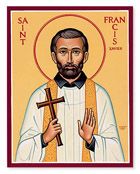
Today, December 3, we celebrate the feast day of Saint Frances Xavier (1506-1552), Jesuit missionary, miracle-worker, and tireless proclaimer of the Word of God. Saint Frances traveled the world at a time when such things were significantly more difficult, always eager to take the Christian faith, and the salvation of Jesus Christ, to those who needed it. One of the seven original men who founded the Jesuits, the legacy of Saint Frances lives on today through the international mission work continued by the Society of Jesus.
Frances was born into nobility, growing up in his family’s castle in Navarre, Spain. He was fortunate to receive tutoring—a privilege of the noble class-- which prepared him to continue his education. At the age of 19, he undertook studies in Paris, at the College of Sainte-Barbe, living as roommates with Blessed Peter Faber.
Frances’ studies were progressing according to plan when everything changed dramatically. When he was just 23, he encountered Saint Ignatius of Loyola, an older student, who demonstrated a prayerful life to Frances. Not before long, Peter Faber had joined Ignatius in his wish to enter the priesthood. Frances, however, resisted, truly aspiring to worldly career. Earning his degree, Frances began teaching philosophy at the College of Dormans-Beauvais in Paris, but continued lived with Faber and Loyola. Eventually, the constant witness of Saint Ignatius softened Frances’ heart, and he accepted his calling. Along with four other friends, the seven young men pronounced vows of poverty, chastity, and mission work in 1534. Their goal, inspired by Ignatius, was to travel to the Holy Land to “convert the infidels.”
That same year, Saint Xavier began studying theology. Two years later, the group traveled to Venice, where they would board a ship to the Holy Land. It took several months to find passage, during which time they volunteered in hospitals. Frances further traveled to Rome, seeking papal permission for their mission, and requesting ordination of those among them not yet priests. Saint Frances, Saint Ignatius and four others were ordained by the papal delegate in his private chapel in 1537.
They waited another year for a ship to the Holy Land, due to war, nothing was sailing. Instead, the group dispersed to colleges, preaching and teaching, and Saint Ignatius traveled to Rome and placed the group at the disposal of the pope.
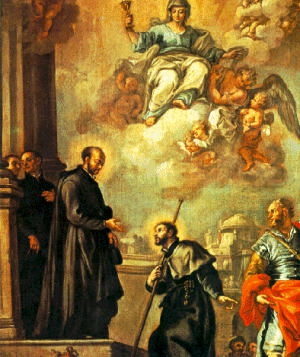
Saint Frances went to Rome in April 1538 and began preaching in the French church of St. Louis. There, he also helped form the new religious order, The Society of Jesus, known as the Jesuits. Before long, he was asked to travel to India by Saint Ignatius. This was a bittersweet assignment: Sweet in that Frances would be bringing the Gospel of Christ to those who hadn’t heard it; bitter in that he would likely never see his closest friend—Saint Ignatius—again. Obediently, and excitedly, he went.
This trip was the start of Saint Frances’ missionary calling. He worked in Lisbon, Portugal, caring for prisoners, while waiting for the ship to take him to India. One year later, on his thirty-fifty birthday, he boarded a ship, with a letter of authority over all clergy in Goa in hand. Thirteen months later, he arrived in India. In the meantime, he had worked in Mozambique, where the crew had waited some time for “favorable winds.”
Saint Frances embraced his new job with vigor, attempting to learn Tamil to speak with the locals, but generally relying on translators. He traveled throughout India and the Spice Islands, converting thousands, preaching, and baptizing upwards of 10,000. Saint Frances paid special attention to children, instructing them early in the ways of the faith, and modeling the perfection of Christian virtues. Wherever he went, he lived with the poorest people, sharing their food and rough accommodations. He spent countless hours ministering to the sick and the poor, particularly to lepers. Very often he had no time to sleep or even to say his breviary but, as we know from his letters, he was filled always with joy.
From a letter from Saint Frances to his superiors in Rome:
“Every Sunday I collected them all, men and women, boys and girls, in the church. They came with great readiness and with a great desire for instruction. Then, in the hearing of all, I began by calling on the name of the most holy Trinity, Father, Son, and Holy Ghost, and I recited aloud the Lord's Prayer, the Hail Mary, and the Creed in the language of the country: they all followed me in the same words, and delighted in it wonderfully. Then I repeated the Creed by myself, dwelling upon each article singly. Then I asked them as to each article, whether they believed it unhesitatingly; and all, with a loud voice and their hands crossed over their breasts, professed aloud that they truly believed it. I take care to make them repeat the Creed oftener than the other prayers; and I tell them that those who believe all that is contained therein are called Christians. After explaining the Creed I go on to the Commandments, teaching them that the Christian law is contained in those ten precepts, and that every one who observes them all faithfully is a good and true Christian and is certain of eternal salvation, and that, on the other hand, whoever neglects a single one of them is a bad Christian, and will be cast into hell unless he is truly penitent for his sin. Converts and heathen alike are astonished at all this, which shows them the holiness of the Christian law, its perfect consistency with itself, and its agreement with reason.
As to the numbers who become Christians, you may understand them from this, that it often happens to me to be hardly able to use my hands from the fatigue of baptizing: often in a single day I have baptized whole villages. Sometimes I have lost my voice and strength altogether with repeating again and again the Credo and the other forms. The fruit that is reaped by the baptism of infants, as well as by the instruction of children and others, is quite incredible. These children, I trust heartily, by the grace of God, will be much better than their fathers. They show an ardent love for the Divine law, and an extraordinary zeal for learning our holy religion and imparting it to others. Their hatred for idolatry is marvelous.”
From India, he traveled to Japan in 1549. Because he could find no ship captain willing to take him, he hired a pirate to take he and his companions. Upon arrival, he was given permission by the local prince to preach Christianity. However, the prince refused to convert, so Saint Frances set his sights on the Emperor. However, he was unable to learn how to find the capital city, so remained in Kagoshima for one year, and then Hirado for one year. In each city, he had little success, converting only 100 people.
Eventually, the small band of Jesuit brothers found a prince willing to take them to the Imperial City to have audience with the emperor. However, they were unsuccessful, learning that the real power lied with the Daimyo of Yamaguchi. A self-important man, they realized that would need to appeal to his sense of pride. To impress him, the brothers dressed in fineries and presented lavish gifts. The daimyo not only provided them with a residence, but decreed that any of his citizens could become Christian. Soon, they had converted over 500.
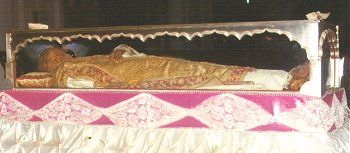
Saint Frances left some Jesuits to continue his work in Japan, and set sail to return to India. However, while sailing, he caught sight of China, and felt called to that country. He sailed for Singapore where he tried to secure passage to China. None would take him, however, and he soon fell ill. After seven days, he fell into a coma, but later awakened to devote himself to prayer. He died on December 3, and was buried. When his body was exhumed, it was found to be incorrupt. His remains were later translated to Goa, where they were interred in the Church of Good Jesus.
The life of Saint Frances Xavier is remarkable. In all, his mission work was amazingly successful, personally baptizing more than 40,000 converts over ten years in India, the East Indies, and Japan. Willing to speak with anyone, he dined with head hunters, washed the sores of lepers, and lived amongst the most poor and needy he could find. He traveled thousands of miles, mostly on his bare feet, and saw the greater part of the Far East before any other missionary. Saint Frances was further reported to have the gift of tongues, which aided him in his travels. Numerous miracles are reported at his intercession, including the raising of the dead, calming of storms, miraculous healing, and the gift of prophecy. The real miracle of his life, as has been said, however, was the miracle of his personality, by which he was able to convert thousands to the faith wherever he went and to win their passionate devotion.
From a letter of Saint Frances Xavier to Saint Ignatius of Loyola:
“We have visited the villages of the new converts who accepted the Christian religion a few years ago. The country is so utterly barren and poor. The native Christians have no priests. They know only that they are Christians. There is nobody to say Mass for them; nobody to teach them the Creed, the Our Father, the Hail Mary and the Commandments of God’s Law.
I have not stopped since the day I arrived. I conscientiously made the rounds of the villages. I bathed in the sacred waters all the children who had not yet been baptized. This means that I have purified a very large number of children so young that, as the saying goes, they could not tell their right hand from their left. The older children would not let me say my Office or eat or sleep until I taught them one prayer or another. Then I began to understand: “The kingdom of heaven belongs to such as these.”
I could not refuse so devout a request without failing in devotion myself. I taught them, first the confession of faith in the Father, the Son, and the Holy Spirit; then the Apostles’ Creed, the Our Father, and Hail Mary. I noticed among them persons of great intelligence. If only someone could educate them in the Christian way of life, I have no doubt that they would make excellent Christians.
Many, many people hereabouts are not becoming Christians for one reason only: there is nobody to make them Christians.
I wish the university students would work as hard at converting these people as they do at their books, and so settle their account with God for their learning and the talents entrusted to them.
This thought would certainly stir most of them to meditate on spiritual realities, to listen actively to what God is saying to them. They would forget their own desires, their human affairs, and give themselves over entirely to God’s will and his choice.
They would cry out with all their heart: “Lord, I am here! What do you want me to do?” Send me anywhere you like - even to India!”
Prayer to Saint Frances Xavier:
O great Saint Francis, well beloved and full of charity, with thee I reverently adore the Divine Majesty; and since I specially rejoice in the singular gifts of grace bestowed on thee in life, and of glory after death, I give thanks to God, and beg of thee, with all the affection of my heart that by thy powerful intercession thou mayest obtain for me above all things the grace to live a holy life and die a holy death. Moreover, I beg of thee to obtain for me (here insert some special spiritual or temporal favor); but if what I ask does not tend to the glory of God and the greater good of my soul, do thou, I beseech thee, obtain for me what will more certainly attain these ends. Amen
God our Father, by the preaching of Francis Xavier You brought many nations to Yourself.
Give his zeal for the faith to all who believe in You,
that Your Church may rejoice in continued growth throughout the world.
Grant this through our Lord Jesus Christ, Your Son, who lives and reigns with You and the Holy Spirit, one God, for ever and ever. Amen.
Year 2: Day 337 of 365
Prayer Intentions: Courageous lives of faith centered on the Lord.
Requested Intentions: Financial security for a mother (M); Health, finances, successful marriage (A); Successful resolution of court case for son (K); Continued sobriety (N); Healing of a chronic health condition (B); Successful employment (A): Peace in a family, recovery of a niece from substance use (L); Blessings on a marriage, healing of a husband (P); For the health and recovery of sisters (B); For a daughter and granddaughter (D); Blessings on overseas employment (M); Healing of mother (L); Successful employment for husband (G); Successful employment, personal fulfillment (C); Health and recovery of ill sister (A); Resolution of legal issues; Grace and protection (E); Successful and meaningful employment (S); Restoration of a marriage (A); Peace and tolerance in a family, support for those with Parkinson’s Disease (M); For the restoration of a daughter’s marriage, end to debt (S); Employment and continued strength (K); Successful examinations for a son (J); Employment and blessings of a child (S); Employment and financial security (F); Successful work placement, continued health (A); Grace and healing for a family (P); Healing of a father (M).
Today, December 3, we celebrate the feast day of Saint Frances Xavier (1506-1552), Jesuit missionary, miracle-worker, and tireless proclaimer of the Word of God. Saint Frances traveled the world at a time when such things were significantly more difficult, always eager to take the Christian faith, and the salvation of Jesus Christ, to those who needed it. One of the seven original men who founded the Jesuits, the legacy of Saint Frances lives on today through the international mission work continued by the Society of Jesus.
Frances was born into nobility, growing up in his family’s castle in Navarre, Spain. He was fortunate to receive tutoring—a privilege of the noble class-- which prepared him to continue his education. At the age of 19, he undertook studies in Paris, at the College of Sainte-Barbe, living as roommates with Blessed Peter Faber.
Frances’ studies were progressing according to plan when everything changed dramatically. When he was just 23, he encountered Saint Ignatius of Loyola, an older student, who demonstrated a prayerful life to Frances. Not before long, Peter Faber had joined Ignatius in his wish to enter the priesthood. Frances, however, resisted, truly aspiring to worldly career. Earning his degree, Frances began teaching philosophy at the College of Dormans-Beauvais in Paris, but continued lived with Faber and Loyola. Eventually, the constant witness of Saint Ignatius softened Frances’ heart, and he accepted his calling. Along with four other friends, the seven young men pronounced vows of poverty, chastity, and mission work in 1534. Their goal, inspired by Ignatius, was to travel to the Holy Land to “convert the infidels.”
That same year, Saint Xavier began studying theology. Two years later, the group traveled to Venice, where they would board a ship to the Holy Land. It took several months to find passage, during which time they volunteered in hospitals. Frances further traveled to Rome, seeking papal permission for their mission, and requesting ordination of those among them not yet priests. Saint Frances, Saint Ignatius and four others were ordained by the papal delegate in his private chapel in 1537.
They waited another year for a ship to the Holy Land, due to war, nothing was sailing. Instead, the group dispersed to colleges, preaching and teaching, and Saint Ignatius traveled to Rome and placed the group at the disposal of the pope.
Saint Frances went to Rome in April 1538 and began preaching in the French church of St. Louis. There, he also helped form the new religious order, The Society of Jesus, known as the Jesuits. Before long, he was asked to travel to India by Saint Ignatius. This was a bittersweet assignment: Sweet in that Frances would be bringing the Gospel of Christ to those who hadn’t heard it; bitter in that he would likely never see his closest friend—Saint Ignatius—again. Obediently, and excitedly, he went.
This trip was the start of Saint Frances’ missionary calling. He worked in Lisbon, Portugal, caring for prisoners, while waiting for the ship to take him to India. One year later, on his thirty-fifty birthday, he boarded a ship, with a letter of authority over all clergy in Goa in hand. Thirteen months later, he arrived in India. In the meantime, he had worked in Mozambique, where the crew had waited some time for “favorable winds.”
Saint Frances embraced his new job with vigor, attempting to learn Tamil to speak with the locals, but generally relying on translators. He traveled throughout India and the Spice Islands, converting thousands, preaching, and baptizing upwards of 10,000. Saint Frances paid special attention to children, instructing them early in the ways of the faith, and modeling the perfection of Christian virtues. Wherever he went, he lived with the poorest people, sharing their food and rough accommodations. He spent countless hours ministering to the sick and the poor, particularly to lepers. Very often he had no time to sleep or even to say his breviary but, as we know from his letters, he was filled always with joy.
From a letter from Saint Frances to his superiors in Rome:
“Every Sunday I collected them all, men and women, boys and girls, in the church. They came with great readiness and with a great desire for instruction. Then, in the hearing of all, I began by calling on the name of the most holy Trinity, Father, Son, and Holy Ghost, and I recited aloud the Lord's Prayer, the Hail Mary, and the Creed in the language of the country: they all followed me in the same words, and delighted in it wonderfully. Then I repeated the Creed by myself, dwelling upon each article singly. Then I asked them as to each article, whether they believed it unhesitatingly; and all, with a loud voice and their hands crossed over their breasts, professed aloud that they truly believed it. I take care to make them repeat the Creed oftener than the other prayers; and I tell them that those who believe all that is contained therein are called Christians. After explaining the Creed I go on to the Commandments, teaching them that the Christian law is contained in those ten precepts, and that every one who observes them all faithfully is a good and true Christian and is certain of eternal salvation, and that, on the other hand, whoever neglects a single one of them is a bad Christian, and will be cast into hell unless he is truly penitent for his sin. Converts and heathen alike are astonished at all this, which shows them the holiness of the Christian law, its perfect consistency with itself, and its agreement with reason.
As to the numbers who become Christians, you may understand them from this, that it often happens to me to be hardly able to use my hands from the fatigue of baptizing: often in a single day I have baptized whole villages. Sometimes I have lost my voice and strength altogether with repeating again and again the Credo and the other forms. The fruit that is reaped by the baptism of infants, as well as by the instruction of children and others, is quite incredible. These children, I trust heartily, by the grace of God, will be much better than their fathers. They show an ardent love for the Divine law, and an extraordinary zeal for learning our holy religion and imparting it to others. Their hatred for idolatry is marvelous.”
From India, he traveled to Japan in 1549. Because he could find no ship captain willing to take him, he hired a pirate to take he and his companions. Upon arrival, he was given permission by the local prince to preach Christianity. However, the prince refused to convert, so Saint Frances set his sights on the Emperor. However, he was unable to learn how to find the capital city, so remained in Kagoshima for one year, and then Hirado for one year. In each city, he had little success, converting only 100 people.
Eventually, the small band of Jesuit brothers found a prince willing to take them to the Imperial City to have audience with the emperor. However, they were unsuccessful, learning that the real power lied with the Daimyo of Yamaguchi. A self-important man, they realized that would need to appeal to his sense of pride. To impress him, the brothers dressed in fineries and presented lavish gifts. The daimyo not only provided them with a residence, but decreed that any of his citizens could become Christian. Soon, they had converted over 500.
Saint Frances left some Jesuits to continue his work in Japan, and set sail to return to India. However, while sailing, he caught sight of China, and felt called to that country. He sailed for Singapore where he tried to secure passage to China. None would take him, however, and he soon fell ill. After seven days, he fell into a coma, but later awakened to devote himself to prayer. He died on December 3, and was buried. When his body was exhumed, it was found to be incorrupt. His remains were later translated to Goa, where they were interred in the Church of Good Jesus.
The life of Saint Frances Xavier is remarkable. In all, his mission work was amazingly successful, personally baptizing more than 40,000 converts over ten years in India, the East Indies, and Japan. Willing to speak with anyone, he dined with head hunters, washed the sores of lepers, and lived amongst the most poor and needy he could find. He traveled thousands of miles, mostly on his bare feet, and saw the greater part of the Far East before any other missionary. Saint Frances was further reported to have the gift of tongues, which aided him in his travels. Numerous miracles are reported at his intercession, including the raising of the dead, calming of storms, miraculous healing, and the gift of prophecy. The real miracle of his life, as has been said, however, was the miracle of his personality, by which he was able to convert thousands to the faith wherever he went and to win their passionate devotion.
From a letter of Saint Frances Xavier to Saint Ignatius of Loyola:
“We have visited the villages of the new converts who accepted the Christian religion a few years ago. The country is so utterly barren and poor. The native Christians have no priests. They know only that they are Christians. There is nobody to say Mass for them; nobody to teach them the Creed, the Our Father, the Hail Mary and the Commandments of God’s Law.
I have not stopped since the day I arrived. I conscientiously made the rounds of the villages. I bathed in the sacred waters all the children who had not yet been baptized. This means that I have purified a very large number of children so young that, as the saying goes, they could not tell their right hand from their left. The older children would not let me say my Office or eat or sleep until I taught them one prayer or another. Then I began to understand: “The kingdom of heaven belongs to such as these.”
I could not refuse so devout a request without failing in devotion myself. I taught them, first the confession of faith in the Father, the Son, and the Holy Spirit; then the Apostles’ Creed, the Our Father, and Hail Mary. I noticed among them persons of great intelligence. If only someone could educate them in the Christian way of life, I have no doubt that they would make excellent Christians.
Many, many people hereabouts are not becoming Christians for one reason only: there is nobody to make them Christians.
I wish the university students would work as hard at converting these people as they do at their books, and so settle their account with God for their learning and the talents entrusted to them.
This thought would certainly stir most of them to meditate on spiritual realities, to listen actively to what God is saying to them. They would forget their own desires, their human affairs, and give themselves over entirely to God’s will and his choice.
They would cry out with all their heart: “Lord, I am here! What do you want me to do?” Send me anywhere you like - even to India!”
Prayer to Saint Frances Xavier:
O great Saint Francis, well beloved and full of charity, with thee I reverently adore the Divine Majesty; and since I specially rejoice in the singular gifts of grace bestowed on thee in life, and of glory after death, I give thanks to God, and beg of thee, with all the affection of my heart that by thy powerful intercession thou mayest obtain for me above all things the grace to live a holy life and die a holy death. Moreover, I beg of thee to obtain for me (here insert some special spiritual or temporal favor); but if what I ask does not tend to the glory of God and the greater good of my soul, do thou, I beseech thee, obtain for me what will more certainly attain these ends. Amen
God our Father, by the preaching of Francis Xavier You brought many nations to Yourself.
Give his zeal for the faith to all who believe in You,
that Your Church may rejoice in continued growth throughout the world.
Grant this through our Lord Jesus Christ, Your Son, who lives and reigns with You and the Holy Spirit, one God, for ever and ever. Amen.
Year 2: Day 337 of 365
Prayer Intentions: Courageous lives of faith centered on the Lord.
Requested Intentions: Financial security for a mother (M); Health, finances, successful marriage (A); Successful resolution of court case for son (K); Continued sobriety (N); Healing of a chronic health condition (B); Successful employment (A): Peace in a family, recovery of a niece from substance use (L); Blessings on a marriage, healing of a husband (P); For the health and recovery of sisters (B); For a daughter and granddaughter (D); Blessings on overseas employment (M); Healing of mother (L); Successful employment for husband (G); Successful employment, personal fulfillment (C); Health and recovery of ill sister (A); Resolution of legal issues; Grace and protection (E); Successful and meaningful employment (S); Restoration of a marriage (A); Peace and tolerance in a family, support for those with Parkinson’s Disease (M); For the restoration of a daughter’s marriage, end to debt (S); Employment and continued strength (K); Successful examinations for a son (J); Employment and blessings of a child (S); Employment and financial security (F); Successful work placement, continued health (A); Grace and healing for a family (P); Healing of a father (M).
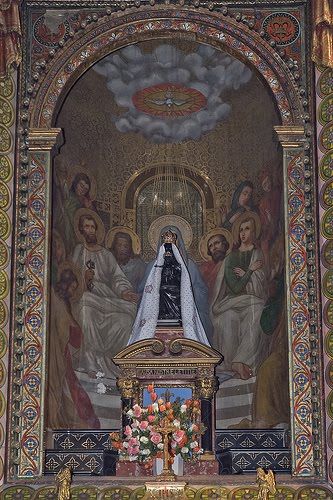
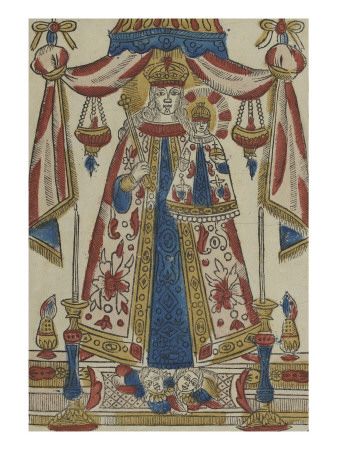
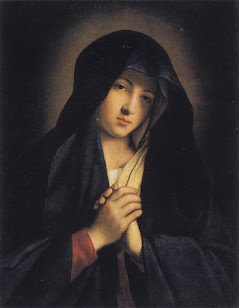
Today, December 2, we also celebrate the Marian feast day of Our Lady of Liesse, also known as “Our Lady, Cause of Our Joy.” This devotion to Our Blessed Mother originated in Egypt, and was carried to France. We recognize our loving Mother, Mary, as the Cause of Our Joy, for her role in the Incarnation of Jesus, and the grace she mediates from Heaven. Our Lady of Liesse, Pray for us!
Devotion to Our Lady of Liesse is based upon the story of three knights who brought back from Egypt a beautiful statue of Our Lady. As the story is told, in 1134, three brothers, knights from the French region of Laon, left on a voyage to the East. They were captured in Egypt, and held prisoner by the sultan. The sultan wished to force the young pious knights to renounce their faith, but they remained steadfast. Trying at all costs to make them apostatize, he sent his remarkably beautiful daughter to seduce them. Her name was Ismenia, and she engaged them in a conversation about the Gospel, certain that she would draw their attention away from the Lord and into licentious behavior.
The knights, however, in describing the beauty and grace of Our Blessed Mother, changed Ismenia’s heart. She requested that they carve an image of Mary for her. The knights agreed, praying to the Blessed Virgin to guide their hands, so that they might produce an image worthy of her grace and beauty.
But they did not have to carve anything. While they slept that evening, the Mother of God dispatched angels, bearing her radiant image, to the knights. When they awoke, they were amazed, and when Ismenia returned to the dungeons, she found them filled with a dazzling light and heavenly perfume emanating from the statue. She was instantly converted, and took the statue with her to her chambers. The knights praised the Lord, and His Mother, crying out “Our Lady of Liesse!”
The following evening, Ismenia heard the statue say: "Trust me, Ismenia! I have prayed to my Son for you. You will be his faithful servant. You will free my three beloved knights. You will be baptized and through you, France will be enriched by countless graces. Through you my name will become famous and later, I will receive you forever in paradise."
Doing as she was told, Ismenia assisted the three brothers in their escape, and fled back to France with them. On their journey, all four were overtaken by a deep sleep, and during that sleep, heavenly angels transported them to France. When they awoke, the three knights were in their country, near their castle in Marchais. Ismenia was baptized and they had a chapel built at the site where they had awoken, in honor of Our Lady of Liesse.
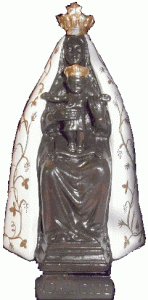
Since that time, countless miracles have been reported at the site, King Louis VII visited in pilgrimage in 1146, and since that time, Our Lady of Liesse has become a favorite pilgrimage destination of the faithful of Europe. Sadly, the original statue was destroyed during the French Revolution, but the medieval basilica at Liesse remains a center of devotion to the Mother of God. A new statue, created in the likeness of the original, was installed and crowned there in 1857.
O God, who brought joy to the world by the Incarnation of Christ your Son, grant to us, who honor his Mother as Cause of our Joy, the grace to follow your commandments and to set our hearts on the true joys of heaven. We ask this through our Lord Jesus Christ your Son, who lives and reigns with you and the Holy Spirit, one God for ever and ever. Amen.
Year 2: Day 336 of 365
Prayer Intentions: The blessings of the Lord, mediated through Our Blessed Mother.
Requested Intentions: Financial security for a mother (M); Health, finances, successful marriage (A); Successful resolution of court case for son (K); Continued sobriety (N); Healing of a chronic health condition (B); Successful employment (A): Peace in a family, recovery of a niece from substance use (L); Blessings on a marriage, healing of a husband (P); For the health and recovery of sisters (B); For a daughter and granddaughter (D); Blessings on overseas employment (M); Healing of mother (L); Successful employment for husband (G); Successful employment, personal fulfillment (C); Health and recovery of ill sister (A); Resolution of legal issues; Grace and protection (E); Successful and meaningful employment (S); Restoration of a marriage (A); Peace and tolerance in a family, support for those with Parkinson’s Disease (M); For the restoration of a daughter’s marriage, end to debt (S); Employment and continued strength (K); Successful examinations for a son (J); Employment and blessings of a child (S); Employment and financial security (F); Successful work placement, continued health (A); Grace and healing for a family (P); Healing of a father (M).
Devotion to Our Lady of Liesse is based upon the story of three knights who brought back from Egypt a beautiful statue of Our Lady. As the story is told, in 1134, three brothers, knights from the French region of Laon, left on a voyage to the East. They were captured in Egypt, and held prisoner by the sultan. The sultan wished to force the young pious knights to renounce their faith, but they remained steadfast. Trying at all costs to make them apostatize, he sent his remarkably beautiful daughter to seduce them. Her name was Ismenia, and she engaged them in a conversation about the Gospel, certain that she would draw their attention away from the Lord and into licentious behavior.
The knights, however, in describing the beauty and grace of Our Blessed Mother, changed Ismenia’s heart. She requested that they carve an image of Mary for her. The knights agreed, praying to the Blessed Virgin to guide their hands, so that they might produce an image worthy of her grace and beauty.
But they did not have to carve anything. While they slept that evening, the Mother of God dispatched angels, bearing her radiant image, to the knights. When they awoke, they were amazed, and when Ismenia returned to the dungeons, she found them filled with a dazzling light and heavenly perfume emanating from the statue. She was instantly converted, and took the statue with her to her chambers. The knights praised the Lord, and His Mother, crying out “Our Lady of Liesse!”
The following evening, Ismenia heard the statue say: "Trust me, Ismenia! I have prayed to my Son for you. You will be his faithful servant. You will free my three beloved knights. You will be baptized and through you, France will be enriched by countless graces. Through you my name will become famous and later, I will receive you forever in paradise."
Doing as she was told, Ismenia assisted the three brothers in their escape, and fled back to France with them. On their journey, all four were overtaken by a deep sleep, and during that sleep, heavenly angels transported them to France. When they awoke, the three knights were in their country, near their castle in Marchais. Ismenia was baptized and they had a chapel built at the site where they had awoken, in honor of Our Lady of Liesse.
Since that time, countless miracles have been reported at the site, King Louis VII visited in pilgrimage in 1146, and since that time, Our Lady of Liesse has become a favorite pilgrimage destination of the faithful of Europe. Sadly, the original statue was destroyed during the French Revolution, but the medieval basilica at Liesse remains a center of devotion to the Mother of God. A new statue, created in the likeness of the original, was installed and crowned there in 1857.
O God, who brought joy to the world by the Incarnation of Christ your Son, grant to us, who honor his Mother as Cause of our Joy, the grace to follow your commandments and to set our hearts on the true joys of heaven. We ask this through our Lord Jesus Christ your Son, who lives and reigns with you and the Holy Spirit, one God for ever and ever. Amen.
Year 2: Day 336 of 365
Prayer Intentions: The blessings of the Lord, mediated through Our Blessed Mother.
Requested Intentions: Financial security for a mother (M); Health, finances, successful marriage (A); Successful resolution of court case for son (K); Continued sobriety (N); Healing of a chronic health condition (B); Successful employment (A): Peace in a family, recovery of a niece from substance use (L); Blessings on a marriage, healing of a husband (P); For the health and recovery of sisters (B); For a daughter and granddaughter (D); Blessings on overseas employment (M); Healing of mother (L); Successful employment for husband (G); Successful employment, personal fulfillment (C); Health and recovery of ill sister (A); Resolution of legal issues; Grace and protection (E); Successful and meaningful employment (S); Restoration of a marriage (A); Peace and tolerance in a family, support for those with Parkinson’s Disease (M); For the restoration of a daughter’s marriage, end to debt (S); Employment and continued strength (K); Successful examinations for a son (J); Employment and blessings of a child (S); Employment and financial security (F); Successful work placement, continued health (A); Grace and healing for a family (P); Healing of a father (M).
“As to the treasons which have been laid to my charge, and for which I come here to suffer, I desire you all to bear witness with me that I am thereto altogether innocent. I am a Catholic man and a priest; in that Faith I have lived, and in that Faith do I intend to die. If you esteem my Religion treason, then I am guilty; as for the other treason, I never committed any, God is my judge.”
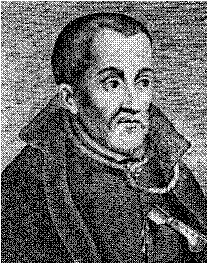
Today, December 1st, we celebrate the feast day of Saint Edmund Campion (1540-1581), Jesuit priest and English martyr. Saint Edmund sacrificed all he had—including his life—to enter the Catholic priesthood and minister to those greatly in need during the time of English persecution of the Church. Declining an offer to serve Queen Elizabeth, as well as an appointment at Oxford University, Saint Edmund demonstrates to us that the call of God comes first, takes precedence over the riches and glories of our earthly lives.
Edmund was born in London to a family of merchants. Academically gifted, he drew recognition early on for his intellect, and received a grant to finance his education at Saint John’s College in Oxford. Eventually, upon completing his degree, Edmund became a renowned lecturer in Rhetoric, drawing crowds whenever he spoke. One admirer was Queen Elizabeth, who had the opportunity to hear him speak while visiting the University. Impressed by his lecture on the natural sciences (which he delivered in Latin), she offered him Royal patronage and pressed him to enter into her service. However, he declined, and later was determined to have been ineligible for such a post, due to his belief in “old religion.”
Rather than face persecution at home, the college offered him a traveling scholarship, and sent him to Dublin, where he taught and wrote his first book, “The History of Ireland.” He returned briefly to England, but was quickly transferred to the English College in Douai, Belgium, as links to Catholicism were being considered treason in England at that time. From Belgium, at the age of 33, Edmund walked to Rome, where he was accepted into the Society of Jesus, the Jesuits, as a novice. For six years he studied for the priesthood, and was ordained in Prague at the age of 39.
Saint Edmund spent the next several years traveling throughout Europe, coming to be known for his eloquence in both preaching and writing. His desire, however, was to return to England to serve those Catholics who were practicing the faith in secret. Receiving approval, he prepared to return to London. On the night prior to his departure, a brother wrote this prophetic inscription above his door: “P. Edmundus Campianus Martyr.”
Edmund returned to England in disguise, dressed as a diamond merchant. Port authorities were suspicious, but Saint Edmund answered their questions adequately and they let him enter. In London, he began visiting Catholics imprisoned or in hiding, preaching, celebrating secret Masses, and delivering the Sacraments. His eloquence ensured that soon it was known that ‘Campion the Jesuit’ was at large in the shires. He also penned what is known today as “Campion’s Brag,” which details the goal of the mission to England in religious, not political, terms. Saint Edmund further employed Saint Nicholas Owen to build a hiding place within his home, and instructed him in the Jesuit tradition.
As he continued his work, fines were increased, and informants were paid large sums of money to report and identify those associated with the Church. The crime of practicing Catholicism was raised to “high treason.” However, Saint Edmund was full of the courage of the Lord, and continued traveling throughout Nottinghamshire, Derbyshire, Yorkshire and Lancashire preaching more openly and to larger audiences. He further wrote his most famous book, “Ten Reasons,” which detailed arguments to prove the truth of Catholicism and the falsity of Protestantism. Once it was printed, copies were left on the benches of Oxford's University Church of Saint Mary. Saint Edmund was remembered, and the books were eagerly read. However, the bounty on his head was also increased, given his brash preaching.
Eventually, Saint Edmund was turned into the police by a government informant. He was discovered hiding in a priesthole (probably built by Saint Nicholas Owen) in a family home in Berkshire. He was led by cart to London, accompanied by sympathetic crowds who jeered his captors. Saint Edmund remained cheerful, preaching, and encouraging the crowd in their faith. He was imprisoned in the Tower of London, where he was initially well-treated, hoping that he would recant his faith and embrace the Anglican Church.
Of course, recognizing the Catholic Church as the one, true faith, Saint Edmund refused all offers—including those that would give him wealth and power—and was subsequently tortured on the rack. Unwilling to name accomplices or identify other practicing priests, he was tortured mercilessly for two weeks. The English government spread rumors that he had betrayed those he refused to name, but even this did not sway public opinion. He underwent public trial in Westminster along with several other imprisoned priests. At his trial six, Saint Edmund was ordered to raise his right hand and take an oath, but was unable to do so due to injuries sustained in his torture. After one of the other priests raised it for him, Saint Edmund attempted to defend all the priests by pointing out their motives were religious, not political (similar to what he had written in “Campion’s Brag”). However, in the end, they were all found guilty of high treason and condemned to be hanged, drawn and quartered. Upon hearing the verdict, the priests sang the Te Deum.
On December first, Saint Edmund was dragged through the rainy and muddy roads of London to Tyburn, where a large crowd had gathered. He refused the prayers of an Anglican priest, appointed to pray over those who were sentenced to death, preferring to pray (in Latin) by himself. After forgiving those who had convicted and betrayed him, Saint Edmund was martyred.
From his biography, written by Evelyn Waugh:
“Campion stood in prayer. The lords of the Council still shouted up questions to him about the Bull of Excommunication [Pope Pius V's excommunication of Queen Elizabeth I], but now Campion would not answer and stood with his head bowed and his hands folded on his breast. An Anglican clergyman attempted to direct his prayers, but he answered gently, "Sir, you and I are not one in religion, wherefore I pray you content yourself. I bar none of prayer; but I only desire them that are of the household of faith to pray with me, and in mine agony to say one creed."
They called to him to pray in English, but he replied with great mildness that ‘he would pray to God in a language which they both well understood.’”
Saint Edmund Campion’s life was one of choices. He chose to give up the promises of wealth, power, and fame to enter a life of service to the Lord. He chose to return to England, in danger of his life, to preach the one, true faith. He chose to remain loyal to his friends and brothers in Christ, and to the faith, under penalty of death. Contemplating the life of this holy and courageous man, we are reminded of the choices that we make, in our every day lives. How often do we take the easy way out? What choices have we made that place our own wants and desires before those of the Lord?
Saint Edmund Campion, martyr for the Roman Primacy, obtain for us, but especially for the Church's bishops and priests, such obedient loyalty to the Vicar of Christ that like you, they will not be afraid to proclaim the truth and like you, they will be willing to shed their blood for Jesus Christ. Amen.
Year 2: Day 335 of 365
Prayer Intentions: Courageous lives of faith centered on the Lord.
Requested Intentions: Financial security for a mother (M); Health, finances, successful marriage (A); Successful resolution of court case for son (K); Continued sobriety (N); Healing of a chronic health condition (B); Successful employment (A): Peace in a family, recovery of a niece from substance use (L); Blessings on a marriage, healing of a husband (P); For the health and recovery of sisters (B); For a daughter and granddaughter (D); Blessings on overseas employment (M); Healing of mother (L); Successful employment for husband (G); Successful employment, personal fulfillment (C); Health and recovery of ill sister (A); Resolution of legal issues; Grace and protection (E); Successful and meaningful employment (S); Restoration of a marriage (A); Peace and tolerance in a family, support for those with Parkinson’s Disease (M); For the restoration of a daughter’s marriage, end to debt (S); Employment and continued strength (K); Successful examinations for a son (J); Employment and blessings of a child (S); Employment and financial security (F); Successful work placement, continued health (A); Grace and healing for a family (P); Healing of a father (M).
Today, December 1st, we celebrate the feast day of Saint Edmund Campion (1540-1581), Jesuit priest and English martyr. Saint Edmund sacrificed all he had—including his life—to enter the Catholic priesthood and minister to those greatly in need during the time of English persecution of the Church. Declining an offer to serve Queen Elizabeth, as well as an appointment at Oxford University, Saint Edmund demonstrates to us that the call of God comes first, takes precedence over the riches and glories of our earthly lives.
Edmund was born in London to a family of merchants. Academically gifted, he drew recognition early on for his intellect, and received a grant to finance his education at Saint John’s College in Oxford. Eventually, upon completing his degree, Edmund became a renowned lecturer in Rhetoric, drawing crowds whenever he spoke. One admirer was Queen Elizabeth, who had the opportunity to hear him speak while visiting the University. Impressed by his lecture on the natural sciences (which he delivered in Latin), she offered him Royal patronage and pressed him to enter into her service. However, he declined, and later was determined to have been ineligible for such a post, due to his belief in “old religion.”
Rather than face persecution at home, the college offered him a traveling scholarship, and sent him to Dublin, where he taught and wrote his first book, “The History of Ireland.” He returned briefly to England, but was quickly transferred to the English College in Douai, Belgium, as links to Catholicism were being considered treason in England at that time. From Belgium, at the age of 33, Edmund walked to Rome, where he was accepted into the Society of Jesus, the Jesuits, as a novice. For six years he studied for the priesthood, and was ordained in Prague at the age of 39.
Saint Edmund spent the next several years traveling throughout Europe, coming to be known for his eloquence in both preaching and writing. His desire, however, was to return to England to serve those Catholics who were practicing the faith in secret. Receiving approval, he prepared to return to London. On the night prior to his departure, a brother wrote this prophetic inscription above his door: “P. Edmundus Campianus Martyr.”
Edmund returned to England in disguise, dressed as a diamond merchant. Port authorities were suspicious, but Saint Edmund answered their questions adequately and they let him enter. In London, he began visiting Catholics imprisoned or in hiding, preaching, celebrating secret Masses, and delivering the Sacraments. His eloquence ensured that soon it was known that ‘Campion the Jesuit’ was at large in the shires. He also penned what is known today as “Campion’s Brag,” which details the goal of the mission to England in religious, not political, terms. Saint Edmund further employed Saint Nicholas Owen to build a hiding place within his home, and instructed him in the Jesuit tradition.
As he continued his work, fines were increased, and informants were paid large sums of money to report and identify those associated with the Church. The crime of practicing Catholicism was raised to “high treason.” However, Saint Edmund was full of the courage of the Lord, and continued traveling throughout Nottinghamshire, Derbyshire, Yorkshire and Lancashire preaching more openly and to larger audiences. He further wrote his most famous book, “Ten Reasons,” which detailed arguments to prove the truth of Catholicism and the falsity of Protestantism. Once it was printed, copies were left on the benches of Oxford's University Church of Saint Mary. Saint Edmund was remembered, and the books were eagerly read. However, the bounty on his head was also increased, given his brash preaching.
Eventually, Saint Edmund was turned into the police by a government informant. He was discovered hiding in a priesthole (probably built by Saint Nicholas Owen) in a family home in Berkshire. He was led by cart to London, accompanied by sympathetic crowds who jeered his captors. Saint Edmund remained cheerful, preaching, and encouraging the crowd in their faith. He was imprisoned in the Tower of London, where he was initially well-treated, hoping that he would recant his faith and embrace the Anglican Church.
Of course, recognizing the Catholic Church as the one, true faith, Saint Edmund refused all offers—including those that would give him wealth and power—and was subsequently tortured on the rack. Unwilling to name accomplices or identify other practicing priests, he was tortured mercilessly for two weeks. The English government spread rumors that he had betrayed those he refused to name, but even this did not sway public opinion. He underwent public trial in Westminster along with several other imprisoned priests. At his trial six, Saint Edmund was ordered to raise his right hand and take an oath, but was unable to do so due to injuries sustained in his torture. After one of the other priests raised it for him, Saint Edmund attempted to defend all the priests by pointing out their motives were religious, not political (similar to what he had written in “Campion’s Brag”). However, in the end, they were all found guilty of high treason and condemned to be hanged, drawn and quartered. Upon hearing the verdict, the priests sang the Te Deum.
On December first, Saint Edmund was dragged through the rainy and muddy roads of London to Tyburn, where a large crowd had gathered. He refused the prayers of an Anglican priest, appointed to pray over those who were sentenced to death, preferring to pray (in Latin) by himself. After forgiving those who had convicted and betrayed him, Saint Edmund was martyred.
From his biography, written by Evelyn Waugh:
“Campion stood in prayer. The lords of the Council still shouted up questions to him about the Bull of Excommunication [Pope Pius V's excommunication of Queen Elizabeth I], but now Campion would not answer and stood with his head bowed and his hands folded on his breast. An Anglican clergyman attempted to direct his prayers, but he answered gently, "Sir, you and I are not one in religion, wherefore I pray you content yourself. I bar none of prayer; but I only desire them that are of the household of faith to pray with me, and in mine agony to say one creed."
They called to him to pray in English, but he replied with great mildness that ‘he would pray to God in a language which they both well understood.’”
Saint Edmund Campion’s life was one of choices. He chose to give up the promises of wealth, power, and fame to enter a life of service to the Lord. He chose to return to England, in danger of his life, to preach the one, true faith. He chose to remain loyal to his friends and brothers in Christ, and to the faith, under penalty of death. Contemplating the life of this holy and courageous man, we are reminded of the choices that we make, in our every day lives. How often do we take the easy way out? What choices have we made that place our own wants and desires before those of the Lord?
Saint Edmund Campion, martyr for the Roman Primacy, obtain for us, but especially for the Church's bishops and priests, such obedient loyalty to the Vicar of Christ that like you, they will not be afraid to proclaim the truth and like you, they will be willing to shed their blood for Jesus Christ. Amen.
Year 2: Day 335 of 365
Prayer Intentions: Courageous lives of faith centered on the Lord.
Requested Intentions: Financial security for a mother (M); Health, finances, successful marriage (A); Successful resolution of court case for son (K); Continued sobriety (N); Healing of a chronic health condition (B); Successful employment (A): Peace in a family, recovery of a niece from substance use (L); Blessings on a marriage, healing of a husband (P); For the health and recovery of sisters (B); For a daughter and granddaughter (D); Blessings on overseas employment (M); Healing of mother (L); Successful employment for husband (G); Successful employment, personal fulfillment (C); Health and recovery of ill sister (A); Resolution of legal issues; Grace and protection (E); Successful and meaningful employment (S); Restoration of a marriage (A); Peace and tolerance in a family, support for those with Parkinson’s Disease (M); For the restoration of a daughter’s marriage, end to debt (S); Employment and continued strength (K); Successful examinations for a son (J); Employment and blessings of a child (S); Employment and financial security (F); Successful work placement, continued health (A); Grace and healing for a family (P); Healing of a father (M).
Subscribe to:
Comments (Atom)