Why pray the Rosary every day for a year?


Each time the Blessed Virgin has appeared-- whether it be to Saint Bernadette Soubirous at Lourdes; to Lucia, Jacinta, and Francisco at Fatima; or to Mariette Beco at Banneux-- she has asserted the importance, saving grace, and power of praying the Holy Rosary on a daily basis. Based upon her words, the Rosary is penance and conversion for sinners, a pathway to peace, an end to war, and a powerful act of faith in Jesus Christ. Pope Paul VI presented the Rosary as a powerful means to reach Christ "not merely with Mary but indeed, insofar as this is possible to us, in the same way as Mary, who is certainly the one who thought about Him more than anyone else has ever done."

To show us how this is done, perhaps no one has been more eloquent than the great Cardinal Newman, who wrote: "The great power of the Rosary consists in the fact that it translates the Creed into Prayer. Of course, the Creed is already in a certain sense a prayer and a great act of homage towards God, but the Rosary brings us to meditate again on the great truth of His life and death, and brings this truth close to our hearts. Even Christians, although they know God, usually fear rather than love Him. The strength of the Rosary lies in the particular manner in which it considers these mysteries, since all our thinking about Christ is intertwined with the thought of His Mother, in the relations between Mother and Son; the Holy Family is presented to us, the home in which God lived His infinite love."


As Mary said at Fatima, "Jesus wants to use you to make Me known and loved. He wishes to establish the devotion to My Immaculate Heart throughout the world. I promise salvation to whoever embraces it; these souls will be dear to God, like flowers put by Me to adorn his throne."


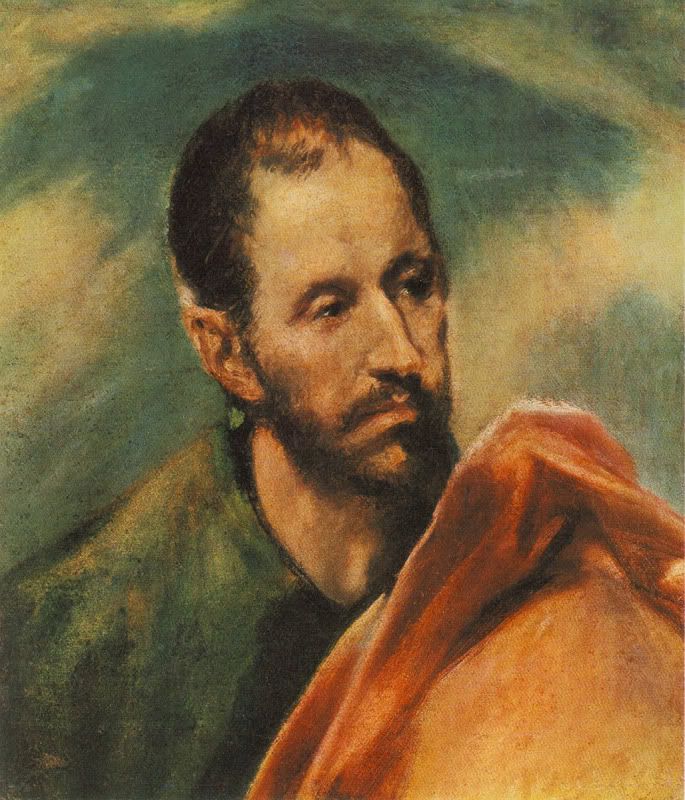
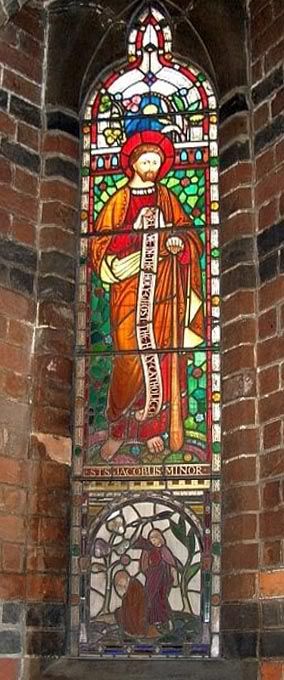
May 3, 2013: Saint James the Less

Posted by Jacob

May 3 marks the feast day of Saint James the Less (died 62 AD), the ninth of the twelve disciples of Jesus, and author of the Biblical epistle to the twelve “tribes scattered among the nations.” While some confusion remains regarding the identity of Saint James, Biblical scholars agree that his place among the twelve disciples—the first pillars of the Church—was due to his holiness. For this reason, he is sometimes referred to as “James the Just.” The official designation of James the Less (or Lesser) likely stems from his being called to ministry later in life than the other disciples, being of short stature, or from youth. It is a useful distinguishing title from James the Greater, son of Zebedee, another of the twelve. James is remembered for his deep faith—upon the death of Jesus, James stated that he would fast until the Lord returned. Following the resurrection, Jesus appeared personally to James, preparing a meal for him to eat.


Saint James the Lesser was called to discipleship in the second year of the ministry of Jesus. Upon the Ascension of the Lord, James was appointed Bishop of Jerusalem. During this time of great danger to the Church, Saint James’ virtues kept the persecution and anger of the citizens of Jerusalem at bay. Despite his faith, he came to be respected by them. Saint Jerome gave the following account concerning his sanctity: "He was always a virgin, and was a Nazarite, or one consecrated to God. In consequence of which he was never shaved, never cut his hair, never drank any wine or other strong liquor; moreover, he never used any bath, or oil to anoint his limbs, and never ate of any living creature except when of precept, as the paschal lamb: he never wore sandals, never used any other clothes than one single linen garment. He prostrated so much in prayer, that the skin of his knees and forehead was hardened like to camels' hoofs." Working under the direction of Saint Peter, the first pope, Saint James the Lesser toiled tirelessly within the community of Jerusalem, addressing the laws of Moses, and converting thousands of Jews to Christianity.

Saint James the Lesser penned the epistle to the universal Church—to those converted Jews throughout scattered throughout the known world at that time. In his epistle, James provides guidance and instruction in the holy life, restates the importance of the sacraments, and the necessity of both faith and good works.

2Consider it pure joy, my brothers, whenever you face trials of many kinds, 3because you know that the testing of your faith develops perseverance. 4Perseverance must finish its work so that you may be mature and complete, not lacking anything. 5If any of you lacks wisdom, he should ask God, who gives generously to all without finding fault, and it will be given to him. 6But when he asks, he must believe and not doubt, because he who doubts is like a wave of the sea, blown and tossed by the wind. 7That man should not think he will receive anything from the Lord; 8he is a double-minded man, unstable in all he does.


9The brother in humble circumstances ought to take pride in his high position. 10But the one who is rich should take pride in his low position, because he will pass away like a wild flower. 11For the sun rises with scorching heat and withers the plant; its blossom falls and its beauty is destroyed. In the same way, the rich man will fade away even while he goes about his business.


12Blessed is the man who perseveres under trial, because when he has stood the test, he will receive the crown of life that God has promised to those who love him.


13When tempted, no one should say, "God is tempting me." For God cannot be tempted by evil, nor does he tempt anyone; 14but each one is tempted when, by his own evil desire, he is dragged away and enticed. 15Then, after desire has conceived, it gives birth to sin; and sin, when it is full-grown, gives birth to death.

16Don't be deceived, my dear brothers. 17Every good and perfect gift is from above, coming down from the Father of the heavenly lights, who does not change like shifting shadows. 18He chose to give us birth through the word of truth, that we might be a kind of first fruits of all he created. (James 1: 2-18)

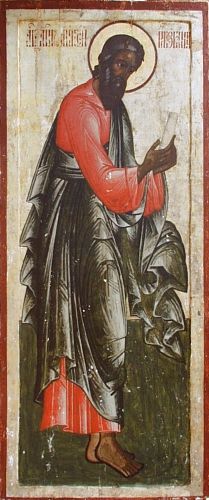
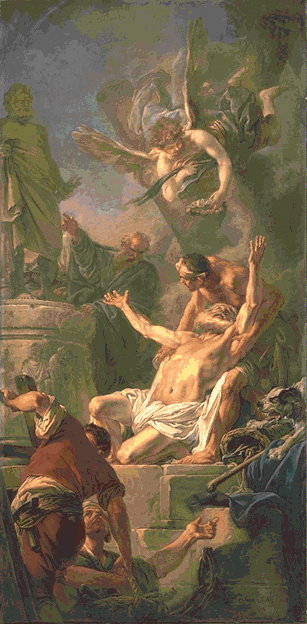
Out of fear and political retribution, Saint James was summoned before the Sanhedrim at some point following his writing of the epistle. During this hearing, he was accused of violating the law, and sentenced to death by stoning. Biblical scholars suggest that this sentencing had less to do with law violation (as Saint James had committed no crime) and more to do with the frustration of the Jews at the time in not being able to punish Saint Paul, who had escaped persecution by appealing directly to Caesar. Saint James was carried to the top of the battlements of Jerusalem, where he was ordered to renounce his faith. Rather, he preached to the great crowd assembled, declaring that Jesus, the Son of man, was seated at the right hand of the Sovereign Majesty, and would come in the clouds of heaven to judge the world. Enraged, the scribes through him from the battlements to the ground below. There he managed to pull himself into a kneeling position, praying to the Lord, and forgiving his attackers before the crowd stoned and clubbed him to death for his faith. The Breviary contains a description of his death: "When he was ninety-six years old and had governed the Church for thirty years in a most holy manner, the Jews sought to stone him, then took him to the pinnacle of the temple and cast him off headlong. As he lay there half dead, with legs broken by the fall, he lifted his hands toward heaven and prayed to God for the salvation of his enemies, saying: Lord, forgive them for they know not what they do! While the apostle was still praying, a fuller struck his head a mortal blow."

The relics of Saint James now rest next to those of St. Philip in the church of the Holy Apostles in Rome, and their names are mentioned in the first list in the Canon of the Mass. Pope Benedict XVI's addressed the life of Saint James the Less in his General Audience on Wednesday, June 28, 2006:

In our weekly catechesis on the Church’s apostolic ministry, we now turn to the Apostle James the Less. In the Gospels, James is called the son of Alphaeus. He is often identified with another James, known as "James the younger" (cf. Mk 15:40), or "James, the brother of the Lord" (cf. Mt 13:55; Gal 1:19). The Gospels themselves do not relate anything about either James during our Lord’s earthly ministry. The Acts of the Apostles, however, present a "James" whom Saint Paul names with Peter as a "column" of the Church in Jerusalem (Gal 2:9). At the Council of Jerusalem (cf. Acts 15), it was James who proposed that the Gentiles converted to Christ not be forced to follow all the precepts of the Mosaic Law. Together with Peter, he thus enabled Gentile Christians to maintain their identity, while respecting the perennially valid relationship between Christianity and its Jewish origins. James also gave his name to the New Testament Letter of James, which continues to speak to us today, stressing the need for a living faith expressed in good works (2:26), and serene abandonment to the will of God (4:15).


O Almighty God, whom truly to know is everlasting life: Grant us perfectly to know thy Son Jesus Christ to be the way, the truth, and the life; that, following the steps of thy holy Apostle, Saint James, we may steadfastly walk in the way that leadeth to eternal life; through the same thy Son Jesus Christ our Lord. Amen.


December 27: Saint John the Evangelist, "Beloved Disciple," Disciple of Charity

Posted by Jacob

Saint John, Saint John was Christ's disciple,

and Evangelist also;
He for the sake of Jesus Christ
Much pains did undergo,
Because he loved our Saviour Christ,
As Holy Scriptures say,
And was belov'd of him also,
And in his bosom lay.


Saint John for love of our Saviour
Did undergo much pain
And never ceased during life
To preach Christ Jesus' name.


Saint John, he at Jerusalem
Did preach God's holy word,
And for the same the spiteful pagans
They did him cruel scourge.
Then did he for the same rejoice,
That he was counted worthy
To suffer for the sake of Christ,
And would him not deny.


To Patmos banish'd was Saint John,
As Scripture doth record,
For the testimony of Christ,
And his most holy word.
And as he was in the Spirit
On the Lord's blessed day,


Our Saviour by an Angel spake,
and unto him did say,
I am Alpha and Omega,
Which was and is to come;
And what thou seest write in a book
Thus said he to Saint John
And send it to the Churches then,
Which are in Asia seven.
And said the Angel to Saint John,
Which came to him from Heaven.


Then John turn'd him about to see,
And was astonished
At the sight of the Angel bright,
Who said, Be comforted,
For I was alive, and also dead,
Now I live for evermore,
And have the keys of death and hell;
Take comfort now therefore.


Then wretched Caesar, as 'tis said,
The Emperor Domitian,
Into a tub of boiling oil
At Rome he thrust Saint John.
Therein received he no harm,
But safely from thence came,
And died at last at Ephesus
Writing declares the same.


Saint John for love of our Saviour

Did undergo much pain
And never ceased during life
To preach Christ Jesus' name.

"We have come to know and to believe in the love God has for us. God is love, and whoever remains in love remains in God and God in him." (1 John 4:16)

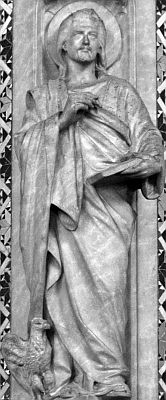
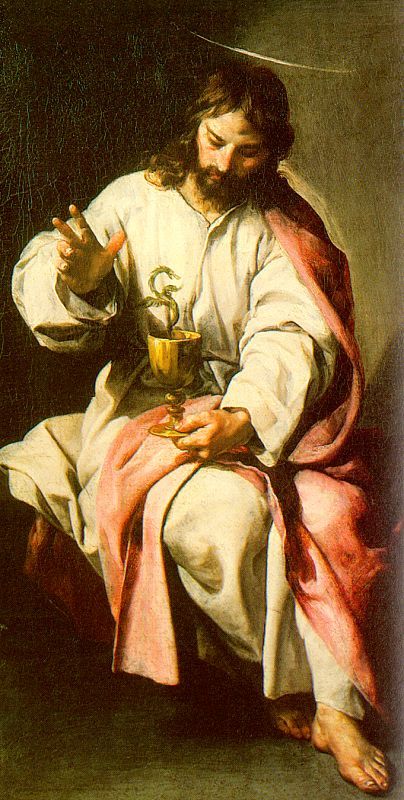
Today, December 27, we the feast day of Saint John the Evangelist (died 101), the Beloved Disciple of Jesus, also known as the Disciple of Charity. Saint John preached a message of love and service to one another, a lesson he learned directly from Jesus. He persistently emphasized his followers, and still today, us, to “love one another.” It is the basis of the Christian faith: The way we came to know love was that he laid down his life for us; so we ought to lay down our lives for our brothers.” (1 John 3:16)

John, the son of Zebedee and Salome, and the brother of Saint James the Greater, was called to follow Jesus at the onset of His public ministry. They lived as fishermen on the shores of the sea of Galilee. From what we can tell regarding the family’s livelihood, including their ability to hire help on their fishing boats, suggests that John (the younger brother) and James were living comfortably prior to their encounter with the Lord.

21 Going on from there, he saw two other brothers, James son of Zebedee and his brother John. They were in a boat with their father Zebedee, preparing their nets. Jesus called them, 22 and immediately they left the boat and their father and followed him. (Matthew 4: 21-22)

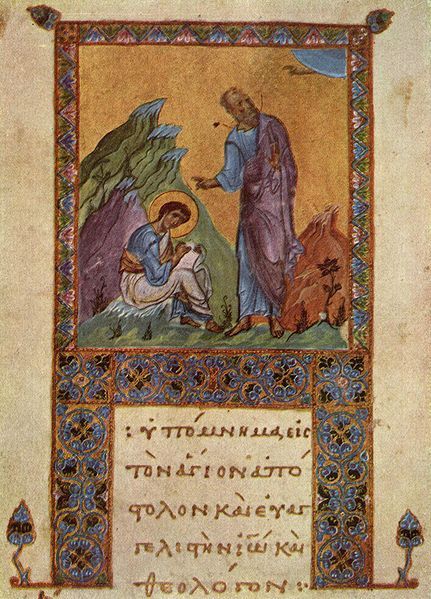
Saint John and Saint Andrew were likely followers of Saint John the Baptist, who met and spent the day with Jesus (as recounted in the Gospel of John). While we do not know what they conversed about, we can imagine that the Beloved Disciple’s heart was filled with the grace and love of Jesus on that day, setting the stage for his devotion throughout the remainder of his life!

35 The next day John was there again with two of his disciples. 36 When he saw Jesus passing by, he said, “Look, the Lamb of God!”


37 When the two disciples heard him say this, they followed Jesus. 38 Turning around, Jesus saw them following and asked, “What do you want?”


They said, “Rabbi” (which means “Teacher”), “where are you staying?”


39 “Come,” he replied, “and you will see.”


So they went and saw where he was staying, and they spent that day with him. It was about four in the afternoon. (John 1: 35-39)

Saint John followed Jesus, was with him at the wedding miracle in Cana, witnessed the Transfiguration, and rarely left his side. He was privileged to find himself in the innermost circle, spending time with Jesus

37 He did not let anyone follow him except Peter, James and John the brother of James. (Mark 5:37)

but also suffering alongside him.

36 Then Jesus went with his disciples to a place called Gethsemane, and he said to them, “Sit here while I go over there and pray.” 37 He took Peter and the two sons of Zebedee along with him, and he began to be sorrowful and troubled. 38 Then he said to them, “My soul is overwhelmed with sorrow to the point of death. Stay here and keep watch with me.” (Matthew 26:36-38)

Referred to by Christ as “beloved,” John was the only member of the original twelve disciples who did not forsake Jesus during His Passion. Memorably, he stood watch at the foot of the cross, with Our Blessed Mother, and Jesus entrusted her care to him. John and Peter were the first to hear of the Resurrection from Mary Magdalene, and impetuously, John ran to the tomb, arriving first. Following the Resurrection of Christ, John was the first to recognize the risen Christ on the shores of the sea of Galilee where he had first followed Him.

The remainder of Saint John’s life was lived, caring for Mary, and preaching in Jerusalem and Ephesus. He is credited with the establishment of numerous churches throughout the region, and the conversion of many souls for the Lord.

Biblical scholars recognize Saint John as the author of the fourth Gospel, three Epistles, and the Book of Revelation. Based upon his good works, tradition tells us that he was sentenced to death by Emperor Domitian, but was unable to be harmed or killed—even when submerged in a cauldron of boiling oil. He was subsequently exiled to the island of Pathmos, where we was forced to labor in the mines for a year. Returning to Ephesus, John continued to preach and model the charity instilled in him by both Our Lord and Our Blessed Mother until his death in extreme old age. Saint John is believed to have been the last of the apostles to join Jesus in heaven. Upon his death, a grand church was constructed in Ephesus atop his tomb, later converted into a mosque.


Saint John lived the Gospel throughout his life. He recorded the words of Jesus at the Last Supper, and then lived them dramatically through his charitable example:

9 “As the Father has loved me, so have I loved you. Now remain in my love. 10 If you keep my commands, you will remain in my love, just as I have kept my Father’s commands and remain in his love. 11 I have told you this so that my joy may be in you and that your joy may be complete. 12 My command is this: Love each other as I have loved you. 13 Greater love has no one than this: to lay down one’s life for one’s friends. 14 You are my friends if you do what I command. 15 I no longer call you servants, because a servant does not know his master’s business. Instead, I have called you friends, for everything that I learned from my Father I have made known to you. 16 You did not choose me, but I chose you and appointed you so that you might go and bear fruit—fruit that will last—and so that whatever you ask in my name the Father will give you. 17 This is my command: Love each other.” (John 15:9-17)

Today, we turn our attention to our own lives, and the manner in which we love those we come into contact with. Have we loved our friends, our families, our enemies, strangers in a manner which is pleasing to the Lord? Have we loved others as Jesus has loved us? Saint John’s example reminds us that love is the basis of our entire Christian faith, and without love, we are lost!


O Glorious Saint John, you were so loved by Jesus that you merited to rest your head upon his breast, and to be left in his place as a son to Mary. Obtain for us an ardent love for Jesus and Mary. Let me be united with them now on earth and forever after in heaven.


Year 2: Day 361 of 365
Prayer Intentions: Lives filled with pure love.
Requested Intentions: Healing (M); Safety, security, and sanctity for a family (A); Healing (N); Successful relationship (N); Healing of a friend; growth in the Lord (M); To hear and answer the Lord’s call (M); Healing of a friend undergoing chemotherapy (L); For the peace, safety, and holiness of a sister (J); Financial security (C); Conversion of a newly married couple (M); Peace in a family (S); Peaceful repose of departed mother (J); Blessings on a relationship (J); Financial security, successful employment (J); Obedience to God’s will (A); Conversion of souls (A); Success of business venture; faith of daughter (S); Safe return home (J); Recovery of mother and son; repose of the souls of the dearly departed (A); Blessings upon a relationship (M); Sobriety and recovery for a son (M); Employment and successful marriage (A); Employment, healing, freedom from anxiety (T); Financial security (C); Conversion (T); Peace in difficult times at work (E); Financial security and blessings for mother and children (T); Financial security for a mother (M); Health, finances, successful marriage (A); Successful resolution of court case for son (K); Continued sobriety (N); Healing of a chronic health condition (B); Successful employment (A): Peace in a family, recovery of a niece from substance use (L); Blessings on a marriage, healing of a husband (P); For the health and recovery of sisters (B); For a daughter and granddaughter (D); Blessings on overseas employment (M); Healing of mother (L).


November 30: Saint Andrew, First Disciple of Christ

Posted by Jacob

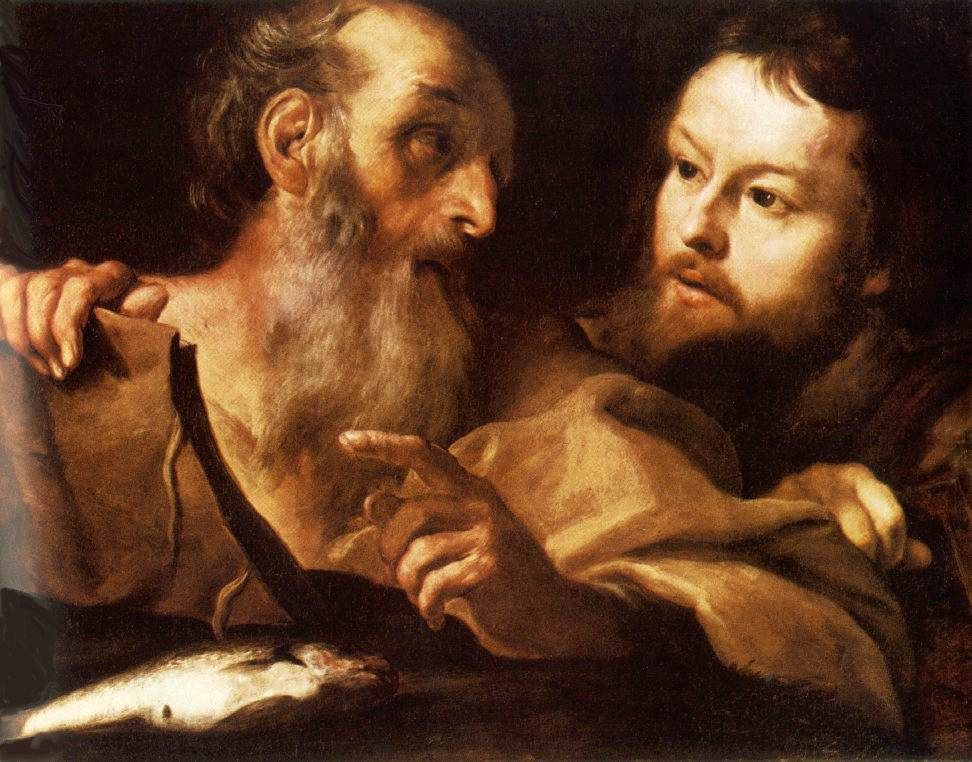
Today, November 30, we celebrate the feast day of Saint Andrew (died 60 AD), the Lord’s first apostle, martyr for the faith, and patron saint of Scotland. While John is not featured prominently in the New Testament (although is always listed within the first four disciples, signifying importance), we realize that his faith brought not only his brother, Simon Peter, to follow Jesus, but also many others. Throughout his life, Andrew testified to the love and divinity of Christ, earning himself the martyr’s crown.


Andrew, like his brother Simon Peter, was a fisherman. Early in his life, he became a disciple of Saint John the Baptist, but was quick to understand the implication of Saint John’s naming of Jesus, “Behold the Lamb of God!”

29 The next day John saw Jesus coming toward him and said, “Look, the Lamb of God, who takes away the sin of the world! 30 This is the one I meant when I said, ‘A man who comes after me has surpassed me because he was before me.’ 31 I myself did not know him, but the reason I came baptizing with water was that he might be revealed to Israel.”


32 Then John gave this testimony: “I saw the Spirit come down from heaven as a dove and remain on him. 33 And I myself did not know him, but the one who sent me to baptize with water told me, ‘The man on whom you see the Spirit come down and remain is the one who will baptize with the Holy Spirit.’ 34 I have seen and I testify that this is God’s Chosen One.”


35 The next day John was there again with two of his disciples. 36 When he saw Jesus passing by, he said, “Look, the Lamb of God!”


37 When the two disciples heard him say this, they followed Jesus. 38 Turning around, Jesus saw them following and asked, “What do you want?”


They said, “Rabbi” (which means “Teacher”), “where are you staying?”


39 “Come,” he replied, “and you will see.”


So they went and saw where he was staying, and they spent that day with him. It was about four in the afternoon.


40 Andrew, Simon Peter’s brother, was one of the two who heard what John had said and who had followed Jesus. 41 The first thing Andrew did was to find his brother Simon and tell him, “We have found the Messiah” (that is, the Christ). 42 And he brought him to Jesus.


Jesus looked at him and said, “You are Simon son of John. You will be called Cephas” (which, when translated, is Peter). (John 1: 29-42)


After hearing John’s proclamation, Andrew, without hesitation, left Saint John and began to follow Jesus, recognizing him as master. Jesus knew that Andrew was walking behind him, and turning back, he asked, "what do you seek?" When Andrew answered that he would like to know where Jesus lived, Our Lord replied, "Come and see." Andrew had been only a little time with Jesus when he realized that this was truly the Messiah.

It was later, that while Andrew and his brother were fishing that the Lord called them to the apostolate.

18 As Jesus was walking beside the Sea of Galilee, he saw two brothers, Simon called Peter and his brother Andrew. They were casting a net into the lake, for they were fishermen. 19 “Come, follow me,” Jesus said, “and I will send you out to fish for people.” 20 At once they left their nets and followed him. (Matthew 4: 18-20)

Only two other explicit references to Saint Andrew are contained in the Gospels. The first occurs during the miracle of the loaves and fishes. It was Andrew who reported that a local boy had bread and fish with him:

8 Another of his disciples, Andrew, Simon Peter’s brother, spoke up, 9 “Here is a boy with five small barley loaves and two small fish, but how far will they go among so many?” (John 6: 8-9)

This suggests that Andrew may have been one of the twelve who helped manage the day-to-day tasks of Jesus’ ministry. It was he who was circulating through the crowd of five thousand, attending to the practical needs of the people.

The second of the explicit references to Saint Andrew occurs a few days before the death of Jesus, when Saint Philip was asked by some Greek festival-goers for an audience with Jesus. Philip referred the matter to Andrew, as one of greater authority.

20 Now there were some Greeks among those who went up to worship at the festival. 21 They came to Philip, who was from Bethsaida in Galilee, with a request. “Sir,” they said, “we would like to see Jesus.” 22 Philip went to tell Andrew; Andrew and Philip in turn told Jesus.


23 Jesus replied, “The hour has come for the Son of Man to be glorified. 24 Very truly I tell you, unless a kernel of wheat falls to the ground and dies, it remains only a single seed. But if it dies, it produces many seeds. 25 Anyone who loves their life will lose it, while anyone who hates their life in this world will keep it for eternal life. 26 Whoever serves me must follow me; and where I am, my servant also will be. My Father will honor the one who serves me.

27 “Now my soul is troubled, and what shall I say? ‘Father, save me from this hour’? No, it was for this very reason I came to this hour. 28 Father, glorify your name!” (John 12: 20-28)

These two moments in the life of Saint Andrew demonstrate his closeness to Jesus, one of his trusted circle of disciples. Saint Andrew was present at the Last Supper, beheld the Risen Lord in the Upper Room, witnessed the Ascension, was filled with the Spirit at Pentecost, and continued to preach following the Ascension of Jesus into Heaven. Church legend tells us that Saint Andrew traveled to Greece, Turkey, and Palestine to preach following the death, Resurrection, and Ascension of Jesus.

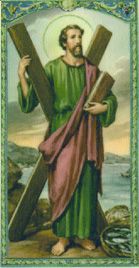
While the exact location of his preaching is unclear, it is generally agreed upon that he was crucified by order of the Roman Governor Aegeas, at Patrae (in Achaia). Upon seeing the cross that would bear him to his death, Saint Andrew was overwhelmed with love, such was his faith in Christ. As he was bound to the X-shaped cross with rope (rather than nails, to prolong his suffering), he exclaimed:

“O most beautiful cross that was glorified by carrying the body of Christ! Glorious cross, sweetly desired, ardently loved, always sought, and finally prepared for my heart that has so long awaited you. Take me, o cross! Embrace me. Release me from my life among men. Bring me quickly and diligently to the Master. Through you He will receive me, He, Who through you has saved me.”


Saint Andrew remained two days on the cross, suffering, yet preaching to the people. His last words were recorded as follows:

“Lord, eternal King of glory, receive me hanging from the wood of this sweet cross. Thou who art my God, whom I have seen, do not permit them to loosen me from the cross. Do this for me, O Lord, for I know the virtue of Thy Holy Cross.”

The X-shaped decussate cross is now known as Saint Andrew’s Cross. Saint Andrew was buried in Patrae, but eventually his relics were translated to Constantinople, and deposited in the church of the Apostles there, around 357 A.D. When Constantinople fell to French occupation and rule, in the beginning of the thirteenth century, Cardinal Peter of Capua brought the relics to Italy and placed them in the cathedral of Amalfi, where most of them still remain. Saint Regulas also took some of these relics, warned in a dream by an angel, to Scotland with him, explaining Saint Andrew’s association with Scotland.


As is the case with most of the Disciples of Christ, the Gospels tell us very little about the holiness of Saint Andrew. We are left to infer from the words of the New Testament that his life was one of close companionship with Jesus, of service to the Lord and others, and of deep faith and holiness. Jesus called him personally to follow Him, and he gave up all that he had, without hesitation, to do so. We are called to the same life of service, of following Christ, of holiness today. How will we answer the call?


From a homily on the Gospel of John by Saint John Chrysostom:

“After Andrew had stayed with Jesus and had learned much from him, he did not keep this treasure to himself, but hastened to share it with his brother Peter. Notice what Andrew said to him: “We have found the Messiah, that is to say, the Christ.” Notice how his words reveal what he has learned in so short a time. They show the power of the master who has convinced them of this truth. Andrew’s words reveal a soul waiting with the utmost longing for the coming of the Messiah, looking forward to his appearing from heaven, rejoicing when he does appear, and hastening to announce to great an event to others. To support one another in the things of the spirit is the true sign of good will between brothers, loving kinship and sincere affection.”


Prayer to Saint Andrew

O Glorious Saint Andrew, you were the first to recognize and follow the Lamb of God. With your friend Saint John you remained with Jesus for that first day, for your entire life, and now throughout eternity.


As you led your brother Saint Peter to Christ and many others after him, draw us also to him. Teach us to lead others to Christ solely out of love for him and dedication in his service. Help us to learn the lesson of the Cross and to carry our daily crosses without complaint so that they may carry us to Jesus.


Almighty God, who didst give such grace unto thy holy Apostle Saint Andrew, that he readily obeyed the calling of thy Son Jesus Christ, and followed him without delay; Grant unto us all, that we, being called by thy holy word, may forthwith give up ourselves obediently to fulfill thy holy commandments; through Jesus Christ our Lord. Amen.


Year 2: Day 334 of 365
Prayer Intentions: An attitude of holiness. The courage to answer the call of the Lord.
Requested Intentions: Financial security for a mother (M); Health, finances, successful marriage (A); Successful resolution of court case for son (K); Continued sobriety (N); Healing of a chronic health condition (B); Successful employment (A): Peace in a family, recovery of a niece from substance use (L); Blessings on a marriage, healing of a husband (P); For the health and recovery of sisters (B); For a daughter and granddaughter (D); Blessings on overseas employment (M); Healing of mother (L); Successful employment for husband (G); Successful employment, personal fulfillment (C); Health and recovery of ill sister (A); Resolution of legal issues; Grace and protection (E); Successful and meaningful employment (S); Restoration of a marriage (A); Peace and tolerance in a family, support for those with Parkinson’s Disease (M); For the restoration of a daughter’s marriage, end to debt (S); Employment and continued strength (K); Successful examinations for a son (J); Employment and blessings of a child (S); Employment and financial security (F); Successful work placement, continued health (A); Grace and healing for a family (P); Healing of a father (M).

October 28: Feast of Saints Simon and Jude

Posted by Jacob

Today, October 28, we celebrate the feast day of two saints: Saint Jude (Thaddeus) and Saint Simon the Zealot, discples of Christ, who are listed together in the Roman Canon. Ancient Christian writers tell us that following Pentecost, together they traveled to Mesopotamia and Persia, where they preached the Gospel and were eventually martyred. In actual fact, we know very little about this holy men beyond what is told us of their being called as Apostles in the New Testament.


Saint Simon is usually called "the Zealot" (Luke 6:15), probably because he belonged to the Jewish party of the "Zealous of the Law,” and rigorously observed the law. Saint Jude, also known as Judas (not to be confused with Judas Iscariot) or Thaddeus (as described in the Gospels of Matthew and Mark), is mentioned only as one of the 12 disciples of Jesus. Little is mentioned of him elsewhere in the New Testament, although like Simon, we can assume the great gift of holiness poured out on this faithful disciple of Christ. We know, however, that he was the brother of Saint James the Lesser.

12One of those days Jesus went out to a mountainside to pray, and spent the night praying to God. 13When morning came, he called his disciples to him and chose twelve of them, whom he also designated apostles: 14Simon (whom he named Peter), his brother Andrew, James, John, Philip, Bartholomew, 15Matthew, Thomas, James son of Alphaeus, Simon who was called the Zealot, 16Judas son of James, and Judas Iscariot, who became a traitor. (Luke 6: 12-16)

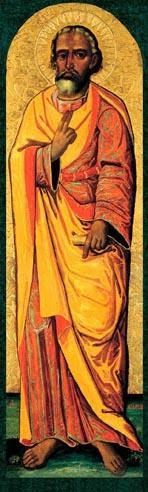
Saint Simon is represented in art with a saw, the instrument of his martyrdom. Saint Jude is traditionally pictured with a builder’s square, identifying him as an architect of the house of God. In the Gospel of Saint John we learn another detail regarding Saint Jude:

22Then Judas (not Judas Iscariot) said, "But, Lord, why do you intend to show yourself to us and not to the world?"


23Jesus replied, "If anyone loves me, he will obey my teaching. My Father will love him, and we will come to him and make our home with him. 24He who does not love me will not obey my teaching. These words you hear are not my own; they belong to the Father who sent me. (John 14:22-24)

Bolstered by the words of Jesus, following the Ascension, Saints Simon and Jude left the comfort and safety of their secure environment to go out into the world and to preach the gospel, converting many hearts. As simple farmers, they appeared to be the least likely candidates to be called to perform such a great task for the Lord. However, the Lord chooses the least among us to do great things—but only through the incalculable grace He lavishes upon us.

Ancient writers tell us that both Saints Jude and Simon preached the Gospel in Judea, Samaria, Idumaea, Syria, Mesopotamia, and Lybia. According to Eusebius, they returned to Jerusalem in the year 62, and assisted at the election of Saint Simeon as Bishop of Jerusalem. Both are recorded as martyred in Persia sometime after 70 AD.


Father,
you revealed yourself to us
through the preaching of your apostles Simon and Jude.
By their prayers,
give your Church continued growth
and increase the number of those who believe in you.
Grant this through our Lord Jesus Christ, your Son,
who lives and reigns with you and the Holy Spirit,
one God, for ever and ever. Amen.


On the Lives of Saints Simon and Jude, From the Golden Legend:

Here followeth of the Holy Apostles Simon and Jude, and first of their names.


Simon is as much to say as obedient, or being in heaviness. And he had a double name; he was said Simon Zelotes, and Simon Cananean of Cana a street that is in Galilee, there whereas our Lord converted the water into wine. And Zelotes is as much to say as Cananean. This holy man had in him obedience of the commandments by execution, heaviness by pity of torment, and had love of souls by firm ardour of love. Judas is as much to say as confessing or glorious; or Judas is as much to say as giving joy. For he had confession of faith, glory of reign, and glory of the everlasting joy. This Judas was called by many names. He was said Judas James, for he was brother to James the Less, and he was called Thaddeus, which is as much to say as taking a prince; or Thadee is said of Thadea, that is a vesture, and of Deus, that is God, for he was vesture royal of God by ornament of virtues, by which he took Christ the prince. He is said also in the History Ecclesiastic, Lebbæus, which is as much to say as heart, or worshipper of heart. Or he is said Lebbæus of lebes, that is a vessel of heart by great hardiness, or a worshipper of heart by purity, a vessel by plenitude of grace, for he deserved to be a vessel of virtues and a caldron of grace. And Abdias, bishop of Babylon, by the apostles ordained, wrote their passion and legend in Greek, and Tropæus the disciple of Abdias translated it out of Greek into Latin. And he was named Africanus.


Of the Holy Saint Simon and Saint Jude


Simon Cananean and Judas Thaddeus were brethren of James the Less and sons of Mary Cleophas, which was married to Alpheus. And Jude was sent of Thomas to the king Abgarus of Edessa after the ascension of our Lord. And it is read in the History Scholastic that the said Abgarus sent an epistle unto our Lord Jesu Christ in this manner. Abgarus the son of Euchania to Jesus, blessed Saviour, which appeareth in the places of Jerusalem, sendeth salutation. I have heard of thee, and that the healths and recoverings that thou makest and dost, be without medicines and herbs, and that thou makest the blind to see by thine only word, and the lame to go, the mesels to be cured and made whole, and the dead bodies to live again. Which things heard of thee, I ween in my courage that thou art one of two, that is that thou art God that art descended from heaven for to do this, or that thou art the son of God that dost such things. Wherefore I pray thee by writing that thou wilt travail so much as to come to me and heal me of my malady, of which I have long been vexed. And I have heard say that the Jews murmur against thee and lie in await against thee. Come therefore to me, for I have a little city, but it is honest, and shall shall well suffice to us both. Our Lord Jesus answered him by writing in these words: Blessed art thou that hast believed in me when thou hast not seen me. It is written of me, that they that see me not shall believe in me, and they that see me shall not believe. Of that thou hast written to me that I shall come to thee, me behoveth to accomplish that which I am sent for, and after to be received of him from whom I am sent. When I am ascended, I shall send to thee one of my disciples to heal thee and quicken thee. This is written in Historia Ecclesiastica. And when Abgarus saw that he might not see God presently, after that it is said in an ancient history, as John Damascene witnesseth in his fourth book, he sent a painter unto Jesu Christ for to figure the image of our Lord, to the end that at least that he might see him by his image, whom he might not see in his visage. And when the painter came, because of the great splendour and light that shone in the visage of our Lord Jesu Christ, he could not behold it, ne could not counterfeit it by no figure. And when our Lord saw this thing he took from the painter a linen cloth and set it upon his visage, and emprinted the very phisiognomy of his visage therein, and sent it unto the king Abgarus which so much desired it.


And in the same history is contained how this image was figured. It was well-eyed, well-browed, a long visage or cheer, and inclined, which is a sign of maturity or ripe sadness. That epistle of our Lord Jesu Christ is of such virtue, that in the city of Edessa no heretic ne no paynim may live therein, ne none tyrant may grieve it. For if any people come against that city by force of arms, a child shall stand upon the gate, and shall read that epistle, and that same day either the enemies shall flee and be afraid, or they shall make peace with them of the town. And as is said: This hath been done. But this city hath been sith taken of the Saracens and touched in such wise, that for the multiplying of sins this benefit is lost.


Also it is read in the History Ecclesiastic that when our Lord was ascended into heaven, Thomas the apostle sent Thaddeus, that was Jude, unto the king Abgarus according to the promise of our Lord. And when he was come to him, and had told to him that he was messenger of our Lord Jesu Christ, which had promised to send him one, then Abgarus saw in the visage of Thaddeus a marvellous and godly brightness. And when he had seen it he was all abashed and afeared, and worshipped our Lord saying: Verily, thou art the disciple of Jesu Christ, Son of God, which sent to me word that he would send to me some one of his disciples that should heal me and give to me life. To whom Thaddeus said: If thou believest in the Son of God thou shalt have all the desires of thine heart. And Abgarus said: I believe on him, verily, and those Jews that slew him, I would gladly slay them if it were possible to me, and had power, howbeit that the authority letteth it. And as it is read in some places and books, that Abgarus was leper, and Thaddeus took the epistle of our Saviour, and rubbed and frotted therewith the visage of Abgarus, and anon he received full health.


Judas preached first in Mesopotamia and in Pontus, and Simon preached in Egypt, and from thence came they into Persia, and found there two enchanters, Zaroes and Arphaxat, whom Saint Matthew had driven out of Ethiopia. And found there also Baradach, a duke of the kings of Babylon, which should go in battle against them of India, and could have none answer of his gods. And then they went to a temp]e nigh to the city, and there they had answer that because that the apostles that were come they might not answer. Then the duke did enquire for them, and found them, and demanded them wherefore they were come, and what they were. Which answered: If thou demand of our lineage, we be Hebrews, and if thou demand of our condition, we be servants of Jesu Christ, and if thou demand wherefore we be come, we be for your health. To whom the duke answered: When I shall return joyously from the battle I shall hear you. To whom the apostles said: It is more convenable to thee to know him now, by whom thou mayst overcome and appease them that be rebel to thee. And the duke answered: I see you more mighty than our gods; I pray you to say to us tofore the end of the battle. And the apostles said: Because that thou knowest thy gods to be liars, we command them that they give answer to that thou demandest, because that when they have we shall prove that they have lied. Then the idols said that the battle should be great, and much people should be overthrown on both sides. And then the apostles began to laugh and the duke said to them: I am afeard and ye laugh. And the apostles said: Doubt ye nothing, for peace shall be made among you, and tomorn at the hour of tierce the messengers of the Medes shall come, and shall submit them to thy puissance with peace. And then the bishops of the idols made a great laughter, and said to the duke: These men here would assure thee here, to the end that thou shouldst believe foolishly, and that thou shouldst be betaken of thine adversaries. And the apostles said: We say not abide a month, but one day only, and thou shalt be vanquisher all in peace. Then the duke made to be kept that one and that other, that they that said the truth should be honoured, and the liars punished. Then on the morn, like as the apostles had said, it happed, and then the duke would have burnt the bishops of the idols, but the apostles letted him that he should not slay them, for they were not come for to slay but for to quicken the dead. And then the duke much marvelled that they would not that they should be slain ne receive none of their goods, and brought them to the king and said: These be gods hid in form of men. And when he had told all to him in the presence of his enchanters, the enchanters, being moved of envy, said that they were malicious and wicked men, and purposed some malice against the realm subtly. Then the duke said to them: Now if ye dare, assay ye and dispute with them. And the enchanters said: If thou wilt, thou shalt see that they shall not now speak. We being present, make men to come hither that be eloquent and can well speak. And if they dare speak tofore us despise ye us, and say we be fools. And then were brought tofore them many advocates, and anon they were made dumb tofore the enchanters, so that by signs they might not show that they might not speak. Then said the enchanters to the king: To the end that thou know that we be gods, we shall suffer them to speak, but they shall not mow go, and then we shall give to them their going and shall take away their sight, and yet shall their eyes be open. And when they had done all these things, the duke brought the advocates all confused unto the apostles, and when the advocates saw the apostles so evil clothed, they had of them great despite in their courage. To whom Simon said: Ofttimes it happeth that among coffers of gold wrought with precious stones be right evil things enclosed, and within coffers of tree be laid gold rings and precious stones. Promise ye that ye will forsake the idols and will worship one only God invisible, and we shall make the sign of the cross in your foreheads, and ye shall then mow confound these enchanters. And when these advocates had renounced the idols and were marked in the foreheads with the sign of the cross, they entered again to the king tofore the enchanters. Then might they not be overcome of the enchanters, but confounded them openly before the king and all the people. The enchanters were then angry, and made to come a great multitude of serpents. Then the apostles came anon by the commandment of the king, and filled their mantles with the serpents, and threw them against the enchanters, saying: Move ye not in the name of our Lord Jesu Christ but be ye to-torn and beaten, so that ye cry and bray in showing what sorrow and pain ye suffer. And then when the serpents bit and eat the flesh of the enchanters, they cried and howled like wolves, and the king and the others prayed the apostles that they would suffer them to die with the serpents. And the apostles answered that they were sent for to bring men from death to life, and not from life to death. Then made they their prayers and commanded the serpents that they should take from them again the venom that they had shed, and return again to the places that they came from. And the enchanters felt greater pain when they drew out their venom again, than they did the first time when they bit them. And the apostles said to them: Ye shall feel this pain three days, and at the third day ye shall be whole, so that ye depart from your malice. And when they had been tormented three days without meat and drink and without sleep, the apostles came to them and said: God deigneth not to have service by force, and therefore arise ye all whole and go your way, ye have power to do what ye will. And they, abiding in their malice, arose up and fled from the apostles and moved almost against them all Babylon.


After, the daughter of a duke conceived a son by fornication, and at her deliverance thereof she defamed an holy deacon, and said that he had defouled her and she had conceived of him. And when the friends of her would have slain the deacon, the apostles came and demanded when the child had been born. And they said: Yesterday, the first hour of the day. And the apostles said: Bring hither the child to us, and also the deacon that ye accuse. And when that was done, the apostles said to the child: Say to us in the name of our Lord if this deacon hath done this deed, and the child answered: This deacon is chaste and an holy man, ne he never defouled his flesh. And then the parents and friends required that the apostle should demand who had done that felony. They answered: It appertaineth to us for to excuse the innocents, and not betray ne hurt them that be culpable. That time it happed that two cruel tigers, which were enclosed in a pit, brake out and devoured all them that they met and encountered, and then the apostles came to them and made them as meek and debonair, in the name of our Lord, as they had been sheep or lambs. And then the apostles would have departed thence, but they were holden by prayers so that they abode there a year and three months, and in that espace of time the king and more than sixty thousand men were baptized, without children. And the foresaid enchanters went into a city called Suamar, whereas were seventy bishops of idols, whom they moved against the apostles, so that when they came thither, either they should do sacrifice to the idols or they should be slain. And when the apostles had gone round about the province, they came to said city, and anon all the bishops and the people took them and brought them to the temple of the sun. And the devils began to cry in the simulachres: What will these apostles of the living God do to us? Lo! how we be burnt by flames in their entering into this city. And then the angel of our Lord appeared unto the apostles, and said to them: Choose ye of two things that one, that is, either that this people be suddenly dead or slain, or that ye be martyred. To whom they said: We will that thou convert them here, and lead us to the pain of martyrdom. And they then commanded silence, and the apostles said: Because that ye shall know that these idols be full of devils, we comnmand them for to come out, and that each of them break and destroy his false image. And anon two Ethiopians, black and naked, issued out of the idols, all the people seeing which were abashed, and all tobrake their idols, and went their way, crying cruelly. And when the bishops saw this, they ran upon the apostles and hewed them to death anon. And that same hour, which was right fair weather, came so great thunder and lightning that the temple was smitten in three, and the two enchanters were turned into coals by the stroke of thunder. And the king bare the bodies of the apostles into his city, and did do make a church of marvellous greatness in the honour of them. And it is founden in divers places, of Saint Simon, that he was nailed to the cross, which thing Isidore saith in the book of the Death of the Apostles, and Eusebius in the History Ecclesiastic, and Bede upon the Acts of the Apostles, and Master John Beleth in his Summa witnesseth the same. And as they say, when he had preached in Egypt, he came again and was made bishop in Jerusalem after the death of James the Less, and was chosen of the court of the apostles, and it is said that he raised thirty dead men to life. When he had governed the church of Jerusalem many years, unto the time of Trajan the emperor, in the time that Atticus was consul in Jerusalem, of whom he was taken and tormented and done to much wrong. And at the last he was tormented and fixed to the cross, and the judge and all they that were there marvelled that the man which was six score years old might suffer the torment of the cross. And some say verily that it was not this Simon that suffered the martyrdom of the cross, but it was another, the son of Cleophas, brother of Joseph, and Eusebius, bishop of Cæsarea, witnesseth it in his chronicle. For Isidore and Eusebius corrected their chronicles of that they said tofore, which appeareth by Bede, that when he felt this he revoked it in his retractions. And the same witnesseth Usuard in his Martyrology. Then let us devoutly pray these apostles to be our special advocates unto our blessed Lord Jesu Christ their master, to have pity and mercy on us. Amen.


Year 2: Day 301 of 365
Prayer Intentions: Simple faith and great service to the Lord.
Requested Intentions: Restoration of a marriage (A); Peace and tolerance in a family, support for those with Parkinson’s Disease (M); For the restoration of a daughter’s marriage, end to debt (S); Employment and continued strength (K); Successful examinations for a son (J); Employment and blessings of a child (S); Employment and financial security (F); Successful work placement, continued health (A); Grace and healing for a family (P); Healing of a father (M); Academic success for son, employment for husband and brother (B); Freedom from anxiety and panic attacks (R); Health and healing in preparation for surgery (C); Healing of a chronic illness (P); Safety of a family during storms (A); Successful home ownership (P); Healing of a marriage (M); Employment for a husband, blessings for a marriage (E); Successful examinations for a daughter, healing of a relationships (V); Blessing for a family (V); Healing of baby girl M and all children suffering (M); Special intentions (R); Business success, peace, health (E); Conversion and deliverance of those who suffer, increase in vocations (M); Financial security and safe housing (M); For a daughter (K).