Why pray the Rosary every day for a year?


Each time the Blessed Virgin has appeared-- whether it be to Saint Bernadette Soubirous at Lourdes; to Lucia, Jacinta, and Francisco at Fatima; or to Mariette Beco at Banneux-- she has asserted the importance, saving grace, and power of praying the Holy Rosary on a daily basis. Based upon her words, the Rosary is penance and conversion for sinners, a pathway to peace, an end to war, and a powerful act of faith in Jesus Christ. Pope Paul VI presented the Rosary as a powerful means to reach Christ "not merely with Mary but indeed, insofar as this is possible to us, in the same way as Mary, who is certainly the one who thought about Him more than anyone else has ever done."

To show us how this is done, perhaps no one has been more eloquent than the great Cardinal Newman, who wrote: "The great power of the Rosary consists in the fact that it translates the Creed into Prayer. Of course, the Creed is already in a certain sense a prayer and a great act of homage towards God, but the Rosary brings us to meditate again on the great truth of His life and death, and brings this truth close to our hearts. Even Christians, although they know God, usually fear rather than love Him. The strength of the Rosary lies in the particular manner in which it considers these mysteries, since all our thinking about Christ is intertwined with the thought of His Mother, in the relations between Mother and Son; the Holy Family is presented to us, the home in which God lived His infinite love."


As Mary said at Fatima, "Jesus wants to use you to make Me known and loved. He wishes to establish the devotion to My Immaculate Heart throughout the world. I promise salvation to whoever embraces it; these souls will be dear to God, like flowers put by Me to adorn his throne."


May 5, 2013: Saint Hilary of Arles

Posted by Jacob


Today, May 5, we remember Saint Hilary of Arles (400-449), a saint called to holiness at a young age, who suffered persecution from within the church late in life for his obedience to the Lord. The life of Saint Hilary suggests to us that even the holiest of men and women struggle with their callings, require assistance and support in prayer and encouragement from their friends and families, and despite their sanctity, are slaves to their human weaknesses.

Hilary was born into a noble family in France, a relative of Saint Honoratus, Archbishop of Arles. Hilary was raised with an extraordinary education, wealth, and privilege, and seemed poised to make his mark on the secular world when Saint Honoratus came to him, urging his entrance into the Abbey at Lerins. Saint Hilary was torn, as the monastic life was not what he had planned, nor had he felt called to completely. He wrote, "On one side, me-thought I saw the Lord calling me; on the other the world offering me its seducing charms and pleasures. How often did I embrace and reject, will and not will the same thing! But in the end Jesus Christ triumphed in me. And three days after Honoratus had left me, the mercy of God, solicited by his prayers, subdued my rebellious soul."

Following his visit with Saint Honoratus, Hillary entered the Abbey at Lerins, eager to embark on his spiritual mission alongside his relative. "What floods of tears," he wrote about Saint Honoratus, "did this true friend shed to soften the hardness of my heart! How often did he embrace me with the most tender and compassionate affection, to obtain of me that I would take into serious consideration the salvation of my soul! Yet, by an unhappy victory, I still remained conqueror." Honoratus, finding his endeavors to wean him from the charms of a deceitful world not completely effective, turned to prayer, saying to our soon-to-be-Saint, "I will obtain of God, what you will not now grant me."

At the young age of 29, Hilary was chosen as Archbishop of Arles—an appointment he resisted in humility-- succeeding Honoratus. He became known for his austerities, despite his appointed role, his mortification and penance, and for the love he showed to his community of faith—the “congregation” as he referred to them (possibly the first to do so). He spent his days in manual labor, raising money for the poor, and was quick to sell church property in ransom for captives. He traveled everywhere on foot, preaching, and converting many through the gift of persuasive oration provided to him by the Lord. Able to easily tailor his language to the education level of the listener, Saint Hilary was fond of saying phrases similar to, “You will not so easily get out of hell, if you are once unhappily fallen into its dungeons!" as warning to sinners.

Upon his appointment, Saint Hilary sold all the property he had inherited, distributing the money raised to the poor and to financially struggling monastic communities. He became a model of prayer, fasting, charity, and virtue. His zeal for the holy life raised the attention and anger of others in leadership roles in the Church, to whom Hilary’s zeal appeared hasty and disobedient. In his exuberance to spread the word of God, he occasionally made powerful governmental adversaries in a time when the power of the pope had not yet been fully established. Indeed, in speaking out on many issues, Saint Hilary—in his humanity-- made mistakes which led to his eventual reprimand by Pope Leo, and the stripping of his title. Eventually, through this time of trial, Saint Hilary refined his virtue, furthering his humility, patience, submissiveness, and obedience. After some time, he was restored by the patient pope, and served the Lord until his death at age 49. While some doubted his methods, none had ever doubted his piety and holiness.

Not only was Saint Hilary a gifted orator, he also wrote several treatises on God, some of which survive today. "We are all equal," he wrote, "in Jesus Christ; and the highest degree of our nobility is to be of the number of the true servants of God. Neither science, nor birth, according to this world, can exalt us, but in proportion to our contempt of them."

“The Lord taught by way of example that the glory of human ambition must be left behind when he said, “The Lord your God shall you adore and him only shall you serve.” And when he announced through the prophets that he would choose a people humble and in awe of his words, he introduced the perfect Beatitude as humility of spirit. Therefore he defines those who are inspired as people aware that they are in possession of the heavenly kingdom. Nothing belongs to anyone as being properly one’s own, but all have the same things by the gift of a single parent. They have been given the first things needed to come into life and have been supplied with the means to use them.”

The life of Saint Hilary is one of struggle to be obedient. His plans for his life were not what the Lord had in mind, and he struggled to obey—relying not only on his own merit but on the prayers and support of his family. At age 29, Saint Hilary resisted his appointment as Archbishop, but eventually was obedient to the Lord’s will and served with zeal. Even in his older age, Saint Hilary struggled with submissiveness to the pope, but through prayer and penance was able to again overcome his human weakness.

Oftentimes we think of the lives of the saints as perfect and smooth. Saint Hilary’s life reminds us that human struggles are part of the Lord’s plan for us, part of His calling to us, part of our refining process. Through prayer, penance, and fasting, Saint Hilary overcame his human weakness, increasing his obedience, and submitting himself to the will of God—but it wasn’t easy, and it took his entire life! We are encouraged by Saint Hilary when we, ourselves, struggle—that while we work to understand and follow the Lord’s will, our time on earth (while never smooth and easy) will yield holy fruit if we strive for virtue!


A Prayer for the Virtue of Obedience

Jesus, Almighty King of kings, You Who obeyed Your Father to the end, Teach me the meaning of obedience. My soul burns to comply to Your Will, Striving to charm Your Divinity. While my worldly nature seeks one way, My spiritual nature seeks another. Bless me with the strength to obey, That my soul may subdue both natures, Blending them as a fair aromatic bloom. I always seek favor in Your eyes, To always obey You until my last breath!


May 22: Saint Quiteria, Virgin Martyr of the Church

Posted by Jacob


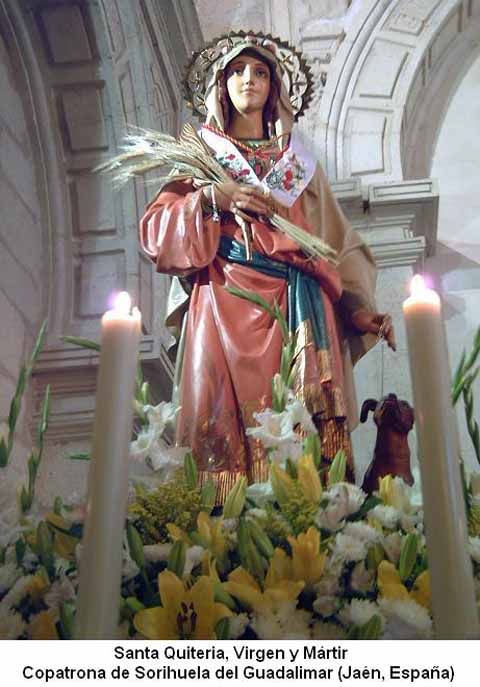
Today, May 22, we celebrate the feast day of Saint Quiteria (2nd century), virgin martyr for the faith.  Depending on which account of her life you read, Saint Quiteria and her sisters were soldiers for Christ—traveling the countryside, freeing Christians from imprisonment, and smashing pagan idols.   Her courageous proclamation of the Gospel led to her eventual capture and death, although her faith never wavered.  Quiteria and her sisters demonstrate that from the direst of circumstances, the Lord can create miraculous moments of love and truth!

Quiteria was born into royalty, the daughter of a Galician prince.  She was one of nine daughters born together (nonuplets).  Her mother, Calsia, was disgusted at the fact that she had produced nine daughters (rather than sons), and suffered through nine childbirths. Viewing the experience as a waste of her time, she ordered her maid, Sila, to take the nine girls to the river and drown them.  Sila, however, was a Christian, and secretly refused the task, instead delivering the infants to a Cistercian monastery to be raised in community.

Quiteria and her sisters were raised by monks, baptized as Christians, and embraced the faith.  Quiteria was the most dedicated of her sisters, studying and practicing the tenets of the faith, reading the Gospel, praying, and developing a profound devotion to Our Blessed Mother.  The monks, placing a strong premium on truth, informed the girls of their royal lineage when they were old enough to understand.  Yet, none of the girls wished to return to the palace or live a luxurious lifestyle.  Instead, they became warriors for Christ, forming a “gang” who traveled the country, breaking Christians out of jail, proclaiming the Gospel, and smashing pagan idols. 

The gang survived for a few years, but were eventually caught and brought before the King, their father.  Recognizing his daughters, he requested that they give up their reckless ways and come live in the palace with him.  This they did, but only to witness to the royal court.  The sisters converted their rooms into prayer halls, and spent their days praying and praising the Lord.   When the king realized they were Christians, he ordered them to renounce their ways, sacrifice to the Roman gods, and marry pagan husbands. 

The sisters refused, led by Quiteria.  They were immediately jailed, but their imprisonment did little to lessen their faith or joy in the Lord.  In jail they praised and glorified Jesus, and eventually an angel came and proclaimed to Quiteria, “Happy and fortunate you are, for you deserved to find grace in front of God, so that God has chosen you as his spouse. It is God's will, that you are to live in solitude in the Mount Oria and there you will exercise in oration and contemplation.”

Released from imprisonment by the angel of God, the sisters split up, escaping by each traveling in a separate direction.  It is said that they were each eventually killed for their Christian faith.  Quiteria, for her part, followed the angel and did as instructed, forming a small community of women on the hills of Mount Oria, and living for a brief time in peaceful contemplation of the Lord.  She was eventually captured, and subsequently freed from imprisonment again by an angel.  In the process of her imprisonment, she converted many, and her community continued to grow.

Eventually, Quiteria encountered the powerful ruler of the city of Aufragia, Prosen Lastiano.  She successfully converted him to Christianity, but a few days later he reverted to his pagan beliefs.  Humiliated in front of his people, he ordered Quiteria tracked down and killed.  His soldiers tracked her to her hillside community, but upon approach, Prosen suffered inexplicable injuries, including the loss of feeling in his hands and legs.  Quiteria prayed for him, and his senses and movements were restored.  Again, he converted to Christianity, this time filled with the faith of God.  Many of his followers did the same, which infuriated the king.

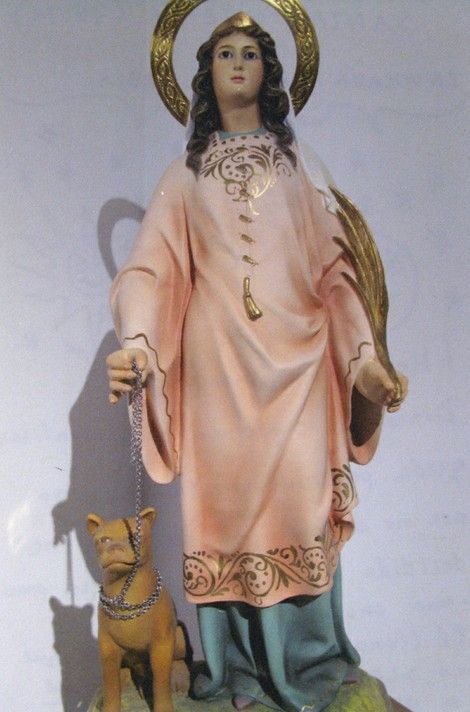
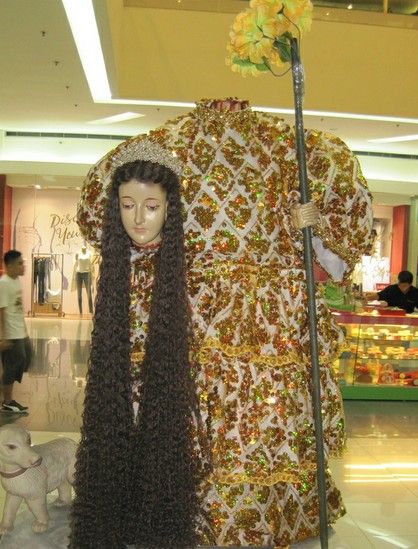
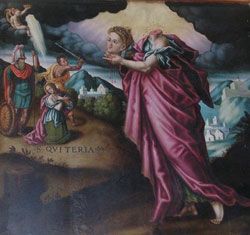
Under his order, Quiteria was found and beheaded for her Christian faith.  Prior to beheading, she is said to have kept the king’s vicious attack dogs at bay, with simply a gentle word.  For this reason, she is often invoked against rabies, and frequently pictured leading a dog.  (In rural Spain and France, farmers continue to lead their livestock to a bridge that is said to contain a relic of Saint Quiteria.  Passing the animals over the bridge is said to protect them from contracting disease).  Each of the women who had found refuge in her community was beheaded as well.  Legend states that following her martyrdom, Saint Quiteria walked to the Church of the Virgin Mary, carrying her head in her hands.  There, at Airein Gascony, her relics were interred (until later scattered by the Huguenots), and she continues to be venerated in southern France and northern Spain.

The live of Saint Quiteria, while possibly pious legend, is one of struggle for the faith.  Despite a chance at a luxurious lifestyle, this lovely young woman and her sisters instead chose to fight for the truth of the Gospel, forsaking her family, her comfort, and eventually her life.  Saint Quiteria’s courage and faith remind us that in our moments of difficulty, we need only turn to the Lord for inspiration and support, and that He will send His angels to protect and assist us.  We pray today for the confident faith in Christ, as exemplified by so many of the saints and martyrs that have come before us!


October 27: Saint Frumentius of Ethiopia

Posted by Jacob

Today, October 27, we celebrate the feast day of Saint Frumentius of Ethiopia (died 383), also known as “Abuna,” or the Father of Ethiopia. Together with his twin brother, saint Aedesius, he is credited with bringing the faith to that region of Africa, as well as translating the New Testament into local language to make it more accessible to the people there. A disciple of Saint Athanasius of Alexandria, Saint Frumentius turned the tragedy of his youth into a powerful opportunity to preach the truth of the Gospel to those in need.


Born in Tyre, Lebanon, Frumentius and his brother were taken on a voyage to Ethiopia what still young children by their uncle, Meropius, a Christian philosopher and explorer. During the voyage, tragedy struck and the ship was attacked by barbarian pirates while harbored in a community on the Red Sea. The entire crew, with the exception of the two children, were slain, and the ship destroyed. Frumentius and Aedesius were taken as slaves.

The two youth were unlike the people of the region in appearance, and as such were given to the king of Axum as a curiosity. He was immediately taken with their youth, beauty, and wit, and installed them as members of his court, seeing to their education, and providing them protection and care. Aedesius would eventually become the king’s cup-bearer, and Frumentius his secretary.

The brothers grew in faith, serving their king well. On his deathbed, grateful for years of service, the king granted the twins their freedom. However, the queen begged them to stay at court and assist her in governing the country until the heir to the throne came of age. This, they gladly did, convincing her to allow the introduction of Christianity to the country, and opening trade ties with the West. Over time, the brothers used their influence to spread Christianity first throughout the court, and then throughout the country. First they encouraged Christian merchants, who had been recently allowed into the country, to practice their faith openly by meeting at places of public worship. Eventually, this led to the conversion of the native residents. When the prince reached the age of governing, the brothers resigned their posts.

Saint Frumentius traveled to Alexandria, where he arranged a meeting with Saint Athanasius, and begged him to send a bishop back to Ethiopia to shepherd the fledgling Christian community. Athanasius, a wise man of faith, consecrated Frumentius a bishop, sending him back to the Ethiopians, recognizing him to be the best man for the position.

Upon his return, Frumentius was welcomed back with reverence, and through working of miracles and holy example, converted the king, and subsequently, the majority of the nation. He worked tirelessly throughout the country until his death in approximately the year 383. The people of Ethiopia called him Abuna (Our Father), Kesate Birhan (Revealer of Light), and Abba Salama (Father of Peace).

Pray for us, dear Frumentius, that we may also “bloom where we are planted.” You were just a young boy in a strange and pagan land, but you made the best of the situation and brought truth and life to that desolate land and lost people. We pray for your intercession that we may bring the light of Christ with us wherever we go in the hope of inspiring others to follow Him. In His name we pray. Amen.


Year 2: Day 300 of 365
Prayer Intentions: Perseverance, Endurance, Faith in difficult situations.
Requested Intentions: Restoration of a marriage (A); Peace and tolerance in a family, support for those with Parkinson’s Disease (M); For the restoration of a daughter’s marriage, end to debt (S); Employment and continued strength (K); Successful examinations for a son (J); Employment and blessings of a child (S); Employment and financial security (F); Successful work placement, continued health (A); Grace and healing for a family (P); Healing of a father (M); Academic success for son, employment for husband and brother (B); Freedom from anxiety and panic attacks (R); Health and healing in preparation for surgery (C); Healing of a chronic illness (P); Safety of a family during storms (A); Successful home ownership (P); Healing of a marriage (M); Employment for a husband, blessings for a marriage (E); Successful examinations for a daughter, healing of a relationships (V); Blessing for a family (V); Healing of baby girl M and all children suffering (M); Special intentions (R); Business success, peace, health (E); Conversion and deliverance of those who suffer, increase in vocations (M); Financial security and safe housing (M); For a daughter (K).

August 14: Saint Maximilian Mary Kolbe

Posted by Jacob

"Hatred is not a creative force: only love is."


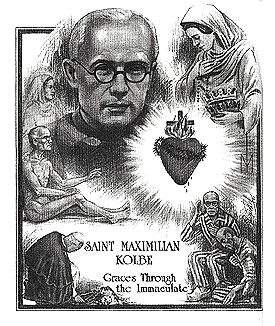
Today, August 15, we celebrate the feast day of Saint Maximilian Mary Kolbe (1894-1941), martyr of the faith, and founder of the Militia of the Immaculata, a group devoted and consecrated to Our Blessed Mother. During his life, Saint Maximilian founded and grew the largest religious community in Europe, assisting those in need, speaking out against the tyranny of war, and aiding thousands of Jews escape persecution during the Second World War. His commitment to the rights and dignity of all, as filtered through his zeal for the Lord and devotion to Mary, allowed him to achieve great works while alive, and the crown of martyrdom in death.

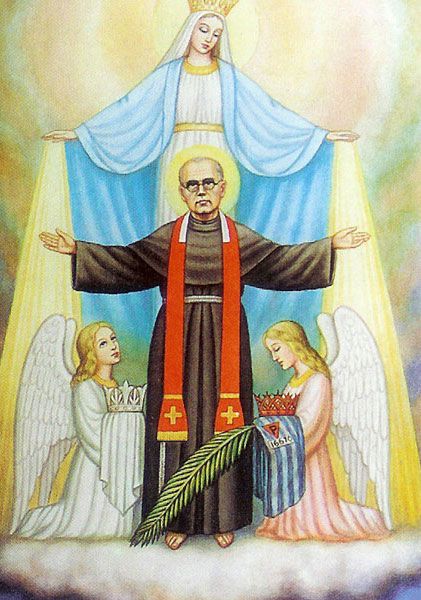
In the words of John Paul II, “Maximilian prepared for this definitive sacrifice by following Christ from the first years of his life in Poland. From these years comes the mysterious vision of two crowns – one white and one red. From these our saint does not choose. He accepts them both. From the years of his youth, in fact, Maximilian was filled with great love of Christ and the desire for martyrdom.”

Born into a poor family in Russian-occupied Poland in 1894, Raymond (his given name) was a boisterous and difficult child. His mother famously—in exasperation—asked of him, “what is going to become of you?” Raymond’s life changed dramatically around the age of 12 when, when he made his First Holy Communion at the Church of the Assumption of Mary. At that time, the young boy was graced with a vision of the Blessed Virgin Mary which was to change his life. In recounting the vision, Raymond said:

“I asked the Mother of God what was to become of me. Then she came to me holding two crowns, one white, the other red. She asked if I was willing to accept either of these crowns. The white one meant that I should persevere in purity, and the red that I should become a martyr. I said that I would accept them both.”

His mother, in her memoirs, wrote of the event:

"I knew ahead of time, based on an extraordinary event that took place in his infancy, that Maximilian would die a martyr. I just don't recall if it took place before or after his first confession. Once I did not like one of his pranks and I reproached him for it: ‘My son, what ever will become of you?!’ Later, I did not think of it again, but I noticed that the boy had changed so radically, he was hardly recognizable. We had a small altar hidden between two dressers before which he used to often retire without being noticed and he would pray there crying. In general, he had a conduct superior to his age, always recollected and serious and when he prayed he would burst into tears. I was worried, thinking he had some sort of illness so I asked him: ‘Is there anything wrong? You should share everything with your mommy!’ Trembling with emotion and with his eyes flooded in tears, he shared: ‘Mama, when you reproached me, I pleaded with the Blessed Mother to tell me what would become of me. At Church I did the same; I prayed the same thing again. So then the Blessed Mother appeared to me holding in her hands two crowns: one white the other red. She looked at me with tenderness and asked me if I wanted these two crowns. The white one signified that I would preserve my purity and the red that I would be a martyr. I answered that I accepted them...(both of them). Then the Virgin Mary looked at me with sweetness and disappeared.’ The extraordinary change in the boys' behavior testified to me the truth of what he related. He was fully conscious and as he spoke to me, with his face radiating; it showed me his desire to die a martyr.”

At age 13, Raymond and his elder brother illegally crossed the border so that they could enter the Franciscan Fathers Seminary in the polish city of Lvov, which was at that time occupied by Austria. There he took the name Maximilian Maria, to demonstrate his love and devotion to the Blessed Mother. He traveled to Krakow and Rome, continuing his studies, earning a doctorate in theology. He completed his religious studies in Rome, and was ordained a priest at age 24.

During his time in Rome, Maximilian witnessed increased opposition to papal authority, and various attacks on the Church from both within and without. Devoted to the Immaculate Conception, he believed that the Church should be more militant in its cooperation with Divine Grace for the advancement of the Catholic Faith. Moved by this devotion and conviction, in 1917 he founded a movement called, "The Militia of the Immaculata" whose members consecrated themselves to the Blessed Virgin Mary and whose purpose would be to fight, through all the morally valid means available, for the building of the Reign of God in the whole world. In his own words, the movement would have "a global vision of catholic life under a new form that consists in a union with the Immaculata.” The means of consecration was accomplished through the Immaculata Prayer, penned by the saint.

The Immaculata friars utilized the most modern printing and administrative techniques in publishing catechetical and devotional tracts, a daily newspaper with a circulation of 230,000 and a monthly magazine, named “Knight of the Immaculata” with a circulation of over one million. This magazine was oriented to promote knowledge, love, and service to the Blessed Mother in the conversion of souls.

Following his ordination, Maximilian returned to a now liberated Poland, and founded the monastery of Niepokalanów near Warsaw, a seminary, a radio station and several other organizations and publications. Niepokalanów became the largest religious community of its time—with nearly 800 brothers living in a “city of the Immaculata.” The monastery and seminary were joined with homes for the poor and sick, a hospital, living quarters, radio station, printing presses and distribution centers, and stores. Among the inhabitants of Niepokalanów were doctors, dentists, farmers, mechanics, tailors, builders, printers, gardeners, shoemakers, cooks. The “city” was entirely self-supporting. Through their work, the people of Poland were converted to Catholicism. Years later, after the war, the Polish bishops sent an official letter to the Holy See claiming that Father Kolbe's magazine had prepared the Polish nation to endure and survive the horrors of the war that was soon to follow.

Saint Maximilian was not content to build only one city for Mary, however. In 1931, after the Pope solicited missionaries, he offered himself as a volunteer to travel to Japan where he founded a new city of the Immaculata ("Mugenzai No Sono") and published in Japanese the magazine, "Knight of the Immaculata" ("Seibo No Kishi"). He further founded a monastery at the outskirts of Nagasaki, which remains prominent in the Roman Catholic Church in Japan. Built on the “wrong side” of a mountain, according to Shinto beliefs, the monastery miraculously survived the atomic bomb blast which devastated Nagasaki during the Second World War. Had he built the monastery on the preferred side of mountain as he was advised, his work and all of his fellow monks would have been destroyed.

Having contracted Tuberculosis as a child, Maximilian was frequently sick as he grew older. His already frail constitution weakened and he was frequently racked by violent headaches and covered with abscesses. He bore his suffering with patient endurance, but could not remain quiet about the approaching war in Europe. He became active as a radio amateur, with Polish call letters SP3RN, vilifying Nazi activities through his reports. The many publications of the Immaculata also spoke out against war and the growing disrespect for human dignity.

When the Germans invaded Poland in September of 1939, Father Kolbe realized that his monastery—like everything else-- would soon be taken over. He sent most of the friars home, warning them not to join the underground resistance, but to preserve their lives for God. Niepokalanów was ransacked, including the monastery where he lived, and Maximilian, accompanied by 40 other friars, were transported to a holding camp in Germany, and later to one in Poland. He is remembered as having said at the moment of arrest: “Courage, my sons. Don’t you see that we are leaving on a mission? They pay our fare in the bargain. What a piece of good luck! The thing to do now is to pray well in order to win as many souls as possible. Let us, then, tell the Blessed Virgin that we are content, and that she can do with us anything she wishes”

The friars were released and allowed to return to the monastery in December of 1939. Niepokalanów became a refugee camp for thousands of Poles and Jews seeking escape from Nazi persecution. The friars shared everything they had with the refugees and the monastery became a universal shelter of brotherhood. For this reason, Father Kolbe and his friars soon came under suspicion by the Gestapo. Furthermore, German citizenship had been extended to Maximilian—as a journalist, publisher, and intellectual of advanced degree. However, he had declined to accept the offer, which infuriated German authorities and roused their suspicions further. To incriminate him, he was permitted one final printing of the "Knight of Mary Immaculate" in December of 1940. It was in this issue that Father Maximilian wrote:

“The real conflict is inner conflict. Beyond armies of occupation and the catacombs of concentration camps, there are two irreconcilable enemies in the depth of every soul: good and evil, sin and love. And what use are victories on the battle-field if we ourselves are defeated in our innermost personal selves?”

Two months later, in February 2941, Father Kolbe was again arrested—this time on charges of aiding Jews and participating in the Polish underground which stood in resistance to the Nazi regime. Maximilian was sent to the infamous Pawiak prison in German-occupied Warsaw, and subsequently to Auschwitz. There, he was given the prison number 16670, and was singled out for special ill treatment.

On June 15, 1941, he managed to write a letter to his mother, which was smuggled out of the camp. It read:

"Dear Mama, At the end of the month of May I was transferred to the camp of Auschwitz. Everything is well in my regard. Be tranquil about me and about my health, because the good God is everywhere and provides for everything with love. It would be well that you do not write to me until you will have received other news from me, because I do not know how long I will stay here. Cordial greetings and kisses, affectionately. Raymond."

During his time at Auschwitz, Saint Maximilian remained true in his devotion to Our Blessed Mother, doing all that he could to ease the burdens, struggles, and suffering of his fellow prisoners. At night, he moved from bunk to bunk, saying: "I am a Catholic priest. Can I do anything for you?" A prisoner later recalled how he and several other men often crawled across the floor at night to be near the bed of Father Kolbe, to make their confessions and ask for consolation. Father Kolbe pleaded with his fellow prisoners to forgive their persecutors and to overcome evil with good. When he was beaten by the guards, he never cried out. Instead, he prayed for his tormentors.

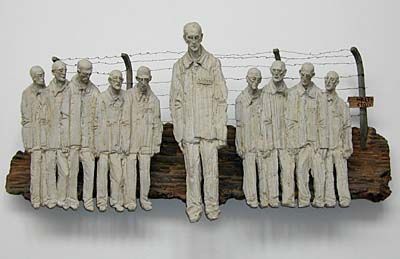
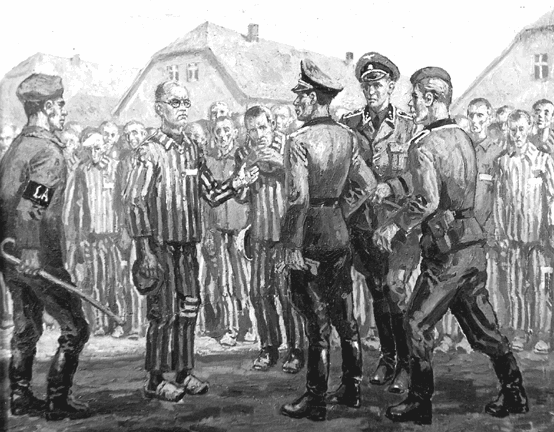
At that time, to discourage escapes, the guards at Auschwitz had a rule that if a man escaped (or attempted to escape), ten men would be killed in retaliation. In July 1941, a man from Kolbe's bunker was believed to have escaped (although it was later discovered that he had drowned in one of the camp latrines). Ten men were selected to die in the most horrific manner—the ten would be placed in a “starvation chamber” where they would suffer without food or drink for two weeks. At the end of that time, if any survived, they would be executed by having carbolic acid injected into their veins.

One of the ten men selected, Franciszek Gajowniczek, sobbed upon being pulled out of formation: "My poor wife. My poor children - what will they do?" Maximilian stepped silently forward, took off his cap, and standing before the commandant, said, "I am a Catholic priest. Let me take his place. I am old. He has a wife and children."

The Nazi commandant asked, "What does this Polish pig want?"

Father Kolbe pointed with his hand to the condemned Franciszek Gajowniczek and repeated "I am a Catholic priest from Poland; I would like to take his place, because he has a wife and children."

Mr. Gajowniczek would later recall:

"I could only thank him with my eyes. I was stunned and could hardly grasp what was going on. The immensity of it: I, the condemned, am to live and someone else willingly and voluntarily offers his life for me - a stranger. Is this some dream?


I was put back into my place without having had time to say anything to Maximilian Kolbe. I was saved. And I owe to him the fact that I could tell you all this. The news quickly spread all round the camp. It was the first and the last time that such an incident happened in the whole history of Auschwitz.


For a long time I felt remorse when I thought of Maximilian. By allowing myself to be saved, I had signed his death warrant. But now, on reflection, I understood that a man like him could not have done otherwise. Perhaps he thought that as a priest his place was beside the condemned men to help them keep hope. In fact he was with them to the to the last.'”

Father Kolbe, along with the other victims, were left to starve in Building 13. Maximilian Kolbe encouraged the others with prayers, psalms, and meditations on the Passion of Christ. After the two weeks, only four remained alive. The cell was needed for more victims so the camp executioner came in and injected a lethal dose of carbolic acid into the left arm of each of the four dying men. Kolbe was the only one still fully conscious. With a prayer on his lips, the last prisoner raised his arm for the executioner.

Bruno Borgowiec, a fellow prisoner assigned to give services to that bunker, gave a personal testimony about Maximilian Kolbe’s death to his parish priest before he died in 1947:

"The ten condemned to death went through terrible days. From the underground cell in which they were shut up there continually arose the echo of prayers and canticles. The man in-charge of emptying the buckets of urine found them always empty. Thirst drove the prisoners to drink the contents. Since they had grown very weak, prayers were now only whispered. At every inspection, when almost all the others were now lying on the floor, Father Kolbe was seen kneeling or standing in the center as he looked cheerfully in the face of the SS men. Father Kolbe never asked for anything and did not complain, rather he encouraged the others, saying that the fugitive might be found and then they would all be freed. One of the SS guards remarked: ‘this priest is really a great man. We have never seen anyone like him.’ Two weeks passed in this way. Meanwhile one after another they died, until only Father Kolbe was left. This the authorities felt was too long. The cell was needed for new victims. So one day they brought in the head of the sick-quarters, a German named Bock, who gave Father Kolbe an injection of carbolic acid in the vein of his left arm. Father Kolbe, with a prayer on his lips, himself gave his arm to the executioner. Unable to watch this I left under the pretext of work to be done. Immediately after the SS men had left I returned to the cell, where I found Father Kolbe leaning in a sitting position against the back wall with his eyes open and his head drooping sideways. His face was calm and radiant."

Father Maximilian Mary Kolbe was 47 years old when he was executed, on the vigil of the Feast of the Assumption of Our Lady. His body was burned in the crematorium on the following day, the Feast of the Assumption. He had stated years earlier: “I would like to be reduced to ashes for the cause of the Immaculata, and may this dust be carried over the whole world, so that nothing would remain.”

Pope John Paul II, in his homily at the canonization of Maximilian Mary Kolbe, proclaimed the character and steadfastness of a man who believed in the supreme value of every human life:

“’Greater Love has no man than this that a man lay down his life for his friends.’ (John 15:13). From today on, the Church desires to address as “Saint” a man who was granted the grace of carrying out these words of the Redeemer in an absolutely literal manner.” For towards the end of July, 1941, when the camp commander ordered the prisoners destined to die of starvation to fall in line, this man-Maximilian Mary Kolbe spontaneously came forward and declared himself ready to go to death in the place of one of them. This readiness was accepted and, after more than two weeks of torment caused by starvation, Father Maximilian’s life was ended with a lethal injection on August 14, 1941.”

The life and works of Saint Maximilian Mary Kolbe are hard to imagine. His suffering and death are remarkable, and impossible to comprehend. They seem as events of the distant past, when in fact these things happened only 70 years ago. Since that time, genocide and other forms of disrespect for the dignity of human lives have continued unabated across the world. Saint Maximilian found his strength through devotion and consecration to Our Blessed Mother—the refuge of sinners, advocate for mankind, mediatrix of grace, and co-redemptrix of the world. Through his love for Mary, he urged aggressive promotion of the love of Christ on earth, to build a kingdom of God. We each are called to action, to confront the evils of the world, and to stand up for the dignity and respect of every human life!


Selected Quotations from Saint Maximilian Mary Kolbe:

"God sends to us the one who personifies his love: Mary, the spouse of the Spirit - a spirit of maternal love - immaculate, all beautiful, spotless, even though she is our sister, a true daughter of the human race."
"Sanctity is not a luxury but it is an obligation, and is not difficult."

“The most deadly poison of our times is indifference. And this happens, although the praise of God should know no limits. Let us strive, therefore, to praise Him to the greatest extent of our powers.”

“For Jesus Christ I am prepared to suffer still more.”
“No one in the world can change truth. What we can do and should do is seek it and serve it when it is found."

"God dwells in our midst, in the Blessed Sacrament of the altar."

"He remains among us until the end of the world. He dwells on so many altars, though so often offended and profaned."

"The culmination of the Mass is not the consecration, but Communion."
"You come to me and unite Yourself intimately to me under the form of nourishment. Your Blood now runs in mine, Your Soul, Incarnate God, co penetrates mine, giving courage and support. What miracles! Who would have ever imagined such!"

"If angels could be jealous of men, they would be so for one reason: Holy Communion."


Gracious God, you filled your priest and martyr, Saint Maximilian Kolbe, with zeal for souls and love for his neighbor. Through the prayer of this devoted servant of Mary Immaculate, grant that in our efforts to serve others for your glory we too may become like Christ your Son, who loved his own in the world even to the end, and now lives and reigns with you and the Holy Spirit, one God, for ever and ever. Amen.


Year 2: Day 226 of 365
Prayer Intentions: Respect for the dignity of all human life.
Requested Intentions: For personal family intentions, for the sick, poor, hungry, and homeless (G); Financial security and peace (J); Grace, peace, and obedience to the will of God in a marriage (H); Successful and blessed marriage for sin, freedom from anxiety for husband, spiritual contentedness for family (N); Employment and health for a husband (B); Recovery and health of a mother (J); For a family to grow closer to the Church, salvation for all children (D); Successful employment (L); Successful employment (S); Renewal of faith life (A); Support for an intended marriage, health for friend and aunt (J); Mental health assistance for son (G); Freedom from illness (S); Successful employment (C); Financial assistance and employment (B); For a family’s intentions (T); Successful examination results (B); Healing of a friend with cancer, for all those who help others (B); Healing and love (L); Grace and healing (V); Healing of a heart, consecration of a marriage (M); Health of a family, intentions of apostolate (H); For repentance (J); For a family in trouble (R); Healing, successful relationships for son, financial success (J); Success of a company (L); For a religious society (J); Healing of a husband, strength as a faithful caregiver (D); Healing of a son (T); Financial security, Healing and guidance (M); Healing of a heart and relationship (V); Employment for daughter (J); For a marriage that glorifies the Lord (K); Resolution of family situation, parents’ health (A); Positive results (C); For a son’s employment, faith, and relationships (S).

June 15: Saint Germaine of Pibrac, the "Holy Shepherdess"

Posted by Jacob

Today, June 15, we celebrate the feast day of Saint Germaine Cousin (1579-1601), virgin of the Church, a long-suffering young woman who despite her trials lived a life of simple love and adoration of the Lord. Through her witness, the grace and peace of Christ shone into the lives of those she encountered, deepening faith, affecting conversion, and working miracles. Saint Germaine Cousin is the patron saint of victims of child abuse, a problem that continues to impact millions of children world-wide each year, and an estimated 800,000 children in the United States. UNICEF estimates that nearly 20% of girls and 10% of boys will be victims of physical or sexual abuse prior to the age of 18. From this startling statistics, it is clear that our world needs the intercession of Saint Germaine now, more than ever!


Germaine was born to a poor farming family in Pibrac, France, just north of Toulouse. She was born quite ill, and suffered numerous birth defects including a paralyzed and deformed right hand. Her mother, who passed away while Germaine was an infant, was a pious and loving woman who efficiently ran the household, caring for Germaine and nurturing her through frailty and sickness. Upon her death, Germaine’s father was left unable to care for himself and quickly re-married a mean-spirited and cruel woman named Hortense. Germaine’s new stepmother quickly turned on her, subjecting her to emotional and physical cruelties and insults. Her father, afraid to lose his new wife, pretended not to notice, focusing his attention on the new children that he and Hortense produced.

Germaine, just a girl, was left to fend for herself. Given virtually no food—even as a toddler—she learned at an early age to crawl to the dog’s dish, eating discarded scraps left for the shepherding canines. While caring for the farm’s chickens, Hortense set the infant Germaine down on a recessed grate, forgot about her, and left her in the cold barn for three days before finding her. She further scalded the young girl’s legs with hot water, beat her, and fed her scraps—all for imagined misdeeds.

Germaine, who Hortense quite vocally considered ugly, grew frailer and sicker from her mistreatment, coming down with a form of Tuberculosis which causes bleeding sores and lesions and swelling of the neck. Repulsed by her step-daughter’s appearance, and afraid that she would spread her disease to the other children, Hortense forced sickly Germaine to sleep in the barn. There, she received comfort and warmth from the sheep of the family’s flock, burrowing beneath their wooly coats during the frigid winters.

Sadly, having learned by watching Hortense, Germaine’s step-siblings were no more kind to her than her stepmother. The spent their days in leisure, tormenting Germaine, while she performed household chores. When she was provided with food, her step-siblings made sure that they had mixed inedible ash into it. On the rare occasions she was given clean clothing, they quickly covered it with pitch from the trees, making it sticky and unwearable.

Starving, maligned, sick, and ill-treated, Germaine never once cried out in hatred. Rather, she turned to the Lord. Uneducated, when she was nine years old she was put in charge of the family’s flock of sheep, with whom she spent her days in the fields. With only sheep for company, Germaine prayed the few prayers she had memorized in Catechism, as well as a homemade Holy Rosary, made from knotted string, which she carried in her pocket. Her favorite prayer was simple and obedient: "Dear God, please don't let me be too hungry or too thirsty. Help me to please my mother. And help me to please you." From her simple request, repeated daily, grew an inspiring faith, profound holiness, and a deep trust of God.

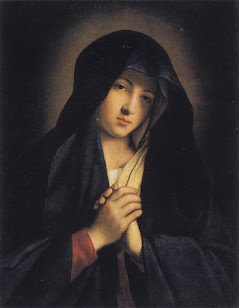
Saint Germaine was especially devoted to Our Blessed Mother. Not only did she make and pray the Rosary, she gathered children of the village to teach them the catechism, demonstrating with her Rosary, and instilling in them the love of Jesus and Mary. Her devotion to the Angelus is said to have been so great that she would fall on her knees at the sound of the bells, even if she were crossing a stream.

Saint Germaine left her flock each day, in the care of the Lord and her guardian angel, setting down her staff and crook, and walking into the nearby town to attend daily Mass. She never worried about her sheep, confident that the Lord would watch over them. And despite the constant threat of thieves and wolves, no harm every came to her flock. Miraculously, on a day when it had rained torrentially, local villagers witnessed the swollen river that Germaine was forced to cross on the way to Mass part, allowing her to walk on dry land to the church.

Despite having so little, Germaine readily shared all she had in love and charity. The few scraps she was provided for food each day more often than not were given to those less fortunate than her. Her clothing, thin and unsuitable for the cold winters, could be found on the shoulders of those she encountered, she, herself, preferring to go cold than watch another suffer. She engaged in many self-imposed austerities, in reparation for the sins of the world. Her life of charity, self-denial, penance, and piety became well known to the townspeople, who began to look upon her with respect and awe.

When word of her holiness reached her stepmother, Hortense was predictably angry. Hoping to catch her step-daughter giving away the family’s food after discovering that she had let a beggar sleep in the barn, Hortense confronted Germaine. Livid, she knocked the wrapped bundle that Germaine was carrying from her arms, expecting to see the family’s bread being given away to the hungry. Instead, despite it being in the midst of winter, when Germaine opened her apron, out fell bright beautiful flowers should not have been in bloom until springtime. Germaine handed her stepmother a flower saying, "Please accept this flower, Mother. God sends it to you in sign of his forgiveness." In her heart, Germaine had forgiven her stepmother—the woman who had tormented her for years—as well.

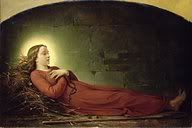
As the days went on, Hortense began to change, softening at first, later inviting Germaine back into the house to sleep. Germaine, now used to the straw of the barn, and not wishing to become too comfortable when so many were suffering, refused. It was there, laying in the barn with her sheep, with her Rosary entwined in her fingers, she died peacefully at age 22, her long, difficult life finally taking its toll on her frail body. That same morning, a group of traveling priests and religious hurried into the village, saying: "Last night I saw a virgin going up to Heaven. She was wearing a brilliant crown and was accompanied by a crowd of angels that were brighter than the stars." The faithful townspeople knew at once that it was Germaine, the holy shepherdess.

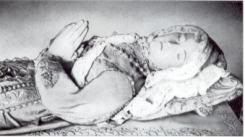
Saint Germaine’s body was buried in the church at Pibrac, her simple life, faith, and holiness momentarily forgotten about by the world, except by the local devout who recounted stories of her piety and the miracles they had witnesses. Forty years after her burial, the body was exhumed and found to be incorrupt, exuding the sweet smell of sanctity, smiling a gentle smile. Two hundred years following that, during the French Revolution, heretics opened her lead casket and desecrated her body, again finding it incorrupt. Following the war, her undamaged body (save where some lime had been thrown on her garments) was re-interred. The Lord had preserved His beautiful creature, and immediately numerous miracles were attributed at her tomb and through her intercession. As of today, over 400 miraculous cures, multiplications of food, and other miracles have been recorded. Annually, thousands of faithful continue to visit the church at Pibrac on pilgrimage, to pray before her relics.

Saint Germaine’s life reminds us that we all are burdened in some way by shortcomings—whether it be loneliness, dissatisfaction with our appearance, illness, infirmity, poverty, hardship… the list is endless. Saint Germaine suffered all of these trials, and did so joyfully, looking to the Lord for guidance and safety, thanking Our Blessed Mother for the many graces she had received. We pray today for the simple faith and obedience of Saint Germaine—that we, too, may turn to the Lord in our times of deep distress and hurt, and simply pray that despite our weaknesses, we please Him.


O Saint Germaine, look down from Heaven and intercede for the many abused children in our world. Help them to sanctify these sufferings. Strengthen children who suffer the effects of living in broken families. Protect those children who have been abandoned by their parents and live in the streets. Beg God's mercy on the parents who abuse their children. Intercede for handicapped children and their parents.


Saint Germaine, you who suffered neglect and abuse so patiently, pray for us. Amen.