Why pray the Rosary every day for a year?


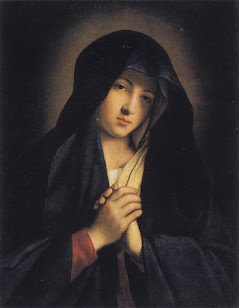
Each time the Blessed Virgin has appeared-- whether it be to Saint Bernadette Soubirous at Lourdes; to Lucia, Jacinta, and Francisco at Fatima; or to Mariette Beco at Banneux-- she has asserted the importance, saving grace, and power of praying the Holy Rosary on a daily basis. Based upon her words, the Rosary is penance and conversion for sinners, a pathway to peace, an end to war, and a powerful act of faith in Jesus Christ. Pope Paul VI presented the Rosary as a powerful means to reach Christ "not merely with Mary but indeed, insofar as this is possible to us, in the same way as Mary, who is certainly the one who thought about Him more than anyone else has ever done."

To show us how this is done, perhaps no one has been more eloquent than the great Cardinal Newman, who wrote: "The great power of the Rosary consists in the fact that it translates the Creed into Prayer. Of course, the Creed is already in a certain sense a prayer and a great act of homage towards God, but the Rosary brings us to meditate again on the great truth of His life and death, and brings this truth close to our hearts. Even Christians, although they know God, usually fear rather than love Him. The strength of the Rosary lies in the particular manner in which it considers these mysteries, since all our thinking about Christ is intertwined with the thought of His Mother, in the relations between Mother and Son; the Holy Family is presented to us, the home in which God lived His infinite love."


As Mary said at Fatima, "Jesus wants to use you to make Me known and loved. He wishes to establish the devotion to My Immaculate Heart throughout the world. I promise salvation to whoever embraces it; these souls will be dear to God, like flowers put by Me to adorn his throne."


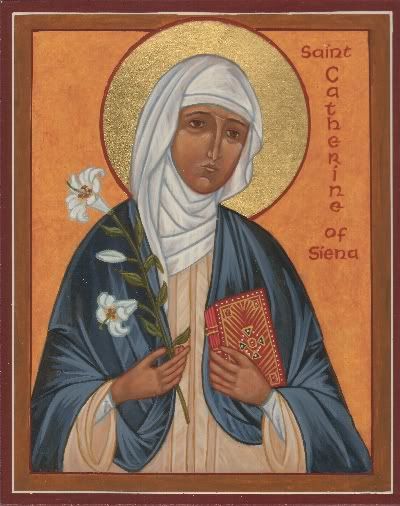
April 29, 2013: Saint Catherine of Siena

Posted by Jacob


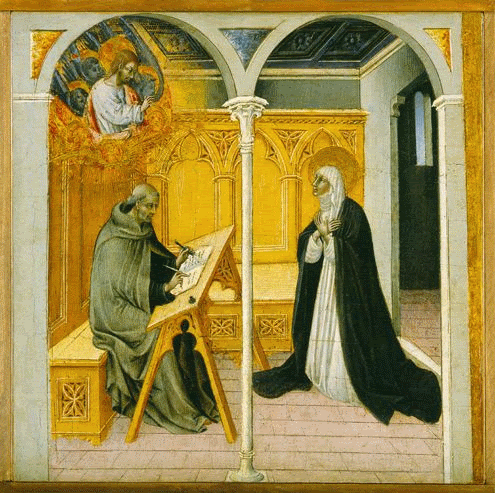
Today, April 29, we celebrate the feast day of a truly holy woman, Saint Catherine of Siena (1347-1380), virgin, mystic, and Doctor of the Church. A individual must fulfill three requirements to be deemed a Doctor of the Church: 1) holiness that is truly outstanding, even among saints; 2) depth of doctrinal insight; and 3) an extensive body of writings which the church can recommend as an expression of the authentic and life-giving Catholic Tradition. The life of Saint Catherine of Siena easily meets these criteria.


Saint Catherine was born the 23rd child of a poor wool dyer in Northern Italy. She was marked by the sign of holiness from a young age, clearly experiencing visions by the age of six in which she saw both her neighbors and their guardian angels simultaneously. That same year, at age 6, she was observed to fall into a religious ecstasy while reporting a vision of Christ, dressed as the pope, and the apostles. In her vision, Christ blessed her, anointing her with her earthly mission. As she aged, her intelligence and beauty grew, along with her piety. As she approached marrying age, her mother encouraged her to look for a spouse, but Catherine instead cut off her hair (to make herself less attractive) and committed herself to a life of prayer and meditation, consecrated a virgin bride of Christ. While her mother was distraught, her father encouraged her, setting aside a room of the family’s small home for Catherine to use in pursuit of her spiritual endeavors.

At age sixteen, Catherine took the habit of the Dominican Tertiaries (Third Order of Saint Dominic), where she continued to have ecstatic visions of Christ, Our Blessed Mother, and the saints. During these visions, she engaged in familiar conversations with Christ over three years, and underwent the mystical experience of “mystical espousal” to Christ.

Despite her lack of formal education, the writings of Saint Catherine are regarded as treasures of the Church, and her mind one of the most brilliant theological minds throughout the ages. She was a prolific writer, the most famous of her works being The Dialogue, which she dictated while experiencing her ecstatic visions and conversations with Christ. In this work, she expounds on the mysteries of the Church, the Creed, the sinfulness of man, and the divine mercy of the Lord.

Saint Catherine experienced visions of both heaven and hell while on earth. She worked tirelessly, through letters (over 400!) and counsel to church and world leaders—including Pope Gregory XI and various kings and queens of the time. Her goal was church reform, inspired by her visions of Christ, and her call to public service. Saint Catherine devoted her free time to the poor and ill, and the conversion of sinners. Five years prior to her death, Catherine was graced with the stigmata, although she kept this a secret due to her humility. Saint Catherine is said to have eaten very little during her life, with the exception of Holy Eucharist each day. She bore continuous stomach ailment and discomfort without complaint, uniting her suffering to that of Christ. Saint Catherine engaged in severe forms of mortification, wearing a metal shirt which cut into her hips, beating herself with a chain for her own sins (and those of others), sleeping on a wooden bench, and oftentimes refusing to speak. For Catherine, the greater her suffering, the greater the triumph of heaven!

During her lifetime, the Church experienced great turmoil, which Catherine sought to reconcile. She offered herself and her life as a victim for the Church in it’s agony. Saint Catherine died when she was only 33, and upon exhumation of her body over 100 years later, was found to be incorrupt. Her head and thumb, miraculously smuggled out of Rome during time of persecution (upon examination by guards, the bag in which her head was hidden was observed to be filled with rose petals, but upon moving past the guards, the roses disappeared and the holy face of Saint Catherine returned), were returned to Siena, where they remain incorrupt in the Basilica of San Domenico. Numerous miracles have been recorded through her intercession.

The life and inspiration of Saint Catherine of Siena can best be found in her words, preserved in over 400 letters written in her hand, numerous prayers, as well as in The Dialogue. Selected quotations are presented below. The words of Saint Catherine remind us of our faith, of our weakness and sinfulness, and of the unending love and mercy of the Lord. In her words, everything we do should begin in love—love for our neighbors, love for our Lord, love for ourselves. The Lord does nothing without love in mind, and Saint Catherine reminds us that neither should we!


Selected Writings of Saint Catherine of Siena

“So take a lesson from the true father and shepherd. For you see that now is the time to give your life for the little sheep who have left the flock. You must seek and win them back by using patience and war–by war I mean by raising the standard of the sweet blazing cross and setting out against the unbelievers. so you must sleep no longer, but wake up and raise that standard courageously. I am confident that by God’s measureless goodness you will win back the unbelievers and [at the same time] correct the wrongdoing of Christians, because everyone will come running to the fragrance of the cross, even those who have rebelled against you most.”

“No one should judge that he has greater perfection because he performs great penances and gives himself in excess to the staying of the body than he who does less, inasmuch as neither virtue nor merit consists therein; for otherwise he would be an evil case, who for some legitimate reason was unable to do actual penance. Merit consists in the virtue of love alone, flavored with the light of true discretion without which the soul is worth nothing."

"If not for my sins, the world would be a better place."

“You know that the devil is not cast out by the devil, but by virtue.”

"There is no perfect virtue-none that bears fruit- unless it is exercised by means of our neighbor."

“Charity is the sweet and holy bond which links the soul with its Creator: it binds God with man and man with God.”

“Eternal Trinity, Godhead, mystery deep as the sea, you could give me no greater gift than the gift of yourself. For you are a fire ever burning and never consumed, which itself consumes all the selfish love that fills my being. Yes, you are a fire that takes away the coldness, illuminates the mind with its light, and causes me to know your truth. And I know that you are beauty and wisdom itself. The food of angels, you gave yourself to man in the fire of your love.”

“Everything comes from love, all is ordained for the salvation of man, God does nothing without this goal in mind.”

“And let the truth be your delight; let it always be in your mouth, and proclaim it when it is needed. Proclaim it lovingly and to everyone, especially those whom you love with a special love---but with a certain congeniality, putting the shortcomings of the other person on your own shoulders. If in the past you haven't done it as sensitively as you should, let's do better in the future.”

“I long to see you a productive tree planted in fertile soil and laden with sweet mellow fruit. For a tree uprooted from the soil (I mean the soil of true self-knowledge) would dry up and bear no fruit.”

“We lack nothing but virtue and hunger for the salvation of souls---but there is a remedy for this, father: that we do away with loving ourselves or anyone or anything else apart from God. Let us concentrate no longer on friends or relatives or on our own material needs, but only on virtue and the promotion of spiritual matters. For the only reason you are wanting for material things is your abandonment of concern for the spiritual.”

“Learn from the Master of truth, who preached virtue only after he had practiced it.... To this wonderful school, then, my children!... Open your ears, I tell you, to hear his teaching --- and it is this: voluntary poverty; patience in the face of injury; returning good to those who do us evil; being little, humble, oppressed and forsaken in the world; with ridicule, torment, wrongs, insults, detraction, gossip, difficulties, and harassment from the world.... No more indifference, then! No more sleeping in unawareness! No, with bold and blazing heart stretch your sweet loving desires to go and give honor to God and your best efforts to your neighbors, never losing sight of your objective, Christ crucified.”

"Love is the most necessary of all virtues. Love in the person who preaches the word of God is like fire in a musket. If a person were to throw a bullet with his hands, he would hardly make a dent in anything; but if the person takes the same bullet and ignites some gunpowder behind it, it can kill. It is much the same with the word of God. If it is spoken by someone who is filled with the fire of charity- the fire of love of God and neighbor- it will work wonders."

"Everything comes from love, all is ordained for the salvation of man, God does nothing without this goal in mind."

"Merit consists in the virtue of love alone, flavored with the light of true discretion without which the soul is worth nothing."

"Strange that so much suffering is caused because of the misunderstandings of God's true nature. God's heart is more gentle than the Virgin's first kiss upon the Christ. And God's forgiveness to all, to any thought or act, is more certain than our own being."

“When then, eternal Father, did you create this creature of yours?…You show me that you made us for one reason only: in your light you saw yourself compelled by the fire of your love to give us being in spite of the evil we would commit against you, eternal Father. It was fire, then, that compelled you. Oh, unutterable love, even though you saw all the evils your creatures would commit against your infinite goodness, you acted as if you did not see and set your eye on the beauty of your creature, with whom you had fallen in love like one drunk and crazy with love…You are the fire, nothing but a fire of love, crazy over what you have made.”

“My Lord, turn the eye of your mercy on your people and on your mystic body, holy Church. How much greater would be your glory if you would pardon so many and give them the light of knowledge! For then they would surely all praise you, when they see that your infinite goodness has saved them from deadly sin and eternal damnation. How much greater this than to have praise only from my wretched self....


So I beg you, divine eternal love, to take your revenge on me, and be merciful to your people. I will not leave your presence till I see that you have been merciful to them.”


Prayers Composed by Saint Catherine of Siena

Holy Spirit, come into my heart, by your power I journey to You, God, and grant me charity with fear. Protect me, o Christ, from every evil thought, warm me with Your sweet love, so that each burden seems light to me. My holy Father and my sweet Lord, help me always in all my endeavors, Christ love, Christ love. Amen.

Precious Blood,
Ocean of Divine Mercy:
Flow upon us!
Precious Blood,
Most pure Offering:
Procure us every Grace!
Precious Blood,
Hope and Refuge of sinners:
Atone for us!
Precious Blood,
Delight of holy souls:
Draw us! Amen.


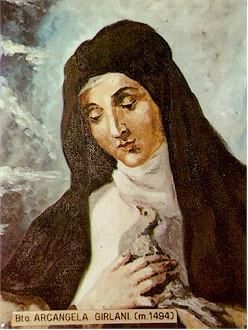
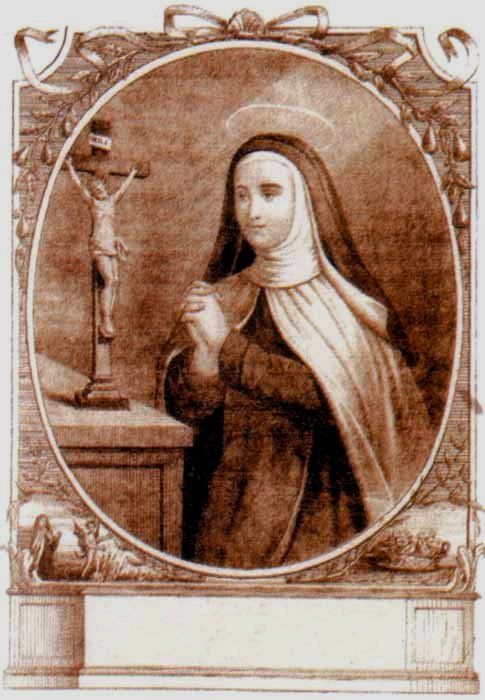
February 13, 2013: Blessed Archangela Girlani

Posted by Jacob

Today, February 13, we celebrate the feast of Blessed Archangela Girlani (1460-1495), virgin, foundress, and miracle worker. The life of Blessed Archangela is one of deep faith and commitment to the Lord. Willing to reconsider her own plans for those that the Lord placed before her, Archangela served and followed wherever the Holy Spirit led her.


Born Eleanor Girlani in the small Italian town of Trino (Piedmont), Eleanor demonstrated great piety and holiness as a child. Despite her family’s noble heritage, her only ambition in life was to become a Benedictine sister, and together with some friends and relatives, she prepared to travel to the monastery of Rocca delle Donne, who had agreed to accept and raise her as a member of the Order. However, this was not to occur. Upon mounting her horse to travel, the animal refused to carry her to the monastery. As this particular horse was one of gentle and obedient spirit, the animal’s refusal to move was interpreted as a sign from the Lord, and Eleanor returned home. Despairing, she prayed for guidance and contented herself in her own daily practices of contemplation, penance, and service to others.

Eleanor soon encountered a Carmelite monk, who introduced her to the sisters of the Carmelite Order. Understanding this as divine intervention, Eleanor sought admission, and was accepted into the Order on her seventeenth birthday. She lived and served in the convent of Maria Maddalena in Parma, along with her sisters Mary and Scholastica.

Eleanor received the veil as a Carmelite sister at age eighteen, taking the name Archangela as her own. She was made Prioress of the abbey, given her nobility (as was the custom of the time), and became a model of Christian virtue to her sisters. Especially devoted to the Holy Trinity, Archangela spent hours in the chapel praying and contemplating the divinity of the Lord.

Sister Archangela soon was requested to found an additional abbey in Mantua, which was named Santa Maria del Paradiso (The Convent of Mary in Paradise). There, under her direction, sisters of the Order lived as if already absorbed into heaven. The monastery developed a reputation for great holiness, and received many new sisters. As prioress, Archangela experienced great ecstasies, some lasting well over 24 hours, and on more than on occasion was discovered by her sisters to be levitating above the ground while contemplating the Holy Trinity. She further performed many miracles.

Only three years after founding the monastery at Mantua, Blessed Archangela fell gravely ill. Strengthened with the Sacraments and with her eyes fixed on an image of the Crucified Christ, she repeated her frequently uttered words; “Jesus, my Love" and peacefully died at the young age of thirty-four. Based upon her request, was buried in the simplicity of a common grave at the monastery. Three years later, when the tomb was re-opened to commit another sister to the earth, her remains were found incorrupt and exuding the fragrance of holiness. Great miracles were reported, and her relics were enclosed in a crystal tomb, and placed above the alter at the monastery.

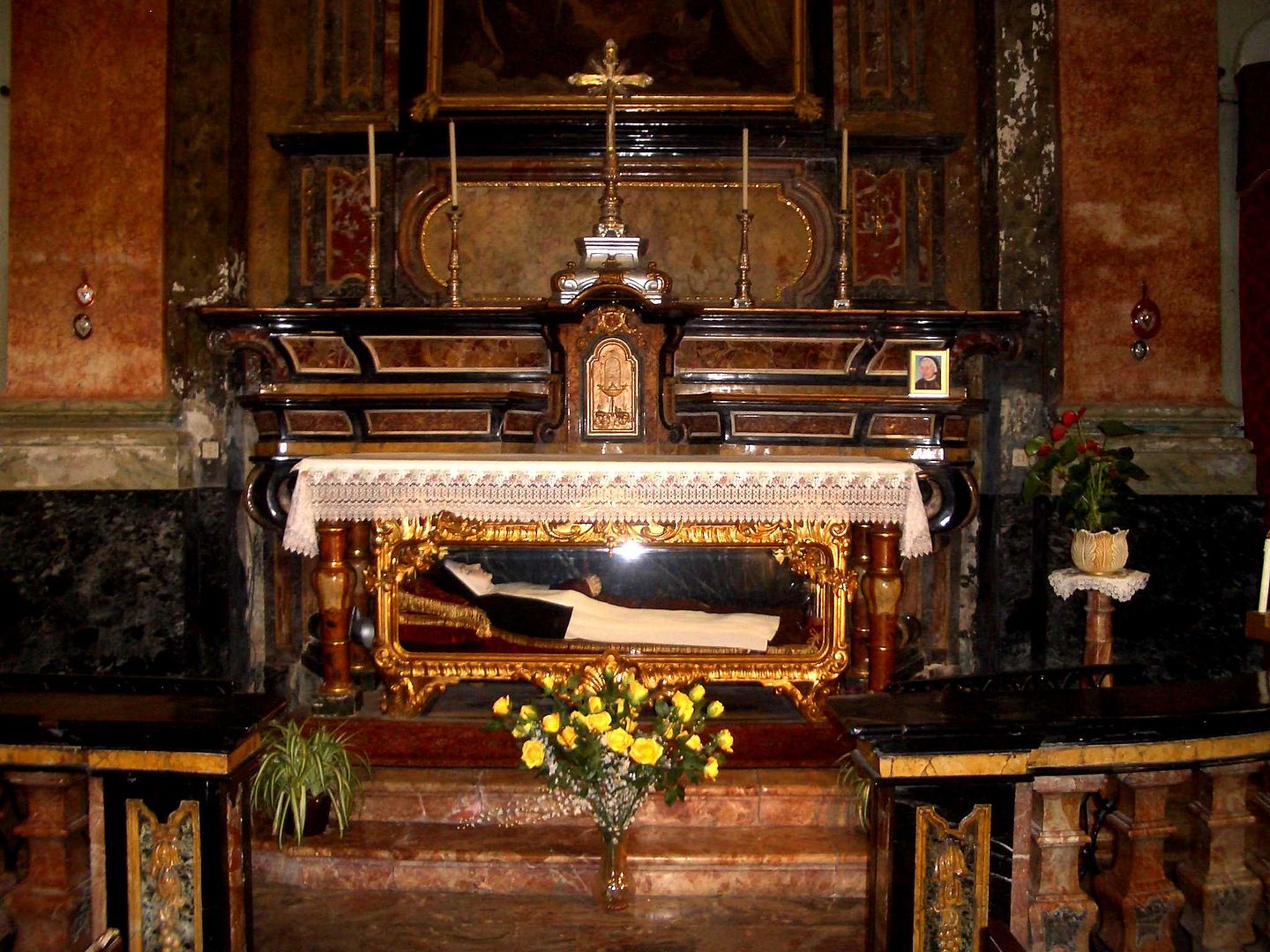
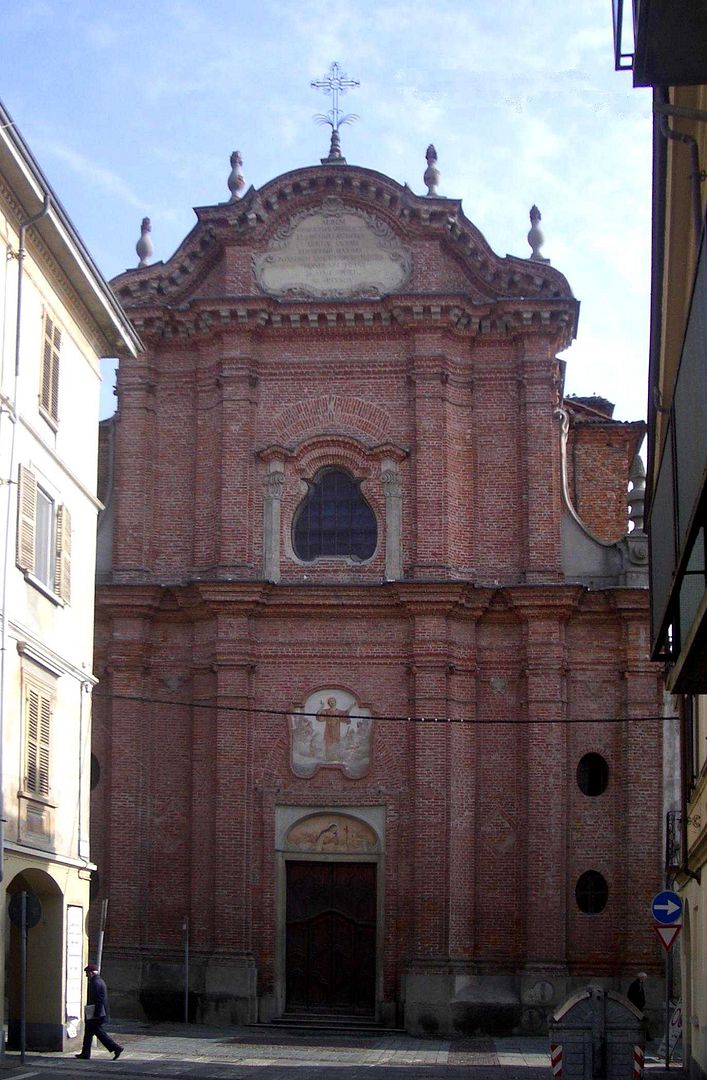
Nearly 300 years after her death, the monastery in Mantua was closed, and Archangela’s relics were translated to Trino, where she had been born. Her relics, still venerated today, were placed in the church of Saint Lorenzo. There, her body rests, wearing the habit of the barefoot Carmelite, in a casket of crystal.

Incorrupt Body of Beata Archangela Girlani


Church of San Lorenzo in Trino

Blessed Archangela’s life reminds us that we should remain vigilant in our daily lives, seeking out the plan of God, and following it to the best of our abilities. Blessed Archangela placed her life and destiny squarely in the hands of the Lord, and He led her to a place of deep connection, mysticism, ecstasy, and miracle-working. We pray for her same dedication and willingness to listen to the call of the Lord, that we might follow in her footsteps.


Father in heaven,
you gave the virgin Blessed Archangela Girlani
particular dedication to the mystery of the eternal Trinity.
Through her prayers
may we taste the delights of your glory
already here on earth,
and look upon you for ever in heaven.

We ask this through Christ, our Lord.
Amen.


January 16, 2013: Saint Fursey, Bishop of Ireland

Posted by Jacob


Today, January 16, we celebrate the feast day of Saint Fursey (575-650, also known as Saint Fursa, Fursy, or Furseus), Bishop of Ireland, visionary, missionary in East Anglia, and founder and abbot of monasteries.  Saint Fursey is remembered not only for his missionary work, but also for his ecstasies and visions of the afterlife, including clear visions of Purgatory.  Much of his life was recorded by the Venerable Bede, who wrote of him with the highest esteem.
Saint Fursey was born on the island of Inisguia en Lough Carri, Ireland.  Born into a noble family, his brothers, Saints Foillan and Ulan, were also called to the faith early in life.  Fursey left home at a young age, and went to the monastery built by Saint Meldan, located on Quinn Island. “He was of very noble Irish blood!” writes Venerable Bede, "but was much more noble in mind than by birth… He gave himself very much to reading holy Writ and following the monastic life even from his boyhood; and he did everything that he learned ought to be done as is befitting holy men!” 
Following his studies at the monastery on Quinn Island, Saint Meldan sent Fulsey to build a monastery at Eathmat.  This he did, also preaching and traveling on mission work throughout Ireland.  He converted many, drawing more and more into the faith.  However, Fursey felt called to leave Ireland and spread the faith beyond her borders. ''Fursey,” wrote Venerable Bede, “after having preached the Word of God for many years in Ireland, being unable to bear the crowds that flocked about him, leaving everything, went away from his country, and came with a few brethren through the country of the British into the country of the East-Angles. This holy man, famous for his words and works and for his wonderful goodness, wishing to live as an exile for our Lord, came out of Ireland at the time that Saeberht was King, (a.d. 633.) When he had come to the country of the East-Angles he was welcomed and treated with great honour by the King. He at once gave himself to the holy work of preaching the Word of God, and by his great holiness of life and by his sermons, he brought many unbelievers into the sheepfold of Jesus Christ, and strengthened the faithful in the Faith and in the love of God.”
Saint Fursey eventually fell ill, worn out by his tireless preaching and evangelization.  He was not expected to life long, but rather than succomb, he continued praying and undertook the construction of a monastery on land given to him by the king.   He also began experiencing visions and ecstasies, the Lord gifting him with knowledge of the afterlife.  The Venerable Bede wrote, “Fursey built the monastery in order to give himself more freely to the study of heavenly things. He fell sick whilst living there, and being in a swoon, and out of his body, was found worthy to behold the choirs of the Angels and to hear the hymns that are sung in heaven. He beheld three days afterwards the happiness of the Blessed: the Devils who strove to hinder him reaching heaven, and the Angels who shielded him from their attacks. He heard the Devils accusing him of his deeds, words, and thoughts, as if they were written in a book: and he also heard wonderful things, both woeful and gladsome, from the Angels and from the Blessed!”
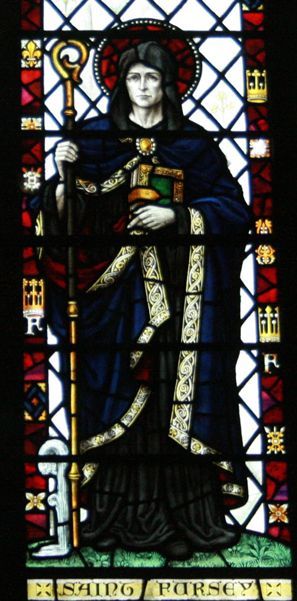
“When he was borne up aloft he was told by the Angels who were by his side to look downwards towards the earth.  He looked, and beheld beneath him a darksome valley and four fires blazing near each other. He asked the Angels to tell him what these fires meant, and they said: ‘These fires shall burn the earth to ashes: one is Falsehood and the breaking of the promise made at Baptism to renounce the Devil and his works; the other is Covetousness and the preferring worldly wealth to heavenly things: the other is Discord and offending fellow-men: the fourth is Wickedness and robbery of the weak.' He then beheld the four fires mingle and become a great blaze. An Angel made a pathway through it, and an Angel flying with outstretched wings on each side of him warded off the flames. He saw devils flying through the fire. He then got a glimpse of heaven. As Fursey, led by Angels, was going through the pathway in the fire on his way back to earth a Devil laying hold of a person whom he was torturing in the fire, threw him at him and burned him on his shoulder and cheek; but the Angel threw him back into the fire. The Devil said to Fursey: “Do not reject him whom you before received, for as you accepted the goods of this sinner, so you should have a share in his punishment!” The Angel answered: “He did not receive it through avarice, but to save his soul!” and turning to Fursey, the Angel said: “That which you enkindled burned in you: for had you not received the money of this man who died in his sins, his punishment would not burn in you.’  Fursey bore the wound of the fire on his shoulder and cheek for the remainder of his life: the flesh showing outwardly what the soul had hiddenly endured. He ever strove both by word and example to persuade everyone to lead a holy life, but he would tell his visions only to those who wished to hear them and a desire of conversion.”
“An elderly Monk of our monastery is still alive who is wont to say that a very truthful and holy man had told him that he had seen Fursey in the province of the East Angles, and had heard those visions from his mouth, and added that Fursey when telling them, perspired, as if it were a very hot summer day, although it was very cold and frosty winter weather, and he was clothed with a thin garment!”  
Saint Fursey continued his life, surviving his illness, and lived to preach for many years from his new monastery.  He moved freely amongst the peoples, preaching the Word of God, praying, meditating, and celebrating Mass. Eventually, the toil of his work led him to seek refuge as a hermit, and he left the monastery to his faithful brothers and priests, and took up refuge as an anchorite, living in silence and contemplation for a year.
Despite his wish to remain in isolation, the world was changing, and the faith was threatened by invasions of non-believers.  Abandoning all, Saint Fursey sailed to France where he bolstered the faith of those living there, and built a monastery at Lagny.  Saint Fursey followed the invading heathens, blessing the dead, bringing joy and hope to those who suffered across East Agnlia, Austrasia, and Europe.  Back at the monastery at Lagny, he worked many miracles of health and healing, and was so enjoined to build another monastery at Peronne.  It was while traveling between that monastery and the monastery in East Anglia that an angel visited him, telling him that his time on earth was at an end.  Receiving the Sacraments, he died peacefully, and was buried at the monastery in Peronne.  Needing to be moved some time later, to be enshrined in the church alter, Saint Fursey’s body was found to be incorrupt. “The merits of St. Fursey," writes Venerable Bede, "have been made known by many miracles."
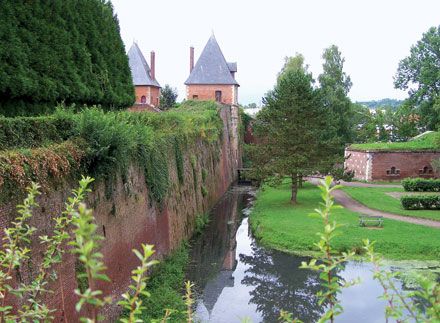
Monastery at Peronne

Hymn to Saint Fursey
Send back the hymn from Erin's Isle
That echoes from Peronne's blest pile,
While joyful choirs in solemn rite
With Fursey’s praise dispel sad night.
Tis here he builds his far-famed cell,
Tis here his brethren calmly dwell:
The water glances from his rod,
Though planted in the thirsty sod.
And yet that graceless woman rails,
And deems that silver nought avails,
If spent with large and generous hand
To raise high temples through the land
Lamp! Star that gleamest bright,
Saint Fursey shine upon our fight!
Keep up our strength, and take our part,
When death shall strike us with his dart.
May Jesus born of spotless Maid,
Sole fount of hope to all displayed,
With Father and with Holy Ghost,
Make Fursey's sons a heavenly host.


Prayer to Saint Fursey
The arms of God be around my shoulders,
The touch of the Holy Spirit upon my head,
The sign of Christ’s cross upon my forehead,
The sound of the Holy Spirit in my ears,
The fragrance of the Holy Spirit in my nostrils,
The vision of heaven’s company in my eyes,
The conversation of heaven’s company on my lips,
The work of God’s church with my hands,
The service of God and my neighbour in my feet,
And a home for God in my heart,
And to God, Father, Son and Holy Spirit my entire being.
Amen.


Throughout 2013, I will be posting the prayer requests received from the previous week on Sundays.  Please join me in lifting these intentions to Our Lord, through the intercession of Our Blessed Mother.

Prayer requests, 2013: Week 2:
Health and healing for a sick aunt (B, USA-CA);  Successful employment (E, Tanzania);  Healthy relationship, financial security (S, India); Resolution to legal situation (M, USA-TX); For the return home of a son (M, USA-MA); Health and healing for a family (M, USA-OR);  For a husband battling mental illness (M, USA-MN);  For an estranged son (J, USA-OH);  For healing and health, for financial security (F, Cameroon); Healing of a husband, blessings upon a family (S, India); For successful employment and financial security (J, USA-CA); Hope and healing, financial security, blessings upon a family (G, USA-CA); For employment for a daughter, for blessings upon a new career, for financial security (B, Canada);  For healing and hope for a mother and son (A, Denmark);  Healing and recovery (M, USA-OH); Reconciliation of a family, forgiveness, (M, India); For guidance in academic careers for children (S, South Africa); Occupational success, health and healing (F, United Kingdom);  Healing, strength, and hope (A, USA-LA); For successful return of fiancĂ© in military (E, Australia);.

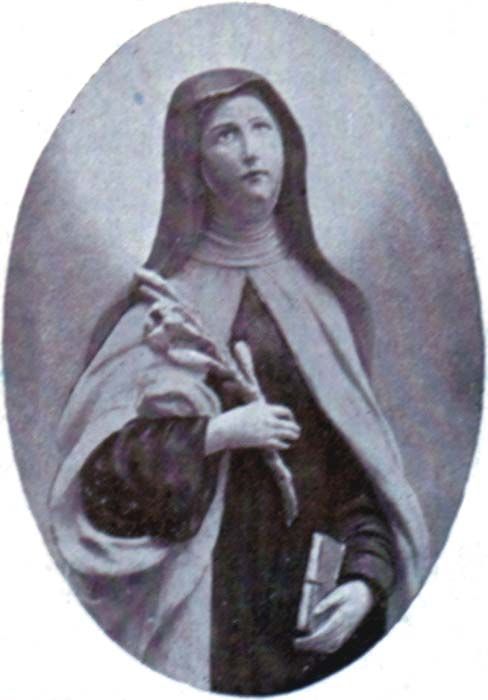
October 15: Saint Teresa of Avila

Posted by Jacob

Let nothing disturb you.

Let nothing make you afraid.
All things are passing.
God alone never changes.
Patience gains all things.
If you have God you will want for nothing.
God alone suffices.

Today, October 15 we celebrate the feast day of Saint Teresa of Avila (also known as Saint Teresa of Jesus, 1515-1582), Virgin, mystic, reformer of the Carmelite Order, and Doctor of the Church. Throughout her life, Saint Teresa was graced with mystical visions and ecstasies, through which she embraced the suffering of Christ. The fruits which remain of the life, labors and prayer of Saint Teresa of Avila bear to her virtue a living and enduring testimony which none can refuse to admit. Her numerous writings remain extant, inspiring the faithful to deeper communion with the Lord today.

Born Teresa Sánchez de Cepeda y Ahumada in the kingdom of Castile in Spain, Teresa was the youngest child of a virtuous nobleman. When she was just seven years old, Teresa fled from her home with one of her younger brothers, hoping to join a missionary trip to Africa, and there earn the crown of martyrdom. Discovered, and returned home, Teresa proclaimed to her angry father, “I want to see God, and I must die before I can see Him.”

Not to be dissuaded, Teresa thereafter began construction of a hermitage for she and her brother in the family garden. At age 12, her mother died, and Teresa’s father, wishing pious instruction for her, placed her in a boarding convent. There, Teresa initially struggled, rebelling against the convent lifestyle, and disobediently pursuing the frivolities of the world. Over time, however, she was filled with the grace of the Holy Spirit, through the careful guidance of the Carmelite Sisters, and decided to enter the religious life. Upon reaching age of consent, Teresa entered the Carmelite monastery of the Incarnation in Avila.

Again, Teresa struggled upon formally entering the religious order, and found herself easily distracted from the Lord. She started to learn and practice mental prayer, in which she "tried as hard as I could to keep Jesus Christ present within me....My imagination is so dull that I had no talent for imagining or coming up with great theological thoughts." Teresa prayed in this manner—unsuccessfully-- off and on for eighteen years without feeling that she was getting results. She still felt distant from the Lord, partly due to the fact that the convent was quite relaxed. The sisters received visitors—including eligible men—and the rigors of the religious life were not enforced. Because Teresa herself was so charming, she attracted many followers who visited the monastery for “spiritual guidance.” However, over time, Teresa came to realize that she was enjoying the flattery, gifts, and compliments she received from her visitors, and the sinfulness of these relationships were keeping her from the Lord.

At approximately age 30, Teresa fell seriously ill with malaria. She was plagued by seizures, and her sisters became so convinced that she was to die that when her fever broke four days later, Teresa found that her grave had already been dug. While she recovered, Teresa was paralyzed for three years, and was never again completely free from pain or suffering. Teresa struggled through her suffering to develop her interior prayer life, but viewed herself as such a sinner, she thought herself too wicked to pray. Eventually, she found her way, proclaiming, "Prayer is an act of love, words are not needed. Even if sickness distracts from thoughts, all that is needed is the will to love."

It was not until her 30s that Teresa broke free from her self-doubt, into the freedom of a relationship with the Lord. She began experiencing powerful visions and ecstasies, first of the suffering Christ, and later of hell. It was following her mystical vision of a place in hell being reserved for her due to her faults, that she devoted herself entirely to God. From that moment, Teresa’s every thought was of heaven and the Lord, but at a price. She lived in constant distrust of herself, fearing her worldly and frivolous ways would lead her away from God. Teresa enacted severe penances and bodily mortifications, fasting and praying constantly. Upon being named Prioress of the monastery (quite against her will), she placed a statue of Our Blessed Mother in the governing seat, offering the guidance of the community to her grace, and winning the hearts and obedience of all the sisters.

Having struggled with her own prayer life for so long, Teresa instructed her sisters, and provided them with encouragement. She wrote, "For mental prayer in my opinion is nothing else than an intimate sharing between friends; it means taking time frequently to be alone with him who we know loves us. The important thing is not to think much but to love much and so do that which best stirs you to love. Love is not great delight but desire to please God in everything."

As her prayer deepened, Teresa was graced with numerous mystical and ecstatic experiences: the prayer of quiet where God's presence overwhelmed her senses, raptures where God overcame her with glorious foolishness, prayer of union where she felt God melt her soul away. Sometimes her whole body was raised from the ground. If she felt God was going to levitate her body, she stretched out on the floor and called the nuns to sit on her and hold her down. Far from being excited about these events, she "begged God very much not to give me any more favors in public."

Teresa’s friends, to whom she was very attached, became worried that her visions and ecstasies were diabolical in nature, coming not from God, but from the devil. A Jesuit was sent to examine her, who confirmed that the spiritual gifts were divine in nature. Teresa felt that the best evidence that her delights came from God was that the experiences gave her peace, inspiration, and encouragement. "If these effects are not present I would greatly doubt that the raptures come from God; on the contrary I would fear lest they be caused by rabies."

Saint Teresa’s visions of the bodily Christ continued for almost two years. During these visions, she spoke with Jesus, at one point remarking about the persecution and doubt she was suffering at the hands of her friends. Jesus told her: "Teresa, that's how I treat my friends," and she reportedly responded, "No wonder you have so few friends."

In another vision—one of her most famous-- a seraph drove the fiery point of a golden lance repeatedly through her heart, causing an ineffable spiritual-bodily pain. She wrote “I saw in his hand a long spear of gold, and at the iron's point there seemed to be a little fire. He appeared to me to be thrusting it at times into my heart, and to pierce my very entrails; when he drew it out, he seemed to draw them out also, and to leave me all on fire with a great love of God. The pain was so great, that it made me moan; and yet so surpassing was the sweetness of this excessive pain, that I could not wish to be rid of it...”

Saint Teresa came to view Christ as “her closest friend,” and wished to found a convent that restored the basics of the contemplative life: a simple order devoted entirely to poverty, contemplation, and prayer. Teresa’s plans only got her into worldly trouble, she faced legal persecution, was threatened with the Inquisition, and basically instructed to remain at her present convent and not make trouble. Instead, Teresa placed her life in God’s hands, and continued with her plan, saying, “May God protect me from gloomy saints.”

Over time, through her intimate conversations with Jesus, Teresa changed her manner of running her convents. To her, spiritual life was an attitude of love, not a rule. Although she proclaimed poverty, she believed in work, not in begging. She believed in obedience to God more than penance. She instructed her sisters, if you do something wrong, don't punish yourself -- change. When someone felt depressed, her advice was that she go some place where she could see the sky and take a walk. When someone was shocked that she was going to eat well, she answered, "There's a time for partridge and a time for penance."

Having successfully reformed her convent, Teresa set out at age 51 to reform others. She was denounced by her religious brethren as "a restless disobedient gadabout who has gone about teaching as though she were a professor.” She was excommunicated, and physically barred from entering convents. Her writings were brought before the Inquisition (and cleared). The other religious orders opposed her wherever she went. She often had to enter a town secretly in the middle of the night to avoid causing a riot.

Teresa looked on these difficulties as good publicity. Soon she had postulants clamoring to get into her reform convents. Many people thought about what she said and wanted to learn about prayer from her. Soon her ideas about prayer swept not only through Spain but all of Europe. In time, Teresa founded seventeen convents for the Discalced Carmelite Sisters, and fifteen others for the Fathers of the Reform were established during her lifetime, with the aid of Saint John of the Cross. To the end of her life she acted only under obedience to her confessors, and this practice both made her strong and preserved her from error.

Saint Teresa died while traveling to found another convent, working for the Lord until the hour of her death. Her last words were: "My Lord, it is time to move on. Well then, may your will be done. O my Lord and my Spouse, the hour that I have longed for has come. It is time to meet one another.” She is only the second woman to be declared a Doctor of the Church. Saint Teresa’s relics remain incorrupt to this day, marked by the heavenly perfume of the holy. Her heart, which was removed, bears unmistakable marks of the Transverberation (the spiritual-bodily piercing Saint Teresa experienced in her ecstatic visions).


A Prayer after Individual Confession (written by Saint Teresa of Avila)

Although I have often abandoned you, O Lord, you have never abandoned me. Your hand of love is always outstretched towards me, even when I stubbornly look the other way. And your gentle voice constantly calls me, even when I obstinately refuse to listen. When the sins in my soul are increasing, I lose the taste for virtuous things. Yet, even at such moments, Lord, I know I am failing you and failing myself. You alone can restore my taste for virtue. There are so many false friends willing to encourage sin. But your friendship alone can give the strength of mind to resist and defeat sin.


What a good friend you are, Lord! You are so patient, willing to wait as long as necessary for me to turn to you. You rejoice at the times when I love you, but you do not hold against me the times when I ignore you. Your patience is beyond my understanding. Even when I pray, my mind fills with worldly concerns and vain daydreams. Yet you are happy if I give only a single second of honest prayer, turning that second into a seed of love.


Oh Lord, I enjoy your friendship so much, why is it not possible for me to think of you constantly?


A Prayer for Virtue (written by Saint Teresa of Avila)

Lord,
Thou knowest better than I myself
that I am growing older and will someday be old.
Keep me from the fatal habit of thinking
I must say something on every subject and on every occasion.
Release me from craving to
straighten out everybody’s affairs.

Make me thoughtful but not moody;
helpful but not bossy.
With my vast store of wisdom,
it seems a pity not to use it all;
but Thou knowest, Lord,
that I want a few friends at the end.

Keep my mind free from the recital of endless details;
give me wings to get to the point.
Seal my lips on my aches and pains;
they are increasing, and love of rehearsing them
is becoming sweeter as the years go by.
I dare not ask for improved memory,
but for a growing humility and a lessening cock-sureness
when my memory seems to clash with the memories of others.

Teach me the glorious lesson that occasionally I may be mistaken.
Keep me reasonably sweet, for a sour old person
is one of the crowning works of the devil.
Give me the ability to see good things in unexpected places
and talents in unexpected people;
and give, O Lord, the grace to tell them so.
Amen.


God, You raised up Saint Teresa
by Your Spirit so that she could manifest to the Church the way to perfection.
Nourish us with the food of Heaven,
and fire us with a desire for holiness.
Amen.


Year 2: Day 288 of 365
Prayer Intentions: Deeper prayer life with Christ; Love before all things
Requested Intentions: Successful work placement, continued health (A); Grace and healing for a family (P); Healing of a father (M); Academic success for son, employment for husband and brother (B); Freedom from anxiety and panic attacks (R); Health and healing in preparation for surgery (C); Healing of a chronic illness (P); Safety of a family during storms (A); Successful home ownership (P); Healing of a marriage (M); Employment for a husband, blessings for a marriage (E); Successful examinations for a daughter, healing of a relationships (V); Blessing for a family (V); Healing of baby girl M and all children suffering (M); Special intentions (R); Business success, peace, health (E); Conversion and deliverance of those who suffer, increase in vocations (M); Financial security and safe housing (M); For a daughter (K); Conversion of a family, deliverance of the souls in Purgatory (S); Successful marriage (A); Health, safety, grace, success of a building project (A); Successful treatment and recovery from cancer (D); Clear speech for a child (C); Conversion of a family (A); Successful employment (S); For the healing of impaired vision (F); For a couple experiencing difficulties (L); Successful employment after finishing college (M); Mother’s health (A); Financial security, freedom from anxiety (S).