Why pray the Rosary every day for a year?


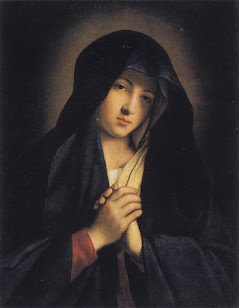
Each time the Blessed Virgin has appeared-- whether it be to Saint Bernadette Soubirous at Lourdes; to Lucia, Jacinta, and Francisco at Fatima; or to Mariette Beco at Banneux-- she has asserted the importance, saving grace, and power of praying the Holy Rosary on a daily basis. Based upon her words, the Rosary is penance and conversion for sinners, a pathway to peace, an end to war, and a powerful act of faith in Jesus Christ. Pope Paul VI presented the Rosary as a powerful means to reach Christ "not merely with Mary but indeed, insofar as this is possible to us, in the same way as Mary, who is certainly the one who thought about Him more than anyone else has ever done."

To show us how this is done, perhaps no one has been more eloquent than the great Cardinal Newman, who wrote: "The great power of the Rosary consists in the fact that it translates the Creed into Prayer. Of course, the Creed is already in a certain sense a prayer and a great act of homage towards God, but the Rosary brings us to meditate again on the great truth of His life and death, and brings this truth close to our hearts. Even Christians, although they know God, usually fear rather than love Him. The strength of the Rosary lies in the particular manner in which it considers these mysteries, since all our thinking about Christ is intertwined with the thought of His Mother, in the relations between Mother and Son; the Holy Family is presented to us, the home in which God lived His infinite love."


As Mary said at Fatima, "Jesus wants to use you to make Me known and loved. He wishes to establish the devotion to My Immaculate Heart throughout the world. I promise salvation to whoever embraces it; these souls will be dear to God, like flowers put by Me to adorn his throne."


June 14: Saint Joseph the Hymnographer

Posted by Jacob

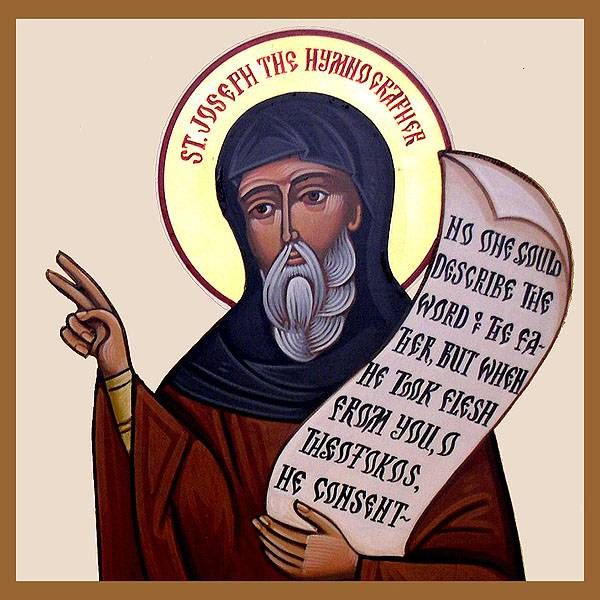
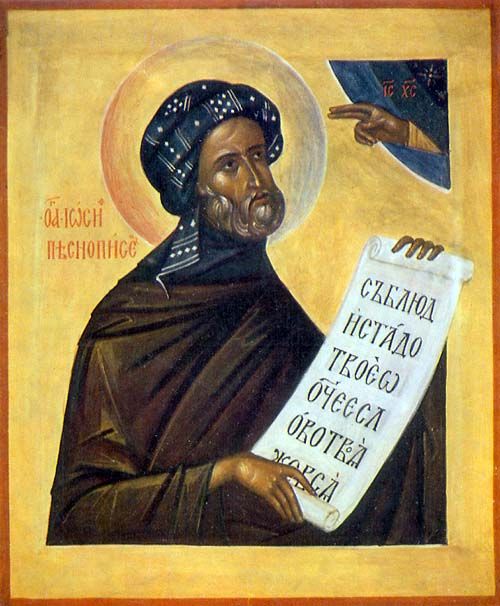
Today, June 14, we celebrate the feast day of Saint Joseph the Hymnographer (810-886), tireless servant of the Lord, glorifying Him in life, in works, and through writing countless hymns and canons to the saints. Despite a lifetime of struggle, suffering, and imprisonment, Saint Joseph produced a catalog of writings which remain today, as well as over 200 hymns, many of which are still sung by modern congregations. He has been called "the sweet-voiced nightingale of the Church." Through his legacy of writings and song, Saint Joseph preserved a priceless record of the history of our faith—a faith which continues, unchanged and unabated, today.


Joseph was born into a pious Christian family in Sicily. His parents, Plotinus and Agatha, in response to an invasion of Arabs, moved the family to Greece. There, at the young age of 15, Joseph entered the monastery at Thessolonica, and earned the love and respect of his community through industriousness, obedience, piety, humility, and scholastic aptitude.

During a routine visit to the monastery, Saint Gregory (then deacon) took notice of the young brother, and asked him to accompany him to the church in Constantinople—then suffering under the iconoclast persecution (see also Saint Theodosia of Constantinople). There, they lived near the Church of the Holy Martyrs, defending religious icons, preaching the Word of God, and ministering to the suffering Christian population. When it was decided that an emissary should be sent to Rome to have audience with Pope Leo III and inform him of the persecution under the Byzantine Emperor, Joseph was selected due to his obedience, wisdom, and gift of oration. He set off for Rome at once.

But life was not to be easy for Saint Joseph. On the way to Rome, he was taken captive by Arab bandits, brought to the island of Crete, and turned over to the Iconoclasts who locked him away in a dungeon. Never giving up hope and faith in the Lord, Joseph ministered to his fellow prisoners, keeping their spirits high, praying with them, and inspiring many to die martyr’s deaths for the faith.
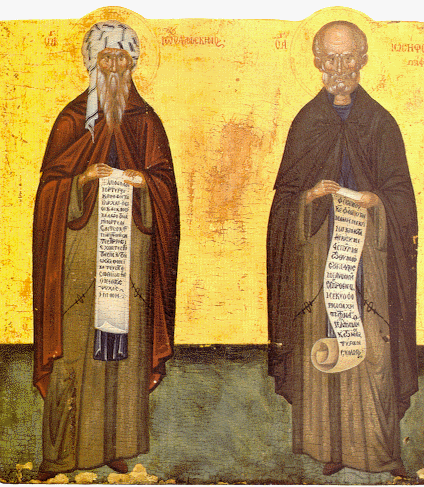
Saint Joseph spent six years in prison, until the death of the Byzantine Emperor and the end of the iconoclast persecution. Prior to his release, he received a heavenly vision from Saint Nicholas of Myra, who provided him with a scroll upon which read: “Hasten, O Bountiful One and as Thou art merciful, hasten to come to our aid, for as Thou wilst, Thou canst…” Saint Joseph, after receiving instruction from Saint Nicholas, sang the words aloud, causing his chains to fall to the ground and the prison gates to be opened. He returned to Constantinople where he established a church in patronage to Saint Nicholas, and later a monastery.

Saint Joseph received the gift of the relics of Saint Bartholomew, which he placed in the church. He felt compelled to sing a hymn of praise to the saint, but no such suitable hymn existed, and he didn’t feel qualified or capable to write a canon for one so deserving. Saint Joseph prayed for 40 days, trying to discern the proper course of action, upon when Saint Bartholomew appeared to him. He said, “May the Right Hand of Almighty God bless thee, may Heavenly Wisdom pour out upon thy tongue, may thy heart be a temple of the Holy Spirit, and may thy hymnody sweeten the universe.” Following the apparition, Joseph wrote the canon to Saint Bartholomew, and from then on began to compose liturgical hymns in honor of Jesus, the Heavenly Father, the Mother of God, and the Saints.

One of those hymns, Stars of the Morning, follows:

Stars of the morning, so gloriously bright,
Filled with celestial splendor and light,
These that, where night never followeth day,
Raise the “Thrice Holy” song ever and aye.

These are Thy ministers, these dost Thou own,
God of Sabaoth, the nearest Thy throne;
These are Thy messengers, These dost Thou send,
Help of the helpless ones! man to defend.


“Who like the Lord?” thunders Michael the chief;
Raphael, “the cure of God,” comforteth grief;
And, as at Nazareth, prophet of peace,
Gabriel, “the light of God,” bringeth release.


Then, when the earth was first poised in mid space,
Then, when the planets first sped on their race,
Then, when were ended the six days’ employ,
Then all the sons of God shouted for joy.


Still let them succor us; still let them fight,
Lord of angelic hosts, battling for right;
Till, where their anthems they ceaselessly pour,
We with the angels may bow and adore.


Upon the resurgence of iconoclasm, Saint Joseph was exiled for eleven years, but was subsequently returned to his position in Constantinople, and eventually made Bishop of Salonica. He continued to write Canons and hymns, many of which survive. After attaining advanced age for that time, Saint Joseph fell ill. Prior to his death, he received a vision from the Lord, telling of his approaching journey to Heaven. Saint Joseph set his affairs in order, and spent the remainder of his days in quiet prayer. He received Holy Eucharist, blessed those from the community who were present, and joyfully gave his life to the Lord. Saint Theodore, later appearing to an impatient friend of Saint Joseph stated, "Why do you become angry O man? Joseph the Hymnographer's soul was being separated from his body and we were with him. When he died this night, all of us whom he glorified in hymns, translated his soul to the heavens and placed it before the Face of God. That is why I was tardy in not appearing to you."

Saint Joseph is credited with 200 hymns and canons, although some place the number he wrote at more than one thousand. Throughout his life, he preached the Word of God—through his writings, through Canons to the Saint, through opposition to persecution, and through joyful song. Encouraged by his visions of saints, Saint Joseph the Hymnographer raised his voice in praise of Our Lord, even when he faced violent opposition, imprisonment, and exile. How often can we say the same of ourselves?


Let Us Now Our Voices Raise (written by Saint Joseph, the Hymnographer)


Let us now our voices raise,
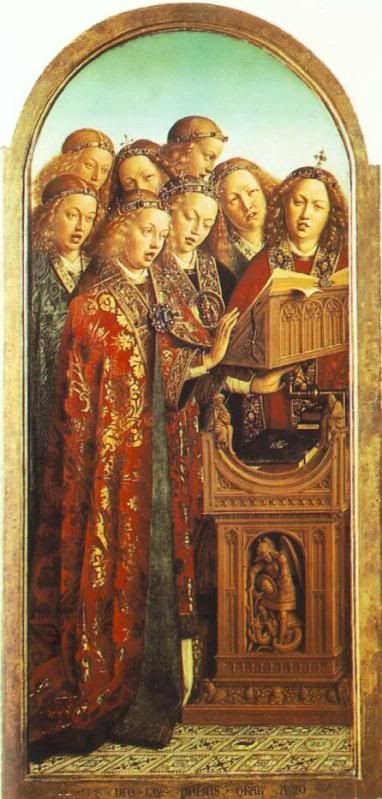
Wake the day with gladness;
God Himself to joy and praise
Turns our human sadness;
Joy that martyrs won their crown,
Opened heav’ns bright portal,
When they laid the mortal down
For the life immortal.


Never flinched they from the flame,
From the torment never;
Vain the tyrant’s sharpest aim,
Vain each fierce endeavor:
For by faith they saw the land
Decked in all its glory,
Where triumphant now they stand
With the victor’s story.


Up and follow, Christian men!
Press through toil and sorrow;
Spurn the night of fear, and then,
O the glorious morrow!
Who will venture on the strife;
Who will first begin it?
Who will grasp the land of life?
Warriors, up and win it!
Hymns of Saint Joseph the Hymnographer

Posted by Jacob

Today, June 14, we celebrate the feast day of Saint Joseph the Hymnographer (810-886), tireless servant of the Lord, glorifying Him in life, in works, and through writing countless hymns and canons to the saints. Despite a lifetime of struggle, suffering, and imprisonment, Saint Joseph produced a catalog of writings which remain today, as well as over 200 hymns, many of which are still sung by modern congregations. He has been called "the sweet-voiced nightingale of the Church." Through his legacy of writings and song, Saint Joseph preserved a priceless record of the history of our faith—a faith which continues, unchanged and unabated, today.


Below, two additional hymns, originally penned by Saint Joseph (and later adapted for modern usage in the Church):

And Wilt Thou Pardon, Lord

And wilt Thou pardon, Lord,

A sinner such as I,
Although Thy book his crimes record,
Of such a crimson dye?


So deep are they engraved,
So terrible their fear,
The righteous scarcely shall be saved,
And where shall I appear?


O Thou Physician blest,
Make clean my guilty soul
And me, by many a sin oppressed,
Restore and keep me whole.


I know not how to praise
Thy mercy and Thy love;
But deign my soul from earth to raise

And learn from Thee above.


O Happy Band of Pilgrims

O happy band of pilgrims,

If onward you will tread,
With Jesus as your Fellow,
To Jesus as your Head.


O happy if you labor,
As Jesus did for men;
O happy if you hunger
As Jesus hungered then.


The cross that Jesus carried
He carried as your due;
The crown that Jesus weareth
He weareth it for you.


The faith by which you see Him,
The hope in which you yearn,
The love that through all troubles
To Him alone will turn.


What are they but forerunners
To lead you to His sight?
What are they save the effluence
Of uncreated Light?


The trials that beset you,
The sorrows you endure,
The manifold temptations
That death alone can cure.


What are they but His jewels
Of right celestial worth?
What are they but the ladder
Set up to heaven on earth?


O happy band of pilgrims,
Look upward to the skies,
Where such a light affliction
Shall win you such a prize.


To Father, Son, and Spirit,
The God Whom we adore,
Be loftiest praises given,

Now and for evermore.

June 14: Saint Joseph the Hymnographer

Posted by Jacob

Today, June 14, we celebrate the feast day of Saint Joseph the Hymnographer (810-886), tireless servant of the Lord, glorifying Him in life, in works, and through writing countless hymns and canons to the saints. Despite a lifetime of struggle, suffering, and imprisonment, Saint Joseph produced a catalog of writings which remain today, as well as over 200 hymns, many of which are still sung by modern congregations. He has been called "the sweet-voiced nightingale of the Church." Through his legacy of writings and song, Saint Joseph preserved a priceless record of the history of our faith—a faith which continues, unchanged and unabated, today.


Joseph was born into a pious Christian family in Sicily. His parents, Plotinus and Agatha, in response to an invasion of Arabs, moved the family to Greece. There, at the young age of 15, Joseph entered the monastery at Thessolonica, and earned the love and respect of his community through industriousness, obedience, piety, humility, and scholastic aptitude.

During a routine visit to the monastery, Saint Gregory (then deacon) took notice of the young brother, and asked him to accompany him to the church in Constantinople—then suffering under the iconoclast persecution (see also Saint Theodosia of Constantinople). There, they lived near the Church of the Holy Martyrs, defending religious icons, preaching the Word of God, and ministering to the suffering Christian population. When it was decided that an emissary should be sent to Rome to have audience with Pope Leo III and inform him of the persecution under the Byzantine Emperor, Joseph was selected due to his obedience, wisdom, and gift of oration. He set off for Rome at once.

But life was not to be easy for Saint Joseph. On the way to Rome, he was taken captive by Arab bandits, brought to the island of Crete, and turned over to the Iconoclasts who locked him away in a dungeon. Never giving up hope and faith in the Lord, Joseph ministered to his fellow prisoners, keeping their spirits high, praying with them, and inspiring many to die martyr’s deaths for the faith.

Saint Joseph spent six years in prison, until the death of the Byzantine Emperor and the end of the iconoclast persecution. Prior to his release, he received a heavenly vision from Saint Nicholas of Myra, who provided him with a scroll upon which read: “Hasten, O Bountiful One and as Thou art merciful, hasten to come to our aid, for as Thou wilst, Thou canst…” Saint Joseph, after receiving instruction from Saint Nicholas, sang the words aloud, causing his chains to fall to the ground and the prison gates to be opened. He returned to Constantinople where he established a church in patronage to Saint Nicholas, and later a monastery.

Saint Joseph received the gift of the relics of Saint Bartholomew, which he placed in the church. He felt compelled to sing a hymn of praise to the saint, but no such suitable hymn existed, and he didn’t feel qualified or capable to write a canon for one so deserving. Saint Joseph prayed for 40 days, trying to discern the proper course of action, upon when Saint Bartholomew appeared to him. He said, “May the Right Hand of Almighty God bless thee, may Heavenly Wisdom pour out upon thy tongue, may thy heart be a temple of the Holy Spirit, and may thy hymnody sweeten the universe.” Following the apparition, Joseph wrote the canon to Saint Bartholomew, and from then on began to compose liturgical hymns in honor of Jesus, the Heavenly Father, the Mother of God, and the Saints.

One of those hymns, Stars of the Morning, follows:

Stars of the morning, so gloriously bright,
Filled with celestial splendor and light,
These that, where night never followeth day,
Raise the “Thrice Holy” song ever and aye.

These are Thy ministers, these dost Thou own,
God of Sabaoth, the nearest Thy throne;
These are Thy messengers, These dost Thou send,
Help of the helpless ones! man to defend.


“Who like the Lord?” thunders Michael the chief;
Raphael, “the cure of God,” comforteth grief;
And, as at Nazareth, prophet of peace,
Gabriel, “the light of God,” bringeth release.


Then, when the earth was first poised in mid space,
Then, when the planets first sped on their race,
Then, when were ended the six days’ employ,
Then all the sons of God shouted for joy.


Still let them succor us; still let them fight,
Lord of angelic hosts, battling for right;
Till, where their anthems they ceaselessly pour,
We with the angels may bow and adore.


Upon the resurgence of iconoclasm, Saint Joseph was exiled for eleven years, but was subsequently returned to his position in Constantinople, and eventually made Bishop of Salonica. He continued to write Canons and hymns, many of which survive. After attaining advanced age for that time, Saint Joseph fell ill. Prior to his death, he received a vision from the Lord, telling of his approaching journey to Heaven. Saint Joseph set his affairs in order, and spent the remainder of his days in quiet prayer. He received Holy Eucharist, blessed those from the community who were present, and joyfully gave his life to the Lord. Saint Theodore, later appearing to an impatient friend of Saint Joseph stated, "Why do you become angry O man? Joseph the Hymnographer's soul was being separated from his body and we were with him. When he died this night, all of us whom he glorified in hymns, translated his soul to the heavens and placed it before the Face of God. That is why I was tardy in not appearing to you."

Saint Joseph is credited with 200 hymns and canons, although some place the number he wrote at more than one thousand. Throughout his life, he preached the Word of God—through his writings, through Canons to the Saint, through opposition to persecution, and through joyful song. Encouraged by his visions of saints, Saint Joseph the Hymnographer raised his voice in praise of Our Lord, even when he faced violent opposition, imprisonment, and exile. How often can we say the same of ourselves?


Let Us Now Our Voices Raise (written by Saint Joseph, the Hymnographer)


Let us now our voices raise,
Wake the day with gladness;
God Himself to joy and praise
Turns our human sadness;
Joy that martyrs won their crown,
Opened heav’ns bright portal,
When they laid the mortal down
For the life immortal.


Never flinched they from the flame,
From the torment never;
Vain the tyrant’s sharpest aim,
Vain each fierce endeavor:
For by faith they saw the land
Decked in all its glory,
Where triumphant now they stand
With the victor’s story.


Up and follow, Christian men!
Press through toil and sorrow;
Spurn the night of fear, and then,
O the glorious morrow!
Who will venture on the strife;
Who will first begin it?
Who will grasp the land of life?
Warriors, up and win it!


Year 2: Day 165 of 365

Prayer Intentions: Praise for the Lord, ever on our lips!
Requested Intentions: Restoration of health (D); Successful employment for couple (N); For employment for children (K); For health of friend, for successful relationships for children, for safe pregnancy for daughter (C); For the health of a mother (J); Virtue for daughter (V); Successful acceptance to college for nephew (M); For the health of a cousin (T); Freedom from legal difficulties for husband (S); Husband’s freedom from illness (L); Personal intentions (S); Successful passing of dental board examination (P); Blessings on a family (Z); Successful permanent employment (C); Healing of a son with autism (J); Son’s successful employment (L); For the intentions of family and relatives, for the Carthusian community (T); For personal intentions (A); Restoration of lost hearing (C); Resolution of relational and financial challenges (S); Comfort following loss of husband, security for family, assistance with housing (B); Healing and return of brother (O); Successful hermitage foundation (S); Support from family, permission to marry (H); Recovery of wife following surgery, freedom from depression (W); Protection and recovery of mentally ill daughter (J); Successful resolution to legal proceedings (N); Freedom from worry and successful employment (M); For successful sale of home and freedom from debt (J); Freedom from pain and illness (E).

Saint Gregory of Nyssa: “In Praise of Blessed Theodore, the Great Martyr”

Posted by Jacob

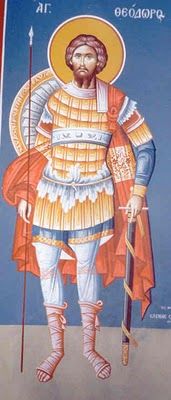
Today, November 9, we celebrate the feast day of Saint Theodore Tyro (also known as Saint Theodore of Amasea and Saint Theodore the Recruit, 286-306), one of the oldest of the eastern martyrs. While little is known about his life, he is included in the Roman martyrology, and greatly venerated in the Eastern Church as one of the three "Soldier Saints," with Saints George and Demetrios. Saint Gregory of Nyssa was one of the first to record the life and acts of Saint Theodore. Below, an excerpt from a homily he gave, “In Praise of Blessed Theodore, the Great Martyr.”


You, the people who belong to Christ, a holy flock, a royal priesthood which had come from every place, city and the countryside, what is the source of that sign which brought you to this sacred place? Who are you who hasten here and planned this [journey] beforehand? Is it not the season of winter which is untroubled by war, when armed soldiers are not present, sailors set sail over the foamy [waves] and the farmer puts to rest the ox used for plowing in the stall? It is not clear that the holy martyr sounded the trumpet from among the roster of warriors, rouses people from diverse regions to a place of rest, proclaims a home, not in preparation for war but to a sweet and attractive peace for Christians? We believe that in the year when the barbarian invasion stopped and the horrible war against the savage Sythians came to an end we witnessed no frightening, terrible war, no triple crested helmet nor a brandished sword glittering in the sun, but the all-powerful cross of Christ which wards them off, the means by which he obtained glory through his suffering.


Furthermore, I ask you to consider closely those who keep blameless religious observance such as the martyrs who compose an outstanding assembly of the just as well as those deemed worthy of recompense while still in the world. Let me affirm that they are still with us. Their great honor is open for all to see: by recognizing the fruit of piety, you must strive to share in their reverence. Desire the honors which Christ dispenses according to the worthiness of his athletes. But if it pleases him that we may enjoy future benefits which a pure hope offers to the just when the judge of our lives comes to us, we may see the company of the saints which is so magnificent and glorious. For the soul which is ascending is fond of residing in its own inheritance and converses in an incorporeal manner with its own brethren; the body a deserving and immaculate vehicle for that purpose which never allows the harm originating from its own passions to reside with incorruptibility. Enwrapped with much honor and solicitude, it dwells in this holy place as an inestimable treasure reserved for the time of regeneration and shares the uniqueness with regard to other bodies. For this common death which is similar in nature has no comparison. There are other abominable matters, for example, no one should lightly disregard the tomb, but if this person opens himself to persuasion, he is liable to have no share in the repugnance of this present age, thereby avoiding the burden of the human condition.


Should a person come to a place similar to our assembly today where the memory of the just and the rest of the saints is present, first consider this house's great dignity to which souls are lead. God's temple is brightly adorned with magnificence and is embellished with decorations, pictures of animals which masons have fashioned with delicate silver figures. It exhibits images of flowers made in the likeness of the martyr's virtues, his struggles, sufferings, the various savage actions of tyrants, assaults, that fiery furnace, the athlete's blessed consummation and the human form of Christ presiding over all these events. They are like a book skillfully interpreting by means of colors which express the martyr's struggles and glorify the temple with resplendent beauty. The pictures located on the walls are eloquent by their silence and offer significant testimony; the pavement on which people tread is combined with small stones and is significant to mention in itself.


These spectacles strike the senses and delight the eye by drawing us near to Saint Theodore’s tomb which we believe to be both a sanctification and blessing. If anyone takes dust from the martyr's resting place, it is a gift and a deserving treasure. Should a person have both the good fortune and permission to touch the relics, this experience is a highly valued prize and seems like a dream both to those who were cured and whose wish was fulfilled. The body appears as if it were alive and healthy: the eyes, mouth, ears, as well as the other senses are a cause for pouring out tears of reverence and emotion. In this way one implores the martyr who intercedes on our behalf and is an attendant of God for imparting those favors and blessings which people seek.


From all this, oh devout people, learn that "the death of His holy ones is admirable before the Lord" [Ps 115.6], for all men comprise one and the same body; they share the same substance as one dough and are carried off to death. However, the martyr's suffering bestows grace which is lovable, joyful and undeniable as the text above teaches. Therefore we believe that appearances hold out the promise of future blessings procured from trials endured in the world. Many are those who pursue [pleasures of] the stomach, vainglory and the rubbish of all this world's charms while neglecting that which is to come; rather, such persons believe that death puts an end to all these things [Phil 3.19]. But a thoughtful person will learn about great matters from that which is small and about archetypes from shadows. To whom will the honor of kings go? Who will be remembered among men with regard to that arrogance resulting from visible reality? Which general who has captured fortified cities and has enslaved many peoples is celebrated as this soldier, poor man and conscript, whom Paul has armed [Eph 6.11] and whom the angels have anointed for combat and whom Christ has crowned with victory [2 Tim 4.8]? Since these words unite you to the martyr's trials, follow the saint's uncommon example and forsake any useless pursuit because everyone loves such things.


Therefore, oh blessed anniversary graciously provided by the Creator, we flock to your festival with the martyrs' holy band which worships a common God. By recalling the victory of our many struggles, you return to us, and when you arrive, you provide us with a day of celebration. We beseech you, whether you dwell in the air above or in some celestial circle or angelic chorus, that you assist the Lord or worship him as a faithful servant with the powers and virtues. Come from that place to those who beseech you, invisible friend! You have learned of his death, a means by which you might give double thanks to God who conferred this favor through one passion and one pious confession that you may rejoice in the blood he shed and in the grievous fire he endured. As a result you will have as worthy ministers those who witnessed the spectacle. We lack many benefactors. Intercede on behalf of the people that they may share one kingdom because the martyr's country is one of affliction whose citizens and brethren and kinsmen have died and have been honored. We fear afflictions and expect danger because we are close to the ungodly Sythians who grieve us with war. As a soldier, fight for us; as a martyr, grant courage to your fellow servants. Since you have prevailed over this life yet are familiar with humanity's sufferings and needs, grant peace that the festivals may continue, that the furious, insolent, mad barbarians might not triumph over the temples or altars and that they might not tread the holy place.


We who have been kept safe and unharmed ponder your beneficence and implore protection for the future. Should we experience stress and dishonor, let your people beseech the chorus of your fellow martyrs; the prayers of many just people will exonerate sin. Remember Peter, awaken Paul along with John the theologian and beloved disciple, who are solicitous on behalf of the churches which they have founded and on whose behalf they endured dangers and death. They did not engage in idol worship which was inimical to our Head [Christ] in order that heresy may resemble thorns to pluck out vines, that weeds might not suffocate wheat, that no rock hinder the true, rich dew and that anything without root may show the power of the fertile word [cf. Mt 13.25, 7, 20]. But by the power of your intercession and those with you, oh marvelous and most bright among the martyrs, the young shoot will return to you, the flourishing citizenship of Christians will endure to the end in the splendid, fruitful field of faith in Christ which always bears the fruit of eternal life in Christ Jesus the Lord. To him with the Father and Holy Spirit be glory, power and honor now and forever. Amen.

Saint Bruno of Cologe: “If I Forget You, Jerusalem”

Posted by Jacob

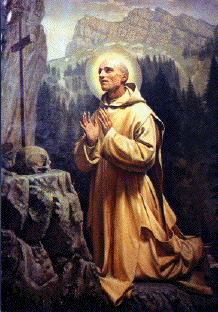
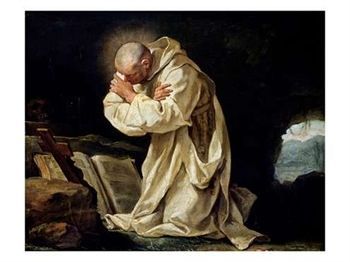
Today, October 6, we celebrate the feast of Saint Bruno of Cologne (1030-1101), founder of The Chartreuse Order of cloistered monks (the Carthusians). Saint Bruno’s life was one of poverty, manual labor, prayer, and piety. He inspired his brothers to a life of holiness, served as Papal advisor, and wrote both letters and commentaries on the tenets of the faith. Ever-humble, Saint Bruno sought an eremitical life, avoided public honors, and even succeeded in never being officially canonized. Nevertheless, the Church honors this great and pious saint as we aspire to his faith and humility.


A gifted commentator on Scripture, Saint Bruno’s commentary on Psalm 84, entitled “If I Forget You, Jerusalem,” follows:


How delightful is your dwelling-place, Lord of hosts!
My soul is weak with longing for the courts of your palace
That is, for the broad spaces of the heavenly Jerusalem, which is the city of God.


Blessed are they who dwell in your house:
they will praise you for ever.

Now the psalmist shows why he desires to enter the courts of the Lord: Lord, God of all powers in heaven, my king and my God, blessed are they who dwell in your house. It is as if he said, ‘Who would not wish to enter your courts, since you are God, that is, the Creator, the Lord of the powers, the King, and since all are blessed who live in your house?’ Because ‘courts’ and ‘house’ mean the same thing here. When he says ‘blessed’ he means that they have all conceivable blessedness. And they are surely blessed, because they will praise you with loving devotion for ever, that is, for all eternity. They would not be able to praise the Lord for all eternity unless they were blessed for all eternity.


Blessed the man whose help comes from you,
who has set his heart on climbing to you.


But no-one can reach this blessedness on his own, even if he has hope, faith and love. Blessed is the man whose help comes from you – in other words, only the man whose help comes from you will attain the blessedness he has set his heart on. That is to say: the only people who will attain blessedness are those who set their hearts on climbing many steps of virtue and good works, but also receive the help of your grace. No-one can climb by himself, as the Lord himself has said: No-one has gone up to heaven except the Son of Man who is in heaven.


I say that he is climbing to you because he now lives in the valley of tears, that is, in this present life, which is lowly and filled with the tears of tribulation; as opposed to the other life, which can be called a mountain in comparison, a mountain full of joy.


Since the psalmist has said, Blessed the man whose help comes from you, one might ask, ‘Will God give his help?’ The answer is that help is truly offered by God to the blessed. For the lawgiver, that is, Christ, gave us the law and he gives us and will go on giving us blessings (that is, the many gifts of grace) by which he blesses his own people. This means he will raise them up to blessedness, and so they will go from strength to strength as they climb. In the future heavenly Zion Christ will be seen, the God of gods, and since he is God he will make his people divine also. Or, if you prefer, you can say that the God of gods, God the Trinity, will be visible in a spiritual sense in those who dwell in Zion. By the light of their understanding they will see God in themselves in a way that now they cannot, for God will be all in all.

June 14: Saint Joseph the Hymnographer

Posted by Jacob

Today, June 14, we celebrate the feast day of Saint Joseph the Hymnographer (810-886), tireless servant of the Lord, glorifying Him in life, in works, and through writing countless hymns and canons to the saints. Despite a lifetime of struggle, suffering, and imprisonment, Saint Joseph produced a catalog of writings which remain today, as well as over 200 hymns, many of which are still sung by modern congregations. He has been called "the sweet-voiced nightingale of the Church." Through his legacy of writings and song, Saint Joseph preserved a priceless record of the history of our faith—a faith which continues, unchanged and unabated, today.


Joseph was born into a pious Christian family in Sicily. His parents, Plotinus and Agatha, in response to an invasion of Arabs, moved the family to Greece. There, at the young age of 15, Joseph entered the monastery at Thessolonica, and earned the love and respect of his community through industriousness, obedience, piety, humility, and scholastic aptitude.

During a routine visit to the monastery, Saint Gregory (then deacon) took notice of the young brother, and asked him to accompany him to the church in Constantinople—then suffering under the iconoclast persecution (see also Saint Theodosia of Constantinople). There, they lived near the Church of the Holy Martyrs, defending religious icons, preaching the Word of God, and ministering to the suffering Christian population. When it was decided that an emissary should be sent to Rome to have audience with Pope Leo III and inform him of the persecution under the Byzantine Emperor, Joseph was selected due to his obedience, wisdom, and gift of oration. He set off for Rome at once.

But life was not to be easy for Saint Joseph. On the way to Rome, he was taken captive by Arab bandits, brought to the island of Crete, and turned over to the Iconoclasts who locked him away in a dungeon. Never giving up hope and faith in the Lord, Joseph ministered to his fellow prisoners, keeping their spirits high, praying with them, and inspiring many to die martyr’s deaths for the faith.

Saint Joseph spent six years in prison, until the death of the Byzantine Emperor and the end of the iconoclast persecution. Prior to his release, he received a heavenly vision from Saint Nicholas of Myra, who provided him with a scroll upon which read: “Hasten, O Bountiful One and as Thou art merciful, hasten to come to our aid, for as Thou wilst, Thou canst…” Saint Joseph, after receiving instruction from Saint Nicholas, sang the words aloud, causing his chains to fall to the ground and the prison gates to be opened. He returned to Constantinople where he established a church in patronage to Saint Nicholas, and later a monastery.

Saint Joseph received the gift of the relics of Saint Bartholomew, which he placed in the church. He felt compelled to sing a hymn of praise to the saint, but no such suitable hymn existed, and he didn’t feel qualified or capable to write a canon for one so deserving. Saint Joseph prayed for 40 days, trying to discern the proper course of action, upon when Saint Bartholomew appeared to him. He said, “May the Right Hand of Almighty God bless thee, may Heavenly Wisdom pour out upon thy tongue, may thy heart be a temple of the Holy Spirit, and may thy hymnody sweeten the universe.” Following the apparition, Joseph wrote the canon to Saint Bartholomew, and from then on began to compose liturgical hymns in honor of Jesus, the Heavenly Father, the Mother of God, and the Saints.

One of those hymns, Stars of the Morning, follows:

Stars of the morning, so gloriously bright,
Filled with celestial splendor and light,
These that, where night never followeth day,
Raise the “Thrice Holy” song ever and aye.

These are Thy ministers, these dost Thou own,
God of Sabaoth, the nearest Thy throne;
These are Thy messengers, These dost Thou send,
Help of the helpless ones! man to defend.


“Who like the Lord?” thunders Michael the chief;
Raphael, “the cure of God,” comforteth grief;
And, as at Nazareth, prophet of peace,
Gabriel, “the light of God,” bringeth release.


Then, when the earth was first poised in mid space,
Then, when the planets first sped on their race,
Then, when were ended the six days’ employ,
Then all the sons of God shouted for joy.


Still let them succor us; still let them fight,
Lord of angelic hosts, battling for right;
Till, where their anthems they ceaselessly pour,
We with the angels may bow and adore.


Upon the resurgence of iconoclasm, Saint Joseph was exiled for eleven years, but was subsequently returned to his position in Constantinople, and eventually made Bishop of Salonica. He continued to write Canons and hymns, many of which survive. After attaining advanced age for that time, Saint Joseph fell ill. Prior to his death, he received a vision from the Lord, telling of his approaching journey to Heaven. Saint Joseph set his affairs in order, and spent the remainder of his days in quiet prayer. He received Holy Eucharist, blessed those from the community who were present, and joyfully gave his life to the Lord. Saint Theodore, later appearing to an impatient friend of Saint Joseph stated, "Why do you become angry O man? Joseph the Hymnographer's soul was being separated from his body and we were with him. When he died this night, all of us whom he glorified in hymns, translated his soul to the heavens and placed it before the Face of God. That is why I was tardy in not appearing to you."

Saint Joseph is credited with 200 hymns and canons, although some place the number he wrote at more than one thousand. Throughout his life, he preached the Word of God—through his writings, through Canons to the Saint, through opposition to persecution, and through joyful song. Encouraged by his visions of saints, Saint Joseph the Hymnographer raised his voice in praise of Our Lord, even when he faced violent opposition, imprisonment, and exile. How often can we say the same of ourselves?


Let Us Now Our Voices Raise (written by Saint Joseph, the Hymnographer)


Let us now our voices raise,
Wake the day with gladness;
God Himself to joy and praise
Turns our human sadness;
Joy that martyrs won their crown,
Opened heav’ns bright portal,
When they laid the mortal down
For the life immortal.


Never flinched they from the flame,
From the torment never;
Vain the tyrant’s sharpest aim,
Vain each fierce endeavor:
For by faith they saw the land
Decked in all its glory,
Where triumphant now they stand
With the victor’s story.


Up and follow, Christian men!
Press through toil and sorrow;
Spurn the night of fear, and then,
O the glorious morrow!
Who will venture on the strife;
Who will first begin it?
Who will grasp the land of life?
Warriors, up and win it!


Inspired by the origins and spiritual history of the Holy Rosary, we continue our meditation on the psalms, one each day, in order, for 150 days.


Today’s Psalm: Psalm 50: The Acceptable Sacrifice

1 The Mighty One, God, the LORD,
speaks and summons the earth
from the rising of the sun to the place where it sets.
2 From Zion, perfect in beauty,
God shines forth.
3 Our God comes and will not be silent;
a fire devours before him,
and around him a tempest rages.
4 He summons the heavens above,
and the earth, that he may judge his people:
5 "Gather to me my consecrated ones,
who made a covenant with me by sacrifice."
6 And the heavens proclaim his righteousness,
for God himself is judge.
7 "Hear, O my people, and I will speak,
O Israel, and I will testify against you:
I am God, your God.
8 I do not rebuke you for your sacrifices
or your burnt offerings, which are ever before me.
9 I have no need of a bull from your stall
or of goats from your pens,
10 for every animal of the forest is mine,
and the cattle on a thousand hills.
11 I know every bird in the mountains,
and the creatures of the field are mine.
12 If I were hungry I would not tell you,
for the world is mine, and all that is in it.
13 Do I eat the flesh of bulls
or drink the blood of goats?
14 Sacrifice thank offerings to God,
fulfill your vows to the Most High,
15 and call upon me in the day of trouble;
I will deliver you, and you will honor me."
16 But to the wicked, God says:
"What right have you to recite my laws
or take my covenant on your lips?
17 You hate my instruction
and cast my words behind you.
18 When you see a thief, you join with him;
you throw in your lot with adulterers.
19 You use your mouth for evil
and harness your tongue to deceit.
20 You speak continually against your brother
and slander your own mother's son.
21 These things you have done and I kept silent;
you thought I was altogether like you.
But I will rebuke you
and accuse you to your face.
22 "Consider this, you who forget God,
or I will tear you to pieces, with none to rescue:
23 He who sacrifices thank offerings honors me,
and he prepares the way
so that I may show him the salvation of God."


Day 165 of 365
Prayer Intentions: Hearts and voices of Praise for Our Loving God!
Requested Intentions: Healing of a relationship (T); Eternal rest for the dearly departed, end to financial struggles, successful sale of home, ability to travel on pilgrimage (L); Financial security of a family, healing of relationships, end to addiction, direction for a family member (L); For healing of a stomach illness (L); For the repose of the soul of a sister (C); Vocational security for family, Financial security for daughter beginning college (M); Vocational guidance, courage and strength (I); Reconciliation of a relationship (M); Strength, financial security, motivation, repose of a loved one (V); Recovery of left shoulder fracture (E); Financial recovery (A); The repose of a lonely soul (L); Health for an ailing nephew (A); Those suffering from depression (J); Successful adoption (S); Healing of a father battling cancer (S).
Psalm: Psalm 50: The Acceptable Sacrifice