Why pray the Rosary every day for a year?


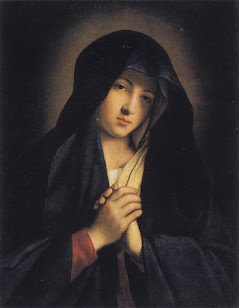
Each time the Blessed Virgin has appeared-- whether it be to Saint Bernadette Soubirous at Lourdes; to Lucia, Jacinta, and Francisco at Fatima; or to Mariette Beco at Banneux-- she has asserted the importance, saving grace, and power of praying the Holy Rosary on a daily basis. Based upon her words, the Rosary is penance and conversion for sinners, a pathway to peace, an end to war, and a powerful act of faith in Jesus Christ. Pope Paul VI presented the Rosary as a powerful means to reach Christ "not merely with Mary but indeed, insofar as this is possible to us, in the same way as Mary, who is certainly the one who thought about Him more than anyone else has ever done."

To show us how this is done, perhaps no one has been more eloquent than the great Cardinal Newman, who wrote: "The great power of the Rosary consists in the fact that it translates the Creed into Prayer. Of course, the Creed is already in a certain sense a prayer and a great act of homage towards God, but the Rosary brings us to meditate again on the great truth of His life and death, and brings this truth close to our hearts. Even Christians, although they know God, usually fear rather than love Him. The strength of the Rosary lies in the particular manner in which it considers these mysteries, since all our thinking about Christ is intertwined with the thought of His Mother, in the relations between Mother and Son; the Holy Family is presented to us, the home in which God lived His infinite love."


As Mary said at Fatima, "Jesus wants to use you to make Me known and loved. He wishes to establish the devotion to My Immaculate Heart throughout the world. I promise salvation to whoever embraces it; these souls will be dear to God, like flowers put by Me to adorn his throne."


July 25, 2013: Saint James the Greater, "Son of Thunder"

Posted by Jacob

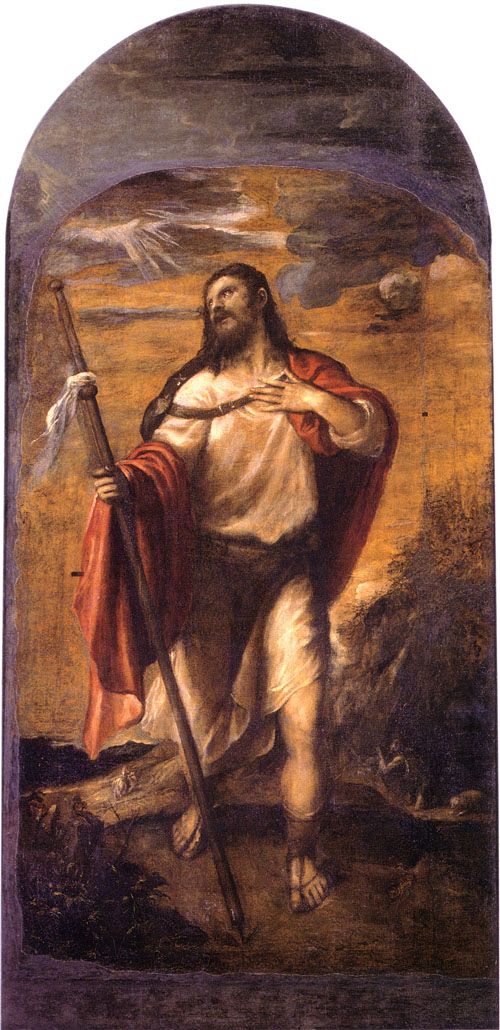
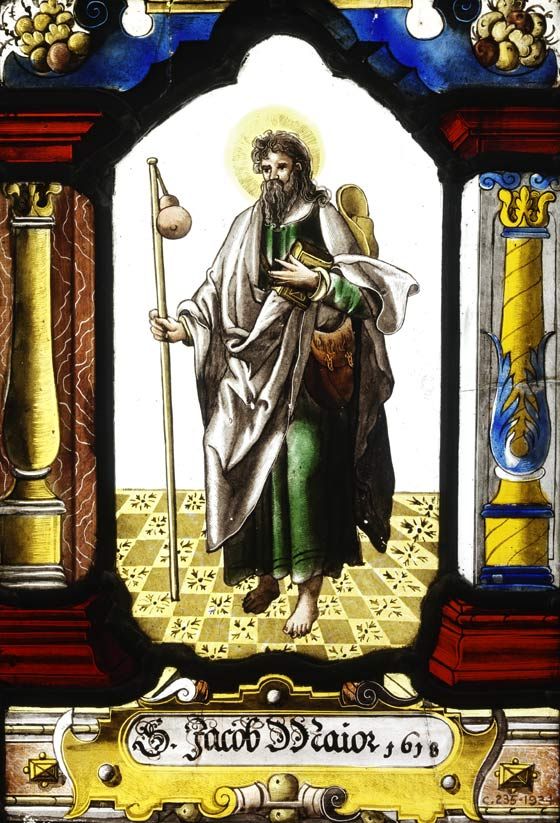
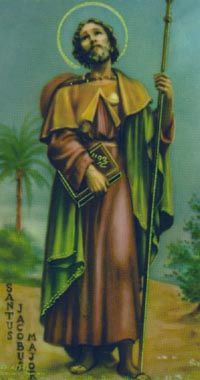
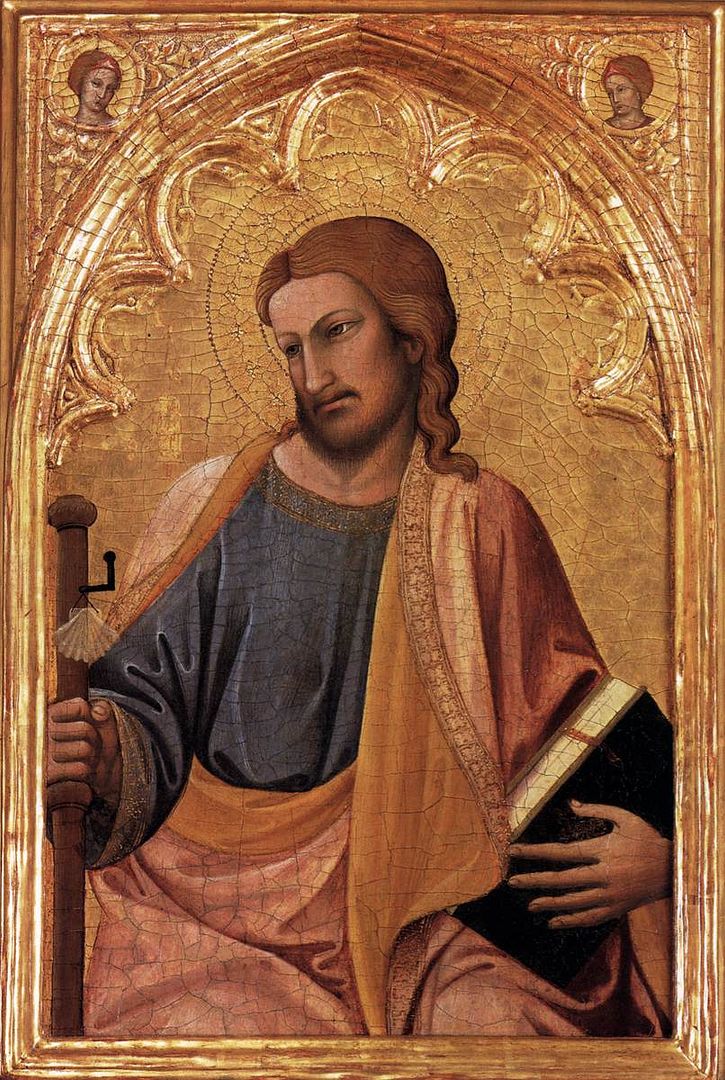
Today, July 25, we celebrate the feast day of Saint James the Greater (died 44), Disciple and friend of Christ, “Son of Thunder,” and first martyr of the Church. Impetuous and quick to temper, James was also a faithful companion to Our Lord, present at significant moments in His life. A gifted preacher, following the death of Jesus, James spent the days until his martyrdom in Spain, establishing the still-popular pilgrimage site of Santiago de Compostela. According to Saint Epiphanus and other historians, he also conserved his virginity in consecration to the Lord. He is honored as the patron of Spain, equestrians, blacksmiths, tanners, veterinarians, and many other locales and professions.

(For “James the Greater,” General Audience delivered by Pope Benedict XVI, June 21, 2006, visit here.)
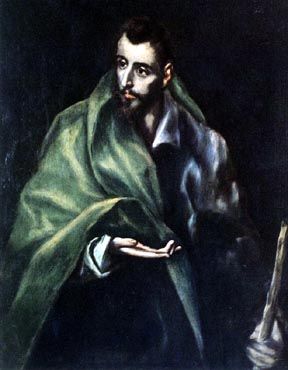
Saint James was the son of Zebedee, a Galilean fisherman, and Salome, a pious woman who tended after Christ. He and his younger brother, Saint John, were called as disciples just after Simon Peter and Andrew were called.

19When he had gone a little farther, he saw James son of Zebedee and his brother John in a boat, preparing their nets. 20Without delay he called them, and they left their father Zebedee in the boat with the hired men and followed him. (Mark 1: 19-20)
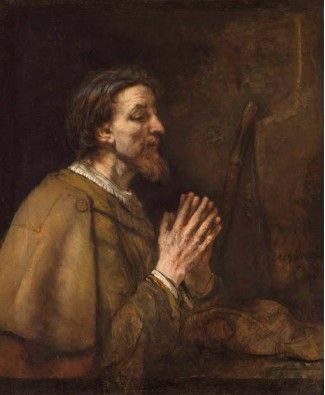

Saint James, along with Peter and John, are often mentioned together in Scripture, as the closest companions of Jesus. They were present at the healing of Peter’s mother in law:

29As soon as they left the synagogue, they went with James and John to the home of Simon and Andrew. 30Simon's mother-in-law was in bed with a fever, and they told Jesus about her. 31So he went to her, took her hand and helped her up. The fever left her and she began to wait on them. (Mark 1:29)

… and the raising of Jairus’ daughter:

51When he arrived at the house of Jairus, he did not let anyone go in with him except Peter, John and James, and the child's father and mother. 52Meanwhile, all the people were wailing and mourning for her. "Stop wailing," Jesus said. "She is not dead but asleep."
53They laughed at him, knowing that she was dead. 54But he took her by the hand and said, "My child, get up!" 55Her spirit returned, and at once she stood up. Then Jesus told them to give her something to eat. 56Her parents were astonished, but he ordered them not to tell anyone what had happened. (Luke 8: 51-56)
Saint James, Peter, and John were present at the Transfiguration of Our Lord:

2After six days Jesus took Peter, James and John with him and led them up a high mountain, where they were all alone. There he was transfigured before them. 3His clothes became dazzling white, whiter than anyone in the world could bleach them. 4And there appeared before them Elijah and Moses, who were talking with Jesus.
5Peter said to Jesus, "Rabbi, it is good for us to be here. Let us put up three shelters—one for you, one for Moses and one for Elijah." 6(He did not know what to say, they were so frightened.)
7Then a cloud appeared and enveloped them, and a voice came from the cloud: "This is my Son, whom I love. Listen to him!"
8Suddenly, when they looked around, they no longer saw anyone with them except Jesus. (Mark 9:2-8)

… and the Lord’s Agony in the Garden of Gethsemane:

36Then Jesus went with his disciples to a place called Gethsemane, and he said to them, "Sit here while I go over there and pray." 37He took Peter and the two sons of Zebedee along with him, and he began to be sorrowful and troubled. 38Then he said to them, "My soul is overwhelmed with sorrow to the point of death. Stay here and keep watch with me."

39Going a little farther, he fell with his face to the ground and prayed, "My Father, if it is possible, may this cup be taken from me. Yet not as I will, but as you will."
40Then he returned to his disciples and found them sleeping. "Could you men not keep watch with me for one hour?" he asked Peter. 41"Watch and pray so that you will not fall into temptation. The spirit is willing, but the body is weak."

42He went away a second time and prayed, "My Father, if it is not possible for this cup to be taken away unless I drink it, may your will be done."

43When he came back, he again found them sleeping, because their eyes were heavy. 44So he left them and went away once more and prayed the third time, saying the same thing.
45Then he returned to the disciples and said to them, "Are you still sleeping and resting? Look, the hour is near, and the Son of Man is betrayed into the hands of sinners. 46Rise, let us go! Here comes my betrayer!" (Matthew 26: 36-46)


Earning their nickname “Sons of Thunder,” James and his brother John are recorded as wishing to reign down fire from heaven on a Samaritan village which refused them hospitality:

51As the time approached for him to be taken up to heaven, Jesus resolutely set out for Jerusalem. 52And he sent messengers on ahead, who went into a Samaritan village to get things ready for him; 53but the people there did not welcome him, because he was heading for Jerusalem. 54When the disciples James and John saw this, they asked, "Lord, do you want us to call fire down from heaven to destroy them?" 55But Jesus turned and rebuked them, 56and they went to another village. (Luke 9: 51-56)

Perhaps James is remembered most for the conversation his mother, Salome, had with Jesus, requesting that her two sons be placed at His right and left-- not realizing the crucifixion and death that lie in store for Christ, but rather imagining an earthly kingdom and throne:

20Then the mother of Zebedee's sons came to Jesus with her sons and, kneeling down, asked a favor of him.

21"What is it you want?" he asked.
She said, "Grant that one of these two sons of mine may sit at your right and the other at your left in your kingdom."
22"You don't know what you are asking," Jesus said to them. "Can you drink the cup I am going to drink?"
"We can," they answered.
23Jesus said to them, "You will indeed drink from my cup, but to sit at my right or left is not for me to grant. These places belong to those for whom they have been prepared by my Father."
24When the ten heard about this, they were indignant with the two brothers. 25Jesus called them together and said, "You know that the rulers of the Gentiles lord it over them, and their high officials exercise authority over them. 26Not so with you. Instead, whoever wants to become great among you must be your servant, 27and whoever wants to be first must be your slave— 28just as the Son of Man did not come to be served, but to serve, and to give his life as a ransom for many." (Matthew 20: 20-28)
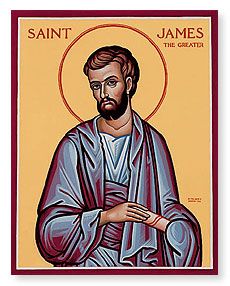
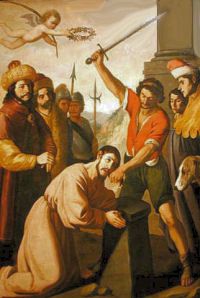
Following the death of Christ, James was present in the Upper Room, and on more than one recorded appearance of the Resurrected Jesus. From the time of Jesus’ Ascension into Heaven, there is little recorded history of James’ missionary activity until that of his martyrdom. Biblical scholars suggest that he probably traveled between Judea and Samaria, and tradition speaks of his journey to Spain, where later his mortal remains were received.

Saint James was the first of the apostles to suffer martyrdom, in Jerusalem, in approximately 44. After nine years preaching in Spain, he had returned to Jerusalem, and was brought before King Herod Agrippa. The Apostle had been preaching fearlessly there, curing the sick and the blind, and delivering possessed persons. Herod promptly sentenced James to execution, reported sparsely by Luke in the Acts of the Apostles: “About that time Herod the king laid violent hands upon some who belonged to the Church, and he killed James, the brother of John with the sword” (Acts 12, 1-2). As Clement of Alexandria, James died by beheading after having converting his accuser: “He who had brought him to the tribunal was so moved seeing him give testimony that he also confessed to being a Christian himself.”

Tradition holds that following his martyrdom in Jerusalem, his followers are believed to have carried his body down the coast and placed it in a stone boat—which was carried by angels to the northern coast of Spain. There, his remains were buried, and promptly forgotten about until the ninth century, when a hermit was led by heavenly vision to the spot. The tomb was rediscovered, and the relics authenticated. From that time, the spot-- Santiago (Iago translating as James) de Compostela—became a center of miracle and pilgrimage-- so much so that Compostela became the third greatest place of pilgrimage, just after Jerusalem and Rome. Today, pilgrims continue to flock to Compostelo, taking one of the many routes known as the “Camino." Pilgrims attach cockleshells—the symbol of Saint James-- or their facsimile to their hats or clothes as "pilgrim badges," signs that they'd venerated the holy relics of the great saint.

(For a recipe for Coquilles St. Jacques à la Provençale, traditionally eaten on the feast of Saint James, see here.)

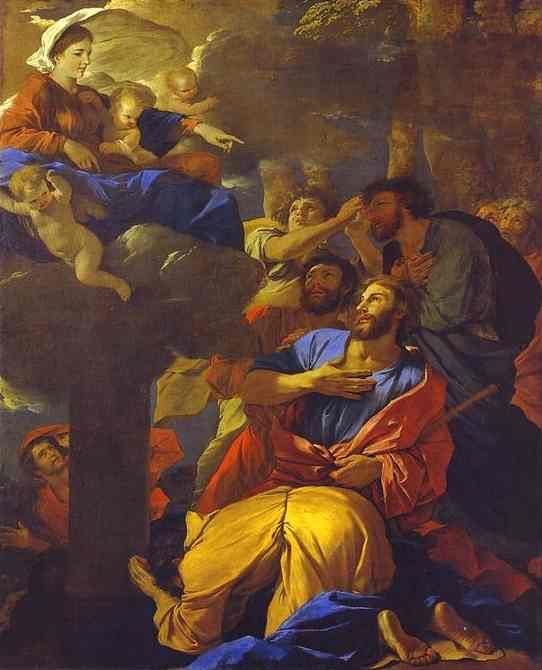
Saint James is also recognized as having appeared in corporeal form, during the Spanish defense of their land and Christianity from the invading Moors. The saint is said to have appeared on a white horse at the Battle of Clavijo, adorned in cockle shells, in 844, while the Christians were in retreat before the onslaught of the Arab and Berber invaders. Thanks to James’ miraculous appearance, the Moors were defeated. The rallying cry of the Spanish troops, from that time, became “Santiago!”


Saint James the Greater is recognized for his special place within the Disciples of Christ-- having been selected by Our Lord because of his burning, impetuous, and outspoken faith. Through his interaction with Jesus, these qualities were purified, and the former “Son of Thunder” could then proclaim the Gospel of peace. We could all benefit from the same purification, the conversion of our anger, temper, and frustration to righteous instruments of peace and Christian virtue. We look to Saint James today, for inspiration and intercession, that we might better embody the peaceful message of Jesus Christ.

Almighty Father,
by the martyrdom of Saint James you blessed the work of the early Church.
May his profession of faith give us courage and his prayers bring us strength.
Grant, O merciful God, that as thine holy Apostle Saint James, leaving his father and all that he had, without delay was obedient unto the calling of thy Son Jesus Christ, and followed him; so we, forsaking all worldly and carnal affections, may be evermore ready to follow thy holy commandments; through Jesus Christ our Lord. Amen.


Saint Peter of Tarentaise, the "Runaway Bishop"

Posted by Jacob


Today, we celebrate the feast day of Saint Peter of Tarentaise (1102-1175), Archbishop, minister to the poor, and saintly model of charity.  Known as the “runaway bishop,” Saint Peter’s ideal life was to live as a simple monk… but he recognized that the Lord had other plans for him, and was willing to follow the path put before him.  Once he realized that his place was in service to the diocese of Tarentaise, Peter threw himself whole-heartedly into his duties, sacrificing his own wants for those of God.  Today, on his feast day, we are reminded to seek the Lord’s will in our own lives, keeping our eyes fixed firmly on the heavens, and following where He might lead us.

Peter was born in Vienne, France, to a peasant family.  He was a model of steadfastness and holiness as a youth, joining the Cistercian monastery at Bonnevaux at the age of twenty.  There, he shone so brightly as a holy light, he attracted many followers, including his two brothers and his father, who joined the order.  By age 30, Peter was elected abbot of a new Cistercian house in the Tarentaise mountains.  There, the monastery sat atop a perch which overlooked the major traveling route between Geneva and Savoy.  To aid travelers, Peter saw to the construction of a hospice for those far from home, especially the poor and ill.  Despite his position as abbot, he spent his days humbly, serving all who entered the doors of the hospice, and providing Christian hospitality.

Not long thereafter, having grown the faith in the area through his model, Peter was elected Archbishop of Tarentaise (in 1142).  Reluctantly, Peter accepted the post.  His preference would have been to continue his current service to the poor and wayward, but he felt called to obey the people’s wishes.  Immediately, Peter set about correcting the mismanagement of funds and corruption that had preceded his election.  He replaced those who extorted the faithful with canons regular of the Order of Saint Augustine, rebuilt the cathedral in the glory of holiness, and spent much time creating public programs for the poor and uneducated.  Saint Peter became known for miracles, including physical healings of the lame and sick, and multiplication of scarce provisions during famine and drought.

After 13 years of service, Saint Peter disappeared from his post, only to be discovered one year later in a remote area of Switzerland.  There he had offered himself as a lay member of a Cistercian house, and lived simply as a monk.  Upon discovery, he returned to his see, and lived out the remainder of his life in service. Delighted to see how much he had been missed by his flock, Peter threw himself back into service with renewed vigor.

With his strength renewed, Peter focused his attention on the poor, providing spiritual, physical, and educational nourishment.  He rebuilt the hospice of Little Saint Bernard at the mountain pass, and erected many more hospices for the sick and travelers along the Alpine pass routes. He instituted public bread lines for those who were poor, a practice which continued in the region for hundreds of years.
Always preaching peace, Saint Peter was called upon by Pope Alexander III to assist in minimizing bloodshed throughout France, and later England.  Saint Peter counseled kings and leaders, preaching the Gospel of peace.  He fell ill on a return trip from England, and died at the age of 73 at the Bellevaux monastery.

Saint Peter was a model of charity and peace, one the world would have lost had he followed his own plan, rather than the Lord’s.  What are we depriving the world of when we close our hearts and minds to God’s plan?  Let us recommit ourselves to sowing the seeds of love, service, and peace, as did Saint Peter of Tarentaise.


Almighty God, you have raised up faithful bishops of your church, including your servant Saint Peter of Tarentaise.
May the memory of his life be a source of joy for us and a bulwark of our faith,
so that we may serve and confess your name before the world,
through Jesus Christ, our Savior and Lord, who lives and reigns with you and the Holy Spirit, one God, now and forever.  Amen.

July 25: Saint James the Greater, "Son of Thunder"

Posted by Jacob

Today, July 25, we celebrate the feast day of Saint James the Greater (died 44), Disciple and friend of Christ, “Son of Thunder,” and first martyr of the Church. Impetuous and quick to temper, James was also a faithful companion to Our Lord, present at significant moments in His life. A gifted preacher, following the death of Jesus, James spent the days until his martyrdom in Spain, establishing the still-popular pilgrimage site of Santiago de Compostela. According to Saint Epiphanus and other historians, he also conserved his virginity in consecration to the Lord. He is honored as the patron of Spain, equestrians, blacksmiths, tanners, veterinarians, and many other locales and professions.

(For “James the Greater,” General Audience delivered by Pope Benedict XVI, June 21, 2006, visit here.)

Saint James was the son of Zebedee, a Galilean fisherman, and Salome, a pious woman who tended after Christ. He and his younger brother, Saint John, were called as disciples just after Simon Peter and Andrew were called.

19When he had gone a little farther, he saw James son of Zebedee and his brother John in a boat, preparing their nets. 20Without delay he called them, and they left their father Zebedee in the boat with the hired men and followed him. (Mark 1: 19-20)


Saint James, along with Peter and John, are often mentioned together in Scripture, as the closest companions of Jesus. They were present at the healing of Peter’s mother in law:

29As soon as they left the synagogue, they went with James and John to the home of Simon and Andrew. 30Simon's mother-in-law was in bed with a fever, and they told Jesus about her. 31So he went to her, took her hand and helped her up. The fever left her and she began to wait on them. (Mark 1:29)


… and the raising of Jairus’ daughter:

51When he arrived at the house of Jairus, he did not let anyone go in with him except Peter, John and James, and the child's father and mother. 52Meanwhile, all the people were wailing and mourning for her. "Stop wailing," Jesus said. "She is not dead but asleep."
53They laughed at him, knowing that she was dead. 54But he took her by the hand and said, "My child, get up!" 55Her spirit returned, and at once she stood up. Then Jesus told them to give her something to eat. 56Her parents were astonished, but he ordered them not to tell anyone what had happened. (Luke 8: 51-56)

Saint James, Peter, and John were present at the Transfiguration of Our Lord:

2After six days Jesus took Peter, James and John with him and led them up a high mountain, where they were all alone. There he was transfigured before them. 3His clothes became dazzling white, whiter than anyone in the world could bleach them. 4And there appeared before them Elijah and Moses, who were talking with Jesus.
5Peter said to Jesus, "Rabbi, it is good for us to be here. Let us put up three shelters—one for you, one for Moses and one for Elijah." 6(He did not know what to say, they were so frightened.)
7Then a cloud appeared and enveloped them, and a voice came from the cloud: "This is my Son, whom I love. Listen to him!"
8Suddenly, when they looked around, they no longer saw anyone with them except Jesus. (Mark 9:2-8)


… and the Lord’s Agony in the Garden of Gethsemane:

36Then Jesus went with his disciples to a place called Gethsemane, and he said to them, "Sit here while I go over there and pray." 37He took Peter and the two sons of Zebedee along with him, and he began to be sorrowful and troubled. 38Then he said to them, "My soul is overwhelmed with sorrow to the point of death. Stay here and keep watch with me."

39Going a little farther, he fell with his face to the ground and prayed, "My Father, if it is possible, may this cup be taken from me. Yet not as I will, but as you will."
40Then he returned to his disciples and found them sleeping. "Could you men not keep watch with me for one hour?" he asked Peter. 41"Watch and pray so that you will not fall into temptation. The spirit is willing, but the body is weak."

42He went away a second time and prayed, "My Father, if it is not possible for this cup to be taken away unless I drink it, may your will be done."

43When he came back, he again found them sleeping, because their eyes were heavy. 44So he left them and went away once more and prayed the third time, saying the same thing.
45Then he returned to the disciples and said to them, "Are you still sleeping and resting? Look, the hour is near, and the Son of Man is betrayed into the hands of sinners. 46Rise, let us go! Here comes my betrayer!" (Matthew 26: 36-46)


Earning their nickname “Sons of Thunder,” James and his brother John are recorded as wishing to reign down fire from heaven on a Samaritan village which refused them hospitality:

51As the time approached for him to be taken up to heaven, Jesus resolutely set out for Jerusalem. 52And he sent messengers on ahead, who went into a Samaritan village to get things ready for him; 53but the people there did not welcome him, because he was heading for Jerusalem. 54When the disciples James and John saw this, they asked, "Lord, do you want us to call fire down from heaven to destroy them?" 55But Jesus turned and rebuked them, 56and they went to another village. (Luke 9: 51-56)


Perhaps James is remembered most for the conversation his mother, Salome, had with Jesus, requesting that her two sons be placed at His right and left-- not realizing the crucifixion and death that lie in store for Christ, but rather imagining an earthly kingdom and throne:

20Then the mother of Zebedee's sons came to Jesus with her sons and, kneeling down, asked a favor of him.

21"What is it you want?" he asked.
She said, "Grant that one of these two sons of mine may sit at your right and the other at your left in your kingdom."
22"You don't know what you are asking," Jesus said to them. "Can you drink the cup I am going to drink?"
"We can," they answered.
23Jesus said to them, "You will indeed drink from my cup, but to sit at my right or left is not for me to grant. These places belong to those for whom they have been prepared by my Father."
24When the ten heard about this, they were indignant with the two brothers. 25Jesus called them together and said, "You know that the rulers of the Gentiles lord it over them, and their high officials exercise authority over them. 26Not so with you. Instead, whoever wants to become great among you must be your servant, 27and whoever wants to be first must be your slave— 28just as the Son of Man did not come to be served, but to serve, and to give his life as a ransom for many." (Matthew 20: 20-28)
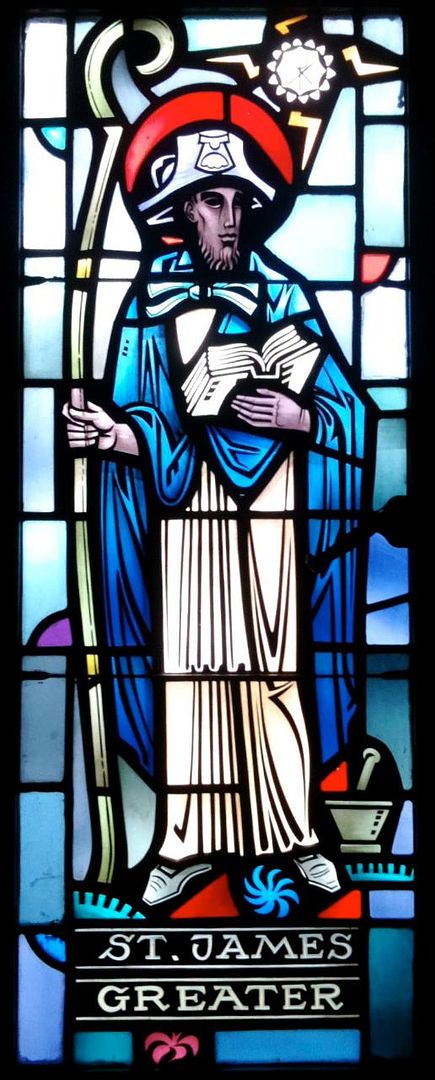
Following the death of Christ, James was present in the Upper Room, and on more than one recorded appearance of the Resurrected Jesus. From the time of Jesus’ Ascension into Heaven, there is little recorded history of James’ missionary activity until that of his martyrdom. Biblical scholars suggest that he probably traveled between Judea and Samaria, and tradition speaks of his journey to Spain, where later his mortal remains were received.

Saint James was the first of the apostles to suffer martyrdom, in Jerusalem, in approximately 44. After nine years preaching in Spain, he had returned to Jerusalem, and was brought before King Herod Agrippa. The Apostle had been preaching fearlessly there, curing the sick and the blind, and delivering possessed persons. Herod promptly sentenced James to execution, reported sparsely by Luke in the Acts of the Apostles: “About that time Herod the king laid violent hands upon some who belonged to the Church, and he killed James, the brother of John with the sword” (Acts 12, 1-2). As Clement of Alexandria, James died by beheading after having converting his accuser: “He who had brought him to the tribunal was so moved seeing him give testimony that he also confessed to being a Christian himself.”

Tradition holds that following his martyrdom in Jerusalem, his followers are believed to have carried his body down the coast and placed it in a stone boat—which was carried by angels to the northern coast of Spain. There, his remains were buried, and promptly forgotten about until the ninth century, when a hermit was led by heavenly vision to the spot. The tomb was rediscovered, and the relics authenticated. From that time, the spot-- Santiago (Iago translating as James) de Compostela—became a center of miracle and pilgrimage-- so much so that Compostela became the third greatest place of pilgrimage, just after Jerusalem and Rome. Today, pilgrims continue to flock to Compostelo, taking one of the many routes known as the “Camino." Pilgrims attach cockleshells—the symbol of Saint James-- or their facsimile to their hats or clothes as "pilgrim badges," signs that they'd venerated the holy relics of the great saint.

(For a recipe for Coquilles St. Jacques à la Provençale, traditionally eaten on the feast of Saint James, see here.)

Saint James is also recognized as having appeared in corporeal form, during the Spanish defense of their land and Christianity from the invading Moors. The saint is said to have appeared on a white horse at the Battle of Clavijo, adorned in cockle shells, in 844, while the Christians were in retreat before the onslaught of the Arab and Berber invaders. Thanks to James’ miraculous appearance, the Moors were defeated. The rallying cry of the Spanish troops, from that time, became “Santiago!”


Saint James the Greater is recognized for his special place within the Disciples of Christ-- having been selected by Our Lord because of his burning, impetuous, and outspoken faith. Through his interaction with Jesus, these qualities were purified, and the former “Son of Thunder” could then proclaim the Gospel of peace. We could all benefit from the same purification, the conversion of our anger, temper, and frustration to righteous instruments of peace and Christian virtue. We look to Saint James today, for inspiration and intercession, that we might better embody the peaceful message of Jesus Christ.
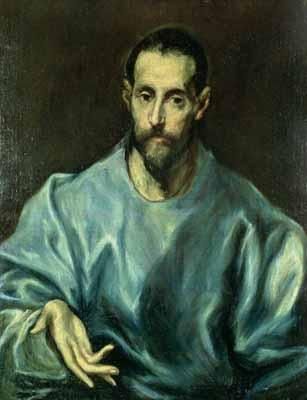
Almighty Father,
by the martyrdom of Saint James you blessed the work of the early Church.
May his profession of faith give us courage and his prayers bring us strength.
Grant, O merciful God, that as thine holy Apostle Saint James, leaving his father and all that he had, without delay was obedient unto the calling of thy Son Jesus Christ, and followed him; so we, forsaking all worldly and carnal affections, may be evermore ready to follow thy holy commandments; through Jesus Christ our Lord. Amen.


Year 2: Day 206 of 365
Prayer Intentions: Deeper faith; Lives of charity and service; Suffering united with Christ.
Requested Intentions: Healing, successful relationships for son, financial success (J); Success of a company (L); For a religious society (J); Healing of a husband, strength as a faithful caregiver (D); Healing of a son (T); Financial security, Healing and guidance (M); Healing of a heart and relationship (V); Employment for daughter (J); For a marriage that glorifies the Lord (K); Resolution of family situation, parents’ health (A); Positive results (C); For a son’s employment, faith, and relationships (S); Restored family relationships (A); Healthy conception and delivery of children (J); For a girlfriend’s recovery from a debilitating mental illness (J); For a daughter’s successful examination results (A); Occupational success, health and safety of family (S); Reduction in anxiety for husband, financial freedom (S); Healing for a sister-in-law (J); For a family experiencing a difficult child custody case (M); Reunification of a family struggling with separation (M): For a son struggling with mental illness (M); Successful examination results (B); To be freed from the chains of sin (J); Admission to a good university (M); For successful surgery (T); For a mother’s mental health and for kindness and forgiveness, for housing problems, for dental health (T).

June 26: Saint Josemaría Escrivá de Balaguer

Posted by Jacob

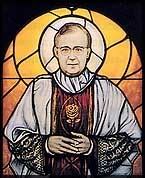
Today, June 26, we commemorate the feast day of Saint Josemaría Escrivá de Balaguer (1902-1975), priest, modern-day saint, and founder of Opus Dei, a Catholic institution dedicated to “helping people turn their work and daily activities into occasions for growing closer to God, for serving others, and for improving society.” Pope John Paul II said of this holy man, “Saint Josemaría was chosen by the Lord to proclaim the universal call to holiness and to indicate that everyday life, its customary activities, are a path towards holiness. It could be said that he was the saint of the ordinary."


Josemaría Escrivá was born in Barbastro, Spain, the son of pious parents. He received a deep Christian education in the home, and the family turned to God during times of need, especially following the deaths of three of his five siblings in infancy and childhood. When Josemaria was a teenager, the family moved to Logrono, as his father needed employment, and it was there that he first sensed his calling to vocation. Moved by the sight of footprints left in the snow by a barefoot friar, he sensed that God was asking something of him, though he did not know exactly what it was. He began to prepare for the priesthood, first in Logrono and later in Saragossa.

Josemaria was ordained in 1925, serving in rural parish, as well as Saragossa for a few years. In 1927, having received permission from his bishop, he traveled to Madrid to earn his doctorate in law. It was while studying in Madrid that Josemaria received from the Lord the purpose of his life: to found Opus Dei-- a way of sanctification in daily work and in the fulfillment of the Christian's ordinary duties. Not limited to religious, this inspired society would be comprised of laity and religious, and would provide a template for bringing the Lord into the daily lives of its members. From that moment on, Josemaria’s life changed. He worked continuously toward his new goal, all the while continuing his studies, ministering to his congregation, and spending time in service to the poor and the ill.

The Spanish Civil War created a challenge to the saint’s mission. When the war broke out in Madrid, religious persecution forced Josemaría to go into hiding, ministering to his flock in secret. Eventually, he left Madrid, and after a harrowing escape across the Pyrenees, took up residence in Burgos. In the years after the civil war, he was able to return to Madrid and complete his doctorate in Law, all the while giving many retreats to laity, priests, and religious.

Saint Josemaria moved to Rome, obtaining a doctorate in Theology, and establishing Opus Dei as an institution. In 1950, it was officially approved by the Holy See. He was appointed by Pope Pius XII as a consultor to two Vatican Congregations, as an honorary member of the Pontifical Academy of Theology, and as an honorary prelate. He was also elevated to the position of Monsignor. In his later y ears, Josemaria traveled the world, preaching, and spreading the message of Opus Dei, bringing large numbers to holiness. By the time of his death in 1975, Opus Dei had begun in dozens of countries and had touched countless lives. After his death thousands of people, including more than a third of the world's bishops, sent letters to Rome asking the Pope to open his cause of beatification and canonization.

Josemaria is remembered for saying, "The ordinary life of a Christian who has faith, when he works or rests, when he prays or sleeps, at all times, is a life in which God is always present.” Through his work in Opus Dei, we are further reminded, "We find the invisible God in the most visible and material things." Today, Opus Dei has around 87,000 members, both men and women, of which 98% are laypersons. The mission of Opus Dei is as follows: “It is in the midst of the most material things of the earth that we must sanctify ourselves, serving God and all mankind. The family, marriage, work – all of our activities – are opportunities for dealing with and imitating Jesus Christ, trying to practice charity, patience, humility, diligence, integrity, cheerfulness and all the other human and Christian virtues.” Members are called to lives of sanctifying work, prayer and sacrifice, charity, and unity of life—the blending of our interior personal relationship with the Lord with our exterior professional and personal lives.

In his 2002 address, in praise of Saint Josemaría Escrivá de Balaguer, founder of Opus Dei, Pope John Paul II proclaimed:

“In the Founder of Opus Dei, there is an extraordinary love for the will of God. There exists a sure criterion of holiness: fidelity in accomplishing the divine will down to the last consequences. For each one of us the Lord has a plan, to each he entrusts a mission on earth. The saint could not even conceive of himself outside of God's plan. He lived only to achieve it.

Saint Josemaría was chosen by the Lord to announce the universal call to holiness and to point out that daily life and ordinary activities are a path to holiness. One could say that he was the saint of ordinary life. In fact, he was convinced that for those who live with a perspective of faith, everything is an opportunity to meet God, everything can be an incentive for prayer. Seen in this light, daily life reveals an unexpected greatness. Holiness is truly within everyone's reach.


Escrivá de Balaguer was a very human saint. All those who met him, whatever their culture or social status, felt he was a father, totally devoted to serving others, for he was convinced that every soul is a marvelous treasure; indeed, every person is worth all of Christ's Blood. This attitude of service is obvious in his dedication to his priestly ministry and in the magnanimity with which he launched so many works of evangelization and human advancement for the poorest persons.


The Lord gave him a profound understanding of the gift of our divine sonship. He taught him to contemplate the tender face of a Father in the God who speaks to us through the most varied events of life. A Father who loves us, who follows us step by step, who protects us, understands us and awaits from each of us a response of love. The consideration of this fatherly presence which accompanies the Christian everywhere gives him steadfast confidence; he must trust in the heavenly Father at every moment. He should never feel lonely or frightened. When the Cross is present, he should not see it as a punishment, but a mission entrusted by the Lord himself. The Christian is necessarily optimistic, because he knows he is a son of God in Christ.”


The life of Saint Josemaría Escrivá de Balaguer calls us to examine our own lives, and the extent to which we lead “double lives”—one life as a hidden Christian, and another as a member of our families, jobs, and communities. We are reminded, through his ongoing legacy of Opus Dei, that “Work, family life, and other ordinary activities are occasions for spiritual union with Jesus Christ.” How might we better unite our deep interior lives of faith with our daily actions? How might we better bring Christ into the world, into our jobs, into our families?


O God, through the mediation of Mary our Mother, you granted your priest St. Josemaría countless graces, choosing him as a most faithful instrument to found Opus Dei, a way of sanctification in daily work and in the fulfillment of the Christian's ordinary duties. Grant that I too may learn to turn all the circumstances and events of my life into occasions of loving You and serving the Church, the Pope and all souls with joy and simplicity, lighting up the pathways of this earth with faith and love. Amen.


Year 2: Day 177 of 365
Prayer Intentions: Union with Christ in our daily lives.
Requested Intentions: For a mother’s mental health and for kindness and forgiveness, for housing problems, for dental health (T); For the soul of a departed friend (X); Restoration of health (D); Successful employment for couple (N); For employment for children (K); For health of friend, for successful relationships for children, for safe pregnancy for daughter (C); For the health of a mother (J); Virtue for daughter (V); Successful acceptance to college for nephew (M); For the health of a cousin (T); Freedom from legal difficulties for husband (S); Husband’s freedom from illness (L); Personal intentions (S); Successful passing of dental board examination (P); Blessings on a family (Z); Successful permanent employment (C); Healing of a son with autism (J).

March 4: Saint Casimir the Peacemaker

Posted by Jacob

Daily, daily

Sing to Mary
Sing, my soul, her praises due!
All her feasts,
Her actions worship
With heart's devotion true.
(Prayer attributed to Saint Casimir)

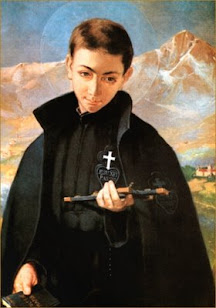
Today, March 4, we celebrate the feast of Saint Casimir (1458-1483), Prince of Poland, the “Peacemaker,” and patron saint of Poland and Lithuania. Casimir is also considered the patron saint of bachelors, having committed himself to virginity in his youth, and despite doctors’ advice, maintaining a strict vow of celibacy throughout his life. Throughout his life, Casimir embodied the Christian tenets of love, peace, and obedience, leading his contemporaries to greatly admire what they termed his “heroic virtue.”

Born the second son of Casimir III, King of Poland, Casimir was one of thirteen children. The next king in the line of succession, he was educated by the learned and pious John Dugloss, at the insistence of his equally virtuous mother, Elizabeth of Austria. Pious from an early age, Casimir soon embodied all Christian virtues through the instruction and modeling of these important figures in his young life.

Despite the luxuries of the royal court, Casimir chose a life of austerity and penance. He fasted daily, wore a hair shirt beneath his robes, slept on the floor (despite the finest of beds), slept little (preferring to spend his nights in prayer), and attended Mass each day. He was frequently observed to enter into ecstasy at Mass, while contemplating the Passion of Christ. His days were spend in charity, working amongst the poor and ill, providing with his own hands for their needs. Referred to as the “father of the poor,” he maintained a cheerful and charismatic disposition, constantly ministering to those in need, and through his model, encouraging others to do the same.

At the age of fifteen, Casimir’s father dispatched him in command of an army to Hungary, to assume the throne there at the request of dissatisfied Hungarian nobility. The sitting king of Hungary raised an army, and stood in wait of Casimir’s troops. For his part, Casimir was against both the invasion of Hungary and his assumption of the throne, but obediently followed his father’s commands. En route to Hungary, Casimir found the conditions of the Polish troops disheartening, with many deserting due to the poor pay and harsh conditions. Upon the advice of his generals, and secure in the knowledge that Pope Sixtus IV had sent an emissary to his father opposed to the invasion, Casimir returned home certain that his decision was the correct and righteous one. His father, of course, did not agree, and forbade him from moving back into the castle, relegating him to confinement for three months. Eventually he was released, but never again took up arms, even with his father’s continued urging. Instead, he devoted himself fully to his studies, prayer, and penance, making a vow of celibacy (again angering his father who was looking for a good political marriage for him).

Saint Casimir was sick throughout most of his life, and at the age of twenty five, foretold the hour of his death. He died at age twenty-six, and was buried at Vilna, where his relics still rest in the church of Saint Stanislaus. Numerous miracles were reported at his tombside, including the healing of the blind, the ill, and the raising of the dead.

One hundred and twenty-two years after his death, Saint Casimir’s was opened, that his relics might be translated to the marble chapel of the same Cathedral. Despite the years, and the poor physical state the tomb and church were in, the Saint’s body, wrapped in robes of silk, still intact, was found whole and incorrupt, and emitting a sweet fragrance. Under his head was found his hymn to Our Lady, which he had had buried with him.


From the Biography of Saint Casimir, written by a contemporary:


By the power of the Holy Spirit, Casimir burned with a sincere and unpretentious love for almighty God that was almost unbelievable in its strength. So rich was his love and so abundantly did it fill his heart, that it flowed out from his inner spirit toward his fellow men. As a result nothing was more pleasant, nothing more desirable for him, than to share his belongings, and even to dedicate and give his entire self to Christ’s poor, to strangers, to the sick, to those in captivity and all who suffer. To widows, orphans and the afflicted, he was not only a guardian and patron but a father, son and brother. One would have to compose a long account to record here all his works of love and dedication for God and for mankind. Indeed, it is difficult to imagine or to express his passion for justice, his exercise of moderation, his gift of prudence, his fundamental spiritual courage and stability, especially in a most permissive age, when men tend to be headstrong and by their very natures inclined to sin.


Daily he urged his father to practice justice throughout his kingdom and in the governance of his people; and whenever anything in the country had been overlooked because of human weakness or simple neglect, he never failed to point it out quietly to the king.


He actively took up the cause of the needy and unfortunate and embraced it as his own; for this reason the people called him the patron of the poor. Though the son of a king and descendant of a noble line, he was never unapproachable in his conversation or dealings with anyone, no matter how humble or obscure.


He always preferred to be counted among the meek and poor of spirit, among those who are promised the kingdom of heaven, rather than among the famous and powerful men of this world. He had no ambition for the power that lies in human rank and he would never accept it from his father. He was afraid the barbs of wealth, which our Lord Jesus Christ spoke of as thorns, would wound his soul, or that he would be contaminated by contact with worldly goods.


Many who acted as his personal servants or secretaries are still alive today; these men, of the highest integrity, who had personal knowledge of his private life, testify that he preserved his chastity to the very end of his life.


All-powerful God,
to serve You is to reign:
by the prayers of Saint Casimir,
help us to serve You in holiness and justice.
Grant this through our Lord Jesus Christ, Your Son,

who lives and reigns with You and the Holy Spirit,
one God, for ever and ever. Amen.


Year 2: Day 63 of 365
Prayer Intentions: Peace in the world.
Requested Intentions: Freedom from medical difficulties, employment, successful relationship (D); End to suffering for sick brother; reconciliation of estranged family (E); End to husband’s addiction; Improved relationship; strength (M); Successful God-centered marriage; Sacramental life (M); Healing, successful relationship (S); For successful marriage (A); For a husband’s freedom from addiction (C); Freedom from pain and illness for a friend (M); Financial freedom (J); Successful passing of occupational examination (S); Healing and conversion, sale of house (L); Occupational success for employee and colleagues (J); Employment for a son (C); Successful attainment of an important appointed position (J); Recovery from cancer for a friend (Z); For a family’s freedom from sin (M); For a daughter with Diabetes (A); Healing of a father following stroke (S).