Why pray the Rosary every day for a year?


Each time the Blessed Virgin has appeared-- whether it be to Saint Bernadette Soubirous at Lourdes; to Lucia, Jacinta, and Francisco at Fatima; or to Mariette Beco at Banneux-- she has asserted the importance, saving grace, and power of praying the Holy Rosary on a daily basis. Based upon her words, the Rosary is penance and conversion for sinners, a pathway to peace, an end to war, and a powerful act of faith in Jesus Christ. Pope Paul VI presented the Rosary as a powerful means to reach Christ "not merely with Mary but indeed, insofar as this is possible to us, in the same way as Mary, who is certainly the one who thought about Him more than anyone else has ever done."

To show us how this is done, perhaps no one has been more eloquent than the great Cardinal Newman, who wrote: "The great power of the Rosary consists in the fact that it translates the Creed into Prayer. Of course, the Creed is already in a certain sense a prayer and a great act of homage towards God, but the Rosary brings us to meditate again on the great truth of His life and death, and brings this truth close to our hearts. Even Christians, although they know God, usually fear rather than love Him. The strength of the Rosary lies in the particular manner in which it considers these mysteries, since all our thinking about Christ is intertwined with the thought of His Mother, in the relations between Mother and Son; the Holy Family is presented to us, the home in which God lived His infinite love."


As Mary said at Fatima, "Jesus wants to use you to make Me known and loved. He wishes to establish the devotion to My Immaculate Heart throughout the world. I promise salvation to whoever embraces it; these souls will be dear to God, like flowers put by Me to adorn his throne."


June 24: Solemnity of the Nativity of Saint John the Baptist

Posted by Jacob

As today is the feast of the nativity of my confirmation saint, I am re-posting my thoughts from last year.  Saint John the Baptist, pray for each of us!

Today, June 24, we celebrate the Solemnity of the Nativity of Saint John the Baptist. For the Church, this is a special day—one of the only feast days of a saint falling on the date of birth, rather than the date on which the saint died (Of course, we also celebrate the beheading of Saint John the Baptist in August). Ordinarily the Church observes the day of a saint's death as his feast, because that day marks his entrance into heaven. To this rule there are two notable exceptions, the birthdays of Blessed Mary (celebrated on September 8) and of Saint John the Baptist. All other persons were stained with original sin at birth, preventing a liturgical celebration of the event. But through the grace of God—in preparation for her special role as Mother of God-- Mary, from the first moment of her existence, was free from original sin. Similarly, John was cleansed of original sin in the womb of his mother, jumping for joy at the greeting of Mary to Elizabeth during her visitation (the second Luminous Mystery of the Holy Rosary).


So, today, the Nativity of Saint John the Baptist, is a special day for the Church. For me, this is also a special day, as Saint John is the saint I chose for my confirmation saint—due to his humility, his foresight, his contemplative nature, his tendencies toward penance, self-deprivation, and mortification, and his understanding of his place in the world (that his role was trivial in comparison to that of Christ). Saint Augustine explained the reason for today's observance—an event which heralds the coming of Jesus in anticipation of Christmas-- in the following words:

"Apart from the most holy solemnity commemorating our Savior's birth, the Church keeps the birthday of no other person except that of John the Baptist. (The feasts of the Immaculate Conception and of the Nativity of the Blessed Virgin had not yet been introduced when he wrote this.) In the case of other saints or of God's chosen ones, the Church, as you know, solemnizes the day on which they were reborn to everlasting beatitude after ending the trials of this life and gloriously triumphing over the world.


"For all these the final day of their lives, the day on which they completed their earthly service is honored. But for John the day of his birth, the day on which he began this mortal life is likewise sacred. The reason for this is, of course, that the Lord willed to announce to men His own coming through the Baptist, lest if He appeared suddenly, they would fail to recognize Him. John represented the Old Covenant and the Law. Therefore he preceded the Redeemer, even as the Law preceded and heralded the new dispensation of grace." (For more from Saint Augustine on the Nativity of Saint John the Baptist, click here.)


 Saint John the Baptist is, therefore, the Precursor of Christ, the forerunner of the Son of Justice, the minister of baptism of Jesus. His birth prepared the way for the coming of Our Lord and Savior, for the coming of salvation for all.
57When it was time for Elizabeth to have her baby, she gave birth to a son. 58Her neighbors and relatives heard that the Lord had shown her great mercy, and they shared her joy.
59On the eighth day they came to circumcise the child, and they were going to name him after his father Zechariah, 60but his mother spoke up and said, "No! He is to be called John."
61They said to her, "There is no one among your relatives who has that name."
62Then they made signs to his father, to find out what he would like to name the child. 63He asked for a writing tablet, and to everyone's astonishment he wrote, "His name is John." 64Immediately his mouth was opened and his tongue was loosed, and he began to speak, praising God. 65The neighbors were all filled with awe, and throughout the hill country of Judea people were talking about all these things. 66Everyone who heard this wondered about it, asking, "What then is this child going to be?" For the Lord's hand was with him.
80And the child grew and became strong in spirit; and he lived in the desert until he appeared publicly to Israel. (Luke 1: 57-66, 80)


John was born to Elizabeth, the “cousin” of Mary, and Zechariah, an elderly man and priest at the Temple of Jerusalem. Elizabeth, also in advanced age, was childless and sterile, although both she and Zechariah very much wished to conceive. According to the Gospel of Luke, John’s birth was foretold by the angel Gabriel to Zechariah while he was at work in the Temple. However, he did not belief, and was struck mute until he named his son John. John, the cousin of Jesus, the infant who leapt in the presence of the Lord prior even to his birth in purity, grew and began his public ministry—one which prepared the way for Christ. In this way, his birth and life anticipated that of Jesus. Both births were foretold by message of an angel—one to a virgin, one to a woman unable to conceive. Both men brought all to faith—one through baptism by water, one by the Spirit.

John left his father’s home—giving up considerable honor and privilege (and even some riches, perhaps!)-- and went into the desert when he was just an adolescent (scholars estimate between 12 and 15 years old). There, in the desert near the river Jordan, he entered into a contemplative life of hermitude, communing with the Lord in silence. He began a life of mortification and penance, wearing a camel-hair shirt, and sustaining his body with locusts and honey. Soon, he gained notoriety as a pious and holy man, and people flocked to him for baptism in the river. He preached reformation of life.

John served the Lord until the age of 29, at which time the angel of the Lord appeared to him, instructing him to proclaim the coming of Christ, preach penance, and to continue baptizing the many. The angel also informed John that Jesus was the Savior of the World, whom John should baptize (the Second Luminous Mystery of the Holy Rosary), and upon whom the Holy Spirit would descend in the form of a dove.

Jesus called John the greatest of all those who had preceded him, saying: “I tell you, among those born of women, no one is greater than John....” But John would have agreed completely with what Jesus added: “Yet the least in the kingdom of God is greater than he.” (Luke 7:28). Saint John lived the words “He must increase; I must decrease,” (John 3:30) believing them to the core of his being.  His purpose was to prepare the way for Jesus. The baptisms John performed were baptisms of repentance and reformation. But the baptisms that Jesus would bring to the world would be through the Holy Spirit and fire. John recognized his role, his insignificance in comparison to the greatness of Christ, and proclaimed himself unworthy to even carry the sandals of Jesus. He said:

31"The one who comes from above is above all; the one who is from the earth belongs to the earth, and speaks as one from the earth. The one who comes from heaven is above all. 32He testifies to what he has seen and heard, but no one accepts his testimony. 33The man who has accepted it has certified that God is truthful. 34For the one whom God has sent speaks the words of God, for God gives the Spirit without limit. 35The Father loves the Son and has placed everything in his hands. 36Whoever believes in the Son has eternal life, but whoever rejects the Son will not see life, for God's wrath remains on him." (John 3: 31-36)

Today is a special day for the Chuch, for all the faithful!  In the words of Blessed Guerric of Igny (c.1080-1157), Cistercian abbot, from his sermon on the Nativity of Saint John the Baptist:

"Rightly, then, did the birth of this child make many rejoice then and does make many rejoice today: born in the old age of his parents he was to preach the grace of rebirth to an aging world. Rightly does the Church solemnly venerate this birth, which is wonderfully brought about by grace and at which nature wonders. To me certainly the birth of the world's Lamp (John 5:35) brings fresh joy, for it enabled me to recognize the true Light shining in the darkness but not mastered by the darkness, (Jn1,5.9).


His birth brings me a joy utterly unspeakable, for so many outstanding benefits accrue to the world through it. He is the first to give the Church instruction, to initiate it by penance, to prepare it by baptism. When it is prepared he delivers it to Christ and unites it with him, (John 3:29). He both trains it to live temperately and, by his own death, gives it the strength to die with fortitude. In all these ways he prepares for the Lord a perfect people, (Luke 1:17).”


All powerful God,
help Your people to walk the path to salvation.
By following the teaching of St. John the Baptist,
may we come to your Son, our Lord Jesus Christ,
who lives and reigns with You and the Holy Spirit,
one God, for ever and ever.
Amen.


One Bread, One Body: The Institution of the Holy Eucharist

Posted by Jacob


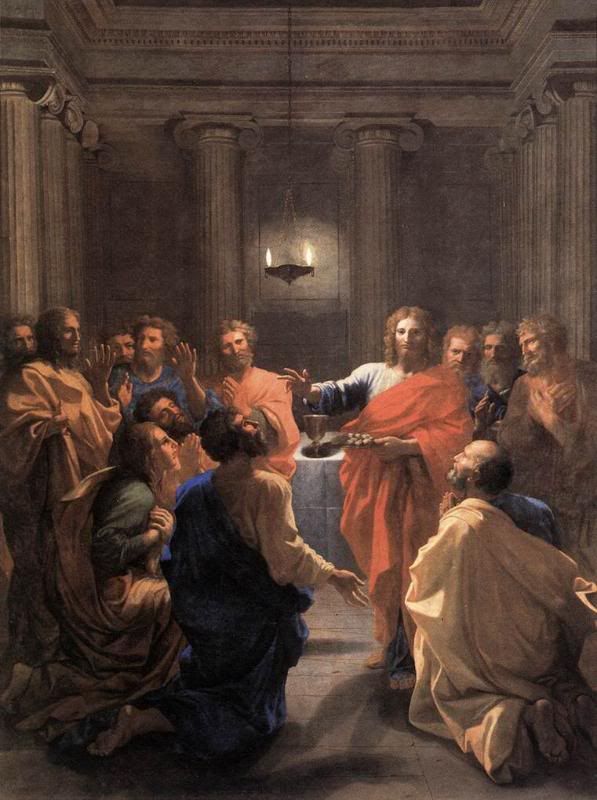
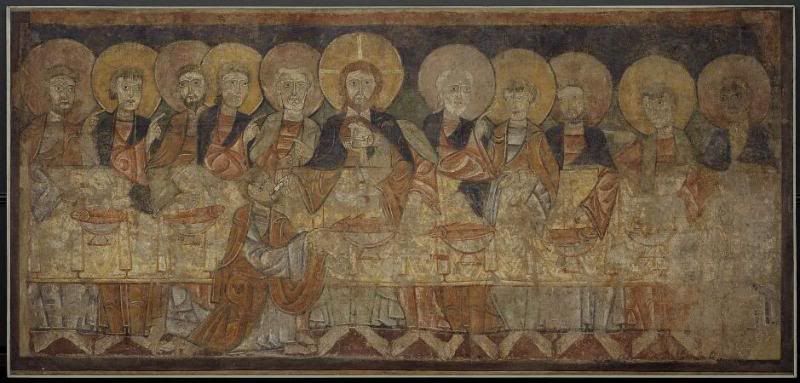
Today, Holy Thursday, we celebrate the Mass of the Lord’s Supper, and the Institution of the Holy Eucharist—the Fifth Luminous Mystery of the Holy Rosary. When Jesus and his disciples gathered in the Upper Room on the eve of His Passion, many things occurred. The Lord washed the feet of His disciples, calling them “friends.” He predicted betrayal on the part of Peter. He let Judas know that he was aware of his treachery. He reminded them about love: 34"A new command I give you: Love one another. As I have loved you, so you must love one another. 35By this all men will know that you are my disciples, if you love one another." (John 13: 34-35). He celebrated the Passover in their presence.


The Last Supper was a moment of love, a stunning moment of self-giving prior to the pain, sorrow, and sacrifice that Jesus would endure for us.  In that moment of love, Jesus instituted the Holy Eucharist, which we continue to celebrate as the Body of Christ.
22While they were eating, Jesus took bread, gave thanks and broke it, and gave it to his disciples, saying, "Take it; this is my body."


23Then he took the cup, gave thanks and offered it to them, and they all drank from it.


24"This is my blood of the covenant, which is poured out for many," he said to them. 25"I tell you the truth, I will not drink again of the fruit of the vine until that day when I drink it anew in the kingdom of God." (Mark 14: 22-25)


In consecrating the bread and wine he presented for His disciples, Jesus accomplished two tasks. First, He literally and physically became the Bread of Life for us, as He first preached, recorded in the Gospel of John:
35Then Jesus declared, "I am the bread of life. He who comes to me will never go hungry, and he who believes in me will never be thirsty. 36But as I told you, you have seen me and still you do not believe. 37All that the Father gives me will come to me, and whoever comes to me I will never drive away. 38For I have come down from heaven not to do my will but to do the will of him who sent me. 39And this is the will of him who sent me, that I shall lose none of all that he has given me, but raise them up at the last day. 40For my Father's will is that everyone who looks to the Son and believes in him shall have eternal life, and I will raise him up at the last day."


53Jesus said to them, "I tell you the truth, unless you eat the flesh of the Son of Man and drink his blood, you have no life in you. 54Whoever eats my flesh and drinks my blood has eternal life, and I will raise him up at the last day. 55For my flesh is real food and my blood is real drink. 56Whoever eats my flesh and drinks my blood remains in me, and I in him. 57Just as the living Father sent me and I live because of the Father, so the one who feeds on me will live because of me. 58This is the bread that came down from heaven. Your forefathers ate manna and died, but he who feeds on this bread will live forever." (John 6: 35-40, 53-58)


But secondly, we all became the Body of Christ. By partaking in the Eucharist, we “acknowledge the body” as Saint Paul wrote to the Corinthians:

27Therefore, whoever eats the bread or drinks the cup of the Lord in an unworthy manner will be guilty of sinning against the body and blood of the Lord. 28A man ought to examine himself before he eats of the bread and drinks of the cup. 29For anyone who eats and drinks without recognizing the body of the Lord eats and drinks judgment on himself. (1 Corinthians 11: 27-29)


In participating in the Eucharist, we receive the generous gift of life from our Savior, but we also are called to give generously to one another—to love one another as Christ, Himself, has loved us. In becoming the body of Christ, we enter into communion not only with Him, but with the Father, and with each other—a powerful agape, participation in the mystery and divinity of Jesus, one body in His name.
16Is not the cup of thanksgiving for which we give thanks a participation in the blood of Christ? And is not the bread that we break a participation in the body of Christ? 17Because there is one loaf, we, who are many, are one body, for we all partake of the one loaf. (1 Corinthians 10:16-17)


In the Eucharist we are called home to the Lord, while remaining in community with each other. We are made one with the Word of God, incarnate, living and tangible. We are renewed in our faith and experience the divinity of Christ. We share in His mystery.  We are forgiven. And we are loved.


Saint Anastasius on the Transfiguration of Our Lord: "It is Good for Us to be Here"

Posted by Jacob

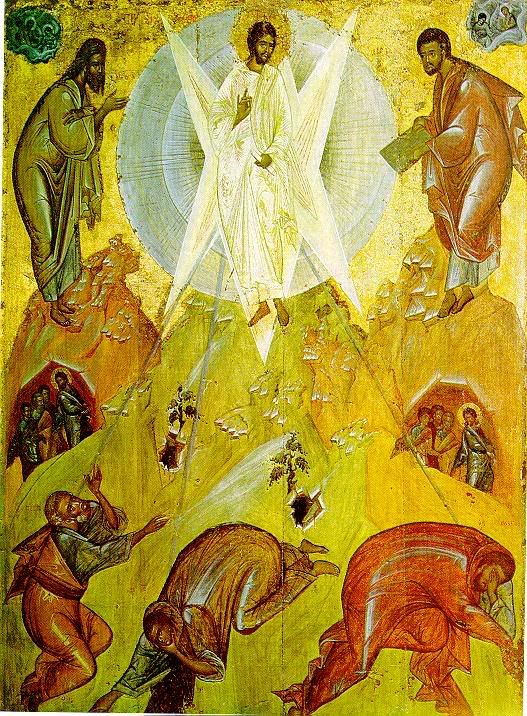
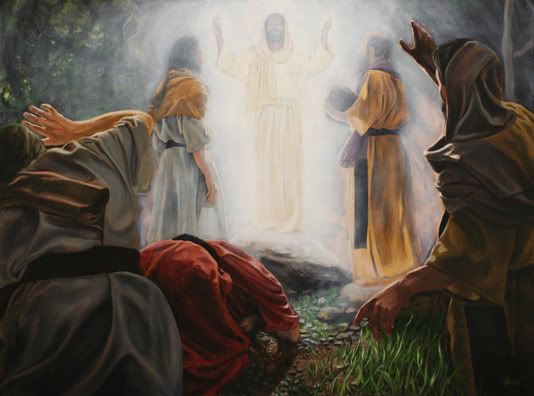
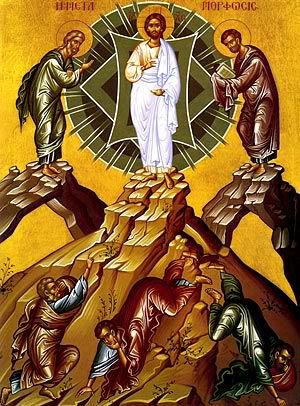
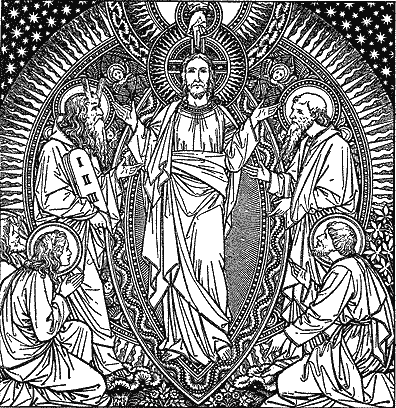
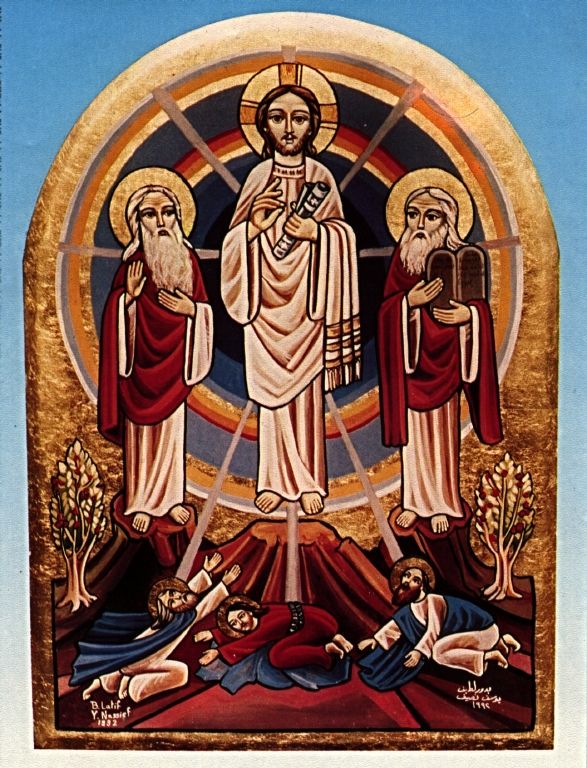
Today, August 6, we celebrate the feast of the Transfiguration of Our Lord, an event Pope Saint Leo the Great called, “Law through Moses, Grace and Truth through Jesus Christ.” The Transfiguration is the fourth Luminous Mystery, or Mystery of Light.  Below, a is an excerpt from a sermon on the on the feast of the Transfiguration, delivered by Saint Anastasius of Sinai, Bishop, and Early Father of the Church. Entitled, “It is Good for Us to be Here,” Saint Anastasius, echoing the words of Peter upon Mount Tabor, reminds us of the goodness and depth of our relationships with Jesus Christ


Upon Mount Tabor, Jesus revealed to his disciples a heavenly mystery. While living among them he had spoken of the kingdom and of his second coming in glory, but to banish from their hearts any possible doubt concerning the kingdom and to confirm their faith in what lay in the future by its prefiguration in the present, he gave them on Mount Tabor a wonderful vision of his glory, a foreshadowing of the kingdom of heaven. It was as if he said to them: “As time goes by you may be in danger of losing your faith. To save you from this I tell you now that some standing here listening to me will not taste death until they have seen the Son of Man coming in the glory of his Father. “Moreover, in order to assure us that Christ could command such power when he wished, the evangelist continues: Six days later, Jesus took with him Peter, James and John, and led them up a high mountain where they were alone. There, before their eyes, he was transfigured. His face shone like the sun, and his clothes became as white as light. Then the disciples saw Moses and Elijah appear, and they were talking to Jesus.


These are the divine wonders we celebrate today; this is the saving revelation given us upon the mountain; this is the festival of Christ that has drawn us here. Let us listen, then, to the sacred voice of God so compellingly calling us from on high, from the summit of the mountain, so that with the Lord’s chosen disciples we may penetrate the deep meaning of these holy mysteries, so far beyond our capacity to express. Jesus goes before us to show us the way, both up the mountain and into heaven, and - I speak boldly - it is for us now to follow him with all speed, yearning for the heavenly vision that will give us a share in his radiance, renew our spiritual nature and transform us into his own likeness, making us for ever sharers in his Godhead and raising us to heights as yet undreamed of.


Let us run with confidence and joy to enter into the cloud like Moses and Elijah, or like James and John. Let us be caught up like Peter to behold the divine vision and to be transfigured by that glorious transfiguration. Let us retire from the world, stand aloof from the earth, rise above the body, detach ourselves from creatures and turn to the creator, to whom Peter in ecstasy exclaimed: Lord, it is good for us to be here.


It is indeed good to be here, as you have said, Peter. It is good to be with Jesus and to remain here for ever. What greater happiness or higher honor could we have than to be with God, to be made like him and to live in his light?


Therefore, since each of us possesses God in his heart and is being transformed into his divine image, we also should cry out with joy: It is good for us to be here - here where all things shine with divine radiance, where there is joy and gladness and exultation; where there is nothing in our hearts but peace, serenity and stillness; where God is seen. For here, in our hearts, Christ takes up his abode together with the Father, saying as he enters: Today salvation has come to this house. With Christ, our hearts receive all the wealth of his eternal blessings, and there where they are stored up for us in him, we see reflected as in a mirror both the first fruits and the whole of the world to come.

August 6: Feast of the Transfiguration of Our Lord

Posted by Jacob

28About eight days after Jesus said this, he took Peter, John and James with him and went up onto a mountain to pray. 29As he was praying, the appearance of his face changed, and his clothes became as bright as a flash of lightning. 30Two men, Moses and Elijah, 31appeared in glorious splendor, talking with Jesus. They spoke about his departure, which he was about to bring to fulfillment at Jerusalem. 32Peter and his companions were very sleepy, but when they became fully awake, they saw his glory and the two men standing with him. 33As the men were leaving Jesus, Peter said to him, "Master, it is good for us to be here. Let us put up three shelters—one for you, one for Moses and one for Elijah." (He did not know what he was saying.)

34While he was speaking, a cloud appeared and enveloped them, and they were afraid as they entered the cloud. 35A voice came from the cloud, saying, "This is my Son, whom I have chosen; listen to him." 36When the voice had spoken, they found that Jesus was alone. The disciples kept this to themselves, and told no one at that time what they had seen. (Luke 9:28-36)


Today, August 6, we celebrate the feast of the Transfiguration of Our Lord, what Pope Saint Leo the Great called, “Law through Moses, Grace and Truth through Jesus Christ.” The Transfiguration is the fourth Luminous Mystery, or Mystery of Light (See also the Miracle at the Wedding in Cana, The Baptism of Jesus, the Proclamation of the Kingdom of God, and the Institution of the Holy Eucharist). Explaining the Transfiguration, Pope John Paul II wrote, "The mystery of light par excellence is the Transfiguration, traditionally believed to have taken place on Mount Tabor. The glory of the Godhead shines forth from the face of Christ as the Father commands the astonished Apostles to 'listen to him' (cf. Luke 9:35 and parallels) and to prepare to experience with him the agony of the Passion, so as to come with him to the joy of the Resurrection and a life transfigured by the Holy Spirit.”

According to the Catechism of the Catholic Church, during the Transfiguration, “For a moment, Jesus discloses His divine glory, confirming Peter's confession. He also reveals that He will have to go by the way of the cross at Jerusalem in order to 'enter into His glory'. (Luke 24:26)" As Luke recounts, God the Father commanded, "Listen to him." The disciple John, called the beloved disciple for his faithfulness to Jesus, was the only disciple who did not abandon Jesus on His way to the Cross at Calvary. As we consider this fact, it is interesting to not that he was only able to accomplish this faithfulness while holding the arm of Mary, the Mother of God. In thinking of John, we realize that we can suffer tremendous pain in this life with bravery, by embracing our Holy Mother and praying her Rosary.

The word "transfigured" is an interesting word. It is defined as “to transform, literally or figuratively to metamorphose, or to change.” It means to change into another form. But it also means to change the outside to match the inside. In the case of Jesus Christ, the Transfiguration provides a glimpse of the glory of heaven, here in the reality of earth. The glory of God incarnate is revealed, and we literally see the majesty of heaven shining forth like a brilliant sun. In that moment, the light of Christ overcomes that of Moses and Elijah—two figured highly revered by the Jews. We can imagine from Peter’s response that he was ecstatic. His master had reached the same level as Moses and Elijah. Despite only days before having proclaimed Jesus the “Christ of God,” Peter equates Him to Moses and Elijah, and in doing so loses sight of his true Godliness. Rather than place Jesus in the Holy Trinity with God the Father and the Holy Spirit, Peter suggests that tents be erected, in homage to a more earthly trinity present in the minds’ of the Jews. He is quickly corrected by the proclamation from Our Father in Heaven: “This is my Son, who I have chosen. Listen to Him.” The cloud overtakes Moses and Elijah, and only Jesus remains, reminding us that while Moses represents the law of the Old Testament and Elias represents the prophets, Jesus is the consummation of the Old Testament. He is the new Law and the fulfillment of all the prophets.

St. Cyril of Alexandria wrote of the Transfiguration in terms of the connection between suffering and glory, between the Law and the Prophets, between the foreshadowing of the Old Testament and the prophesies fulfilled in the Jesus. He wrote in 444: "I say to you, there are some of those standing here who shall not taste of death until they have seen the kingdom of God." ... By the "kingdom of God" He means the sight of the glory in which He will appear at His revelation to the inhabitants of earth. He will come in the glory of God the Father and not in a humble condition like ours. How did He make those who received the promise spectators of a thing so wonderful? He goes up into the mountain taking three chosen disciples with Him. He is transformed to such a surpassing and godlike brightness that His garments even glittered with rays of fire and seemed to flash like lightning. Besides, Moses and Elijah stood at Jesus’ side and spoke with one another about His departure that He was about, it says, to accomplish at Jerusalem. This meant the mystery of the dispensation in the flesh and of His precious suffering upon the Cross. It is also true that the law of Moses and the word of the holy prophets foreshadowed the mystery of Christ. The law of Moses foreshadowed it by types and shadows, painting it as in a picture. The holy prophets in different ways declared beforehand that in due time He would appear in our likeness and for the salvation and life of us all, agree to suffer death on the tree. Moses and Elijah standing before Him and talking with one another was a sort of representation. It excellently displayed our Lord Jesus Christ as having the law and the prophets for His bodyguard. It displayed Christ as being the Lord of the Law and the Prophets, as foretold in them by those things that they proclaimed in mutual agreement beforehand. The words of the prophets are not different from the teachings of the law.”

For Jesus, we can only imagine what He prayed about on the mountain prior to the Transfiguration. Given the pain and Passion that lied in store for Him, we can guess that He was contemplating His earthly sacrifice and death. The Transfiguration was a message from above, preparing the disciples for the pain and suffering that was growing near. As Jesus descends from the mountain, He sets His sights firmly and resolutely on Jerusalem, on His death, on our redemption.

The Transfiguration makes us stop and think for a moment. Jesus revealed His sanctity to the disciples present, and then walked graciously to His death for us. But what of our own transfiguration? How has the sacrifice of Jesus changed us? We only need look to the Eucharist for our answer. For us, we are able to experience moments of profound Transfiguration in the Eucharist, when we receive Holy Communion. This experience of the Eucharist is more than a symbol, it is the physical manifestation of the Body, Blood, Soul and Divinity of Christ. It is for us, according to Saint Thomas Aquinas, “a pledge of future glory, containing in Itself all delight.” The celebration of the Eucharist is our transfiguration on earth to allowing us to endure the agony of our daily passion in preparation for the glorious joy of our Resurrection!


Dear Jesus,


Thou didst appear to Thy three disciples in all Thy glory.


I know that Thou art now in Heaven seated at the right hand of the Father in the same glorious state Thou revealed Thyself in on Mount Tabor.


I am truly thankful that Thou hast suffered, died and risen so as to conquer death so that I may be saved from the it's power.


I know that I will one day be risen with a glorified body when Thou come to judge the living and the dead.


I am sorry for the many times that I have offended Thee by not striving for holiness and by being lazy in my prayer life.


Please send me the graces I need to truly desire holiness and to make the sacrifices necessary to achieve it so that I may live my life always mindful that one day I will stand before Thee and be held accountable for all my action and lack thereof.


Amen.

June 24: Solemnity of the Nativity of Saint John the Baptist

Posted by Jacob

As today is the feast of the nativity of my confirmation saint, I am re-posting my thoughts from last year.  Saint John the Baptist, pray for each of us!

Today, June 24, we celebrate the Solemnity of the Nativity of Saint John the Baptist. For the Church, this is a special day—one of the only feast days of a saint falling on the date of birth, rather than the date on which the saint died (Of course, we also celebrate the beheading of Saint John the Baptist in August). Ordinarily the Church observes the day of a saint's death as his feast, because that day marks his entrance into heaven. To this rule there are two notable exceptions, the birthdays of Blessed Mary (celebrated on September 8) and of Saint John the Baptist. All other persons were stained with original sin at birth, preventing a liturgical celebration of the event. But through the grace of God—in preparation for her special role as Mother of God-- Mary, from the first moment of her existence, was free from original sin. Similarly, John was cleansed of original sin in the womb of his mother, jumping for joy at the greeting of Mary to Elizabeth during her visitation (the second Luminous Mystery of the Holy Rosary).


So, today, the Nativity of Saint John the Baptist, is a special day for the Church. For me, this is also a special day, as Saint John is the saint I chose for my confirmation saint—due to his humility, his foresight, his contemplative nature, his tendencies toward penance, self-deprivation, and mortification, and his understanding of his place in the world (that his role was trivial in comparison to that of Christ). Saint Augustine explained the reason for today's observance—an event which heralds the coming of Jesus in anticipation of Christmas-- in the following words:

"Apart from the most holy solemnity commemorating our Savior's birth, the Church keeps the birthday of no other person except that of John the Baptist. (The feasts of the Immaculate Conception and of the Nativity of the Blessed Virgin had not yet been introduced when he wrote this.) In the case of other saints or of God's chosen ones, the Church, as you know, solemnizes the day on which they were reborn to everlasting beatitude after ending the trials of this life and gloriously triumphing over the world.


"For all these the final day of their lives, the day on which they completed their earthly service is honored. But for John the day of his birth, the day on which he began this mortal life is likewise sacred. The reason for this is, of course, that the Lord willed to announce to men His own coming through the Baptist, lest if He appeared suddenly, they would fail to recognize Him. John represented the Old Covenant and the Law. Therefore he preceded the Redeemer, even as the Law preceded and heralded the new dispensation of grace." (For more from Saint Augustine on the Nativity of Saint John the Baptist, click here.)


 Saint John the Baptist is, therefore, the Precursor of Christ, the forerunner of the Son of Justice, the minister of baptism of Jesus. His birth prepared the way for the coming of Our Lord and Savior, for the coming of salvation for all.
57When it was time for Elizabeth to have her baby, she gave birth to a son. 58Her neighbors and relatives heard that the Lord had shown her great mercy, and they shared her joy.
59On the eighth day they came to circumcise the child, and they were going to name him after his father Zechariah, 60but his mother spoke up and said, "No! He is to be called John."
61They said to her, "There is no one among your relatives who has that name."
62Then they made signs to his father, to find out what he would like to name the child. 63He asked for a writing tablet, and to everyone's astonishment he wrote, "His name is John." 64Immediately his mouth was opened and his tongue was loosed, and he began to speak, praising God. 65The neighbors were all filled with awe, and throughout the hill country of Judea people were talking about all these things. 66Everyone who heard this wondered about it, asking, "What then is this child going to be?" For the Lord's hand was with him.
80And the child grew and became strong in spirit; and he lived in the desert until he appeared publicly to Israel. (Luke 1: 57-66, 80)


John was born to Elizabeth, the “cousin” of Mary, and Zechariah, an elderly man and priest at the Temple of Jerusalem. Elizabeth, also in advanced age, was childless and sterile, although both she and Zechariah very much wished to conceive. According to the Gospel of Luke, John’s birth was foretold by the angel Gabriel to Zechariah while he was at work in the Temple. However, he did not belief, and was struck mute until he named his son John. John, the cousin of Jesus, the infant who leapt in the presence of the Lord prior even to his birth in purity, grew and began his public ministry—one which prepared the way for Christ. In this way, his birth and life anticipated that of Jesus. Both births were foretold by message of an angel—one to a virgin, one to a woman unable to conceive. Both men brought all to faith—one through baptism by water, one by the Spirit.

John left his father’s home—giving up considerable honor and privilege (and even some riches, perhaps!)-- and went into the desert when he was just an adolescent (scholars estimate between 12 and 15 years old). There, in the desert near the river Jordan, he entered into a contemplative life of hermitude, communing with the Lord in silence. He began a life of mortification and penance, wearing a camel-hair shirt, and sustaining his body with locusts and honey. Soon, he gained notoriety as a pious and holy man, and people flocked to him for baptism in the river. He preached reformation of life.

John served the Lord until the age of 29, at which time the angel of the Lord appeared to him, instructing him to proclaim the coming of Christ, preach penance, and to continue baptizing the many. The angel also informed John that Jesus was the Savior of the World, whom John should baptize (the Second Luminous Mystery of the Holy Rosary), and upon whom the Holy Spirit would descend in the form of a dove.

Jesus called John the greatest of all those who had preceded him, saying: “I tell you, among those born of women, no one is greater than John....” But John would have agreed completely with what Jesus added: “Yet the least in the kingdom of God is greater than he.” (Luke 7:28). Saint John lived the words “He must increase; I must decrease,” (John 3:30) believing them to the core of his being.  His purpose was to prepare the way for Jesus. The baptisms John performed were baptisms of repentance and reformation. But the baptisms that Jesus would bring to the world would be through the Holy Spirit and fire. John recognized his role, his insignificance in comparison to the greatness of Christ, and proclaimed himself unworthy to even carry the sandals of Jesus. He said:

31"The one who comes from above is above all; the one who is from the earth belongs to the earth, and speaks as one from the earth. The one who comes from heaven is above all. 32He testifies to what he has seen and heard, but no one accepts his testimony. 33The man who has accepted it has certified that God is truthful. 34For the one whom God has sent speaks the words of God, for God gives the Spirit without limit. 35The Father loves the Son and has placed everything in his hands. 36Whoever believes in the Son has eternal life, but whoever rejects the Son will not see life, for God's wrath remains on him." (John 3: 31-36)

Today is a special day for the Chuch, for all the faithful!  In the words of Blessed Guerric of Igny (c.1080-1157), Cistercian abbot, from his sermon on the Nativity of Saint John the Baptist:

"Rightly, then, did the birth of this child make many rejoice then and does make many rejoice today: born in the old age of his parents he was to preach the grace of rebirth to an aging world. Rightly does the Church solemnly venerate this birth, which is wonderfully brought about by grace and at which nature wonders. To me certainly the birth of the world's Lamp (John 5:35) brings fresh joy, for it enabled me to recognize the true Light shining in the darkness but not mastered by the darkness, (Jn1,5.9).


His birth brings me a joy utterly unspeakable, for so many outstanding benefits accrue to the world through it. He is the first to give the Church instruction, to initiate it by penance, to prepare it by baptism. When it is prepared he delivers it to Christ and unites it with him, (John 3:29). He both trains it to live temperately and, by his own death, gives it the strength to die with fortitude. In all these ways he prepares for the Lord a perfect people, (Luke 1:17).”


All powerful God,
help Your people to walk the path to salvation.
By following the teaching of St. John the Baptist,
may we come to your Son, our Lord Jesus Christ,
who lives and reigns with You and the Holy Spirit,
one God, for ever and ever.
Amen.


Year 2: Day 175 of 365
Prayer Intentions: Knowledge and conviction of our faith; For those wrongly imprisoned. For all those who are wrongly put to death.
Requested Intentions: For a mother’s mental health and for kindness and forgiveness, for housing problems, for dental health (T); For the soul of a departed friend (X); Restoration of health (D); Successful employment for couple (N); For employment for children (K); For health of friend, for successful relationships for children, for safe pregnancy for daughter (C); For the health of a mother (J); Virtue for daughter (V); Successful acceptance to college for nephew (M); For the health of a cousin (T); Freedom from legal difficulties for husband (S); Husband’s freedom from illness (L); Personal intentions (S); Successful passing of dental board examination (P); Blessings on a family (Z); Successful permanent employment (C); Healing of a son with autism (J)



Institution of the Holy Eucharist: The Last Supper

Posted by Jacob


Today, Holy Thursday, we celebrate the Mass of the Lord’s Supper, and the Institution of the Holy Eucharist—the Fifth Luminous Mystery of the Holy Rosary. When Jesus and his disciples gathered in the Upper Room on the eve of His Passion, many things occurred. The Lord washed the feet of His disciples, calling them “friends.” He predicted betrayal on the part of Peter. He let Judas know that he was aware of his treachery. He reminded them about love: 34"A new command I give you: Love one another. As I have loved you, so you must love one another. 35By this all men will know that you are my disciples, if you love one another." (John 13: 34-35). He celebrated the Passover in their presence.


The Last Supper was a moment of love, a stunning moment of self-giving prior to the pain, sorrow, and sacrifice that Jesus would endure for us.  In that moment of love, Jesus instituted the Holy Eucharist, which we continue to celebrate as the Body of Christ.
22While they were eating, Jesus took bread, gave thanks and broke it, and gave it to his disciples, saying, "Take it; this is my body."


23Then he took the cup, gave thanks and offered it to them, and they all drank from it.


24"This is my blood of the covenant, which is poured out for many," he said to them. 25"I tell you the truth, I will not drink again of the fruit of the vine until that day when I drink it anew in the kingdom of God." (Mark 14: 22-25)


In consecrating the bread and wine he presented for His disciples, Jesus accomplished two tasks. First, He literally and physically became the Bread of Life for us, as He first preached, recorded in the Gospel of John:
35Then Jesus declared, "I am the bread of life. He who comes to me will never go hungry, and he who believes in me will never be thirsty. 36But as I told you, you have seen me and still you do not believe. 37All that the Father gives me will come to me, and whoever comes to me I will never drive away. 38For I have come down from heaven not to do my will but to do the will of him who sent me. 39And this is the will of him who sent me, that I shall lose none of all that he has given me, but raise them up at the last day. 40For my Father's will is that everyone who looks to the Son and believes in him shall have eternal life, and I will raise him up at the last day."


53Jesus said to them, "I tell you the truth, unless you eat the flesh of the Son of Man and drink his blood, you have no life in you. 54Whoever eats my flesh and drinks my blood has eternal life, and I will raise him up at the last day. 55For my flesh is real food and my blood is real drink. 56Whoever eats my flesh and drinks my blood remains in me, and I in him. 57Just as the living Father sent me and I live because of the Father, so the one who feeds on me will live because of me. 58This is the bread that came down from heaven. Your forefathers ate manna and died, but he who feeds on this bread will live forever." (John 6: 35-40, 53-58)


But secondly, we all became the Body of Christ. By partaking in the Eucharist, we “acknowledge the body” as Saint Paul wrote to the Corinthians:

27Therefore, whoever eats the bread or drinks the cup of the Lord in an unworthy manner will be guilty of sinning against the body and blood of the Lord. 28A man ought to examine himself before he eats of the bread and drinks of the cup. 29For anyone who eats and drinks without recognizing the body of the Lord eats and drinks judgment on himself. (1 Corinthians 11: 27-29)


In participating in the Eucharist, we receive the generous gift of life from our Savior, but we also are called to give generously to one another—to love one another as Christ, Himself, has loved us. In becoming the body of Christ, we enter into communion not only with Him, but with the Father, and with each other—a powerful agape, participation in the mystery and divinity of Jesus, one body in His name.
16Is not the cup of thanksgiving for which we give thanks a participation in the blood of Christ? And is not the bread that we break a participation in the body of Christ? 17Because there is one loaf, we, who are many, are one body, for we all partake of the one loaf. (1 Corinthians 10:16-17)


In the Eucharist we are called home to the Lord, while remaining in community with each other. We are made one with the Word of God, incarnate, living and tangible. We are renewed in our faith and experience the divinity of Christ. We share in His mystery.  We are forgiven. And we are loved.


Year 2: Day 111of 365

Prayer Intentions: Communities of faith
Requested Intentions: Financial ability to send children to school (S); Safe return of a runaway (J); Healing of a family (J); Reconciliation of marriage (S); Healing of a daughter with congenital heart disease (F); Healing and an end to suffering (J); For the children (M); For a son fighting a rare immune system disease (R); Freedom from imprisonment (J); Employment and end to depression (H); Successful employment (A); Health for a soon to be delivered baby (T); Financial security (L); Healing of tooth pain (A); Health of expectant mother and child (R); Purification of the souls in Purgatory (A); Guidance in studies (J); Healing and security for a displaced family (C); Healing of high blood pressure; Recovery of brother following surgery (A); For a sister in trouble, that she may make better decisions in the light of Christ (M); Health of expectant mother and child (R); Attainment of funds for surgery (J); Freedom from financial difficulties (E); For employment and college acceptance (E); Recovery and healing of a friend (C); For successful outcome to surgery (C); Healing for brother (M); Successful employment (C); For the victims of the Japanese tsunami/earthquake (J); Healing (E); For a son struggling with depression (B); Successful conception (M); Freedom from social anxiety; confidence in the Lord (J); Improved success in employment and studies (D); Freedom from illness (T); For a wife’s employment (E); Healing of a husband’s knee (M); Freedom from sickness (R); Healing (C); Restoration of marriage (F); Freedom from medical difficulties, employment, successful relationship (D); Healing of a father following stroke (S).

Pope Saint Leo the Great: On the Beatitudes

Posted by Jacob

Today, January 30, we read, in part, Matthew’s account of the Sermon on the Mount, the continuation of Jesus’ Proclamation of the Kingdom of Heaven, which began shortly after John the Baptist’s arrest and imprisonment. During the Sermon on the Mount, Jesus builds upon his teachings, providing the new commandments for Christian living. The Proclamation of the Kingdom of Heaven is the third Luminous Mystery—the Mysteries of Light—of the Holy Rosary.


The Sermon on the Mount included Jesus’ teachings regarding the Beatitudes. Below, a homily delivered by Pope Saint Leo the Great, Doctor of the Church, on the Beatitudes.


I. Introduction of the subject.


When our LORD Jesus Christ, beloved, was preaching the gospel of the Kingdom, and was healing various sicknesses through the whole of Galilee, the fame of His mighty works had spread into all Syria: large crowds too from all parts of Judaea were flocking to the heavenly Physician. For as human ignorance is slow in believing what it does not see, and in hoping for what it does not know, those who were to be instructed in the divine lore, needed to be aroused by bodily benefits and visible miracles: so that they might have no doubt as to the wholesomeness of His teaching when they actually experienced His benignant power. And therefore that the LORD might use outward healings as an introduction to inward remedies, and after healing bodies might work cures in the soul, He separated Himself from the surrounding crowd, ascended into the retirement of a neighbouring mountain, and called His apostles to Him there, that from the height of that mystic seat He might instruct them in the lottier doctrines, signifying from the very nature of the place and act that He it was who had once honoured Moses by speaking to him: then indeed with a more terrifying justice, but now with a holier mercifulness, that what had been promised might be fulfilled when the Prophet Jeremiah says: "behold the days come when I will complete a new covenant for the house of Israel and for the house of Judah. After those days, saith the LORD, I will put My laws in their minds, and in their heart will I write them." He therefore who had spoken to Moses, spoke also to the apostles, and the swift hand of the Word wrote and deposited the secrets of the new covenant in the disciples' hearts: there were no thick clouds surrounding Him as of old, nor were the people frightened off from approaching the mountain by frightful sounds and lightning, but quietly and freely His discourse reached the ears of those who stood by: that the harshness of the law might give way before the gentleness of grace, and "the spirit of adoption" might dispel the terrors of bondage.


II. The blessedness of humility discussed


The nature then of Christ's teaching is attested by His own holy statements: that they who wish to arrive at eternal blessedness may understand the steps of ascent to that high happiness. "Blessed," He saith, "are the poor in spirit, for theirs is the kingdom of heaven." It would perhaps be doubtful what poor He was speaking of, if in saying "blessed are the poor" He had added nothing which would explain the sort of poor: and then that poverty by itself would appear sufficient to win the kingdom of heaven which many suffer from hard and heavy necessity. But when He says "blessed are the poor in spirit," He shows that the kingdom of heaven must be assigned to those who are recommended by the humility of their spirits rather than by the smallness of their means. Yet it cannot be doubted that this possession of humility is more easily acquired by the poor than the rich: for submissiveness is the companion of those that want, while loftiness of mind dwells with riches. Notwithstanding, even in many of the rich is found that spirit which uses its abundance not for the increasing of its pride but on works of kindness, and counts that for the greatest gain which it expends in the relief of others' hardships. It is given to every kind and rank of men to share in this virtue, because men may be equal in will, though unequal in fortune: and it does not matter how different they are in earthly means, who are found equal in spiritual possessions. Blessed. therefore, is poverty which is not possessed with a love of temporal things, and does not seek to be increased with the riches of the world, but is eager to amass heavenly possessions.


III. Scriptural examples of humility.


Of this high-souled humility the Apostles first, after the LORD, have given us example, who, leaving all that they had without difference at the voice of the heavenly Master, were turned by a ready change from the catching of fish to be fishers of men, and made many like themselves through the imitation of their faith, when with those first-begotten sons of the Church, "the heart of all was one, and the spirit one, of those that believed:" for they, putting away the whole of their things and possessions, enriched themselves with eternal goods, through the most devoted poverty, and m accordance with the Apostles' preaching rejoiced to have nothing of the world and possess all things with Christ. Hence the blessed Apostle Peter, when he was going up into the temple, and was asked for alms by the lame man, said, "Silver and gold is not mine, but what I have that I give thee: in the Name of Jesus Christ of Nazareth, arise and walk." What more sublime than this humility? what richer than this poverty? He hath not stores of money, but he hath gifts of nature. He whom his mother had brought forth lame from the womb, is made whole by Peter with a word; and he who gave not Caesar's image in a coin, restored Christ's image on the man. And by the riches of this treasure not he only was aided whose lower of walking was restored, but 5,000 men also, who then believed at the Apostle's exhortation on account of the wonder of this cure. And that poor man who had not what to give to the asker, bestowed so great a bounty of Divine Grace, that, as he had set one man straight on his feet, so he healed these many thousands of believers in their hearts, and made them "leap as an hart" in Christ whom he had found limping in Jewish unbelief.


IV. The blessedness of mourning discussed.


After the assertion of this most happy humility, the LORD hath added, saying, "Blessed are they which mourn, for they shall be comforted." This mourning, beloved, to which eternal comforting is promised, is not the same as the affliction of this world: nor do those laments which are poured out in the sorrowings of the whole human race make any one blessed. The reason for holy groanings, the cause of blessed tears, is very different. Religious grief mourns sin either that of others' or one's own: nor does it mourn for that which is wrought by GOD's justice, but it laments over that which is committed by man's iniquity, where he that does wrong is more to be deplored than he who suffers it, because the unjust man's wrongdoing plunges him into punishment, but the just man's endurance leads him on to glory.


V. The blessedness of the meek.

Next the LORD says: "blessed are the meek, for they shall possess the earth by inheritance." To the meek and gentle, to the humble and modest, and to those who are prepared to endure all injuries, the earth is promised for their possession. And this is not to be reckoned a small or cheap inheritance, as if it were distinct from our heavenly dwelling, since it is no other than these who are understood to enter the kingdom of heaven. The earth, then, which is promised to the meek, and is to be given to the gentle in possession, is the flesh of the saints, which in reward for their humility will be changed in a happy resurrection, and clothed with the glory of immortality, in nothing now to act contrary to the spirit, and to be in complete unity and agreement with the will of the soul. For then the outer man will be the peaceful and unblemished possession of the inner man: then the mind, engrossed in beholding GOD, will be hampered by no obstacles of human weakness nor will it any more have to be said "The body which is corrupted, weigheth upon the soul, and its earthly house presseth down the sense which thinketh many things:" for the earth will not struggle against its tenant, and will not venture on any insubordination against the rule of its governor. For the meek shall possess it in perpetual peace, and nothing shall be taken from their rights, "when this corruptible shall have put on incorruption, and this mortal shall have put on immortality:" that their danger may turn into reward, and what was a burden become an honour.


VI. The blessedness of desiring righteousness.


After this the LORD goes on to say: "blessed are they who hunger and thirst after righteousness, for they shall be satisfied." It is nothing bodily, nothing earthly, that this hunger, this thirst seeks for: but it desires to be satiated with the good food of righteousness, and wants to be admitted to all the deepest mysteries, and be filled with the LORD Himself. Happy the mind that craves this food and is eager for such drink: which it certainly would not seek for if it had never tasted of its sweetness. But hearing the Prophet's spirit saying to him: "taste and see that the LORD is sweet;" it has received some portion of sweetness from on high, and blazed out into love of the purest pleasure, so that spurning all things temporal, it is seized with the utmost eagerness for eating and drinking righteousness, and grasps the truth of that first commandment which says: "Thou shalt love the LORD thy GOD out of all thy heart, and out of all thy mind, and out of all thy strength:" since to love GOD is nothing else but to love righteousness. In fine, as in that passage the care for one's neighbour is joined to the love of GOD, so, too, here the virtue of mercy is linked to the desire for righteousness, and it is said:


VII. The blessedness of the merciful:


"Blessed are the merciful, for GOD shall have mercy on them." Recognize, Christian, the worth of thy wisdom, and understand to what rewards thou art called, and by what methods of discipline thou must attain thereto. Mercy wishes thee to be merciful, righteousness to be righteous, that the Creator may be seen in His creature, and the image of GOD may be reflected in the mirror of the human heart expressed by the lines of imitation. The faith of those who do good' is free from anxiety: thou shalt have all thy desires, and shalt obtain without end what thou lovest. And since through thine alms-giving all things are pure to thee, to that blessedness also thou shalt attain which is promised in consequence where the LORD says:


VIII. The blessedness of a pure heart.


"Blessed are the pure in heart, for they shall see GOD." Great is the happiness, beloved, of him for whom so great a reward is prepared. What, then, is it to have the heart pure, but to strive after those virtues which are mentioned above? And how great the blessedness of seeing GOD, what mind can conceive, what tongue declare? And yet this shall ensue when man's nature is transformed, so that no longer "in a mirror," nor "in a riddle," but "face to face" it sees the very Godhead "as He is," which no man could see; and through the unspeakable joy of eternal contemplation obtains that "which eye has not seen, nor ear heard, neither has entered into the heart of man." Rightly is this blessedness promised to purity of heart. For the brightness of the true light will not be able to be seen by the unclean sight: and that which will be happiness to minds that are bright and clean, will be a punishment to those that are stained. Therefore, let the mists of earth's vanities be shunned. and your inward eyes purged from all the filth of wickedness, that the sight may be free to feed on this great manifestation of GOD. For to the attainment of this we understand what follows to lead.


IX. The blessedness of peace-making.


"Blessed are the peace-makers, for they shall be called the sons of GOD." This blessedness, beloved, belongs not to any and every kind of agreement and harmony, but to that of which the Apostle speaks: "have peace towards GOD;" and of which the Prophet David speaks: "Much peace have they that love Thy law, and they have no cause of offences." This peace even the closest ties of friendship and the exactest likeness of mind do not really gain, if they do not agree with GOD's will. Similarity of bad desires, leagues in crimes, associations of vice, cannot merit this peace. The love of the world does not consort with the love of GOD, nor doth he enter the alliance of the sons of GOD who will not separate himself from the children of this generation Whereas they who are in mind always with GOD, "giving diligence to keep the unity of the Spirit in the bond of peace," never dissent from the eternal law, uttering that prayer of faith, "Thy will be done as in heaven so on earth." These are "the peacemakers," these are thoroughly of one mind, and fully harmonious, and are to be called sons "of GOD and joint-heirs with Christ," because this shall be the record of the love of GOD and the love of our neighbour, that we shall suffer no calamities, be in fear of no offence, but all the strife of trial ended, rest in GOD's most perfect peace, through our LORD, Who, with the Father and the Holy Spirit, liveth and reigneth for ever and ever. Amen