Why pray the Rosary every day for a year?


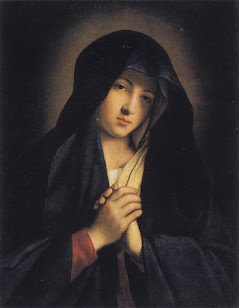
Each time the Blessed Virgin has appeared-- whether it be to Saint Bernadette Soubirous at Lourdes; to Lucia, Jacinta, and Francisco at Fatima; or to Mariette Beco at Banneux-- she has asserted the importance, saving grace, and power of praying the Holy Rosary on a daily basis. Based upon her words, the Rosary is penance and conversion for sinners, a pathway to peace, an end to war, and a powerful act of faith in Jesus Christ. Pope Paul VI presented the Rosary as a powerful means to reach Christ "not merely with Mary but indeed, insofar as this is possible to us, in the same way as Mary, who is certainly the one who thought about Him more than anyone else has ever done."

To show us how this is done, perhaps no one has been more eloquent than the great Cardinal Newman, who wrote: "The great power of the Rosary consists in the fact that it translates the Creed into Prayer. Of course, the Creed is already in a certain sense a prayer and a great act of homage towards God, but the Rosary brings us to meditate again on the great truth of His life and death, and brings this truth close to our hearts. Even Christians, although they know God, usually fear rather than love Him. The strength of the Rosary lies in the particular manner in which it considers these mysteries, since all our thinking about Christ is intertwined with the thought of His Mother, in the relations between Mother and Son; the Holy Family is presented to us, the home in which God lived His infinite love."


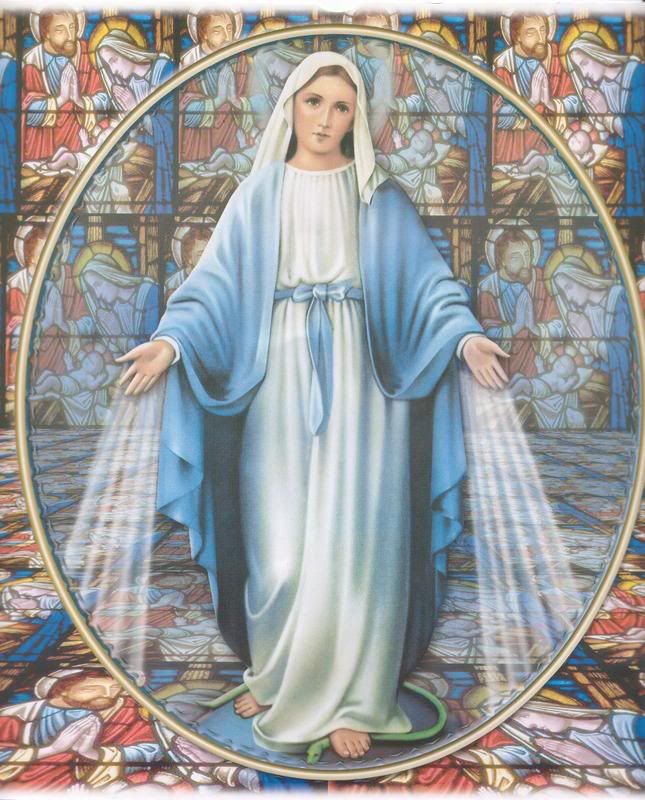
As Mary said at Fatima, "Jesus wants to use you to make Me known and loved. He wishes to establish the devotion to My Immaculate Heart throughout the world. I promise salvation to whoever embraces it; these souls will be dear to God, like flowers put by Me to adorn his throne."


April 7, 2013: Divine Mercy Sunday

Posted by Jacob

Today, we celebrate the feast of Divine Mercy, remembering on the Octave of Easter, the mercy of the Lord. Proclaimed by Pope John Paul II (who is also celebrating beatification today), at the canonization Mass of Saint Faustina, this day “from now on throughout the Church this Sunday will be called Divine Mercy Sunday.”


Prior to her canonization, Pope John Paul II had actively promoted the message of Saint Faustina, regarding the Divine Mercy of Jesus. Saint Faustina had recorded in her diary the specific devotion to Jesus, given to her by the Lord. She stated that anyone who participates in Mass and receives both the sacraments of Reconciliation and the Eucharist on Divine Mercy Sunday, is assured by Jesus of the full remission of their sins. In his encyclical on the Mercy of the Lord, Pope John Paul II developed and explained a spiritual and doctrinal basis for our faith in the mercy of God. By linking the revealed truth about God’s mercy to one of the most solemn Sundays after Easter itself, he illumined the fact that the liturgy already proclaimed the divine mercy. The truth has been embedded for two millennia in the worship of the Church.


Today, during Mass, we sing from Psalm 118, “His mercy endures forever.” In the Gospel of John we remember that gift of “Peace” given to the disciples by the Risen Christ, showing the marks of His suffering and Passion, and demonstrating the saving grace and mercy of His death and resurrection. They, like ourselves, are filled with joy as He provides to the disciples the power of God’s mercy for the sinner, the gift and sacrament we know as Reconciliation: “Receive the holy Spirit. Whose sins you forgive are forgiven them, and whose sins you retain are retained.” Cardinal Justin Rigali of Saint Louis noted regarding Reconciliation, “This beautiful Sacrament was presented to the Church by Christ himself on the day of his Resurrection, hence this Sacrament of Mercy is supremely relevant also in this Easter season.”

As we gather around the table of the Mass, we realize that Divine Mercy Sunday (while possibly given a new name) is not a new feast established to celebrate Saint Faustina's revelations. Indeed, it is not primarily about Saint Faustina at all — nor is it altogether a new feast! This solemn Mass recovers an ancient liturgical tradition, reflected in a teaching attributed to Saint Augustine of Hippo about the Easter Octave, which he called "the days of mercy and pardon," and the Octave Day itself "the compendium of the days of mercy."

We may doubt like Thomas. We may struggle and fall. But we can remain confident in the Divine Mercy of the Lord, given to us in the Passion, Death, and Resurrection of Christ, and present in the sacraments. We need only look to the Eucharist for a vivid reminder of Our Lord’s unending mercy and love, both during the Easter season and throughout the year.


October 5: Saint Faustina

Posted by Jacob

"MY JESUS, Grant that I may have love, compassion and mercy for every soul without exception. O my Jesus, each of Your saints reflects one of Your virtues; I desire to reflect Your compassionate heart, full of mercy; I want to glorify it. Let your mercy, O Jesus, be impressed upon my heart and soul like a seal, and this will be my badge in this and the future life. Glorifying Your mercy is the exclusive task of my life.”


Today, October 5, we celebrate the feast of Saint Faustina (1905-1938), mystic, and “secretary of the Lord.” Throughout her brief life, Jesus appeared and spoke to Saint Faustina, who faithfully recorded His words in her diary, entitled “Divine Mercy in my Soul.” When she left this world, she left this incomprehensible gift behind for the betterment of mankind—detailing the Lord’s gracious gift of Mercy to the world.

“JESUS, make my heart like unto Yours, or rather transform it into Your own Heart that I may sense the needs of other hearts, especially those who are sad and suffering. May the rays of mercy rest in my heart.”

Saint Faustina's struggles were like our own and on the outside her life appeared rather ordinary. But, internally, her soul was transformed daily through prayer and God's mercy. Through Saint Faustina, Jesus Himself commissioned a painting that would portray His mercy, known today as the “Divine Mercy” image. Jesus also taught her to pray the chaplet of Divine Mercy, offering it for sinners and for the world.

Throughout her short life, Our Lord assigned Saint Faustina three basic tasks:

1. To pray for souls, entrusting them to God's Incomprehensible Mercy;
2. To tell the world about God's Generous Mercy;
3. To start a new movement in the Church focusing on God's Mercy.

Saint Faustina struggled to follow God's Will in these three tasks, at times struggling and finding it nearly impossible. Yet, through it all—including suffering and sickness—she entrusted herself to the Lord, relying on His mercy, and letting Him work through her, weak though she may be.


Saint Faustina was born Helena Kowalska, the third of ten children, in the small village of Lodz, Poland. She was able to finish only three years of education, and as a teenager worked as a domestic servant for other families. By the age of 18, she was convinced of her calling to serve the Lord, but her parents objected to her entering the religious life. Ever obedient, Helena attempted to forget her calling, but one night, while at a village dance, Helena saw Jesus, sad and suffering. The very next day she packed a small bag and went to the capital city of Warsaw. After being rejected by several religious orders, she was accepted by the Congregation of the Sisters of Our Lady of Mercy, an order devoted to care and education of troubled young women. The following year she received the habit and took the name Sister Maria Faustina of the Most Blessed Sacrament. She served the Lord as a Sister of Mercy for thirteen years, during which she served her sisters as cook, gardener, and porter.

Beginning in the 1930's, Sister Faustina began receiving from the Lord a message of mercy that she was told to spread throughout the world. She was asked to become the apostle and secretary of God's mercy, a model of how to be merciful to others, and an instrument for reemphasizing God's plan of mercy for the world. He said to her:

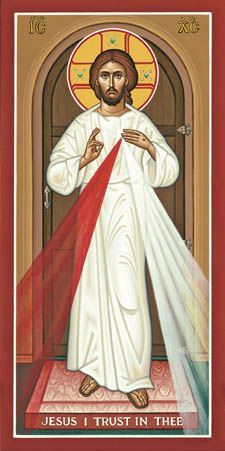
"If souls would put themselves completely in my care, I myself would undertake the task of sanctifying them, and I would lavish even greater graces on them. There are souls who thwart My efforts, but I have not given up on them; as often as they turn to Me, I hurry to their aid, shielding them with My mercy, and I give them the first place in My compassionate Heart.” Jesus also asked that a picture be painted of Him with the inscription: “Jesus, I Trust in You.” She commissioned this painting in 1935, showing a red and a white light shining from Christ’s Sacred Heart, representing the blood and water that poured from His side.

From her diary:

"In the evening, when I was in my cell, I became aware of the Lord Jesus clothed in a white garment. One hand was raised in blessing, the other was touching the garment at the breast. From the opening of the garment at the breast there came forth two large rays, one red and the other pale. In silence I gazed intently at the Lord; my soul was overwhelmed with fear, but also with great joy. After a while Jesus said to me, 'paint an image according to the pattern you see, with the inscription: Jesus, I trust in You.'"

Some time later, Our Lord again spoke to her: “The pale ray stands for the Water which makes souls righteous; the red ray stands for the Blood which is the life of souls. These two rays issued forth from the depths of My most tender Mercy at that time when My agonizing Heart was opened by a lance on the Cross....Fortunate is the one who will dwell in their shelter, for the just hand of God shall not lay hold of him."

During her years of revelation, God gave Sister Faustina a striking vision of His Mercy. From her diary, Saint Faustina describes two of her visions:

"I saw a great light, with God the Father in the midst of it. Between this light and the earth I saw Jesus nailed to the Cross and in such a way that God, wanting to look upon the earth, had to look through Our Lord's wounds and I understood that God blessed the earth for the sake of Jesus."

"I saw an Angel, the executor of God's wrath... about to strike the earth...I began to beg God earnestly for the world with words which I heard interiorly. As I prayed in this way, I saw the punishment...."


Fulfilling the call of the Lord would not be easy, or without sacrifice and suffering. Her entire life, in imitation of Christ's, was to be a sacrifice - a life lived for others. At the Divine Lord's request, she willingly offered her personal sufferings in union with Him to atone for the sins of others. In her daily life, Sister Faustina was to become a model of mercy, bringing joy and peace to others. She was further called to write about the infinite nature of God's mercy, encouraging others to trust in Him and thus preparing the world for His coming.

Saint Faustina wrote and suffered in secret, with only her spiritual director and some of her superiors aware that anything special was taking place in her life. After her death from tuberculosis—a protracted struggle which she offered as suffering for the sins of the world-- even her closest associates were amazed as they began to discover what great sufferings and deep mystical experiences had been given to her, who had always been so cheerful and humble. She had taken deeply into her heart, God's gospel command to "be merciful even as your heavenly Father is merciful" as well as her confessor's directive that she should act in such a way that everyone who came in contact with her would go away joyful.

From the Vatican biography of Saint Faustina:

“The years she had spent at the convent were filled with extraordinary gifts, such as: revelations, visions, hidden stigmata, participation in the Passion of the Lord, the gift of bilocation, the reading of human souls, the gift of prophecy, or the rare gift of mystical engagement and marriage. The living relationship with God, the Blessed Mother, the Angels, the Saints, the souls in Purgatory — with the entire supernatural world — was as equally real for her as was the world she perceived with her senses. In spite of being so richly endowed with extraordinary graces, Sr. Mary Faustina knew that they do not in fact constitute sanctity. In her Diary she wrote: Neither graces, nor revelations, nor raptures, nor gifts granted to a soul make it perfect, but rather the intimate union of the soul with God. These gifts are merely ornaments of the soul, but constitute neither its essence nor its perfection. My sanctity and perfection consist in the close union of my will with the will of God.”

Saint Faustina’s special devotion to Mary Immaculate and to the sacraments of Eucharist and Reconciliation had given her the strength to bear her sufferings as an offering to God on behalf of the Church and those in special need, especially great sinners and the dying. Her suffering was to achieve what Jesus had promised when He told her: “I do not want to punish aching mankind, but I desire to heal it, pressing it to my merciful heart.”

Sister Faustina died peacefully, the name of Jesus on her lips. Her relics are maintained at the Sanctuary of Divine Mercy Chapel in Krakow, Poland. The message of mercy that Sister Faustina received is now being spread throughout the world. The Apostles of Divine Mercy is a movement of priests, religious, and lay people inspired by Faustina’s experiences. The goal of the apostles is to spread knowledge of the mystery of Divine Mercy, and invoke God’s mercy on sinners. Today, this devotional group has spread to 29 countries.

Four years after Faustina's beatification, Pope John Paul II visited the Sanctuary of Divine Mercy and addressed members of her congregation. He said: “The message of divine mercy has always been very close and precious to me. It is as though history has written it in the tragic experience of World War II. In those difficult years, this message was a particular support and an inexhaustible source of hope, not only for those living in Krakow, but for the entire nation. This was also my personal experience, which I carried with me to the See of Peter and which, in a certain sense, forms the image of this pontificate. I thank divine providence because I was able to contribute personally to carrying out Christ's will, by instituting the feast of Divine Mercy. Here, close to the remains of Blessed Faustina, I thank God for the gift of her beatification. I pray unceasingly that God may have 'mercy on us and on the whole world'."


From Saint Faustina’s First Diary:

O Eternal Love, You command Your Sacred Image to be painted
And reveal to us the inconceivable fount of mercy,
You bless whoever approaches Your rays,
And a soul all black will turn into snow.


O sweet Jesus, it is here You established the throne of Your mercy
To bring joy and hope to sinful man.
From Your open Heart, as from a pure fount,
Flows comfort to a repentant heart and soul.
May praise and glory for this Image
Never cease to stream from man's soul.
May praise of God's mercy pour from every heart,
Now, and at every hour, and forever and ever.


O My God
When I look into the future, I am frightened,
But why plunge into the future?
Only the present moment is precious to me,
As the future may never enter my soul at all.
It is no longer in my power,
To change, correct or add to the past;
For neither sages nor prophets could do that.
And so, what the past has embraced I must entrust to God.
O present moment, you belong to me, whole and entire.
I desire to use you as best I can.
 And although I am weak and small,
You grant me the grace of your omnipotence.
And so, trusting in Your mercy,
I walk through life like a little child,
Offering You each day this heart
Burning with love for Your greater glory.


Canonization Homily of Saint Faustina, Delivered by Pope John Paul II

Chaplet of Divine Mercy


Saint Faustina,
You told us that your mission would continue after your death and that you would not forget us. Our Lord also granted you a great privilege, telling you to "distribute graces as you will, to who you will, and when you will." Relying on this, we ask your intercession for the graces we need, especially for the intentions just mentioned. Help us, above all, to trust in Jesus as you did and thus to glorify His mercy every moment of our lives. Amen


Year 2: Day 278 of 365
Prayer Intentions: The ability to suffer with joy, praying for sinners; Atonement for our own sins.
Requested Intentions: Healing of a chronic illness (P); Safety of a family during storms (A); Successful home ownership (P); Healing of a marriage (M); Employment for a husband, blessings for a marriage (E); Successful examinations for a daughter, healing of a relationships (V); Blessing for a family (V); Healing of baby girl M and all children suffering (M); Special intentions (R); Business success, peace, health (E); Conversion and deliverance of those who suffer, increase in vocations (M); Financial security and safe housing (M); For a daughter (K); Conversion of a family, deliverance of the souls in Purgatory (S); Successful marriage (A); Health, safety, grace, success of a building project (A); Successful treatment and recovery from cancer (D); Clear speech for a child (C); Conversion of a family (A); Successful employment (S); For the healing of impaired vision (F); For a couple experiencing difficulties (L); Successful employment after finishing college (M); Mother’s health (A); Financial security, freedom from anxiety (S); For a son and cousins (L); Peace and civility (B); Successful examination results (D); Safety of family, strength, courage, wisdom (C); For the souls of a departed father and brother, finding of a suitable marriage partner (R); Successful pilgrimage, deepening of prayer life (R); Restoration of health (J); Restoration of health (S); Freedom from pride (A); For children and marriage (M); For the birth of a healthy baby (Y); For personal family intentions, for the sick, poor, hungry, and homeless (G).

July 3: Feast of Mary, Mother of Mercy

Posted by Jacob

O noblest Queen of the world, Mary ever Virgin, who didst bring forth Christ the Lord, the Savior of all, pray in our name for mercy, peace, and salvation.


Today, we celebrate the feast of Mary, Mother of Mercy. After the fall, man became subject to sin, misery, disease and death. God, Who is rich in mercy, gave us two persons filled with compassion and mercy: Jesus, Our Lord and Savior, and Mary, Our Blessed Mother. Jesus became like one of us, choosing to know the profoundest depths of sorrow. Mary, the Mother of Sorrows, became the loving Mother of mankind beneath the Cross. From her witness of the mercy of the cross, she is full of compassionate mercy. Let us entreat her help to ease the suffering of mankind, through her mercy as the Mother of God. As Saint Alphonsus Liguori wrote, “Mary is not only called the Mother of Mercy, she is the Mother of Mercy. And she proved that she is by the loving tenderness with which she helps us all.”


From Pope John Paul II’s encyclical, “Rich in Mercy:”

“These words of the Church at Easter re-echo in the fullness of their prophetic content the words that Mary uttered during her visit to Elizabeth, the wife of Zechariah: "His mercy is...from generation to generation.” At the very moment of the Incarnation, these words open up a new perspective of salvation history. After the resurrection of Christ, this perspective is new on both the historical and the eschatological level. From that time onwards there is a succession of new generations of individuals in the immense human family, in ever-increasing dimensions; there is also a succession of new generations of the People of God, marked with the Sign of the Cross and of the resurrection and "sealed" with the sign of the Paschal Mystery of Christ, the absolute revelation of the mercy that Mary proclaimed on the threshold of her kinswoman's house: "His mercy is...from generation to generation."


Mary is also the one who obtained mercy in a particular and exceptional way, as no other person has. At the same time, still in an exceptional way, she made possible with the sacrifice of her heart her own sharing in revealing God's mercy. This sacrifice is intimately linked with the cross of her Son, at the foot of which she was to stand on Calvary. Her sacrifice is a unique sharing in the revelation of mercy, that is, a sharing in the absolute fidelity of God to His own love, to the covenant that He willed from eternity and that He entered into in time with man, with the people, with humanity; it is a sharing in that revelation that was definitively fulfilled through the cross. No one has experienced, to the same degree as the Mother of the crucified One, the mystery of the cross, the overwhelming encounter of divine transcendent justice with love: that "kiss" given by mercy to justice. No one has received into his heart, as much as Mary did, that mystery, that truly divine dimension of the redemption effected on Calvary by means of the death of the Son, together with the sacrifice of her maternal heart, together with her definitive "fiat."


Mary, then, is the one who has the deepest knowledge of the mystery of God's mercy. She knows its price, she knows how great it is. In this sense, we call her the Mother of mercy: our Lady of mercy, or Mother of divine mercy; in each one of these titles there is a deep theological meaning, for they express the special preparation of her soul, of her whole personality, so that she was able to perceive, through the complex events, first of Israel, then of every individual and of the whole of humanity, that mercy of which "from generation to generation" people become sharers according to the eternal design of the most Holy Trinity.


The above titles which we attribute to the Mother of God speak of her principally, however, as the Mother of the crucified and risen One; as the One who, having obtained mercy in an exceptional way, in an equally exceptional way "merits" that mercy throughout her earthly life and, particularly, at the foot of the cross of her Son; and finally as the one who, through her hidden and at the same time incomparable sharing in the messianic mission of her Son, was called in a special way to bring close to people that love which He had come to reveal: the love that finds its most concrete expression vis-à-vis the suffering, the poor, those deprived of their own freedom, the blind, the oppressed and sinners, just as Christ spoke of them in the words of the prophecy of Isaiah, first in the synagogue at Nazareth and then in response to the question of the messengers of John the Baptist.


It was precisely this "merciful" love, which is manifested above all in contact with moral and physical evil, that the heart of her who was the Mother of the crucified and risen One shared in singularly and exceptionally - that Mary shared in. In her and through her, this love continues to be revealed in the history of the Church and of humanity. This revelation is especially fruitful because in the Mother of God it is based upon the unique tact of her maternal heart, on her particular sensitivity, on her particular fitness to reach all those who most easily accept the merciful love of a mother. This is one of the great life-giving mysteries of Christianity, a mystery intimately connected with the mystery of the Incarnation.


‘The motherhood of Mary in the order of grace,’ as the Second Vatican Council explains, ‘lasts without interruption from the consent which she faithfully gave at the annunciation and which she sustained without hesitation under the cross, until the eternal fulfillment of all the elect. In fact, being assumed into heaven she has not laid aside this office of salvation but by her manifold intercession she continues to obtain for us the graces of eternal salvation. By her maternal charity, she takes care of the brethren of her Son who still journey on earth surrounded by dangers and difficulties, until they are led into their blessed home.’”


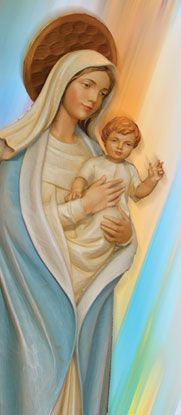
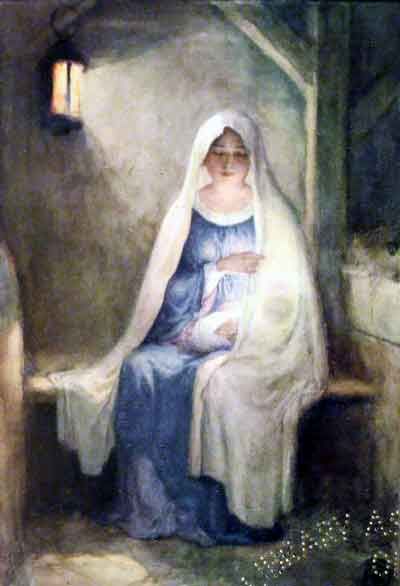
Mary wants us to think of her as our mother, our Heavenly Mother. Mary, the Blessed Virgin, appeared to Saint Faustina, a mystic who encountered Our Blessed Mother repeatedly throughout her life. In her diary, Saint Faustina wrote: “Once, the confessor told me to pray for his intention, and I began a novena to the Mother of God. This novena consisted in the prayer "Hail, Holy Queen" recited nine times. Toward the end of the novena I saw the Mother of God with the Infant Jesus in her arms. ... I could not stop wondering at His beauty. ... I heard a few of the words that the Mother of God spoke. ... The words were: ‘I am not only the Queen of Heaven, but also the Mother of Mercy, and your Mother’” On another occasion, Our Blessed Mother said to Saint Faustina: "Out of the depths of God's Mercy, I am your Mother.”

Similarly, Our Lady spoke to Saint Bridget of Sweden, whose feast day we celebrated just this week: " I am the Queen of Heaven and the Mother of Mercy; I am the joy of the just, and the door through which sinners are brought to God."

In short, the reason we rightfully call Mary our "Mother of Mercy" is that by God's grace, He created her soul to be the masterpiece of His Mercy in the world. That is, this special gift of grace within her was the foundation of His whole work of mercy in the world—namely the birth, life, Passion, death, and resurrection of Jesus Christ, our Lord and Savior. Everything about Mary was fashioned by Divine Mercy and for the work of Divine Mercy. No other creature, therefore, so completely manifests God's mercy as does Mary, immaculately conceived, Our Blessed Mother.


Prayer of Mary, Mother of Mercy (written by Saint Augustine of Hippo):

Blessed Virgin Mary, who can worthily repay you with praise and thanks for having rescued a fallen world by your generous consent! Receive our gratitude, and by your prayers obtain the pardon of our sins. Take our prayers into the sanctuary of heaven and enable them to make our peace with God.


Holy Mary, help the miserable, strengthen the discouraged, comfort the sorrowful, pray for your people, plead for the clergy, intercede for all women consecrated to God. May all who venerate you feel now your help and protection. Be ready to help us when we pray, and bring back to us the answers to our prayers. Make it your continual concern to pray for the people of God, for you were blessed by God and were made worthy to bear the Redeemer of the world, who lives and reigns forever. Amen.

Divine Mercy Sunday

Posted by Jacob

Today, we celebrate the feast of Divine Mercy, remembering on the Octave of Easter, the mercy of the Lord. Proclaimed by Pope John Paul II (who is also celebrating beatification today), at the canonization Mass of Saint Faustina, this day “from now on throughout the Church this Sunday will be called Divine Mercy Sunday.”


Prior to her canonization, Pope John Paul II had actively promoted the message of Saint Faustina, regarding the Divine Mercy of Jesus. Saint Faustina had recorded in her diary the specific devotion to Jesus, given to her by the Lord. She stated that anyone who participates in Mass and receives both the sacraments of Reconciliation and the Eucharist on Divine Mercy Sunday, is assured by Jesus of the full remission of their sins. In his encyclical on the Mercy of the Lord, Pope John Paul II developed and explained a spiritual and doctrinal basis for our faith in the mercy of God. By linking the revealed truth about God’s mercy to one of the most solemn Sundays after Easter itself, he illumined the fact that the liturgy already proclaimed the divine mercy. The truth has been embedded for two millennia in the worship of the Church.


Today, during Mass, we sing from Psalm 118, “His mercy endures forever.” In the Gospel of John we remember that gift of “Peace” given to the disciples by the Risen Christ, showing the marks of His suffering and Passion, and demonstrating the saving grace and mercy of His death and resurrection. They, like ourselves, are filled with joy as He provides to the disciples the power of God’s mercy for the sinner, the gift and sacrament we know as Reconciliation: “Receive the holy Spirit. Whose sins you forgive are forgiven them, and whose sins you retain are retained.” Cardinal Justin Rigali of Saint Louis noted regarding Reconciliation, “This beautiful Sacrament was presented to the Church by Christ himself on the day of his Resurrection, hence this Sacrament of Mercy is supremely relevant also in this Easter season.”

As we gather around the table of the Mass, we realize that Divine Mercy Sunday (while possibly given a new name) is not a new feast established to celebrate Saint Faustina's revelations. Indeed, it is not primarily about Saint Faustina at all — nor is it altogether a new feast! This solemn Mass recovers an ancient liturgical tradition, reflected in a teaching attributed to Saint Augustine of Hippo about the Easter Octave, which he called "the days of mercy and pardon," and the Octave Day itself "the compendium of the days of mercy."

We may doubt like Thomas. We may struggle and fall. But we can remain confident in the Divine Mercy of the Lord, given to us in the Passion, Death, and Resurrection of Christ, and present in the sacraments. We need only look to the Eucharist for a vivid reminder of Our Lord’s unending mercy and love, both during the Easter season and throughout the year.


Year 2: Day 122 of 365

Prayer Intentions: The Divine Mercy of Jesus
Requested Intentions: For children’s faith journey; Recovery of a friend suffering from addiction (M); Successful employment (P); Obedience to the will of the Lord (J); Financial recovery (S); Freedom from evil influence (I); Recovery from illness (J); Freedom from addiction (J); Successful transplant surgery (K); Healing for a daughter (T); Acceptance into school (V); Successful immigration; for a sister’s career and marriage (F); Financial recovery; Successful ministry (A); Financial ability to send children to school (S); Safe return of a runaway (J); Healing of a family (J); Reconciliation of marriage (S); Healing of a daughter with congenital heart disease (F); Healing and an end to suffering (J); For the children (M); For a son fighting a rare immune system disease (R); Freedom from imprisonment (J); Employment and end to depression (H); Successful employment (A); Health for a soon to be delivered baby (T); Financial security (L); Healing of tooth pain (A); Health of expectant mother and child (R); Purification of the souls in Purgatory (A); Guidance in studies (J); Healing and security for a displaced family (C); Healing of high blood pressure; Recovery of brother following surgery (A); For a sister in trouble, that she may make better decisions in the light of Christ (M); Health of expectant mother and child (R); Attainment of funds for surgery (J).

Saint Faustina: Chaplet of Divine Mercy

Posted by Jacob

Today, October 5, we celebrate the feast of Saint Faustina (1905-1938), mystic, and “secretary of the Lord.” Throughout her brief life, Jesus appeared and spoke to Saint Faustina, who faithfully recorded His words in her diary, entitled “Divine Mercy in my Soul.” When she left this world, she left this incomprehensible gift behind for the betterment of mankind—detailing the Lord’s gracious gift of Mercy to the world.

Following her visions of Jesus, Saint Faustina recorded in her diary that “an inner voice” taught her to say the Chaplet of Divine Mercy, using the Holy Rosary as a model.

The instructions for praying the Chaplet of Divine Mercy include:

1. Begin with the Sign of the Cross, 1 Our Father, 1 Hail Mary, and The Apostles Creed.


2. On the Our Father Beads say the following:

“Eternal Father, I offer You the Body and Blood, Soul and Divinity of Your dearly beloved Son, Our Lord Jesus Christ, in atonement for our sins and those of the whole world.”

3. On the 10 Hail Mary Beads say the following:

”For the sake of His sorrowful Passion, have mercy on us and on the whole world.”

4. Conclude by saying the following three times:

”Holy God, Holy Mighty One, Holy Immortal One, have mercy on us and on the whole world.”


Sister Faustina recorded that Jesus later said to her:

"Say unceasingly this chaplet that I have taught you. Anyone who says it will receive great Mercy at the hour of death. Priests will recommend it to sinners as the last hope. Even the most hardened sinner, if he recites this Chaplet even once, will receive grace from My Infinite Mercy. I want the whole world to know My Infinite Mercy. I want to give unimaginable graces to those who trust in My Mercy...."

He also said:

"....When they say this Chaplet in the presence of the dying, I will stand between My Father and the dying person not as the just judge but as the Merciful Savior.”

Saint Faustina: Homily of Canonization by Pope John Paul II

Posted by Jacob

Today, October 5, we celebrate the feast of Saint Faustina (1905-1938), mystic, and “secretary of the Lord.” Throughout her brief life, Jesus appeared and spoke to Saint Faustina, who faithfully recorded His words in her diary, entitled “Divine Mercy in my Soul.” When she left this world, she left this incomprehensible gift behind for the betterment of mankind—detailing the Lord’s gracious gift of Mercy to the world.
On April 30, 2000, Pope John Paul II presided over the Canonization of Sister Mary Faustina Kowalska. He delivered the following homily:


1. "Confitemini Domino quoniam bonus, quoniam in saeculum misericordia eius"; "Give thanks to the Lord for he is good; his steadfast love endures for ever" (Ps 118: 1). So the Church sings on the Octave of Easter, as if receiving from Christ's lips these words of the Psalm; from the lips of the risen Christ, who bears the great message of divine mercy and entrusts its ministry to the Apostles in the Upper Room: "Peace be with you. As the Father has sent me, even so I send you.... Receive the Holy Spirit. If you forgive the sins of any, they are forgiven; if you retain the sins of any, they are retained" (Jn 20: 21-23).


Before speaking these words, Jesus shows his hands and his side. He points, that is, to the wounds of the Passion, especially the wound in his heart, the source from which flows the great wave of mercy poured out on humanity. From that heart Sr Faustina Kowalska, the blessed whom from now on we will call a saint, will see two rays of light shining from that heart and illuminating the world: "The two rays", Jesus himself explained to her one day, "represent blood and water" (Diary, Libreria Editrice Vaticana, p. 132).


2. Blood and water! We immediately think of the testimony given by the Evangelist John, who, when a solider on Calvary pierced Christ's side with his spear, sees blood and water flowing from it (cf. Jn 19: 34). Moreover, if the blood recalls the sacrifice of the Cross and the gift of the Eucharist, the water, in Johannine symbolism, represents not only Baptism but also the gift of the Holy Spirit (cf. Jn 3: 5; 4: 14; 7: 37-39).


Divine Mercy reaches human beings through the heart of Christ crucified: "My daughter, say that I am love and mercy personified", Jesus will ask Sr Faustina (Diary, p. 374). Christ pours out this mercy on humanity though the sending of the Spirit who, in the Trinity, is the Person-Love. And is not mercy love's "second name" (cf. Dives in misericordia, n. 7), understood in its deepest and most tender aspect, in its ability to take upon itself the burden of any need and, especially, in its immense capacity for forgiveness?


Today my joy is truly great in presenting the life and witness of Sr Faustina Kowalska to the whole Church as a gift of God for our time. By divine Providence, the life of this humble daughter of Poland was completely linked with the history of the 20th century, the century we have just left behind. In fact, it was between the First and Second World Wars that Christ entrusted his message of mercy to her. Those who remember, who were witnesses and participants in the events of those years and the horrible sufferings they caused for millions of people, know well how necessary was the message of mercy.


Jesus told Sr Faustina: "Humanity will not find peace until it turns trustfully to divine mercy" (Diary, p. 132). Through the work of the Polish religious, this message has become linked for ever to the 20th century, the last of the second millennium and the bridge to the third. It is not a new message but can be considered a gift of special enlightenment that helps us to relive the Gospel of Easter more intensely, to offer it as a ray of light to the men and women of our time.


3. What will the years ahead bring us? What will man's future on earth be like? We are not given to know. However, it is certain that in addition to new progress there will unfortunately be no lack of painful experiences. But the light of divine mercy, which the Lord in a way wished to return to the world through Sr Faustina's charism, will illumine the way for the men and women of the third millennium.


However, as the Apostles once did, today too humanity must welcome into the upper room of history the risen Christ, who shows the wounds of his Crucifixion and repeats: Peace be with you! Humanity must let itself be touched and pervaded by the Spirit given to it by the risen Christ. It is the Spirit who heals the wounds of the heart, pulls down the barriers that separate us from God and divide us from one another, and at the same time, restores the joy of the Father's love and of fraternal unity.


4. It is important then that we accept the whole message that comes to us from the word of God on this Second Sunday of Easter, which from now on throughout the Church will be called "Divine Mercy Sunday". In the various readings, the liturgy seems to indicate the path of mercy which, while re-establishing the relationship of each person with God, also creates new relations of fraternal solidarity among human beings. Christ has taught us that "man not only receives and experiences the mercy of God, but is also called "to practise mercy' towards others: "Blessed are the merciful, for they shall obtain mercy' (Mt 5: 7)" (Dives et misericordia, n. 14). He also showed us the many paths of mercy, which not only forgives sins but reaches out to all human needs. Jesus bent over every kind of human poverty, material and spiritual.


His message of mercy continues to reach us through his hands held out to suffering man. This is how Sr Faustina saw him and proclaimed him to people on all the continents when, hidden in her convent at £agiewniki in Kraków, she made her life a hymn to mercy: Misericordias Domini in aeternum cantabo.


5. Sr Faustina's canonization has a particular eloquence: by this act I intend today to pass this message on to the new millennium. I pass it on to all people, so that they will learn to know ever better the true face of God and the true face of their brethren.


In fact, love of God and love of one's brothers and sisters are inseparable, as the First Letter of John has reminded us: "By this we know that we love the children of God, when we love God and obey his commandments" (5: 2). Here the Apostle reminds us of the truth of love, showing us its measure and criterion in the observance of the commandments.


It is not easy to love with a deep love, which lies in the authentic gift of self. This love can only be learned by penetrating the mystery of God's love. Looking at him, being one with his fatherly heart, we are able to look with new eyes at our brothers and sisters, with an attitude of unselfishness and solidarity, of generosity and forgiveness. All this is mercy!


To the extent that humanity penetrates the mystery of this merciful gaze, it will seem possible to fulfil the ideal we heard in today's first reading: "The community of believers were of one heart and one mind. None of them ever claimed anything as his own; rather everything was held in common" (Acts 4: 32). Here mercy gave form to human relations and community life; it constituted the basis for the sharing of goods. This led to the spiritual and corporal "works of mercy". Here mercy became a concrete way of being "neighbour" to one's neediest brothers and sisters.


6. Sr Faustina Kowalska wrote in her Diary: "I feel tremendous pain when I see the sufferings of my neighbours. All my neighbours' sufferings reverberate in my own heart; I carry their anguish in my heart in such a way that it even physically destroys me. I would like all their sorrows to fall upon me, in order to relieve my neighbour" (Diary, p. 365). This is the degree of compassion to which love leads, when it takes the love of God as its measure!


It is this love which must inspire humanity today, if it is to face the crisis of the meaning of life, the challenges of the most diverse needs and, especially, the duty to defend the dignity of every human person. Thus the message of divine mercy is also implicitly a message about the value of every human being. Each person is precious in God's eyes; Christ gave his life for each one; to everyone the Father gives his Spirit and offers intimacy.


7. This consoling message is addressed above all to those who, afflicted by a particularly harsh trial or crushed by the weight of the sins they committed, have lost all confidence in life and are tempted to give in to despair. To them the gentle face of Christ is offered; those rays from his heart touch them and shine upon them, warm them, show them the way and fill them with hope. How many souls have been consoled by the prayer "Jesus, I trust in you", which Providence intimated through Sr Faustina! This simple act of abandonment to Jesus dispels the thickest clouds and lets a ray of light penetrate every life. Jezu, ufam tobie.


8. Misericordias Domini in aeternum cantabo (Ps 88 [89]: 2). Let us too, the pilgrim Church, join our voice to the voice of Mary most holy, "Mother of Mercy", to the voice of this new saint who sings of mercy with all God's friends in the heavenly Jerusalem.


And you, Faustina, a gift of God to our time, a gift from the land of Poland to the whole Church, obtain for us an awareness of the depth of divine mercy; help us to have a living experience of it and to bear witness to it among our brothers and sisters. May your message of light and hope spread throughout the world, spurring sinners to conversion, calming rivalries and hatred and opening individuals and nations to the practice of brotherhood. Today, fixing our gaze with you on the face of the risen Christ, let us make our own your prayer of trusting abandonment and say with firm hope: Christ Jesus, I trust in you! Jezu, ufam tobie!

October 5: Saint Faustina

Posted by Jacob

"MY JESUS, Grant that I may have love, compassion and mercy for every soul without exception. O my Jesus, each of Your saints reflects one of Your virtues; I desire to reflect Your compassionate heart, full of mercy; I want to glorify it. Let your mercy, O Jesus, be impressed upon my heart and soul like a seal, and this will be my badge in this and the future life. Glorifying Your mercy is the exclusive task of my life.”


Today, October 5, we celebrate the feast of Saint Faustina (1905-1938), mystic, and “secretary of the Lord.” Throughout her brief life, Jesus appeared and spoke to Saint Faustina, who faithfully recorded His words in her diary, entitled “Divine Mercy in my Soul.” When she left this world, she left this incomprehensible gift behind for the betterment of mankind—detailing the Lord’s gracious gift of Mercy to the world.

“JESUS, make my heart like unto Yours, or rather transform it into Your own Heart that I may sense the needs of other hearts, especially those who are sad and suffering. May the rays of mercy rest in my heart.”

Saint Faustina's struggles were like our own and on the outside her life appeared rather ordinary. But, internally, her soul was transformed daily through prayer and God's mercy. Through Saint Faustina, Jesus Himself commissioned a painting that would portray His mercy, known today as the “Divine Mercy” image. Jesus also taught her to pray the chaplet of Divine Mercy, offering it for sinners and for the world.

Throughout her short life, Our Lord assigned Saint Faustina three basic tasks:

1. To pray for souls, entrusting them to God's Incomprehensible Mercy;
2. To tell the world about God's Generous Mercy;
3. To start a new movement in the Church focusing on God's Mercy.

Saint Faustina struggled to follow God's Will in these three tasks, at times struggling and finding it nearly impossible. Yet, through it all—including suffering and sickness—she entrusted herself to the Lord, relying on His mercy, and letting Him work through her, weak though she may be.


Saint Faustina was born Helena Kowalska, the third of ten children, in the small village of Lodz, Poland. She was able to finish only three years of education, and as a teenager worked as a domestic servant for other families. By the age of 18, she was convinced of her calling to serve the Lord, but her parents objected to her entering the religious life. Ever obedient, Helena attempted to forget her calling, but one night, while at a village dance, Helena saw Jesus, sad and suffering. The very next day she packed a small bag and went to the capital city of Warsaw. After being rejected by several religious orders, she was accepted by the Congregation of the Sisters of Our Lady of Mercy, an order devoted to care and education of troubled young women. The following year she received the habit and took the name Sister Maria Faustina of the Most Blessed Sacrament. She served the Lord as a Sister of Mercy for thirteen years, during which she served her sisters as cook, gardener, and porter.

Beginning in the 1930's, Sister Faustina began receiving from the Lord a message of mercy that she was told to spread throughout the world. She was asked to become the apostle and secretary of God's mercy, a model of how to be merciful to others, and an instrument for reemphasizing God's plan of mercy for the world. He said to her:

"If souls would put themselves completely in my care, I myself would undertake the task of sanctifying them, and I would lavish even greater graces on them. There are souls who thwart My efforts, but I have not given up on them; as often as they turn to Me, I hurry to their aid, shielding them with My mercy, and I give them the first place in My compassionate Heart.” Jesus also asked that a picture be painted of Him with the inscription: “Jesus, I Trust in You.” She commissioned this painting in 1935, showing a red and a white light shining from Christ’s Sacred Heart, representing the blood and water that poured from His side.

From her diary:

"In the evening, when I was in my cell, I became aware of the Lord Jesus clothed in a white garment. One hand was raised in blessing, the other was touching the garment at the breast. From the opening of the garment at the breast there came forth two large rays, one red and the other pale. In silence I gazed intently at the Lord; my soul was overwhelmed with fear, but also with great joy. After a while Jesus said to me, 'paint an image according to the pattern you see, with the inscription: Jesus, I trust in You.'"

Some time later, Our Lord again spoke to her: “The pale ray stands for the Water which makes souls righteous; the red ray stands for the Blood which is the life of souls. These two rays issued forth from the depths of My most tender Mercy at that time when My agonizing Heart was opened by a lance on the Cross....Fortunate is the one who will dwell in their shelter, for the just hand of God shall not lay hold of him."

During her years of revelation, God gave Sister Faustina a striking vision of His Mercy. From her diary, Saint Faustina describes two of her visions:

"I saw a great light, with God the Father in the midst of it. Between this light and the earth I saw Jesus nailed to the Cross and in such a way that God, wanting to look upon the earth, had to look through Our Lord's wounds and I understood that God blessed the earth for the sake of Jesus."

"I saw an Angel, the executor of God's wrath... about to strike the earth...I began to beg God earnestly for the world with words which I heard interiorly. As I prayed in this way, I saw the punishment...."


Fulfilling the call of the Lord would not be easy, or without sacrifice and suffering. Her entire life, in imitation of Christ's, was to be a sacrifice - a life lived for others. At the Divine Lord's request, she willingly offered her personal sufferings in union with Him to atone for the sins of others. In her daily life, Sister Faustina was to become a model of mercy, bringing joy and peace to others. She was further called to write about the infinite nature of God's mercy, encouraging others to trust in Him and thus preparing the world for His coming.

Saint Faustina wrote and suffered in secret, with only her spiritual director and some of her superiors aware that anything special was taking place in her life. After her death from tuberculosis—a protracted struggle which she offered as suffering for the sins of the world-- even her closest associates were amazed as they began to discover what great sufferings and deep mystical experiences had been given to her, who had always been so cheerful and humble. She had taken deeply into her heart, God's gospel command to "be merciful even as your heavenly Father is merciful" as well as her confessor's directive that she should act in such a way that everyone who came in contact with her would go away joyful.

From the Vatican biography of Saint Faustina:

“The years she had spent at the convent were filled with extraordinary gifts, such as: revelations, visions, hidden stigmata, participation in the Passion of the Lord, the gift of bilocation, the reading of human souls, the gift of prophecy, or the rare gift of mystical engagement and marriage. The living relationship with God, the Blessed Mother, the Angels, the Saints, the souls in Purgatory — with the entire supernatural world — was as equally real for her as was the world she perceived with her senses. In spite of being so richly endowed with extraordinary graces, Sr. Mary Faustina knew that they do not in fact constitute sanctity. In her Diary she wrote: Neither graces, nor revelations, nor raptures, nor gifts granted to a soul make it perfect, but rather the intimate union of the soul with God. These gifts are merely ornaments of the soul, but constitute neither its essence nor its perfection. My sanctity and perfection consist in the close union of my will with the will of God.”

Saint Faustina’s special devotion to Mary Immaculate and to the sacraments of Eucharist and Reconciliation had given her the strength to bear her sufferings as an offering to God on behalf of the Church and those in special need, especially great sinners and the dying. Her suffering was to achieve what Jesus had promised when He told her: “I do not want to punish aching mankind, but I desire to heal it, pressing it to my merciful heart.”

Sister Faustina died peacefully, the name of Jesus on her lips. Her relics are maintained at the Sanctuary of Divine Mercy Chapel in Krakow, Poland. The message of mercy that Sister Faustina received is now being spread throughout the world. The Apostles of Divine Mercy is a movement of priests, religious, and lay people inspired by Faustina’s experiences. The goal of the apostles is to spread knowledge of the mystery of Divine Mercy, and invoke God’s mercy on sinners. Today, this devotional group has spread to 29 countries.

Four years after Faustina's beatification, Pope John Paul II visited the Sanctuary of Divine Mercy and addressed members of her congregation. He said: “The message of divine mercy has always been very close and precious to me. It is as though history has written it in the tragic experience of World War II. In those difficult years, this message was a particular support and an inexhaustible source of hope, not only for those living in Krakow, but for the entire nation. This was also my personal experience, which I carried with me to the See of Peter and which, in a certain sense, forms the image of this pontificate. I thank divine providence because I was able to contribute personally to carrying out Christ's will, by instituting the feast of Divine Mercy. Here, close to the remains of Blessed Faustina, I thank God for the gift of her beatification. I pray unceasingly that God may have 'mercy on us and on the whole world'."


From Saint Faustina’s First Diary:

O Eternal Love, You command Your Sacred Image to be painted
And reveal to us the inconceivable fount of mercy,
You bless whoever approaches Your rays,
And a soul all black will turn into snow.


O sweet Jesus, it is here You established the throne of Your mercy
To bring joy and hope to sinful man.
From Your open Heart, as from a pure fount,
Flows comfort to a repentant heart and soul.
May praise and glory for this Image
Never cease to stream from man's soul.
May praise of God's mercy pour from every heart,
Now, and at every hour, and forever and ever.


O My God
When I look into the future, I am frightened,
But why plunge into the future?
Only the present moment is precious to me,
As the future may never enter my soul at all.
It is no longer in my power,
To change, correct or add to the past;
For neither sages nor prophets could do that.
And so, what the past has embraced I must entrust to God.
O present moment, you belong to me, whole and entire.
I desire to use you as best I can.
 And although I am weak and small,
You grant me the grace of your omnipotence.
And so, trusting in Your mercy,
I walk through life like a little child,
Offering You each day this heart
Burning with love for Your greater glory.


Saint Faustina,
You told us that your mission would continue after your death and that you would not forget us. Our Lord also granted you a great privilege, telling you to "distribute graces as you will, to who you will, and when you will." Relying on this, we ask your intercession for the graces we need, especially for the intentions just mentioned. Help us, above all, to trust in Jesus as you did and thus to glorify His mercy every moment of our lives. Amen


Day 278 of 365
Prayer Intentions: The ability to suffer with joy, praying for sinners; Atonement for our own sins.
Requested Intentions: Successful outcome of court case and employment (L); For guidance and righteous love (K); Restoration of a relationship (H); For successful employment (I); For a daughter’s successful relationship (M); For a relationship sanctified by God (M); For health of father; For canonization of Pope John Paul II (A); For the conversion of a family (L); For the ill (A); For the health of a family (I); For a father’s successful surgery and recovery (G); For those who are ill, and their caretakers (D); For the safety of a sister who is traveling (A); Recovery of mother with cancer (R); Successful acquisition of a visa (T); Restoration of a marriage (A); For employment and health of mother (G); Successful employment (M); Restoration of a family, End to brother's addiction, Successful marriage (R); Employment (I); Successful recovery of a mother; for all stroke victims (D); Successful return to the faith (A); Emotional, physical, and financial healing (D); Diagnosis and recovery (A); For a successful relationship (J); Those suffering from depression (J); Successful adoption (S); Healing of a father battling cancer (S).