Why pray the Rosary every day for a year?


Each time the Blessed Virgin has appeared-- whether it be to Saint Bernadette Soubirous at Lourdes; to Lucia, Jacinta, and Francisco at Fatima; or to Mariette Beco at Banneux-- she has asserted the importance, saving grace, and power of praying the Holy Rosary on a daily basis. Based upon her words, the Rosary is penance and conversion for sinners, a pathway to peace, an end to war, and a powerful act of faith in Jesus Christ. Pope Paul VI presented the Rosary as a powerful means to reach Christ "not merely with Mary but indeed, insofar as this is possible to us, in the same way as Mary, who is certainly the one who thought about Him more than anyone else has ever done."

To show us how this is done, perhaps no one has been more eloquent than the great Cardinal Newman, who wrote: "The great power of the Rosary consists in the fact that it translates the Creed into Prayer. Of course, the Creed is already in a certain sense a prayer and a great act of homage towards God, but the Rosary brings us to meditate again on the great truth of His life and death, and brings this truth close to our hearts. Even Christians, although they know God, usually fear rather than love Him. The strength of the Rosary lies in the particular manner in which it considers these mysteries, since all our thinking about Christ is intertwined with the thought of His Mother, in the relations between Mother and Son; the Holy Family is presented to us, the home in which God lived His infinite love."


As Mary said at Fatima, "Jesus wants to use you to make Me known and loved. He wishes to establish the devotion to My Immaculate Heart throughout the world. I promise salvation to whoever embraces it; these souls will be dear to God, like flowers put by Me to adorn his throne."


Pope John Paul II: "Mary Offers a Sublime Model of Service"

Posted by Jacob

Today, March 25, we celebrate the feast of the Annunciation, the first Joyful Mystery of the Holy Rosary. The Annunciation, the message of the Lord delivered by the Archangel Gabriel to Mary, is the first step that Jesus takes towards earth. It is the first step in the reclaiming of sin, sin which began with Eve, the first mother of the nations. It is the miraculous precursor to the Incarnation, the life and death of Christ, and our eternal salvation.


In his General Audience, delivered September 1996, Pope John Paul II cites Our Blessed Mother as a sublime model of service, beginning with her acceptance of Archangel Gabriel’s message, and her “fiat of total obedience.”


1. Mary's words at the Annunciation "I am the handmaid of the Lord; let it be to me according to your word" (Lk 1:38), indicate an attitude characteristic of Jewish piety. At the beginning of the Old Covenant, Moses, in response to the Lord's call, proclaims himself his servant (cf. Ex 4:10; 14:31). With the coming of the New Covenant, Mary also responds to God with an act of free submission and conscious abandonment to his will, showing her complete availability to be the "handmaid of the Lord".


In the Old Testament, the qualification "servant" of God links all those who are called to exercise a mission for the sake of the Chosen People: Abraham (Gn 26:24), Isaac (Gn 24:14) Jacob (Ex 32:13; Ez 37:25), Joshua (Jos 24:29), David (2 Sam 7, 8, etc.). Prophets and priests, who have been entrusted with the task of forming the people in the faithful service of the Lord, are also servants. The Book of the Prophet Isaiah exalts, in the docility of the "suffering Servant", a model of fidelity to God in the hope of redemption for the sins of the many (cf. Is 42:53). Some women also offer examples of fidelity, such as Queen Esther who, before interceding for the salvation of the Jews, addresses a prayer to God, calling herself many times "your servant" (Est 4:17).


Mary's 'fiat' expresses total obedience


2. Mary, "full of grace", by proclaiming herself "handmaid of the Lord" intends to commit herself to fulfil personally and in a perfect manner the service God expects of all his people. The words: "Behold, I am the handmaid of the Lord", foretel1 the One who will say of himself: "The Son of man also came not to be served but to serve, and to give his life as a ransom for many" (Mk 10:45: cf. Mt 20:28). Thus the Holy Spirit brings about a harmony of intimate dispositions between the Mother and the Son which will allow Mary to assume fully her maternal role to Jesus, as she accompanies him in his mission as Servant. In Jesus' life the will to serve is constant and surprising: as Son of God, he could rightly have demanded to be served. Attributing to himself the title "Son of Man", whom, according to the Book of Daniel, "all peoples, nations, and languages should serve" (Dn 7:14), he could have claimed mastery over others. Instead, combating the mentality of the time which was expressed in the disciples' ambition for the first places (cf. Mk 9:34) and in Peter's protest during the washing of the feet (cf. Jn 13:6), Jesus does not want to be served, but desires to serve to the point of totally giving his life in the work of redemption.


3. Furthermore, Mary, although aware of the lofty dignity conferred upon her at the angel's announcement spontaneously declares herself "the handmaid of the Lord". In this commitment of service she also includes the intention to serve her neighbour, as the link between the episodes of the Annunciation and the Visitation show: informed by the angel of Elizabeth's pregnancy, Mary sets out "with haste" (Lk 1:39) for Judah, with total availability to help her relative prepare for the birth. She thus offers Christians of all times a sublime model of service.


The words: "Let it be to me according to your word" (Lk 1:38), show in her who declared herself handmaid of the Lord, a total obedience to God's will. The optative genoito, "let it be done", used by Luke, expresses not only acceptance but staunch assumption of the divine plan, making it her own with the involvement of all her personal resources.
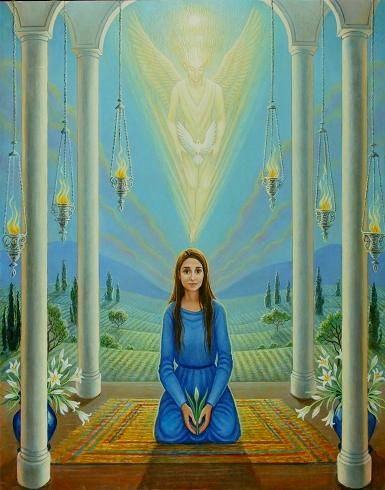

By conforming to God's will, Mary anticipates attitude of Christ


4. By conforming to the divine will, Mary anticipates and makes her own the attitude of Christ who, according to the Letter to the Hebrews, coming into the world, says: "Sacrifice and offerings you did not desire, but a body you prepared for me ... Then I said ... 'Behold I come to do your will, O God'" (Heb 10:5-7; Ps 40 [39]: 7-9).


Mary's docility likewise announces and prefigures that expressed by Jesus in the course of his public life until Calvary. Christ would say: "My food is to do the will of him who sent me, and to accomplish his work" (Jn 4:34). On these same lines, Mary makes the Father's will the inspiring principle of her whole life, seeking in it the necessary strength to fulfil the mission entrusted to her.

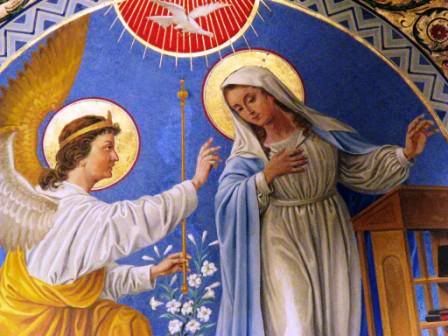
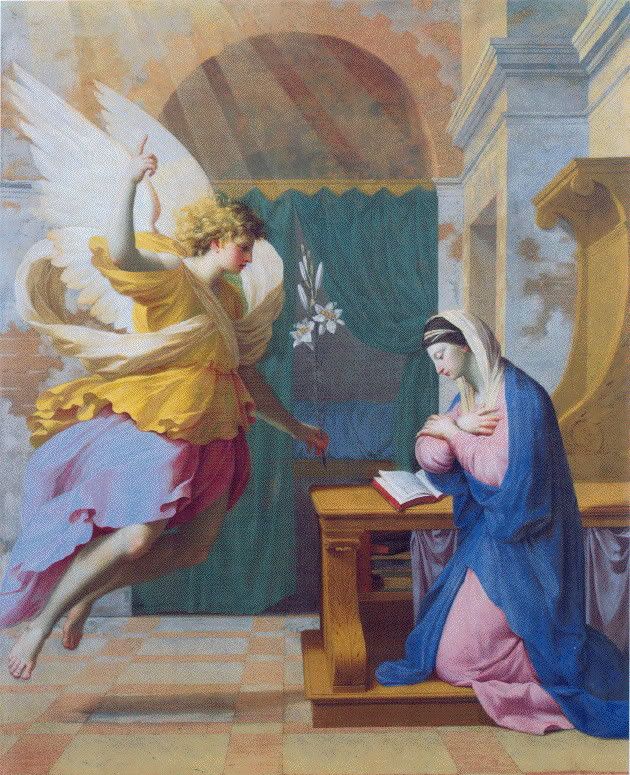
If at the moment of the Annunciation, Mary does not yet know of the sacrifice which will mark Christ's mission, Simeon's prophecy will enable her to glimpse her Son's tragic destiny (cf. Lk 3:34-35). The Virgin will be associated with him in intimate sharing. With her total obedience to God's will, Mary is ready to live all that divine love may plan for her life, even to the "sword" that will pierce her soul.

Saint Bernard of Clairvaux: "The Whole World Awaits Mary's Response"

Posted by Jacob

Today, March 25, we celebrate the feast of the Annunciation, the first Joyful Mystery of the Holy Rosary. The Annunciation, the message of the Lord delivered by the Archangel Gabriel to Mary, is the first step that Jesus takes towards earth. It is the first step in the reclaiming of sin, sin which began with Eve, the first mother of the nations. It is the miraculous precursor to the Incarnation, the life and death of Christ, and our eternal salvation.
Saint Bernard of Clairvaux wrote of Our Blessed Mother’s consent to the Archangel Gabriel’s request, her gracious fiat: “Let it be done to me according to your word!”


You have heard, O Virgin, that you will conceive and bear a son; you have heard that it will not be by man but by the Holy Spirit. The angel awaits an answer; it is time for him to return to God who sent him. We too are waiting, O Lady, for your word of compassion; the sentence of condemnation weighs heavily upon us.


The price of our salvation is offered to you. We shall be set free at once if you consent. In the eternal Word of God we all came to be, and behold, we die. In your brief response we are to be remade in order to be recalled to life.


Tearful Adam with his sorrowing family begs this of you, O loving Virgin, in their exile from Paradise. Abraham begs it, David begs it. All the other holy patriarchs, your ancestors, ask it of you, as they dwell in the country of the shadow of death. This is what the whole earth waits for, prostrate at your feet. It is right in doing so, for on your word depends comfort for the wretched, ransom for the captive, freedom for the condemned, indeed, salvation for all the sons of Adam, the whole of your race.


Answer quickly, O Virgin. Reply in haste to the angel, or rather through the angel to the Lord. Answer with a word, receive the Word of God. Speak your own word, conceive the divine Word. Breathe a passing word, embrace the eternal Word.


Why do you delay, why are you afraid? Believe, give praise, and receive. Let humility be bold, let modesty be confident. This is no time for virginal simplicity to forget prudence. In this matter alone, O prudent Virgin, do not fear to be presumptuous. Though modest silence is pleasing, dutiful speech is now more necessary. Open your heart to faith, O blessed Virgin, your lips to praise, your womb to the Creator. See, the desired of all nations is at your door, knocking to enter. If he should pass by because of your delay, in sorrow you would begin to seek him afresh, the One whom your soul loves. Arise, hasten, open. Arise in faith, hasten in devotion, open in praise and thanksgiving. Behold the handmaid of the Lord, she says, be it done to me according to your word.

Saint Bernard of Clairvaux: "Mary, A Virgin Full of Grace"

Posted by Jacob

Today, March 25, we celebrate the feast of the Annunciation, the first Joyful Mystery of the Holy Rosary. The Annunciation, the message of the Lord delivered by the Archangel Gabriel to Mary, is the first step that Jesus takes towards earth. It is the first step in the reclaiming of sin, sin which began with Eve, the first mother of the nations. It is the miraculous precursor to the Incarnation, the life and death of Christ, and our eternal salvation.

Saint Bernard of Clairvaux wrote of Our Blessed Mother as the only woman who was able to serve as the vessel of the Incarnation-- as she was so filled with the grace of the Lord from before the moment of her conception.


Mary, a Virgin Full of Grace

There was only one mode of birth that was worthy of God, and that was to be born of a Virgin. Equally, who could come from a Virgin birth except God himself? The maker of mankind, if he was to be made man and destined to be born of man, would have to choose, to create a mother whom he knew to be worthy of him, who he knew would be pleasing to him.


It was his will that she should be a virgin, so that he could proceed from an unstained body, stainless, to purify mankind of its stains.


It was his will that she should be meek and humble of heart, since he was to become the outstanding example of these virtues, so necessary for the health of humanity. He granted childbirth to her, having first inspired her vow of virginity and filled her with the virtue of humility.


To put it another way, how could the Angel have addressed her as full of grace if any, even a little, of these virtues had been present in her already and not given to her by grace? It was given to her to be made holy. She, who was to conceive and give birth to the Holy of holies, was made holy in body by the gift of virginity and holy in mind by the gift of humility.


Adorned with the jewels of such virtues and radiant in both mind and body, the royal Virgin’s beauty draws the attention of the citizens of heaven itself, and its King is filled with desire for her and sends his messenger to her from on high.


The Angel was sent to the Virgin, it says. A virgin in body and a virgin in mind, a virgin by her own choice, a virgin, as the Apostle describes her, holy in mind and body. Not someone just now found by chance, but chosen from the beginning of time, foreseen and prepared by the Most High, waited upon by the angels, prefigured by the patriarchs, preached by the prophets.

The Annunciation of the Lord

Posted by Jacob

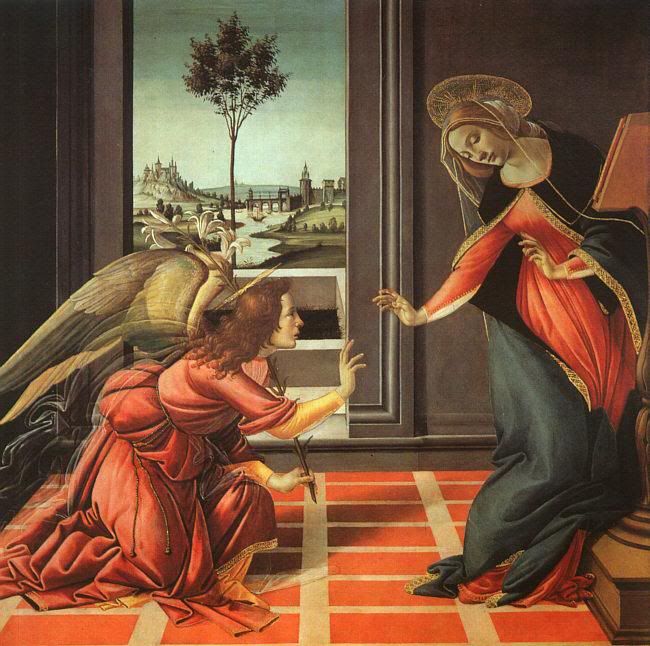
Today, March 25, we celebrate the feast of the Annunciation, the first Joyful Mystery of the Holy Rosary. The Annunciation, the message of the Lord delivered by the Archangel Gabriel to Mary, is the first step that Jesus takes towards earth. It is the first step in the reclaiming of sin, sin which began with Eve, the first mother of the nations. It is the miraculous precursor to the Incarnation, the life and death of Christ, and our eternal salvation. The Annunciation is at once a moment of calm acceptance, and like most of the event in the life of Our Blessed Mother, a moment of deeply troubling foreshadowing, of fear, and of danger. And yet, led by her hunger for the Lord, and her faith in His protection, Mary offers herself unreservedly. “I am the handmaid of the Lord,” she says. “Let it be done to me according to His word.”


26In the sixth month, God sent the angel Gabriel to Nazareth, a town in Galilee, 27to a virgin pledged to be married to a man named Joseph, a descendant of David. The virgin's name was Mary. 28The angel went to her and said, "Greetings, you who are highly favored! The Lord is with you."


29Mary was greatly troubled at his words and wondered what kind of greeting this might be. 30But the angel said to her, "Do not be afraid, Mary, you have found favor with God. 31You will be with child and give birth to a son, and you are to give him the name Jesus. 32He will be great and will be called the Son of the Most High. The Lord God will give him the throne of his father David, 33and he will reign over the house of Jacob forever; his kingdom will never end."


34"How will this be," Mary asked the angel, "since I am a virgin?"


35The angel answered, "The Holy Spirit will come upon you, and the power of the Most High will overshadow you. So the holy one to be born will be called the Son of God. 36Even Elizabeth your relative is going to have a child in her old age, and she who was said to be barren is in her sixth month. 37For nothing is impossible with God."

38"I am the Lord's servant," Mary answered. "May it be to me as you have said.” Then the angel left her. (Luke 1: 26-38)

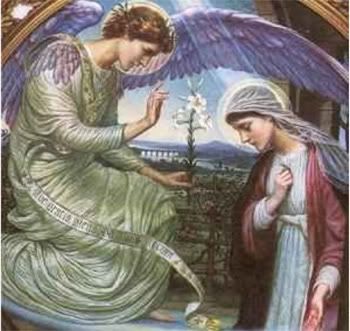
We like to think of the Annunciation as a peaceful event, and that is generally how it has been painted—Gabriel standing in the doorway offering peace, Mary sitting serenely, bathed in golden light, a gentle smile on her face. But if we think about the events depicted in Luke’s Gospel, this depiction seems unlikely.

The arrival of Gabriel tore Mary’s world apart. She was greatly troubled by it. She was being asked to do the impossible, something that would cause her great pain, humiliation, and even potential death. The punishment for pregnancy out of wedlock was stoning in Mary’s day, and even if Joseph were to stand by her, it would require them leaving their home, packing up their lives, heading into the danger of foreign and unfamiliar lands. Mary’s life would change dramatically and completely.

And yet, with the exception of a very practical question, she accepts immediately, without hesitation. The faith of Our Mother is almost tangible in this moment, hanging in the air between she and Gabriel, forever changing the world.

So, too, it can be with us. We are called each day by the Lord to live lives of faith and service to others. Of course, we know this call because of the life and preaching of Jesus, He whom Mary brought forth in virginity, having accepted the message of an angel. But we do not possess the faith of Our Blessed Mother, nor do we share her unwavering confidence and hope in the Lord. All too often, our call to service is too difficult for us, too scary, too inconvenient. And instead of accepting the Lord with all of our heart, we turn away. We say, “I’ll do it tomorrow.” We say, No.”

But the Lord keeps calling us. He may even send “angels,” in the personages of those we encounter. And at some point, we will be moved to answer the call, to overcome our fears and anxieties, to trust completely in the Lord. In that moment, our hearts becoming the dwelling places of Jesus, and we, too, become vessels of Jesus. As Saint Augustine wrote in his Sermons, “You who are astonished at what is wrought in Mary’s body, imitate it in your soul’s inmost chamber. Sincerely believe in God’s justice, and you conceive Christ. Bring forth words of salvation, and you have given birth to Christ.”

The Annunciation is a moment of joy in the life of Mary, in the life of the Church, in our own lives. May we strive to imitate the gracious acceptance of Our Blessed Mother, her loving faith and hope in the Lord, and her unyielding confidence in His protection, mercy, and plan.


Lord Jesus Christ,

Eternal Word,
You became Incarnate as man
in the womb of the Blessed Virgin Mary.
You, through whom the universe was created,
began your earthly course,
in the womb of a humble and chaste Virgin.
At the annunciation of this miracle,
Mary responded in faith:
"let it be done to me
according to your word."
May we who are made new creatures
by your grace,
respond with such faith,
when you call us to your service. Amen

Marian Mondays: A Fiat by any other name...

Posted by Jacob

Marian Mondays is a weekly post focusing on Our Blessed Mother, Mary, Queen of Heaven and Earth. In this post, we explore her life, her special mission, her sanctity, and the Biblical bases for the beliefs of the Church.


Mary exemplifies the Christian virtues of faith, hope, and charity. She was chosen, and is, without a doubt, blessed. When we speak of Mary, we oftentimes use the word “fiat.” You hear people saying, “the fiat of Mary,” or “the ultimate fiat.” But what are we actually talking about? “Fiat” is Latin, translating as “let it be done.” In this way, we can understand the word fiat as more than a simple “yes.” Rather, it is the acknowledgement of one’s lack of control, of one's faith, of one's confidence in the face of the unknown.

When we speak of the fiat of Mary, we are, of course, generally referring to the Annunciation, when she bravely proclaims, “I am the handmaiden of the Lord; Let it be done to me according to your word.” Mary, as previously written here, has no idea what lies in store for her. She stands poised on the brink of the great unknown, and yet, she manages to give up her control, to put her faith in the Lord, and accept the unknown. In doing so, the unknown becomes known through her faith in the Lord.

As Adreinne von Speyr wrote: "The `fiat' of the Mother of the Lord is the most humble thing that the maiden can say or accomplish . . . Since she binds herself entirely to God, she becomes entirely free in God . . . She is infinitely at the disposal of the Infinite. She is absolutely ready for everything, for a great deal more, therefore, than she can know, imagine or begin to suspect. Coming from God, this yes is the highest grace; but, coming from us, it is also the highest achievement made possible by grace: unconditional, definitive self-surrender. It is at once faith, hope and love. It is also the original vow, out of which arises every form of definitive Christian commitment to God and in God. It is the synthesis of love and obedience.”

In consideration of what was being asked of her, Mary’s fiat is not only brave, it is eloquent and virtuous. All too often, we answer the Lord with hesitation, half-heartedness, begrudging acceptance—an “I guess so,” or “If I have to” type response. Our own plans, our fears and anxieties, our competing priorities, our sinfulness betray us in these moments. Our selfishness keeps us from embracing our weakness, gazing into the unknown, and accepting the Lord’s will for us.

Our Blessed Mother had ample opportunity for selfishness, both at the first fiat, and later. At the Wedding in Cana, for example, Mary offers another fiat—this one as selfless as the first. We can imagine the happiness of Mary—of any mother—having her child, her son, return home for this joyous event. We can imagine that many of us would want to keep that child with us, for as long as we could. Mary likely felt the same way about her child, the Christ child. But she chose to let Him go, to start His mission on earth, with the fiat, "Do whatever he tells you." (John 2:5). Mary begins the ministry of Jesus, not knowing what lay in store, but trusting in the Lord. When we meditate upon the Mysteries of the Rosary, we are not only contemplating the life of Jesus, we are relishing the repeated fiat of Mary, and we are learning from both. To what will we say “Let it be done” today? How will we respond to our Lord’s call?


An excerpt from a Homily of Praise to the Virgin’s Fiat
Written by St. Bernard of Clairvaux (1090-1153)

You have heard, O Virgin, that you will conceive and bear a son; you have heard that it will not be by man but by the Holy Spirit. The angel awaits an answer; it is time for him to return to God who sent him. We too are waiting, O Lady, for your word of compassion; the sentence of condemnation weighs heavily upon us.


The price of our salvation is offered to you. We shall be set free at once if you consent. In the eternal Word of God we all came to be, and behold, we die. In your brief response we are to be remade in order to be recalled to life.


Tearful Adam with his sorrowing family begs this of you, O loving Virgin, in their exile from Paradise. Abraham begs it, David begs it. All the other holy patriarchs, your ancestors, ask it of you, as they dwell in the country of the shadow of death. This is what the whole earth waits for, prostrate at your feet. It is right in doing so, for on your word depends comfort for the wretched, ransom for the captive, freedom for the condemned, indeed, salvation for all the sons of Adam, the whole of your race.


Answer quickly, O Virgin. Reply in haste to the angel, or rather through the angel to the Lord. Answer with a word, receive the Word of God. Speak your own word, conceive the divine Word. Breathe a passing word, embrace the eternal Word.


Why do you delay, why are you afraid? Believe, give praise, and receive. Let humility be bold, let modesty be confident. This is no time for virginal simplicity to forget prudence. In this matter alone, O prudent Virgin, do not fear to be presumptuous. Though modest silence is pleasing, dutiful speech is now more necessary. Open your heart to faith, O blessed Virgin, your lips to praise, your womb to the Creator. See, the desired of all nations is at your door, knocking to enter. If he should pass by because of your delay, in sorrow you would begin to seek him afresh, the One whom your soul loves. Arise, hasten, open. Arise in faith, hasten in devotion, open in praise and thanksgiving. Behold the handmaid of the Lord, she says, be it done to me according to your word.