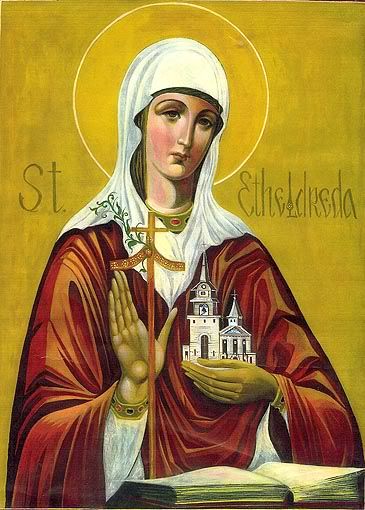
Today, June 23, we celebrate the feast day of Saint Etheldreda (also known as Saint Audrey, 636-379), ascetic, queen, and foundress of the “double monastery” at Ely. Against earthly pressures, and through divine intervention, Saint Etheldreda maintained her personal consecration to the Lord, remaining a virgin and engaging in ascetic pursuits despite her noble station. Her perseverance in faith and commitment to a life of prayer and service is remarkable still today.
Born in Northumbria, the daughter of a king, Etheldreda was brought up in a God-fearing household. From an early age, Etheldreda had but one goal: to consecrate herself entirely to the Lord through entrance into a religious order. Etheldreda longed to fully serve with her life, her wealth, and her actions. Her father, on the other hand, had other plans for her. For political reasons, Etheldreda was married (at quite a young age) to a prince named Tonbert, from who she received a track of land on the Isle of Ely. For three years the couple lived together, and due to her young age and commitment to sanctity, Etheldreda was able to maintain her purity. Upon Tonbert’s untimely death, she relocated to the Isle of Ely, where she intended to devote herself to entirely spiritual pursuits.
However, it was not to be. Her father, again sensing political opportunity, arranged for a second marriage, this time to the young son of the powerful king of Northumbria, Egfrith. Etheldreda obeyed her father’s wishes, but chose to live in the royal palace as a sister to the king, rather than a wife. This was not problematic, due to the youth of the boy, who would sit at Etheldreda’s feet, learning Scripture from her. For twelve years, Etheldreda engaged in purely ascetic activities, forgoing the accoutrements and privilege of her position, and maintaining her purity. Etheldreda became known for devoting her time to works of mercy and love, while observing a scrupulous regularity of discipline.
At the age of twenty-four, Egfrith ascended to the throne of Northumbria, becoming king. As Queen, Etheldreda delighted in the society of monks and nuns, and took care to invite and attract to her those most distinguished for learning and piety. Among these was St. Cuthbert, the young Prior of Lindisfarne, upon whose monastery she bestowed many gifts from her own private property. Over time, Etheldreda became friends with Saint Wilfrid, her confessor, who on her behalf, encouraged the king to allow her to retire for some years to the Convent at Coldingham Abbey. There, she lived as a sister, having received the veil from Saint Wilfrid himself. Her husband, the king, shortly after consenting to her departure from the royal court, changed his mind and pursued her. When Saint Wilfrid pleaded on her behalf, the king made his intentions known: he would find Etheldreda and bring her back to the court by force, where he would consummate his marital privileges.
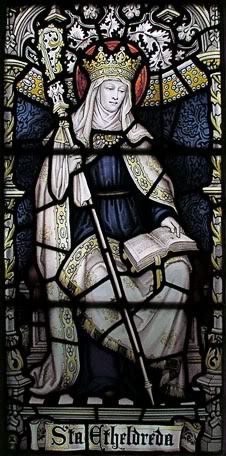
Etheldreda fled toward her land on the Isle of Ely, with the king in pursuit. She took refuge on a headland on the southern coast of England where a miracle prevented further advance of the king. While she was standing on a large outcropping of rock, the tide rose such that it created an island of refuge for the saint, water surrounding her. Etheldreda remained in this island refuge for seven days, until her royal spouse, recognizing the divine will, agreed to leave her in peace.
Etheldreda, freed from her marriage, continued on her trek to the Isle of Ely. On one extremely hot day during her travels, legend tells us that Etheldreda was overpowered with fatigue. She stuck her staff into the ground and lay down to rest on the open plain. When she awoke, the staff had put forth leaves and branches, and it afterwards became a mighty oak tree, larger than any other for many miles around.
At length, after many days of weary walking, the saint arrived on her own lands in Ely. There, she established a “double monastery,” shepherding both nuns and monks. Saint Wilfrid appointed her abbess, and she governed the abbey for many years, serving as advisor to the pope and other Church officials during that time. Etheldreda ruled over her monastery for seven years, setting a great example of piety and abstinence and all other monastic virtues. Though of royal lineage, and having been delicately reared, Etheldreda abstained from all luxuries. She never wore any linen, but only rough woolen clothing. She denied herself the use of the warm bath, only using the bath that had already served the other nuns. Many of her old friends, relations, and courtiers followed her and her example, engaging in ascetic practices, discipline, and prayer. The monastery grew considerably under her holy leadership
Not only holy and a model of virtue in shepherding her people to the Lord, Etheldreda also was graced with the gift of prophecy. Most notable of her prophecies was that of her own death by plague, and the exact number of her monks and nuns who would be carried off by the same epidemic. True to her prophesy, Etheldreda died of a quinsy, a form of plague which led to the development of a large tumor upon her neck. Etheldreda, never complaining about the pain or the sight of the growth, regarded is as a punishment for her former love of fine clothing, and, in particular, for having worn jewels on her neck.
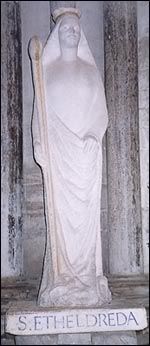
Seventeen years after her death, Saint Wilfrid and Saint Etheldreda’s physician discovered her body to be incorrupt. The incision that had been made into her tumor shortly before she died had miraculously healed in death. (Saint Etheldreda remains the patron of sufferers of throat complaints.) The linen cloths in which her body was wrapped were as fresh as the day she had been buried. Her body was placed in a stone sarcophagus and reburied at the Abbey. Unfortunately, the tomb of Saint Etheldreda was desecrated during the English Reformation, with only the incorrupt hand of the blessed saint surviving. Her relics remain at St Etheldreda's Roman Catholic church at Ely, where many miracles have been reported through her intercession.
The life of Saint Etheldreda reminds us that we cannot truly be servants of Christ when our souls are distracted by the pleasures and desires of the world. In her wisdom, Saint Etheldreda gave up her wealth, station, and privilege, instead choosing to live the ascetic life of a abbess, guiding people to Christ and contributing to His kingdom on earth. We might take a lesson from Saint Etheldreda today, examining what binds us to the world, preventing us from truly and fully serving our Creator.
Eternal God,
who bestowed such grace upon your servant Etheldreda
that she gave herself wholly to the life of prayer
and to the service of your true religion:
grant that we, like her,
may so live our lives on earth seeking your kingdom
that by your guiding
we may be joined to the glorious fellowship of your saints; through Jesus Christ our Lord. Amen.
Why pray the Rosary every day for a year?
Each time the Blessed Virgin has appeared-- whether it be to Saint Bernadette Soubirous at Lourdes; to Lucia, Jacinta, and Francisco at Fatima; or to Mariette Beco at Banneux-- she has asserted the importance, saving grace, and power of praying the Holy Rosary on a daily basis. Based upon her words, the Rosary is penance and conversion for sinners, a pathway to peace, an end to war, and a powerful act of faith in Jesus Christ. Pope Paul VI presented the Rosary as a powerful means to reach Christ "not merely with Mary but indeed, insofar as this is possible to us, in the same way as Mary, who is certainly the one who thought about Him more than anyone else has ever done."
To show us how this is done, perhaps no one has been more eloquent than the great Cardinal Newman, who wrote: "The great power of the Rosary consists in the fact that it translates the Creed into Prayer. Of course, the Creed is already in a certain sense a prayer and a great act of homage towards God, but the Rosary brings us to meditate again on the great truth of His life and death, and brings this truth close to our hearts. Even Christians, although they know God, usually fear rather than love Him. The strength of the Rosary lies in the particular manner in which it considers these mysteries, since all our thinking about Christ is intertwined with the thought of His Mother, in the relations between Mother and Son; the Holy Family is presented to us, the home in which God lived His infinite love."
As Mary said at Fatima, "Jesus wants to use you to make Me known and loved. He wishes to establish the devotion to My Immaculate Heart throughout the world. I promise salvation to whoever embraces it; these souls will be dear to God, like flowers put by Me to adorn his throne."
Today, we remember Chile’s first saint on the feast day of Saint Teresa de Jesus de Los Andes (1900-1920). Teresa was born in Santiago de Chile to a middle class family. Christened Juana, and nicknamed “Juanita,” she was educated by the French nuns of the Sacred Heart, where she read the biography of Carmelite mystic Saint Therese of Lisieux.
By all accounts, Juanita led a typical childhood, embracing her education, learning to play the piano, experiencing a close relationship with her sister. She developed a friendship with a neighborhood boy, but eventually ended the friendship, instead consecrating herself to Christ. At the age of 14, Juanita took a 9-day vow of virginity, which she subsequently renewed every day. Her love for the Lord was overwhelming, and following her first Eucharist she thought of little else. At 14 she entered the monastery of the Discalced Carmelite Nuns in Los Andes (about 90 kilometers from her family home).
At that time, at just age 14, Juanita wrote to her sister in a letter: "How happy I am, my dear sister! I've been captured in the loving nets of The Divine Fisherman. I wish I could make you understand this happiness. I can say with certainty that I am His promised one and that very soon we will celebrate our betrothal in Carmel. I'm going to be a Carmelite. What do you think?.... I've give myself over to Him. On the 8th of December I promised myself to Him. It's impossible to say how much I love Him. My mind is filled with Him alone. He is my Ideal, an infinite ideal. I long for the day when I can go to Carmel to devote myself to Him alone, to abase myself before Him and to live His life alone: to love and suffer that I may save souls. Yes. I thirst for souls because I know that is what my Jesus longs for more than anything else. Oh, I love Him!"
As a novice, Juanita was given the name Teresa de Jesus. She relayed to her confessor that Jesus had spoken to her at her First Eucharist—something that at the time she assumed happened to everyone. He had called her to Himself, but also revealed to her that she would die young and join Him in heaven. She relayed her vision with happiness and peace, confident in her love of the Lord, and ready to meet Him. While on earth, Teresa rarely complained, but rather lived her life to spread the love of the Lord. When she was only 19, Teresa fell ill from Typhus, which she painfully struggled with for six months prior to her death.
Saint Teresa wrote, "How great is the mission opening up before me! It's universal, and I'm so incapable of fulfilling it. But He, my adored Spouse, is with me and will give me the strength to sacrifice myself and pour out all my heart's blood mystically each day, because a Carmelite must die at every moment for her own soul and for all souls. What purity my vocation demands, always united with God. To live my whole life in a divine atmosphere. What recollection, what uninterrupted adoration. What peace. How inflamed with love is the soul espoused to the Crucified One! What poverty and detachment of heart and spirit, and what obedience and submission of our being! Carmelite ... How incapable l am, Father, to fit the pattern offered me by my Divine Spouse and my Most Holy Mother."
Saint Teresa de Jesus de Los Andes is remembered for an extraordinary love, intelligence, and commitment to the Lord. Despite being young, she was a witness of Christ’s love and grace throughout her life. Prior to entering the convent at Los Andes, her classmates and siblings recognized her as different. They were drawn to her, and she to them in the friendship and love of Christ. Serving as a model for those she encountered, Saint Teresa de Jesus demonstrated constant virtue, acceptance, and confidence in the Lord, wedding herself to Him, and living for Him each moment of her life until her early death. She was fond of saying, "Christ so foolish in his love, has driven me madly in love!”
Saint Teresa wrote to her brother, shortly before her death: “My time is not my own. I gave away everything I had. Even my own will! I must do everything Our Lord asks of me moment by moment... What a joy! How happy I find myself in sacrificing everything for God! It's all nothing in comparison with the way Our Savior sacrificed Himself from the cradle to the Cross and from the Cross to the point of annihilating Himself under the form of bread till the end of time. Oh, how great is this infinite love. A love unknown, a love not returned by most of humanity.”
The short, yet intensely holy, life of Saint Teresa de Jesus de Los Andes inspires us to re-center ourselves on our gracious Lord—to live and breathe for Him, to sacrifice for Him, to love Him by loving each other. Saint Teresa was open to the call of the Lord, even at age 10 during her First Eucharist. Are we open to hearing His call?
By all accounts, Juanita led a typical childhood, embracing her education, learning to play the piano, experiencing a close relationship with her sister. She developed a friendship with a neighborhood boy, but eventually ended the friendship, instead consecrating herself to Christ. At the age of 14, Juanita took a 9-day vow of virginity, which she subsequently renewed every day. Her love for the Lord was overwhelming, and following her first Eucharist she thought of little else. At 14 she entered the monastery of the Discalced Carmelite Nuns in Los Andes (about 90 kilometers from her family home).
At that time, at just age 14, Juanita wrote to her sister in a letter: "How happy I am, my dear sister! I've been captured in the loving nets of The Divine Fisherman. I wish I could make you understand this happiness. I can say with certainty that I am His promised one and that very soon we will celebrate our betrothal in Carmel. I'm going to be a Carmelite. What do you think?.... I've give myself over to Him. On the 8th of December I promised myself to Him. It's impossible to say how much I love Him. My mind is filled with Him alone. He is my Ideal, an infinite ideal. I long for the day when I can go to Carmel to devote myself to Him alone, to abase myself before Him and to live His life alone: to love and suffer that I may save souls. Yes. I thirst for souls because I know that is what my Jesus longs for more than anything else. Oh, I love Him!"
As a novice, Juanita was given the name Teresa de Jesus. She relayed to her confessor that Jesus had spoken to her at her First Eucharist—something that at the time she assumed happened to everyone. He had called her to Himself, but also revealed to her that she would die young and join Him in heaven. She relayed her vision with happiness and peace, confident in her love of the Lord, and ready to meet Him. While on earth, Teresa rarely complained, but rather lived her life to spread the love of the Lord. When she was only 19, Teresa fell ill from Typhus, which she painfully struggled with for six months prior to her death.
Saint Teresa wrote, "How great is the mission opening up before me! It's universal, and I'm so incapable of fulfilling it. But He, my adored Spouse, is with me and will give me the strength to sacrifice myself and pour out all my heart's blood mystically each day, because a Carmelite must die at every moment for her own soul and for all souls. What purity my vocation demands, always united with God. To live my whole life in a divine atmosphere. What recollection, what uninterrupted adoration. What peace. How inflamed with love is the soul espoused to the Crucified One! What poverty and detachment of heart and spirit, and what obedience and submission of our being! Carmelite ... How incapable l am, Father, to fit the pattern offered me by my Divine Spouse and my Most Holy Mother."
Saint Teresa de Jesus de Los Andes is remembered for an extraordinary love, intelligence, and commitment to the Lord. Despite being young, she was a witness of Christ’s love and grace throughout her life. Prior to entering the convent at Los Andes, her classmates and siblings recognized her as different. They were drawn to her, and she to them in the friendship and love of Christ. Serving as a model for those she encountered, Saint Teresa de Jesus demonstrated constant virtue, acceptance, and confidence in the Lord, wedding herself to Him, and living for Him each moment of her life until her early death. She was fond of saying, "Christ so foolish in his love, has driven me madly in love!”
Saint Teresa wrote to her brother, shortly before her death: “My time is not my own. I gave away everything I had. Even my own will! I must do everything Our Lord asks of me moment by moment... What a joy! How happy I find myself in sacrificing everything for God! It's all nothing in comparison with the way Our Savior sacrificed Himself from the cradle to the Cross and from the Cross to the point of annihilating Himself under the form of bread till the end of time. Oh, how great is this infinite love. A love unknown, a love not returned by most of humanity.”
The short, yet intensely holy, life of Saint Teresa de Jesus de Los Andes inspires us to re-center ourselves on our gracious Lord—to live and breathe for Him, to sacrifice for Him, to love Him by loving each other. Saint Teresa was open to the call of the Lord, even at age 10 during her First Eucharist. Are we open to hearing His call?
The Shepherd, slain in the
midst of his flock, purchaseth
peace at the price of his blood.
O joyful mourning, O mournful joy!
The Shepherd dead, new life is in
the Flock! The Mother speaks,
through her tears, the praises of
her Son, for still he lives, the
conqueror of the sword.
Hail, O Thomas! sceptre
of justice, light of the earth,
strong champion of the Church,
beloved of the people, favourite
of the clergy! Hail, admirable
keeper of the Flock! keep in
safety all us who rejoice in
glory.
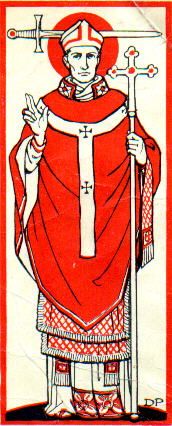
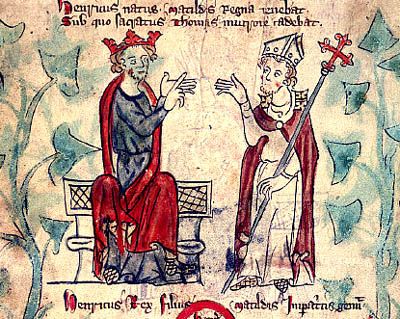
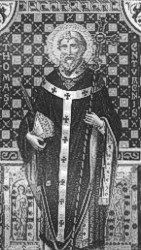
Today, December 29, we celebrate the feast day of Saint Thomas Becket (Thomas á Becket , 1117-1173), Archbishop of Canterbury, and martyr of the Church. Saint Thomas withstood pressures from King Henry II, defending the sanctity and sovereignty of the Church. His vocal opposition eventually led the angered king to exclaim, “Will no one rid me of this meddlesome priest?” upon which four knights slew him in the Cathedral of Canterbury.
Thomas was born in London to parents of Norman descent who were residing inEngland. As described in his youth in the Iceland Saga: “To look upon he was slim of growth and pale of hue, with dark hair, a long nose, and a straightly featured face. Blithe of countenance was he, winning and loveable in his conversation, frank of speech in his discourses, but slightly stuttering in his talk, so keen of discernment and understanding that he could always make difficult questions plain after a wise manner.”
Thomas attended university in Paris, clerked for the Archbishop of Canterbury, and later was sent to study canon law. He was appointed a deacon at approximately the same time that Henry II ascended to the throne of England. Upon the advice of the Archbishop, Henry appointed Thomas his chancellor, and the two grew to become good friends. Thomas embraced the life of luxury that befriending the king afforded, and willingly served alongside his commander in battle as a knight.
Upon the death of the Archbishop of Canterbury, Henry appointed Thomas to succeed him. Consecrated as bishop at the age of 45, Thomas experienced a radical spiritual change. He willingly gave up his former life of indulgence, spending his time in prayer and penance. This newfound pious life resulted in a strained relationship with the king, made worse over disagreements regarding the king’s desire to subject the Church and it’s clerics to his criminal laws and oversight. Saint Thomas actively withstood this assertion by the king, and was threatened with imprisonment and death. Wisely, he traveled to visit the Pope, seeking resolution, and finding none, exiled himself in a French monastery for seven years. During that time, he doubled his penances, spending his days in quiet contemplation and fasting. He further actively combated the expansion of the English king’s power, excommunicating those bishops in England—specifically in London—who sided with Henry.
After seven years, Thomas returned to England, to the cheers of the faithful. While he encouraged peace with the king, Thomas refused to lift the excommunications and censures against those clerics who had sided with Henry, against the Church. The irritation over Saint Thomas’ failure to acquiesce to his wishes led to the king’s famous exclamation, overheard by four knights who set upon Thomas while celebrating Mass at the cathedral.
An eyewitness named Edward Grim recounted the events which transpired next:
“After the monks took [Thomas] through the doors of the church, the four aforementioned knights followed behind with a rapid pace. A certain subdeacon, Hugh the Evil-clerk, named for his wicked offense and armed with their malice, went with them -- showing no reverence for either God or the saints because by following them he condoned their deed. When the holy archbishop entered the cathedral the monks who were glorifying God abandoned vespers -- which they had begun to celebrate for God -- and ran to their father whom they had heard was dead but they saw alive and unharmed.
They hastened to close the doors of the church in order to bar the enemies from slaughtering the bishop, but the wondrous athlete turned toward them and ordered that the doors be opened. "It is not proper," he said, "that a house of prayer, a church of Christ, be made a fortress since although it is not shut up, it serves as a fortification for his people; we will triumph over the enemy through suffering rather than by fighting -- and we come to suffer, not to resist."
Without delay the sacrilegious men entered the house of peace and reconciliation with swords drawn; indeed the sight alone as well as the rattle of arms inflicted not a small amount of horror on those who watched. And those knights who approached the confused and disordered people who had been observing vespers but, by now, had run toward the lethal spectacle exclaimed in a rage: "Where is Thomas Becket, traitor of the king and kingdom?"
No one responded and instantly they cried out more loudly, "Where is the archbishop?"
Unshaken he replied to this voice as it is written, "The righteous will be like a bold lion and free from fear," he descended from the steps to which he had been taken by the monks who were fearful of the knights and said in an adequately audible voice, "Here I am, not a traitor of the king but a priest; why do you seek me?" And [Thomas], who had previously told them that he had no fear of them added, "Here I am ready to suffer in the name of He who redeemed me with His blood; God forbid that I should flee on account of your swords or that I should depart from righteousness."
With these words -- at the foot of a pillar -- he turned to the right. On one side was the altar of the blessed mother of God, on the other the altar of the holy confessor Benedict -- through whose example and prayers he had been crucified to the world and his lusts; he endured whatever the murderers did to him with such constancy of the soul that he seemed as if he were not of flesh.
The murderers pursued him and asked, "Absolve and restore to communion those you have excommunicated and return to office those who have been suspended."
To these words [Thomas] replied, "No penance has been made, so I will not absolve them."
"Then you," they said, "will now die and will suffer what you have earned."
"And I," he said, "am prepared to die for my Lord, so that in my blood the Church will attain liberty and peace; but in the name of Almighty God I forbid that you hurt my men, either cleric or layman, in any way." The glorious martyr acted conscientiously with foresight for his men and prudently on his own behalf, so that no one near him would be hurt as he hastened toward Christ. It was fitting that the soldier of the Lord and the martyr of the Savior adhered to His words when he was sought by the impious, "If it is me you seek, let them leave."
With rapid motion they laid sacrilegious hands on him, handling and dragging him roughly outside of the walls of the church so that there they would slay him or carry him from there as a prisoner, as they later confessed. But when it was not possible to easily move him from the column, he bravely pushed one [of the knights] who was pursuing and drawing near to him; he called him a panderer saying, "Don't touch me, Rainaldus, you who owes me faith and obedience, you who foolishly follow your accomplices."
On account of the rebuff the knight was suddenly set on fire with a terrible rage and, wielding a sword against the sacred crown said, "I don't owe faith or obedience to you that is in opposition to the fealty I owe my lord king." The invincible martyr -- seeing that the hour which would bring the end to his miserable mortal life was at hand and already promised by God to be the next to receive the crown of immortality -- with his neck bent as if he were in prayer and with his joined hands elevated above -- commended himself and the cause of the Church to God, St. Mary, and the blessed martyr St. Denis.
He had barely finished speaking when the impious knight, fearing that [Thomas] would be saved by the people and escape alive, suddenly set upon him and, shaving off the summit of his crown which the sacred chrism consecrated to God, he wounded the sacrificial lamb of God in the head; the lower arm of the writer was cut by the same blow. Indeed [the writer] stood firmly with the holy archbishop, holding him in his arms -- while all the clerics and monks fled -- until the one he had raised in opposition to the blow was severed.
Behold the simplicity of the dove, behold the wisdom of the serpent in this martyr who presented his body to the killers so that he might keep his head, in other words his soul and the church, safe; nor would he devise a trick or a snare against the slayers of the flesh so that he might preserve himself because it was better that he be free from this nature! O worthy shepherd who so boldly set himself against the attacks of wolves so that the sheep might not be torn to pieces! and because he abandoned the world, the world -- wanting to overpower him -- unknowingly elevated him.
Then, with another blow received on the head, he remained firm. But with the third the stricken martyr bent his knees and elbows, offering himself as a living sacrifice, saying in a low voice, "For the Name of Jesus and the protection of the Church I am ready to embrace death."
But the third knight inflicted a grave wound on the fallen one; with this blow he shattered the sword on the stone and his crown, which was large, separated from his head so that the blood turned white from the brain yet no less did the brain turn red from the blood; it purpled the appearance of the church with the colors of the lily and the rose, the colors of the Virgin and Mother and the life and death of the confessor and martyr.
The fourth knight drove away those who were gathering so that the others could finish the murder more freely and boldly. The fifth -- not a knight but a cleric who entered with the knights -- so that a fifth blow might not be spared him who had imitated Christ in other things, placed his foot on the neck of the holy priest and precious martyr and (it is horrible to say) scattered the brains with the blood across the floor, exclaiming to the rest, "We can leave this place, knights, he will not get up again."
But during all these incredible things the martyr displayed the virtue of perseverance. Neither his hand nor clothes indicated that he had opposed a murderer -- as is often the case in human weakness; nor when stricken did he utter a word, nor did he let out a cry or a sigh, or a sign signaling any kind of pain; instead he held still the head that he had bent toward the unsheathed swords.
As his body -- which had been mingled with blood and brain -- laid on the ground as if in prayer, he placed his soul in Abraham's bosom. Having risen above himself, without doubt, out of love for the Creator and wholly striving for celestial sweetness, he easily received whatever pain, whatever malice, the bloody murderer was able to inflict. And how intrepidly -- how devotedly and courageously -- he offered himself for the murder when it was made clear that for his salvation and faith this martyr should fight for the protection of others so that the affairs of the Church might be managed according to its paternal traditions and decrees.”
News of the assassination of Saint Thomas Becket reached across Europe, and the faithful almost immediately began arriving to the cathedral in pilgrimage. Numerous miracles at the tomb of Saint Thomas followed.
Almost immediately after his death, he was canonized a saint by Pope Alexander III, and in recognition, King Henry publicly repented at the tomb, allowing himself to be scourged as penance.
Saint Thomas Becket never wavered from his faith. Following a profound realization of the presence of God, he embraced a life of penance and prayer, realizing that it is never too late to center ourselves on the Almighty. We are much the same way, coming to Jesus every day, realizing that we could better place our trust in Him, fix our gaze on Him, center our lives on Him… and not be deterred by the challenges and opposition we encounter, or the lure of worldly luxuries and temptations. Saint Thomas inspires us to lives of steadfastness and courage, marching steadily toward our heavenly home, united with Christ.
Select Quotations of Saint Thomas Becket:
"Many are needed to plant and water what has been planted now that the faith has spread so far and there are so many people...No matter who plants or waters, God gives no harvest unless what is planted is the faith of Peter and unless he agrees to his teachings."
"Remember the sufferings of Christ, the storms that were weathered...the crown that came from those sufferings which gave new radiance to the faith...All saints give testimony to the truth that without real effort, no one ever wins the crown."
“For our sake Christ offered himself to the Father upon the altar for the cross. He now looks down from heaven on our actions and secret thoughts, and one day he will give each of us the reward his deeds deserve. It must therefore be our endeavor to destroy the right of sin and death, and by nurturing faith and uprightness of life, to build up the Church of Christ into a holy temple of the Lord. The harvest is good and one reaper or even several would not suffice to gather all of it into the granary of the Lord. Yet the Roman Church remains the head of all the churches and the source of Catholic teaching. Of this there can be no doubt. Everyone know that the keys of the kingdom of heaven were given to Peter. Upon his faith and teaching the whole fabric of the Church will continue to be built until we all reach full maturity in Christ and attain to unity in faith and knowledge of the Son of God. Of course many are needed to plant and many to water now that the faith has spread so far and the population become so great. Nevertheless, no matter who plants or waters, God gives no harvest unless what he plants is the faith of Peter, and unless he himself assents to Peter’s teaching. All important questions that arise among God’s people are referred to the judgment of Peter in the person for the Roman Pontiff. Under him the ministers of Mother Church exercise the powers committed to them, each in his own sphere of responsibility. Remember then how our fathers worked out their salvation; remember the sufferings through which the Church has grown, and the storms the ship of Peter has weathered because it has Christ on board. Remember how the crown was attained by those whose sufferings gave new radiance to their faith. The whole company of saints bears witness to the unfailing truth that without real effort no one wins the crown.”
Almighty God,
You granted the martyr Thomas
the grace to give his life for the cause of justice.
By his prayers
make us willing to renounce for Christ
our life in this world
so that we may find it in heaven.
We ask this through our Lord Jesus Christ, Your Son,
who lives and reigns with you and the Holy Spirit,
one God, for ever and ever. Amen.
Year 2: Day 363 of 365
Prayer Intentions: Courage; Steadfastness; Forbearance
Requested Intentions: Healing (M); Safety, security, and sanctity for a family (A); Healing (N); Successful relationship (N); Healing of a friend; growth in the Lord (M); To hear and answer the Lord’s call (M); Healing of a friend undergoing chemotherapy (L); For the peace, safety, and holiness of a sister (J); Financial security (C); Conversion of a newly married couple (M); Peace in a family (S); Peaceful repose of departed mother (J); Blessings on a relationship (J); Financial security, successful employment (J); Obedience to God’s will (A); Conversion of souls (A); Success of business venture; faith of daughter (S); Safe return home (J); Recovery of mother and son; repose of the souls of the dearly departed (A); Blessings upon a relationship (M); Sobriety and recovery for a son (M); Employment and successful marriage (A); Employment, healing, freedom from anxiety (T); Financial security (C); Conversion (T); Peace in difficult times at work (E); Financial security and blessings for mother and children (T); Financial security for a mother (M); Health, finances, successful marriage (A); Successful resolution of court case for son (K); Continued sobriety (N); Healing of a chronic health condition (B); Successful employment (A): Peace in a family, recovery of a niece from substance use (L); Blessings on a marriage, healing of a husband (P); For the health and recovery of sisters (B); For a daughter and granddaughter (D); Blessings on overseas employment (M); Healing of mother (L).
midst of his flock, purchaseth
peace at the price of his blood.
O joyful mourning, O mournful joy!
The Shepherd dead, new life is in
the Flock! The Mother speaks,
through her tears, the praises of
her Son, for still he lives, the
conqueror of the sword.
Hail, O Thomas! sceptre
of justice, light of the earth,
strong champion of the Church,
beloved of the people, favourite
of the clergy! Hail, admirable
keeper of the Flock! keep in
safety all us who rejoice in
glory.
Today, December 29, we celebrate the feast day of Saint Thomas Becket (Thomas á Becket , 1117-1173), Archbishop of Canterbury, and martyr of the Church. Saint Thomas withstood pressures from King Henry II, defending the sanctity and sovereignty of the Church. His vocal opposition eventually led the angered king to exclaim, “Will no one rid me of this meddlesome priest?” upon which four knights slew him in the Cathedral of Canterbury.
Thomas was born in London to parents of Norman descent who were residing inEngland. As described in his youth in the Iceland Saga: “To look upon he was slim of growth and pale of hue, with dark hair, a long nose, and a straightly featured face. Blithe of countenance was he, winning and loveable in his conversation, frank of speech in his discourses, but slightly stuttering in his talk, so keen of discernment and understanding that he could always make difficult questions plain after a wise manner.”
Thomas attended university in Paris, clerked for the Archbishop of Canterbury, and later was sent to study canon law. He was appointed a deacon at approximately the same time that Henry II ascended to the throne of England. Upon the advice of the Archbishop, Henry appointed Thomas his chancellor, and the two grew to become good friends. Thomas embraced the life of luxury that befriending the king afforded, and willingly served alongside his commander in battle as a knight.
Upon the death of the Archbishop of Canterbury, Henry appointed Thomas to succeed him. Consecrated as bishop at the age of 45, Thomas experienced a radical spiritual change. He willingly gave up his former life of indulgence, spending his time in prayer and penance. This newfound pious life resulted in a strained relationship with the king, made worse over disagreements regarding the king’s desire to subject the Church and it’s clerics to his criminal laws and oversight. Saint Thomas actively withstood this assertion by the king, and was threatened with imprisonment and death. Wisely, he traveled to visit the Pope, seeking resolution, and finding none, exiled himself in a French monastery for seven years. During that time, he doubled his penances, spending his days in quiet contemplation and fasting. He further actively combated the expansion of the English king’s power, excommunicating those bishops in England—specifically in London—who sided with Henry.
After seven years, Thomas returned to England, to the cheers of the faithful. While he encouraged peace with the king, Thomas refused to lift the excommunications and censures against those clerics who had sided with Henry, against the Church. The irritation over Saint Thomas’ failure to acquiesce to his wishes led to the king’s famous exclamation, overheard by four knights who set upon Thomas while celebrating Mass at the cathedral.
An eyewitness named Edward Grim recounted the events which transpired next:
“After the monks took [Thomas] through the doors of the church, the four aforementioned knights followed behind with a rapid pace. A certain subdeacon, Hugh the Evil-clerk, named for his wicked offense and armed with their malice, went with them -- showing no reverence for either God or the saints because by following them he condoned their deed. When the holy archbishop entered the cathedral the monks who were glorifying God abandoned vespers -- which they had begun to celebrate for God -- and ran to their father whom they had heard was dead but they saw alive and unharmed.
They hastened to close the doors of the church in order to bar the enemies from slaughtering the bishop, but the wondrous athlete turned toward them and ordered that the doors be opened. "It is not proper," he said, "that a house of prayer, a church of Christ, be made a fortress since although it is not shut up, it serves as a fortification for his people; we will triumph over the enemy through suffering rather than by fighting -- and we come to suffer, not to resist."
Without delay the sacrilegious men entered the house of peace and reconciliation with swords drawn; indeed the sight alone as well as the rattle of arms inflicted not a small amount of horror on those who watched. And those knights who approached the confused and disordered people who had been observing vespers but, by now, had run toward the lethal spectacle exclaimed in a rage: "Where is Thomas Becket, traitor of the king and kingdom?"
No one responded and instantly they cried out more loudly, "Where is the archbishop?"
Unshaken he replied to this voice as it is written, "The righteous will be like a bold lion and free from fear," he descended from the steps to which he had been taken by the monks who were fearful of the knights and said in an adequately audible voice, "Here I am, not a traitor of the king but a priest; why do you seek me?" And [Thomas], who had previously told them that he had no fear of them added, "Here I am ready to suffer in the name of He who redeemed me with His blood; God forbid that I should flee on account of your swords or that I should depart from righteousness."
With these words -- at the foot of a pillar -- he turned to the right. On one side was the altar of the blessed mother of God, on the other the altar of the holy confessor Benedict -- through whose example and prayers he had been crucified to the world and his lusts; he endured whatever the murderers did to him with such constancy of the soul that he seemed as if he were not of flesh.
The murderers pursued him and asked, "Absolve and restore to communion those you have excommunicated and return to office those who have been suspended."
To these words [Thomas] replied, "No penance has been made, so I will not absolve them."
"Then you," they said, "will now die and will suffer what you have earned."
"And I," he said, "am prepared to die for my Lord, so that in my blood the Church will attain liberty and peace; but in the name of Almighty God I forbid that you hurt my men, either cleric or layman, in any way." The glorious martyr acted conscientiously with foresight for his men and prudently on his own behalf, so that no one near him would be hurt as he hastened toward Christ. It was fitting that the soldier of the Lord and the martyr of the Savior adhered to His words when he was sought by the impious, "If it is me you seek, let them leave."
With rapid motion they laid sacrilegious hands on him, handling and dragging him roughly outside of the walls of the church so that there they would slay him or carry him from there as a prisoner, as they later confessed. But when it was not possible to easily move him from the column, he bravely pushed one [of the knights] who was pursuing and drawing near to him; he called him a panderer saying, "Don't touch me, Rainaldus, you who owes me faith and obedience, you who foolishly follow your accomplices."
On account of the rebuff the knight was suddenly set on fire with a terrible rage and, wielding a sword against the sacred crown said, "I don't owe faith or obedience to you that is in opposition to the fealty I owe my lord king." The invincible martyr -- seeing that the hour which would bring the end to his miserable mortal life was at hand and already promised by God to be the next to receive the crown of immortality -- with his neck bent as if he were in prayer and with his joined hands elevated above -- commended himself and the cause of the Church to God, St. Mary, and the blessed martyr St. Denis.
He had barely finished speaking when the impious knight, fearing that [Thomas] would be saved by the people and escape alive, suddenly set upon him and, shaving off the summit of his crown which the sacred chrism consecrated to God, he wounded the sacrificial lamb of God in the head; the lower arm of the writer was cut by the same blow. Indeed [the writer] stood firmly with the holy archbishop, holding him in his arms -- while all the clerics and monks fled -- until the one he had raised in opposition to the blow was severed.
Behold the simplicity of the dove, behold the wisdom of the serpent in this martyr who presented his body to the killers so that he might keep his head, in other words his soul and the church, safe; nor would he devise a trick or a snare against the slayers of the flesh so that he might preserve himself because it was better that he be free from this nature! O worthy shepherd who so boldly set himself against the attacks of wolves so that the sheep might not be torn to pieces! and because he abandoned the world, the world -- wanting to overpower him -- unknowingly elevated him.
Then, with another blow received on the head, he remained firm. But with the third the stricken martyr bent his knees and elbows, offering himself as a living sacrifice, saying in a low voice, "For the Name of Jesus and the protection of the Church I am ready to embrace death."
But the third knight inflicted a grave wound on the fallen one; with this blow he shattered the sword on the stone and his crown, which was large, separated from his head so that the blood turned white from the brain yet no less did the brain turn red from the blood; it purpled the appearance of the church with the colors of the lily and the rose, the colors of the Virgin and Mother and the life and death of the confessor and martyr.
The fourth knight drove away those who were gathering so that the others could finish the murder more freely and boldly. The fifth -- not a knight but a cleric who entered with the knights -- so that a fifth blow might not be spared him who had imitated Christ in other things, placed his foot on the neck of the holy priest and precious martyr and (it is horrible to say) scattered the brains with the blood across the floor, exclaiming to the rest, "We can leave this place, knights, he will not get up again."
But during all these incredible things the martyr displayed the virtue of perseverance. Neither his hand nor clothes indicated that he had opposed a murderer -- as is often the case in human weakness; nor when stricken did he utter a word, nor did he let out a cry or a sigh, or a sign signaling any kind of pain; instead he held still the head that he had bent toward the unsheathed swords.
As his body -- which had been mingled with blood and brain -- laid on the ground as if in prayer, he placed his soul in Abraham's bosom. Having risen above himself, without doubt, out of love for the Creator and wholly striving for celestial sweetness, he easily received whatever pain, whatever malice, the bloody murderer was able to inflict. And how intrepidly -- how devotedly and courageously -- he offered himself for the murder when it was made clear that for his salvation and faith this martyr should fight for the protection of others so that the affairs of the Church might be managed according to its paternal traditions and decrees.”
News of the assassination of Saint Thomas Becket reached across Europe, and the faithful almost immediately began arriving to the cathedral in pilgrimage. Numerous miracles at the tomb of Saint Thomas followed.
Almost immediately after his death, he was canonized a saint by Pope Alexander III, and in recognition, King Henry publicly repented at the tomb, allowing himself to be scourged as penance.
Saint Thomas Becket never wavered from his faith. Following a profound realization of the presence of God, he embraced a life of penance and prayer, realizing that it is never too late to center ourselves on the Almighty. We are much the same way, coming to Jesus every day, realizing that we could better place our trust in Him, fix our gaze on Him, center our lives on Him… and not be deterred by the challenges and opposition we encounter, or the lure of worldly luxuries and temptations. Saint Thomas inspires us to lives of steadfastness and courage, marching steadily toward our heavenly home, united with Christ.
Select Quotations of Saint Thomas Becket:
"Many are needed to plant and water what has been planted now that the faith has spread so far and there are so many people...No matter who plants or waters, God gives no harvest unless what is planted is the faith of Peter and unless he agrees to his teachings."
"Remember the sufferings of Christ, the storms that were weathered...the crown that came from those sufferings which gave new radiance to the faith...All saints give testimony to the truth that without real effort, no one ever wins the crown."
“For our sake Christ offered himself to the Father upon the altar for the cross. He now looks down from heaven on our actions and secret thoughts, and one day he will give each of us the reward his deeds deserve. It must therefore be our endeavor to destroy the right of sin and death, and by nurturing faith and uprightness of life, to build up the Church of Christ into a holy temple of the Lord. The harvest is good and one reaper or even several would not suffice to gather all of it into the granary of the Lord. Yet the Roman Church remains the head of all the churches and the source of Catholic teaching. Of this there can be no doubt. Everyone know that the keys of the kingdom of heaven were given to Peter. Upon his faith and teaching the whole fabric of the Church will continue to be built until we all reach full maturity in Christ and attain to unity in faith and knowledge of the Son of God. Of course many are needed to plant and many to water now that the faith has spread so far and the population become so great. Nevertheless, no matter who plants or waters, God gives no harvest unless what he plants is the faith of Peter, and unless he himself assents to Peter’s teaching. All important questions that arise among God’s people are referred to the judgment of Peter in the person for the Roman Pontiff. Under him the ministers of Mother Church exercise the powers committed to them, each in his own sphere of responsibility. Remember then how our fathers worked out their salvation; remember the sufferings through which the Church has grown, and the storms the ship of Peter has weathered because it has Christ on board. Remember how the crown was attained by those whose sufferings gave new radiance to their faith. The whole company of saints bears witness to the unfailing truth that without real effort no one wins the crown.”
Almighty God,
You granted the martyr Thomas
the grace to give his life for the cause of justice.
By his prayers
make us willing to renounce for Christ
our life in this world
so that we may find it in heaven.
We ask this through our Lord Jesus Christ, Your Son,
who lives and reigns with you and the Holy Spirit,
one God, for ever and ever. Amen.
Year 2: Day 363 of 365
Prayer Intentions: Courage; Steadfastness; Forbearance
Requested Intentions: Healing (M); Safety, security, and sanctity for a family (A); Healing (N); Successful relationship (N); Healing of a friend; growth in the Lord (M); To hear and answer the Lord’s call (M); Healing of a friend undergoing chemotherapy (L); For the peace, safety, and holiness of a sister (J); Financial security (C); Conversion of a newly married couple (M); Peace in a family (S); Peaceful repose of departed mother (J); Blessings on a relationship (J); Financial security, successful employment (J); Obedience to God’s will (A); Conversion of souls (A); Success of business venture; faith of daughter (S); Safe return home (J); Recovery of mother and son; repose of the souls of the dearly departed (A); Blessings upon a relationship (M); Sobriety and recovery for a son (M); Employment and successful marriage (A); Employment, healing, freedom from anxiety (T); Financial security (C); Conversion (T); Peace in difficult times at work (E); Financial security and blessings for mother and children (T); Financial security for a mother (M); Health, finances, successful marriage (A); Successful resolution of court case for son (K); Continued sobriety (N); Healing of a chronic health condition (B); Successful employment (A): Peace in a family, recovery of a niece from substance use (L); Blessings on a marriage, healing of a husband (P); For the health and recovery of sisters (B); For a daughter and granddaughter (D); Blessings on overseas employment (M); Healing of mother (L).
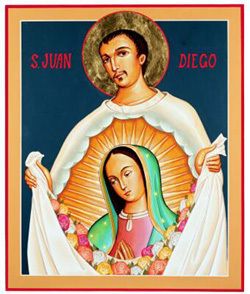
Today, December 9, we celebrate the feast day of Saint Juan Diego Cuauhtlatoatzin (1474-1548), visionary of Our Lady of Guadalupe, and the first Catholic saint indigenous to the Americas. Saint Juan is a model of Christian steadfastness, walking 15 miles to attend Mass each day, and an example of profound humility, stating to Our Blessed Mother: “I am a nobody, I am a small rope, a tiny ladder, the tail end, a leaf.”
Little is factually known about the life of Juan Diego Cuauhtlatoatzin before his conversion at age 50 by Franciscan missionaries. However, tradition, archeological, and iconographical sources, along with the indigenous document detailing the events of the apparitions at Guadalupe (“El nican Mopohua,” written in Náhuatl with Latin characters in 1556) shed some light on this simple and holy man.
Born with the name "Cuauhtlatoatzin" (which means "the talking eagle") in Cuautlitlán, (modern-day Mexico City), Mexico, Juan was a member of the Chichimeca people, a culturally advanced group living in Anáhuac Valley. Thought to an average man, of neither the upper respected classes of priests, warriors and merchants, but also not a slave, Juan is likely to have owned a small house and farmed a small tract of land. He was happily married, although had no children. The remainder of his life is lost to history until his encounter with Franciscan priest, Father Peter da Gand. At age 50, Juan accepted Christ into his life, converting to Catholicism and being baptized. Every day thereafter, he walked more than 15 miles barefoot to attend daily Mass.
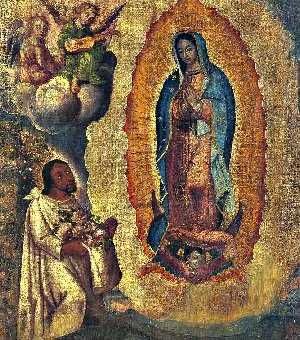
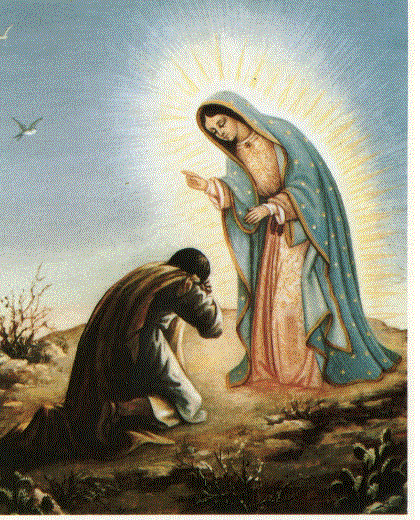
The events of December 9, 1531, occurred during his usual morning walk, when on the crest of Tepeyac Hill (outside Mexico City), the Blessed Virgin Mary appeared to him. Known as Our Lady of Guadalupe (whose feast we celebrate in just 3 days on December 12), Our Lady requested that Juan visit the local bishop and request that a shrine be built in her name. She further promised to pour out her unending grace on those who invoked her. Our Lady talked to Juan in his language, Nahuatl. She called him "Juanito, Juan Dieguito,” "the most humble of my sons,” "my son the least,” and "my little dear.”
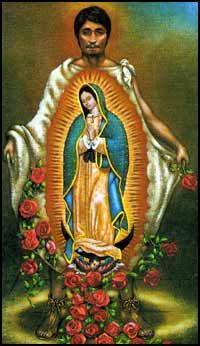
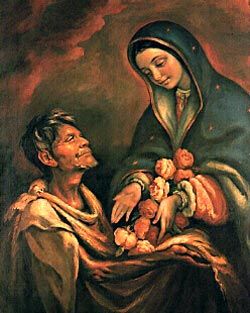
Indeed a humble man, Juan obediently visited the bishop, who did not believe the wild tale—especially from a “nobody.” Why would the Blessed Virgin appear to such a simple man? He requested that Juan return with a sign to prove that the apparition was true. Three days later, on December 12 (the Feast of Our Lady of Guadalupe), Juan was again climbing Tepeyac Hill and encountered Our Lady again. She instructed him to climb to the top of the hill and to pick the flowers he would find there. Despite it being wintertime, he obeyed, climbing the hill, finding fragrant roses in blossom. He picked the flowers and carried them to Our Lady. She gently placed them in his mantle (robe) and instructed him to take them to his bishop as proof of his claims and her appearance.
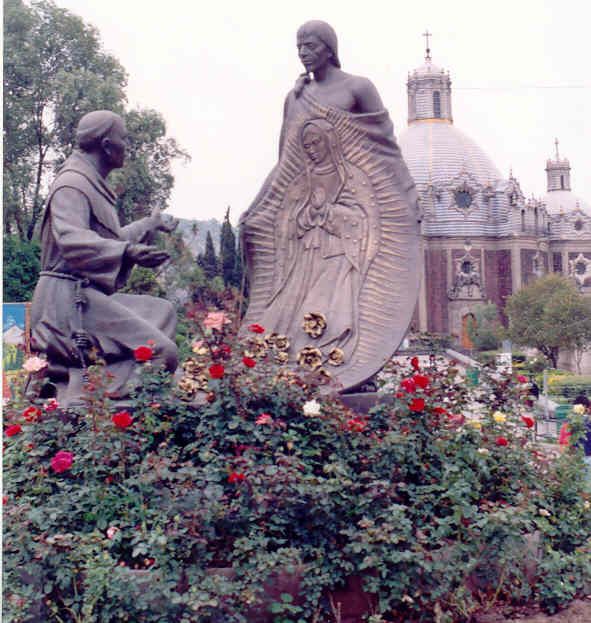
Juan carefully carried the flowers back to the bishop, and miraculously found that when he opened his mantle and the flowers fell to the ground, in their place was an image of the Blessed Mother as she appeared at Tepeyac. The bishop was convinced and ordered a church built for Virgin of Guadalupe, which became a place of pilgrimage for the faithful.
For his part, Juan requested that he be allowed to live in hermitude in a small hut near the chapel that was built to house the miraculous image. Receiving permission from the bishop, he gave up all his worldly possessions and lived his remaining years caring for the church and the pilgrims who visited, venerating the image, and praying for the grace of Mary. Upon his death, he was buried in the chapel of the Virgin of Guadalupe.
Pope John Paul II called Juan “a simple, humble Indian” who accepted Christianity without giving up his identity as an Indian. “In praising the Indian Juan Diego, I want to express to all of you the closeness of the church and the pope, embracing you with love and encouraging you to overcome with hope the difficult times you are going through,” the pope said. Among the thousands present for the event were members of Mexico’s 64 indigenous groups.
Saint Juan Diego reminds us of the universality of the Church, and that the Lord and His Blessed Mother value each of us equally. In the end, as we read the lives of the saints, it becomes clear that race, gender, class, wealth, disability, appearance, culture, sexual orientation—all the things that divide us—are unimportant in the eyes of Lord. Rather, the willingness to open one’s heart, to serve, to embrace the Christian virtues of faith, hope, and charity—to be obedient to the Word of God—these are the things that matter on earth.
From the beatification homily delivered by Pope John Paul II:
At the dawn of Mexican evangelization Saint Juan Diego holds a place all by himself; according to tradition, his indigenous name was Cuauhtlatohuac, “The eagle who speaks”. His lovable figure is inseparable from the Guadalupe event, the miraculous maternal manifestation of the Virgin, Mother of God, both in iconographic and literary memorials as well as in the centuries-old devotion which the Mexican Church has shown for this Indian so loved by Mary. Similar to ancient Biblical personages who were collective representations of all the people, we could say that Juan Diego represents all the indigenous peoples who accepted the Gospel of Jesus, thanks to the maternal aid of Mary, who is always inseparable from the manifestation of her Son and the spread of the Church, as was her presence among the Apostles on the day of Pentecost. The information about him that has reached us praises his Christian virtues: his simple faith, nourished by catechesis and open to the mysteries; his hope and trust in God and in the Virgin; his love, his moral coherence, his unselfishness and evangelical poverty. Living the life of a hermit here near Tepeyac, he was a model of humility. The Virgin chose him from among the most humble as the one to receive that loving and gracious manifestation of hers which is the Guadalupe apparition. Her maternal face and her Saint image which she left us as a priceless gift is a permanent remembrance of this. In this manner she wanted to remain among you as a sign of the communion and unity of all those who were to live together in this land. The recognition of the cult which for centuries has been paid to the layman Juan Diego takes on a special importance. It is a strong call to all the lay faithful of this nation to assume all their responsibilities, for passing on the Gospel message and witnessing to one faith active and working in the sphere of Mexican society. From this privileged spot of Guadalupe, ever-faithful heart of Mexico, I wish to call on all the Mexican laity, to commit themselves more actively to the re-evangelization of society. The lay faithful share in the prophetic, priestly and royal role of Christ (cf. Lumen Gentium, 31), but they carry out this vocation in the ordinary situations of daily life. Their natural and immediate field of action extends to all the areas of human coexistence and to everything that constitutes culture in the widest and fullest sense of the term. As I wrote in the Apostolic Exhortation Christifideles Laici: “In order to achieve their task directed to the Christian animation of the temporal order, in the sense of serving persons and society, the lay faithful are never to relinquish their participation in public life, that is, in the many different economic, social, legislative, administrative and cultural areas, which are intended to promote organically and institutionally the common good” (n. 42). Catholic men and women of Mexico, your Christian vocation is, by its very nature, a vocation to the apostolate (cf. Apostolicam Actuositatem, 3). Therefore, you cannot remain indifferent before the suffering of your brothers and sisters: before the poverty, corruption and outrages committed against the truth and human rights. You must be the salt of the earth and the light of the world (cf. Matthew 5:13-14). Thus the Lord says once more to us today: “Let your light shine before men that they may see your good works and glorify your Father who is in heaven” (Mt 5:16). Juan Diego too shines before you, raised by the Church to the honors of the altar; we can invoke him as the protector and the advocate of the indigenous peoples.”
Prayer to Saint Juan Diego
You who were chosen by Our Lady of Guadalupe as an instrument to show your people and the world that the way of Christianity is one of love, compassion, understanding, values, sacrifices, repentance of our sins, appreciation and respect for God's creation, and most of all one of HUMILITY and obedience. You who we know is now in the Kingdom of the Lord and close to our Mother, be our angel and protect us, stay with us as we struggle in this modern life not knowing most of the time where to set our priorities. Help us to pray to our God to obtain the gifts of the Holy Spirit and use them for the good of humanity and the good of our Church, through the Heart of Our Lady of Guadalupe to the Heart of Jesus. Amen.
Blessed Juan, you faced the skepticism and rejection of a bishop and the crowds to bring Mary's message to Mexico. Pray for us that when we are faced with obstacles to our faith we may show that same courage and commitment. Amen.
Lord God,
hrough Saint Juan Diego
You made known the love of Our Lady of Guadalupe
toward Your people.
Grant by his intercession
that we who follow the counsel of Mary, our Mother,
may strive continually to do Your will.
We ask this through our Lord Jesus Christ, Your Son,
who lives and reigns with You and the Holy Spirit. Amen.
Year 2: Day 343 of 365
Prayer Intentions: Unity within the Church; Humility and Obedience; For all those who are marginalized, maligned, and mistreated.
Little is factually known about the life of Juan Diego Cuauhtlatoatzin before his conversion at age 50 by Franciscan missionaries. However, tradition, archeological, and iconographical sources, along with the indigenous document detailing the events of the apparitions at Guadalupe (“El nican Mopohua,” written in Náhuatl with Latin characters in 1556) shed some light on this simple and holy man.
Born with the name "Cuauhtlatoatzin" (which means "the talking eagle") in Cuautlitlán, (modern-day Mexico City), Mexico, Juan was a member of the Chichimeca people, a culturally advanced group living in Anáhuac Valley. Thought to an average man, of neither the upper respected classes of priests, warriors and merchants, but also not a slave, Juan is likely to have owned a small house and farmed a small tract of land. He was happily married, although had no children. The remainder of his life is lost to history until his encounter with Franciscan priest, Father Peter da Gand. At age 50, Juan accepted Christ into his life, converting to Catholicism and being baptized. Every day thereafter, he walked more than 15 miles barefoot to attend daily Mass.
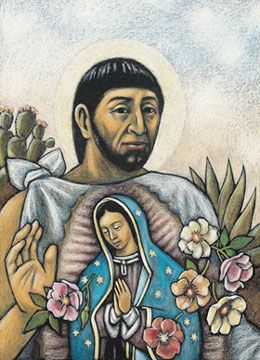
The events of December 9, 1531, occurred during his usual morning walk, when on the crest of Tepeyac Hill (outside Mexico City), the Blessed Virgin Mary appeared to him. Known as Our Lady of Guadalupe (whose feast we celebrate in just 3 days on December 12), Our Lady requested that Juan visit the local bishop and request that a shrine be built in her name. She further promised to pour out her unending grace on those who invoked her. Our Lady talked to Juan in his language, Nahuatl. She called him "Juanito, Juan Dieguito,” "the most humble of my sons,” "my son the least,” and "my little dear.”
Indeed a humble man, Juan obediently visited the bishop, who did not believe the wild tale—especially from a “nobody.” Why would the Blessed Virgin appear to such a simple man? He requested that Juan return with a sign to prove that the apparition was true. Three days later, on December 12 (the Feast of Our Lady of Guadalupe), Juan was again climbing Tepeyac Hill and encountered Our Lady again. She instructed him to climb to the top of the hill and to pick the flowers he would find there. Despite it being wintertime, he obeyed, climbing the hill, finding fragrant roses in blossom. He picked the flowers and carried them to Our Lady. She gently placed them in his mantle (robe) and instructed him to take them to his bishop as proof of his claims and her appearance.
Juan carefully carried the flowers back to the bishop, and miraculously found that when he opened his mantle and the flowers fell to the ground, in their place was an image of the Blessed Mother as she appeared at Tepeyac. The bishop was convinced and ordered a church built for Virgin of Guadalupe, which became a place of pilgrimage for the faithful.
For his part, Juan requested that he be allowed to live in hermitude in a small hut near the chapel that was built to house the miraculous image. Receiving permission from the bishop, he gave up all his worldly possessions and lived his remaining years caring for the church and the pilgrims who visited, venerating the image, and praying for the grace of Mary. Upon his death, he was buried in the chapel of the Virgin of Guadalupe.
Pope John Paul II called Juan “a simple, humble Indian” who accepted Christianity without giving up his identity as an Indian. “In praising the Indian Juan Diego, I want to express to all of you the closeness of the church and the pope, embracing you with love and encouraging you to overcome with hope the difficult times you are going through,” the pope said. Among the thousands present for the event were members of Mexico’s 64 indigenous groups.
Saint Juan Diego reminds us of the universality of the Church, and that the Lord and His Blessed Mother value each of us equally. In the end, as we read the lives of the saints, it becomes clear that race, gender, class, wealth, disability, appearance, culture, sexual orientation—all the things that divide us—are unimportant in the eyes of Lord. Rather, the willingness to open one’s heart, to serve, to embrace the Christian virtues of faith, hope, and charity—to be obedient to the Word of God—these are the things that matter on earth.
From the beatification homily delivered by Pope John Paul II:
At the dawn of Mexican evangelization Saint Juan Diego holds a place all by himself; according to tradition, his indigenous name was Cuauhtlatohuac, “The eagle who speaks”. His lovable figure is inseparable from the Guadalupe event, the miraculous maternal manifestation of the Virgin, Mother of God, both in iconographic and literary memorials as well as in the centuries-old devotion which the Mexican Church has shown for this Indian so loved by Mary. Similar to ancient Biblical personages who were collective representations of all the people, we could say that Juan Diego represents all the indigenous peoples who accepted the Gospel of Jesus, thanks to the maternal aid of Mary, who is always inseparable from the manifestation of her Son and the spread of the Church, as was her presence among the Apostles on the day of Pentecost. The information about him that has reached us praises his Christian virtues: his simple faith, nourished by catechesis and open to the mysteries; his hope and trust in God and in the Virgin; his love, his moral coherence, his unselfishness and evangelical poverty. Living the life of a hermit here near Tepeyac, he was a model of humility. The Virgin chose him from among the most humble as the one to receive that loving and gracious manifestation of hers which is the Guadalupe apparition. Her maternal face and her Saint image which she left us as a priceless gift is a permanent remembrance of this. In this manner she wanted to remain among you as a sign of the communion and unity of all those who were to live together in this land. The recognition of the cult which for centuries has been paid to the layman Juan Diego takes on a special importance. It is a strong call to all the lay faithful of this nation to assume all their responsibilities, for passing on the Gospel message and witnessing to one faith active and working in the sphere of Mexican society. From this privileged spot of Guadalupe, ever-faithful heart of Mexico, I wish to call on all the Mexican laity, to commit themselves more actively to the re-evangelization of society. The lay faithful share in the prophetic, priestly and royal role of Christ (cf. Lumen Gentium, 31), but they carry out this vocation in the ordinary situations of daily life. Their natural and immediate field of action extends to all the areas of human coexistence and to everything that constitutes culture in the widest and fullest sense of the term. As I wrote in the Apostolic Exhortation Christifideles Laici: “In order to achieve their task directed to the Christian animation of the temporal order, in the sense of serving persons and society, the lay faithful are never to relinquish their participation in public life, that is, in the many different economic, social, legislative, administrative and cultural areas, which are intended to promote organically and institutionally the common good” (n. 42). Catholic men and women of Mexico, your Christian vocation is, by its very nature, a vocation to the apostolate (cf. Apostolicam Actuositatem, 3). Therefore, you cannot remain indifferent before the suffering of your brothers and sisters: before the poverty, corruption and outrages committed against the truth and human rights. You must be the salt of the earth and the light of the world (cf. Matthew 5:13-14). Thus the Lord says once more to us today: “Let your light shine before men that they may see your good works and glorify your Father who is in heaven” (Mt 5:16). Juan Diego too shines before you, raised by the Church to the honors of the altar; we can invoke him as the protector and the advocate of the indigenous peoples.”
Prayer to Saint Juan Diego
You who were chosen by Our Lady of Guadalupe as an instrument to show your people and the world that the way of Christianity is one of love, compassion, understanding, values, sacrifices, repentance of our sins, appreciation and respect for God's creation, and most of all one of HUMILITY and obedience. You who we know is now in the Kingdom of the Lord and close to our Mother, be our angel and protect us, stay with us as we struggle in this modern life not knowing most of the time where to set our priorities. Help us to pray to our God to obtain the gifts of the Holy Spirit and use them for the good of humanity and the good of our Church, through the Heart of Our Lady of Guadalupe to the Heart of Jesus. Amen.
Blessed Juan, you faced the skepticism and rejection of a bishop and the crowds to bring Mary's message to Mexico. Pray for us that when we are faced with obstacles to our faith we may show that same courage and commitment. Amen.
Lord God,
hrough Saint Juan Diego
You made known the love of Our Lady of Guadalupe
toward Your people.
Grant by his intercession
that we who follow the counsel of Mary, our Mother,
may strive continually to do Your will.
We ask this through our Lord Jesus Christ, Your Son,
who lives and reigns with You and the Holy Spirit. Amen.
Year 2: Day 343 of 365
Prayer Intentions: Unity within the Church; Humility and Obedience; For all those who are marginalized, maligned, and mistreated.
Requested Intentions: Blessings upon a relationship (M); Sobriety and recovery for a son (M); Employment and successful marriage (A); Employment, healing, freedom from anxiety (T); Financial security (C); Conversion (T); Peace in difficult times at work (E); Financial security and blessings for mother and children (T); Financial security for a mother (M); Health, finances, successful marriage (A); Successful resolution of court case for son (K); Continued sobriety (N); Healing of a chronic health condition (B); Successful employment (A): Peace in a family, recovery of a niece from substance use (L); Blessings on a marriage, healing of a husband (P); For the health and recovery of sisters (B); For a daughter and granddaughter (D); Blessings on overseas employment (M); Healing of mother (L); Successful employment for husband (G); Successful employment, personal fulfillment (C); Health and recovery of ill sister (A); Resolution of legal issues; Grace and protection (E); Successful and meaningful employment (S); Restoration of a marriage (A).
Subscribe to:
Posts (Atom)