Why pray the Rosary every day for a year?


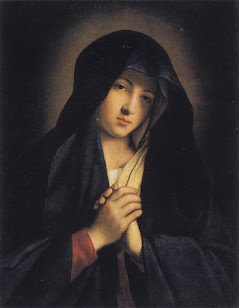
Each time the Blessed Virgin has appeared-- whether it be to Saint Bernadette Soubirous at Lourdes; to Lucia, Jacinta, and Francisco at Fatima; or to Mariette Beco at Banneux-- she has asserted the importance, saving grace, and power of praying the Holy Rosary on a daily basis. Based upon her words, the Rosary is penance and conversion for sinners, a pathway to peace, an end to war, and a powerful act of faith in Jesus Christ. Pope Paul VI presented the Rosary as a powerful means to reach Christ "not merely with Mary but indeed, insofar as this is possible to us, in the same way as Mary, who is certainly the one who thought about Him more than anyone else has ever done."

To show us how this is done, perhaps no one has been more eloquent than the great Cardinal Newman, who wrote: "The great power of the Rosary consists in the fact that it translates the Creed into Prayer. Of course, the Creed is already in a certain sense a prayer and a great act of homage towards God, but the Rosary brings us to meditate again on the great truth of His life and death, and brings this truth close to our hearts. Even Christians, although they know God, usually fear rather than love Him. The strength of the Rosary lies in the particular manner in which it considers these mysteries, since all our thinking about Christ is intertwined with the thought of His Mother, in the relations between Mother and Son; the Holy Family is presented to us, the home in which God lived His infinite love."


As Mary said at Fatima, "Jesus wants to use you to make Me known and loved. He wishes to establish the devotion to My Immaculate Heart throughout the world. I promise salvation to whoever embraces it; these souls will be dear to God, like flowers put by Me to adorn his throne."


February 2, 2013: Saint Joan de Lestonnac

Posted by Jacob


Today, February 2, we celebrate the feast day of Saint Joan de Lestonnac (1556-1640), patron saint of abuse victims, individuals rejected by religious orders, and widows.  Saint Joan is remembered for her steadfast desire to serve the Lord, despite frail health and rejection.  She eventually founded a religious community dedicated to Our Blessed Mother, the Order of the Sisters of the Company of Mary Our Lady, dedicated to “education in the faith and the promotion of justice.”
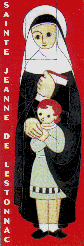
Joan was born in Bordeaux, France in 1556, during the Protestant Reformation sweeping that country at the time.  Joan’s family was affected by these changes, and conflict regarding religion and the upbringing of the children in the faith was no uncommon.  Her mother was a Calvinist, whereas her father held firm to the Catholic teachings and faith. This conflict, Joan later recalled, challenged her to remain steadfast in her Catholic faith and cemented within her a desire to serve the Lord as part of a religious community.
Although she desired nothing more than to devote her life completely to God, her father urged her to marry, and so she did.  At age 17, Joan married Gaston de Montferrand.  A period of sadness and grief followed when her first three children died while still very young.  Later in life, the Lord blessed her with five healthy children, to whom she served as mother, spiritual director, and teacher.  This continued after her husband’s death, when Joan was 40.  Although difficult to raise three children alone, Joan persevered, instructing each in the ways of the faith.

As soon as her five children were grown and capable of caring for themselves, Joan turned her attention to her life-long desire of joining a religious community.  Following a period of serious prayer and discernment, she entered the Cistercian monastery at Toulouse.  However, given that she was 47 at the time, and due to her difficult life and delicate constitution, Joan was unable to successful adapt to the rigorous penance required at the monastery.  She fell gravely ill and was forced to leave after having been only a few days in residence.  Deeply disappointed, Joan prayed to discover God’s will in this latest challenge.
In answer to her prayers, Joan felt called to establish a new religious community.  She returned to Bordeaux, accompanied by several young girls who became her novices.  There, they ministered to victims of the plague and combated the heresies of Calvinism.  Dedicated to Our Blessed Mother, this order was one of the first religious orders with an apostolic dimension for women instituted by the Catholic Church.  At it’s core was the integration and harmonization of social action and contemplation of the faith. 
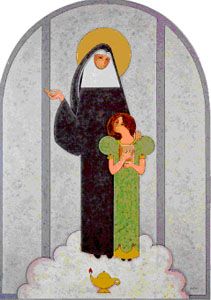
The Order of the Sisters of the Company of Mary Our Lady received papal approval from Pope Paul V in 1607, and soon spread through France.  Joan oversaw the order until her death, in 1640, at the age of 84.  Following her death, many miracles were reported at her tomb.  Her body remains incorrupt to this day.  She was canonized in 1949 by Pope Pius XII.  Today the religious order she founded has over 2,500 sisters spread throughout 17 European countries, Africa, North America, and South America.


Please join me in lifting these intentions to Our Lord, through the intercession of Our Blessed Mother.

Prayer requests, 2013: Week 4:

Blessings and healing upon an aging grandmother (M, USA-NY); Immigration assistance, health and healing, personal intentions, growth of God’s kingdom on earth (A, Philippines); Protection for the homeless, the jobless, and the poor (S, USA-NY); For healing of a husband, protection of a daughter (S, India); Closer relationship with the Lord, healing, blessings upon a family (I, USA-CA); For successful return to work, for blessings upon mother and brother fighting addiction (A, Ireland); Resolution to financial difficulties (J, USA-FL); Health for a husband diagnosed with cancer, financial assistance (A, USA-DE); Healing for a daughter and her boyfriend (A, USA-TN); End to legal difficulties, for religious life, for strength, for approved home improvements (M, USA-TX); For resolution to a difficult family situation; for those who are depressed (G, United Kingdom); For end to health difficulties (S, India); Vocations, financial assistance, healing, repose of souls (H, Philippines); Protection for a family in a difficult situation, healing, strength (M, Ireland); Blessings, wisdom, health, successful employment (L, Romania); Blessings and conversion for a family (M, USA-NE); Successful employment and financial security (G, Canada); Blessings, health, successful pilgrimage, personal intentions (F, India); Reunification of a family (D, USA-MA).

January 18, 2013: Saint Jaime Hilario Barbel, Spanish Educator and Martyr

Posted by Jacob


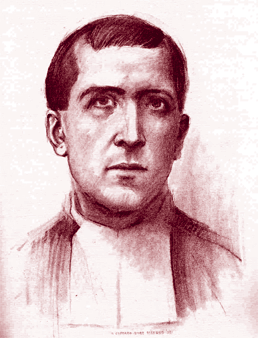
“God be blessed; I'll pray for all of you in heaven. What more could I desire than to die for no other crime but that of being a religious and for having made my contribution to the Christian education of children. Dear father and family, I have been judged and condemned to death. I accept the sentence with joy. No charges have been brought against me. I have been condemned to death only because I am a religious. Do not weep for me, I am not worthy of pity. I shall die for God and for my country. Farewell, I shall be waiting for you in heaven.”  (Saint Jaime Hilario Barbel, writing to his family upon learning his death sentence, prior to his martyrdom)

Today, January 18, we celebrate the feast day of Saint Jaime Hilario Barbel (1898-1937), educator and courageous martyr for the faith.  On the occasion of his canonization, Blessed Pope John Paul II proclaimed, “The ninth Brother, Brother Jaime Hilario Barbel, was from Catalonia and was martyred in 1937 near Tarragona. The Passionist Father had come to the school in Turon in order to hear the children's confessions. The Church is glorifying… [him] because they remained faithful to their consecration even as far as giving their life for the faith and their evangelizing mission. The official recognition of their holiness exalts at the same time their mission - one that we know is delicate and difficult - as Christian educators of youth.”

Manuel Barbal Cosan  was born in Enviny, a town nestled at the foot of the Pyrenees Mountains in northern Spain.  Devout and serious from a young age, his parents were all too pleased to give their blessing when he verbalized his desire to enter the minor seminary at Urgel.  He was only 12!

Sadly, Manuel soon developed hearing problems, which led to the gradual loss of hearing in his ears over the course of his life.  He was advised to leave the seminary, and returned home.  There, he continued his daily prayers and devotions, and looked for alternative ways in which to serve the Lord.  Convinced that he was called to enter the religious life, Manuel was overjoyed to be accepted into the Institute of the Brothers of the Christian Schools in 1917.  Traveling to Irun, Spain, he entered the novitiate and took the name Jaime Hilario.  Brother Jaime spent the next 16 years in various teaching assignments, working with children, and spreading the Word of God.  Working as a catechist and educator, Jaime strongly believed in universal education, especially for the poor and marginalized.   After that time, his hearing loss became too profound to continue as an educator, and instead, he tended the garden at the house of formation in San Jose, Tarragona.  This work he undertook with his usual zeal and effort, finding God in the smallest and most menial of tasks.

In 1936, on a trip to visit his family at Enviny, the Spanish Civil War began.  During the war, religious were actively arrested and persecuted.  Jaime was immediately recognized as a Brother, arrested, and imprisoned.  In December, he was moved to Tarragona, and confined in a prison ship with several other brothers.  There, he did the best he could to keep their spirits up and inspire the group not to lose faith.  Tried in 1937, and offered freedom if he denounced his order and claimed to be only a gardener, Brother Jaime refused, insisting on his identity as a servant of God and brother of the order. 

He was sentenced to execution and brought to the cemetery where it was to occur, known as the Mount of Olives.  On January 18, as he faced down the firing squad, Saint Jaime proclaimed, “To die for Christ, my young friends, is to live.”  The first two volleys of the firing squad failed to wound him, and the soldiers responsible dropped their rifles and fled in panic.  It is said that they purposefully missed, as they feared to harm such a holy and courageous man.  Their commander, however, was not moved, and fired five shots at close range, killing Saint Jaime instantly.  Following his death, over the course of the war, 96 LaSalle Brothers were killed in Catalunia, Spain.  Saint Jaime is the first to be recognized as saint and martyr.

Saint Jaime’s words inspire us today, to listen for, and follow the Lord’s commands, and to dedicate ourselves to him: “The day you learn to surrender yourself totally to God, you will discover a new world, just as I am experiencing. You will enjoy a peace and a calm unknown, surpassing even the happiest days of your life.”

May 11: Blessed Peter the Venerable

Posted by Jacob


Today, May 11, we celebrate the feast day of Blessed Peter the Venerable (also known as Peter of Montboissier, 1092-1156), Abbot of Cluny, and holy man.  Described by his biographer as "A lover of peace he obtained peace in the glory of God on the day of peace."

As described by Pope Benedict XVI in his General Audience (March 2009):

"All who knew him praised his refined meekness, his serene equilibrium, rectitude, loyalty, reasonableness and his special approach to mediation. "It is in my nature" he wrote, "to be particularly inclined to indulgence; I am urged to this by my habit of forgiveness. I am accustomed to toleration and forgiveness." He said further: "With those who hate peace let us always seek to be peacemakers." And he wrote of himself: "I am not the type who is discontented with his lot... whose mind is always tormented by anxiety or doubt and who complains that everyone else is resting while they are the only ones working." With a sensitive and affectionate nature, he could combine love for the Lord with tenderness to his family members, especially his mother, and to his friends. He cultivated friendship, especially with his monks who used to confide in him, certain that they would be heard and understood. According to his biographer's testimony: "he did not look down on anyone and never turned anyone away"; "he appeared friendly to all; in his innate goodness he was open to all." 

Blessed Peter was born into a French noble family, to Blessed Raingarde in Auvergne, France.  At birth, Peter was “Dedicated to the Lord” and given to the monks at the monastery at Sauxillanges to raise.  When he reached the age of consent, at approximatly 17, Peter took his vows and entered the Congregation of Cluny.  Quickly recognized for his holiness and wisdom, Peter was swiftly elevated, assuming a number of important positions, including becoming professor and prior of the monastery of Vézelay at only twenty years of age.  Transferred to the monastery at Domene, he served his congretation and community so well that he was elected general of the order before he reached 30.  As the eighth abbot of Cluny, Peter brought a variety of reforms to the educational system of the order and to its finances.

Representing the order, Peter traveled extensively, going six times to Rome and to England and Spain. When not traveling, Peter spent long periods of time in solitude, praying and studying.  Blessed Peter further sought opportunity to open dialogues between faiths, particularly with Muslims.  He was responsible for the first translation of the Koran into Latin, to allow scholarly discourse on the text with Muslim brethren.  He wrote extensive treatises and letters regarding the scriptures, as well as poems and sermons; his writings reveal a deep knowledge honed by a focus on education, study, and keen insight.

Blessed Peter the Venerable was never formally canonized, but has long been venerated as a holy, beatified church figure. Peter the Venerable died at Cluny on Chrsitmas Day, December 25, 1156, according to his wish.  It is written that he gladly passed from this world "after a sublime sermon to his brethren on the mystery of the day.”

From the Letter of Blessed Peter the Venerable to Heloise:

“To our venerable and dearest sister in Christ, the handmaid of God, Heloise, guide and mistress of the handmaids of God, brother Peter, humble abbot of Cluny: the fullness of God's salvation and of our love in Christ. 

I was happy, very happy, to read the letter from your Sanctity, where I learned that my visit to you was no transitory call, and which made me realize that I have not only been with you, but in spirit have never really left you. My stay, I see, was not one to be remembered as that of a passing guest for a single night, nor was I treated as 'a stranger and a foreigner among you' [Gen.23:4], but as 'a fellow-citizen of God's people and member of God's household' [Ephes.2:19]. Everything I said and did on that fleeting or flying visit of mine has remained so firmly in your holy mind and made such an impression on your gracious spirit that, to say nothing of my carefully-chosen phrases on that occasion, not even a chance, unconsidered word of mine fell to the ground unheeded. You noted all, you committed all to your retentive memory in the warmth of your unbounded sincerity, as if all were the mighty, the heavenly, the sacrosanct words or deeds of Jesus Christ himself. You may have been propmpted to remember them in this way by the injunctions on receiving guests in our common Rule, which belongs to us both: 'Let Christ be worshipped in them, who is received in their persons' [Bened.Rule, 53.7]. Perhaps you were also reminded of the Lord's words concerning those given authority, though I have no authority over you: 'Whoever listens to you listens to me' [Luke 10:16]. 

May I ever be granted this grace from you: that you will think me worthy to be remembered, and will pray for the mercy of the Almighty upon me, along with the holy community of the flock entrusted to your care. I am repaying you now as far as I can, for long before I saw you, and particularly since I have come to know you, I have kept for you in the innermost depths of my heart a special place of real and true affection. I am therefore sending you, now that I have left you, a ratification of the gift of a trental I made you in person, in writing and under seal, as you wished. I am also sending the absolution for Master Peter you asked for, similarly written on parchment and sealed. As soon as I have an opportunity, I will gladly do my best to obtain a prebend in one of the great churches for your Astralabe, who is also ours for your sake. It will not be easy, for the bishops, as I have often found, are apt to show themselves extremely difficult when occasions have arisen for them to give prebends in their churches. But for your sake I will do what I can as soon as I can.”


O God, refuge and surpassing reward
of those who walk blamelessly in Thy presence,
perfect in us, we beseech Thee,
the love of holy religion,
that by the example and intercession of the blessed Abbots of Cluny
we may run with dilated hearts along the way of charity.
Through our Lord Jesus Christ, your Son,
who lives and reigns with Thee in the unity of the Holy Spirit,
God, forever and ever.

May 9: Blessed Mother Maria Theresa von Jesus Gerhardinger

Posted by Jacob


"All the works of God proceed slowly and in pain, but then their roots are the sturdier and their flowering the lovelier."

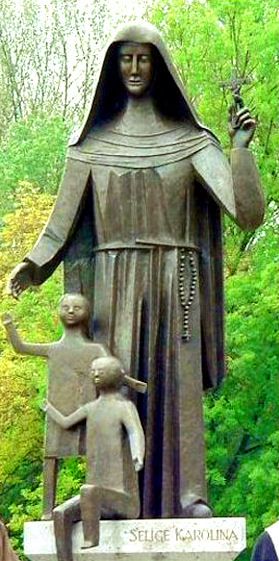
Today, May 9, we celebrate the feast day of Blessed Mother Maria Theresa von Jesus Gerhardinger (1797-1979), the Foundress and First Superior General of the Congregation of the Poor School Sisters of Notre Dame (1833 to 1879).  Blessed Theresa was selected to govern her community at a time when men generally oversaw the spiritual development of religious communities.  Possessing a deep spirit and keen mind, Theresa recognized that the Sisters of Notre Dame required her leadership, and through her guidance, the community spread through Europe, and later the world.  It is written of Blessed Mother Theresa:

"Longing for the oneness of all in God, grounded the congregation in Eucharist, anchored it in poverty, and dedicated it to Mary. A woman of faith, ever seeking God's will, she struggled for unity in our international community and responded to urgent needs, preferring the poor and educating with a world vision. In these gifts of the Spirit to our foundress, Mother Theresa, we recognize the evolving charism of our congregation." (Prologue, You Are Sent, p. 17-18)

Blessed Theresa was born Caroline Gerhardinger, to a working class family in Bavaria.  As a child, she demonstrated a love for the Lord, a gentle spirit, and a concern for others in her parish.  Her parish priest encouraged her to pursue an education, to become a teacher.  Caroline approached this task with a sprititually balanced view, believing strongly that a child's need for love, safety and food were as important as formal education. She wrote, "Let us never forget the love of Jesus for children, whom he took upon his lap and blessed."

Gradually, through her work, Caroline felt drawn to greater service to the Lord.  She received education from the Canonesses of Saint Augustine, until 1809 when all religious orders were closed by decree of the Bavarian government. Caroline was discouraged, but not disheartened, and soon came to realize that she was to found a new religious order, once which would remedy social difficulties through education.  She dedicated her life to assisting the downtrodden, namely women and children, to achieve and succeed through education.  This founding principle was the driving force behind her new order, the Poor School Sisters of Notre Dame.

In 1828, when the Vatican was able to negotiate the reopening of religious communities with the Bavarian government, Caroline and the sisters of her order moved into a refurbished convent.  Caroline took the name Theresa in religious life, and soon became known as Teresa of Jesus due to her devotion to the True Presence of Christ in the Blessed Sacrament. The congregation’s Rule and Constitutions were approved by the Vatican in 1854 and the Order began to quickly spread. While most religious orders of her time were governed by men, she was convinced that a woman could better understand, direct and motivate her sisters.  The Constitution of the School Sisters of Notre Dame, approved by Pope Pius IX in 1865, allowed Mother Theresa and her successors, rather than local bishops, to govern the congregation. Teresa spent the rest of her life devoted to the work.

Under her leadership, the congregation spread across Europe, and later to America following the wave of German immigration.  Within a year, they established a presence in seven US cities.  By the time Blessed Theresa died, the congregation numbered more than 2500 sisters, working in elementary schools, orphanages, industrial schools, nurseries, and Kindergartens. Today, there are over 7500 Poor Sisters of Notre Dame, spread across 825 convents in 31 countries on five continents!

Blessed Theresa once said, "For us education means enabling persons to reach the fullness of their potential as individuals created in God’s image."  We pray today for all those who are deprived of education due to poverty, oppression, or other factors.  We pray for liberation through education, for spiritual growth that comes from freedom, and for grateful hearts for all we have received.

Prayer for Education
Father, we thank You for our children and our lives, they are our heritage. Thank You also Lord for those You have gifted and called to teach our children. We pray for their protection, and we ask You to shield their innocence.

Lord, let Your anointing rest on those who educate. Bless those in school administration with Your wisdom that comes from above and brings peace. Grant them knowledge of Your will and courage to follow after it. We pray that Your name would be exalted above all knowledge that puffs up, and we ask You to establish Your throne in the hearts of all through education. We pray that all would be taught of the Lord and that their peace would be great.

We ask You Lord to cause all peoples to be of excellent spirit, just as Daniel and Joseph were in their day. Holy Spirit, we pray that you would teach us, and help us to remember what you have taught us. Most of all, Lord, we pray that we would learn how to inquire of You and to receive what we need through You. Amen.


Saint John Bosco: "Guiding Principles for Youth Ministry and Parenting"

Posted by Jacob

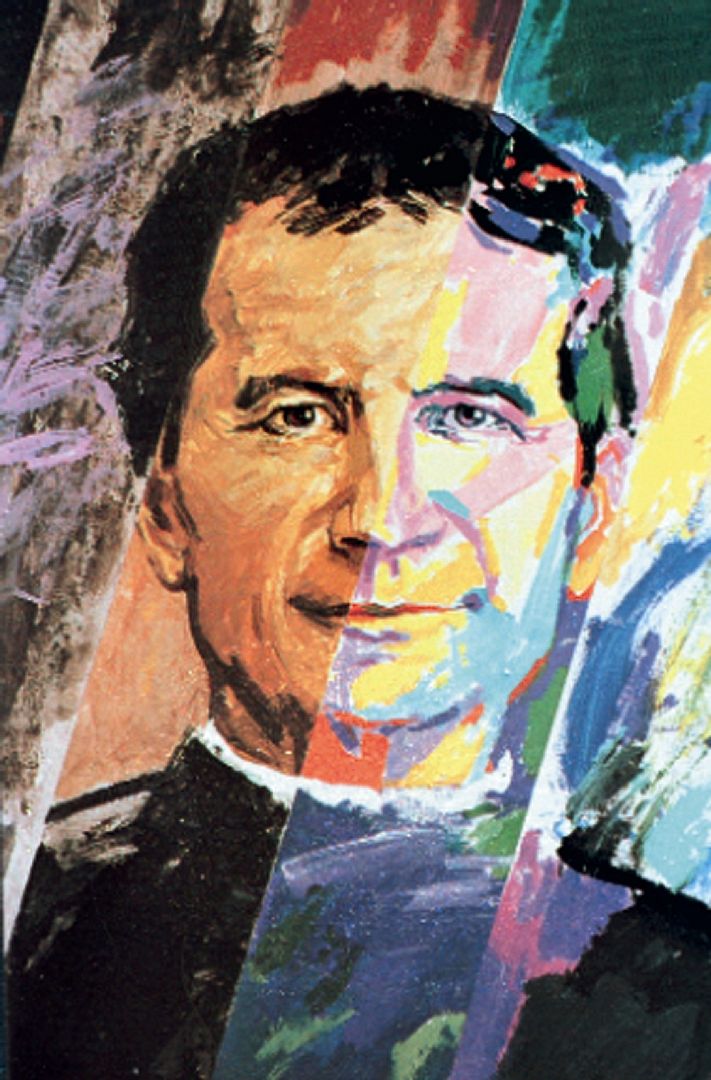
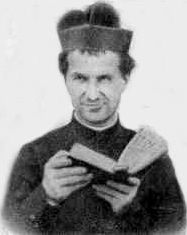
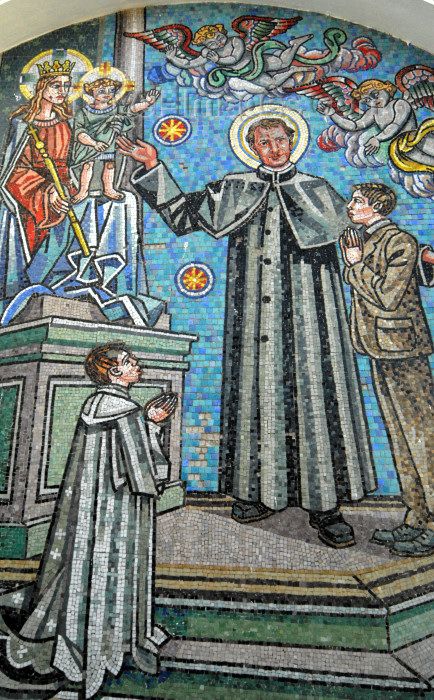
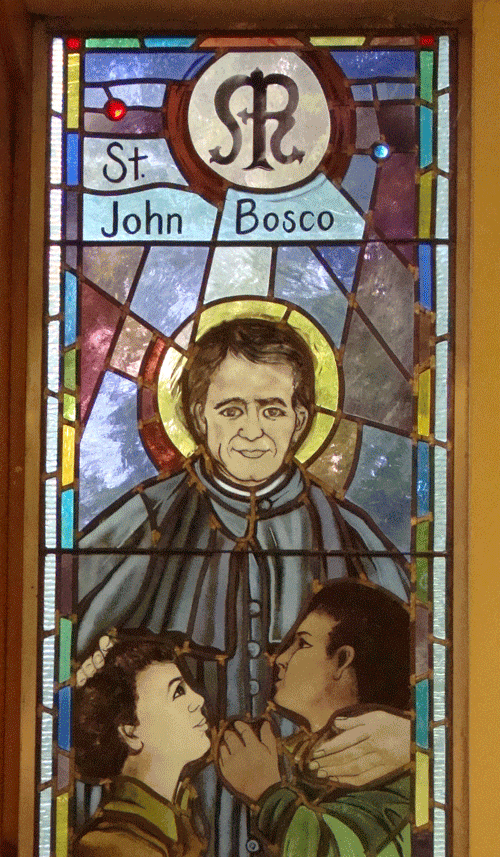
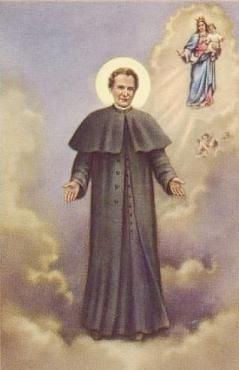
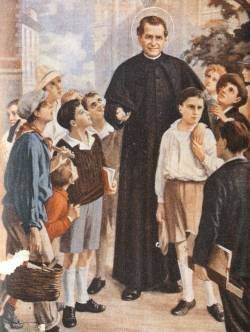
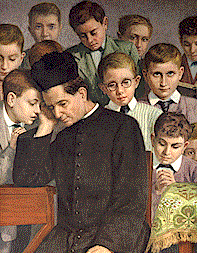
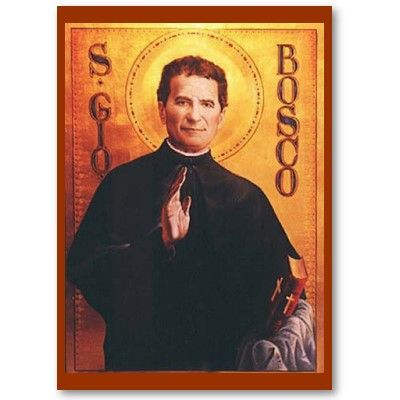
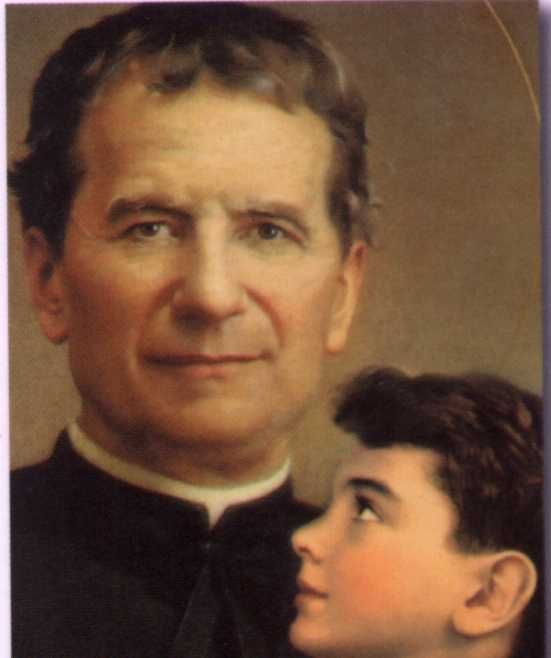
Today, January 31, we celebrate the feast day of Saint John Bosco (1815-1888), Salesians Father, Founder, Confessor, and teacher and patron saint of youth. Saint John worked tirelessly throughout his life to provide education and spiritual instruction to the poor and orphaned children of the world. The orders he founded continue to pursue that mission today. Saint John is remembered for accepting anyone, loving everyone, saying: “A piece of Heaven fixes everything.”

The patron saint of youth, Saint John Bosco spent his life ministering to young people in need of education and religious instruction. Below, an excerpt from one of his letters, providing Guiding Principles for Youth Ministry and Parenting:


First of all, if we wish to appear concerned about the true happiness of our foster children and if we would move them to fulfil their duties, you must never forget that you are taking the place of the parents of these beloved young people. I have always laboured lovingly for them, and carried out my priestly duties with zeal. And the whole Salesian society has done this with me.


My sons, in my long experience very often I had to be convinced of this great truth. It is easier to become angry than to restrain oneself, and to threaten a boy than to persuade him. Yes, indeed, it is more fitting to be persistent in punishing our own impatience and pride than to correct the boys. We must be firm but kind, and be patient with them.


I give you as a model the charity of Paul which he showed to his new converts. They often reduced him to tears and entreaties when he found them lacking docility and even opposing his loving efforts.


See that no one finds you motivated by impetuosity or wilfulness. It is difficult to keep calm when administering punishment, but this must be done if we are to keep ourselves from showing off our authority or spilling out our anger.


Let us regard those boys over whom we have some authority as our own sons. Let us place ourselves in their service. Let us be ashamed to assume an attitude of superiority. Let us not rule over them except for the purpose of serving them better.


This was the method that Jesus used with the apostles. He put up with their ignorance and roughness and even their infidelity. He treated sinners with a kindness and affection that caused some to be shocked, others to be scandalised, and still others to hope for God’s mercy. And so he bade us to be gentle and humble of heart.


They are our sons, and so in correcting their mistakes we must lay aside all anger and restrain it so firmly that it is extinguished entirely.


There must be no hostility in our minds, no contempt in our eyes, no insult on our lips. We must use mercy for the present and have hope for the future, as is fitting for true fathers who are eager for real correction and improvement.


In serious matters it is better to beg God humbly than to send forth a flood of words that will only offend the listeners and have no effect on those who are guilty.

January 31: Saint John Bosco

Posted by Jacob

“Do you want our Lord to give you many graces? Visit him often. Do you want him to give you few graces? Visit him seldom. Visits to the Blessed Sacrament are powerful and indispensable means of overcoming the attacks of the devil. Make frequent visits to Jesus in the Blessed Sacrament and the devil will be powerless against you.”

Today, January 31, we celebrate the feast day of Saint John Bosco (1815-1888), Salesians Father, Founder, Confessor, and teacher and patron saint of youth. Saint John worked tirelessly throughout his life to provide education and spiritual instruction to the poor and orphaned children of the world. The orders he founded continue to pursue that mission today. Saint John is remembered for accepting anyone, loving everyone, saying: “A piece of Heaven fixes everything.”

John was born in Turin, in the Piedmont region of Northern Italy, to a peasant family. His father died when John was only two years old, leaving he and his two brothers in the solitary care of his mother. The family, quite poor, struggled to make ends meet, and John began to work as soon as he was old enough to correctly manipulate tools. He also demonstrated piety and devotion to the Lord from an early age, and professed his wish to become a priest at the age of nine, following a dream. His goal, even from that early age, was to assist youth who suffered in the same manner in which he did. John wished to spread the word of the Gospel, even as a child. He demonstrated great initiative and creativity and learned magic tricks and acrobatics in an attempt to gather an audience so that he could later evangelize and catechize the children and adults of his town. He would begin with a prayer, and while he still had a crows, would often repeat the homily he had heard in church earlier in the week.

His mother approved his wish to become a priest, but to make that happen, John would have to leave home to receive an education in the city. Being larger than his peers, and noticeably more impoverished, John was the constant focus of his classmates’ ridicule and teasing. To pay for his education, John spent his evenings working in whatever capacity he could—as a tailor, cobbler, and a waiter—returning back to his small room to study through the night be candlelight. Upon graduation, he began his studies for the priesthood.

Like most things he set his mind to, John Bosco was ordained a priest at only twenty-six. During his time as a seminarian, he devoted his spare hours to looking after the urchins who roamed the slums of the city. Every Sunday he taught them catechism, supervised their games and entertained them with stories and tricks. He spent weekdays recruiting the roughest and dirtiest he could find, inviting them to the Sunday gatherings. Before long, his kindness had won their confidence, and his “Sunday School” became a ritual with them.

Upon ordination, Saint John immediately sought to formalize his ministry to the poor boys of the city, opening a hospice. When he was unable to secure a building in a “good” section of town, he took one in the slums. This first “oratory” was soon joined by three others, as educators and religious sought to join him in his ministry. His mother joined him as well, serving as housekeeper. Saint John fed and clothed the boys, but also spent long hours providing them with a basic education, and teaching them skills to obtain employment. Within the hospice was a tailoring and shoemaking room, as well as a printing press. Above all, he instructed the boys in the Gospel, modeling by example the life of Jesus Christ, and creating the atmosphere of a Christian family built on trust and love.

Noting the transformation of the youth he ministered to, Don (Father) Bosco began to gather followers to him, who accepted him as their spiritual advisor, leader, and guide. As their number grew, the Salesian Society of priests and lay brothers was formed. Named after Saint Francis de Sales, noted for his gentleness and kindness, Saint John Bosco dedicated this new society to the saint. Saint John traveled to Rome in 1858, and met with Pope Pius IX who encouraged his new religious community. Four years later, he founded an order for women, The Daughters of Mary, Help of Christians, to care for abandoned girls in the same manner.

By 1868, over 800 boys were being cared for in the Salesian oratories. Along with this, Saint John oversaw the writing, printing and distribution countless pamphlets that popularized Catholic teaching and answered the objections of anti-Catholics. Moreover, he was reported to receive supernatural guidance from the Lord, it the form of vivid dreams and visions, many of which he recounted. At times, he was able to predict the deaths of those he was close to, revealed by God, so that he might provide Last Rites. He also received a vivid vision of Hell, which he shared with all he encountered. Saint John is also remembered for working miracles, especially the multiplication of food when funds were short.

Saint John Bosco reformed the manner in which children were educated. Rather than the punitive system which was common at the time, John enacted a preventative system which rejected corporal punishment. By tending to basic needs, educational needs, and spiritual needs, the Salesians sought to put children in an environment which reduced the likelihood to commit sin. He advocated frequent reception of the sacraments of Penance and Holy Communion. He combined catechetical training and fatherly guidance, seeking to unite the spiritual life with his boys’ work, study and play. He is remembered for saying to those he ministered to: "It is enough to know that you are young and abandoned for me to love you very much."

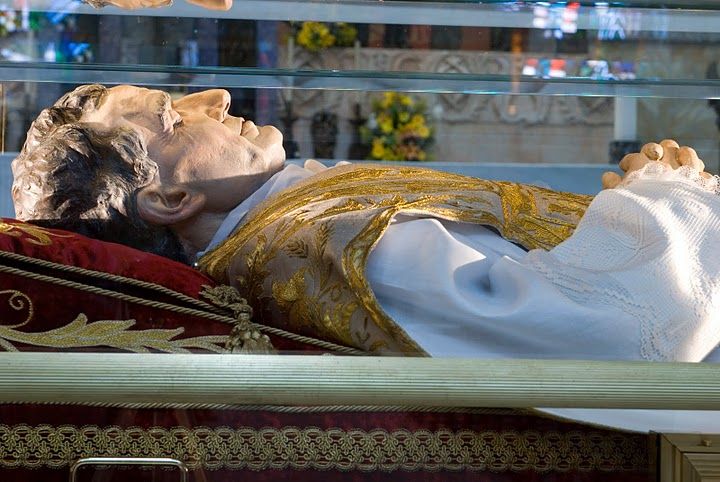
Saint John Bosco died on January 31, 1888. His incorrupt relics are frequently taken on pilgrimage around the world, to visit the faithful. The work begun by Saint John continues today, with thousands dedicated to education youth at risk. The international society of the Salesians of Don Bosco administers over 3,000 schools, colleges, technical schools, and youth centers throughout the world (in 125 countries). All at risk children are served, regardless of religion or social inequalities. The mission of this tireless ministers is to be “signs and bearers of God’s love to the young.”


Saint John Bosco, you reached out to children whom no one cared for despite ridicule and insults. Help us to care less about the laughter of the world and care more about the joy of the Lord. Amen

Admirable apostle of youth, founder of religious Congregations, catechist, educator, writer, and a light that shone brightly in our time, you know that one of the greatest powers today is the power of the Press. Prompt editors to be always truthful and to work for the good of human beings, thus serving the greater glory of God. Amen.


Year 2: Day 30 of 365
Prayer Intentions: To be signs and bearers of God’s love to the young!
Requested Intentions: For a brother who is struggling financially, for a son who is struggling academically (B); For financial security for a friend (C); Success in business; familial happiness and health (J); Health and recovery of a sister (I); Development of a chaste relationship pleasing to the Lord (E); Successful surgery of mother; delivery of daughters’ babies (L); For a friend suffering with depression (M); For a friend entering religious life (R); Success of a parish men’s retreat (H); For a mother who is grieving; for the soul of a dearly departed son (M); Reconciliation of a marriage (M); End to grief after death of son (B&C); End to grief (S); Successful marriage (N); For an RCIA candidate struggling with financial and family stressors (O); Freedom from anxiety regarding medical procedure (J); Return home of an ill mother, peace and financial security (J); Restoration of a marriage; family peace (N); Freedom from persecution (A); For a friend struggling with medical problems and surgery (L); Financial blessings (D); For the success of a project (T); Improved financial stability (A); Improved relationship with business partner (A); For employment (N); Reconciliation of a workplace relationship (R); Healing of son, cousin, and friend (L); Healing of a husband from cancer, end to medical problems (T); Freedom from persecution (E); Successful employment (R); Healing of a father following stroke (S).