Why pray the Rosary every day for a year?


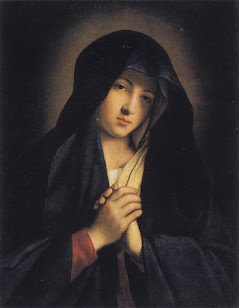
Each time the Blessed Virgin has appeared-- whether it be to Saint Bernadette Soubirous at Lourdes; to Lucia, Jacinta, and Francisco at Fatima; or to Mariette Beco at Banneux-- she has asserted the importance, saving grace, and power of praying the Holy Rosary on a daily basis. Based upon her words, the Rosary is penance and conversion for sinners, a pathway to peace, an end to war, and a powerful act of faith in Jesus Christ. Pope Paul VI presented the Rosary as a powerful means to reach Christ "not merely with Mary but indeed, insofar as this is possible to us, in the same way as Mary, who is certainly the one who thought about Him more than anyone else has ever done."

To show us how this is done, perhaps no one has been more eloquent than the great Cardinal Newman, who wrote: "The great power of the Rosary consists in the fact that it translates the Creed into Prayer. Of course, the Creed is already in a certain sense a prayer and a great act of homage towards God, but the Rosary brings us to meditate again on the great truth of His life and death, and brings this truth close to our hearts. Even Christians, although they know God, usually fear rather than love Him. The strength of the Rosary lies in the particular manner in which it considers these mysteries, since all our thinking about Christ is intertwined with the thought of His Mother, in the relations between Mother and Son; the Holy Family is presented to us, the home in which God lived His infinite love."


As Mary said at Fatima, "Jesus wants to use you to make Me known and loved. He wishes to establish the devotion to My Immaculate Heart throughout the world. I promise salvation to whoever embraces it; these souls will be dear to God, like flowers put by Me to adorn his throne."


July 22, 2013: Saint Mary Magdalene

Posted by Jacob

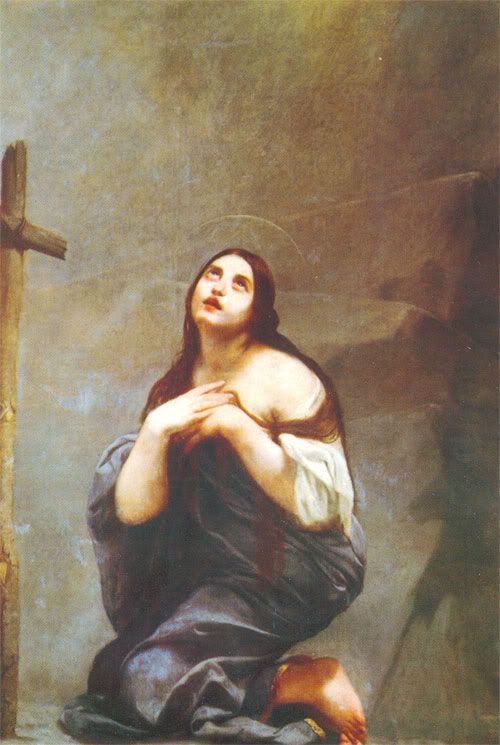
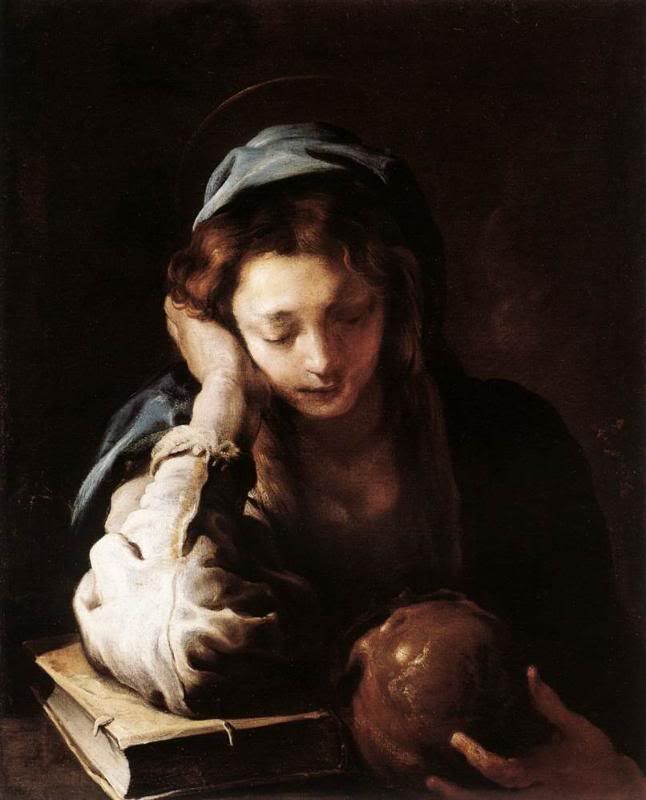
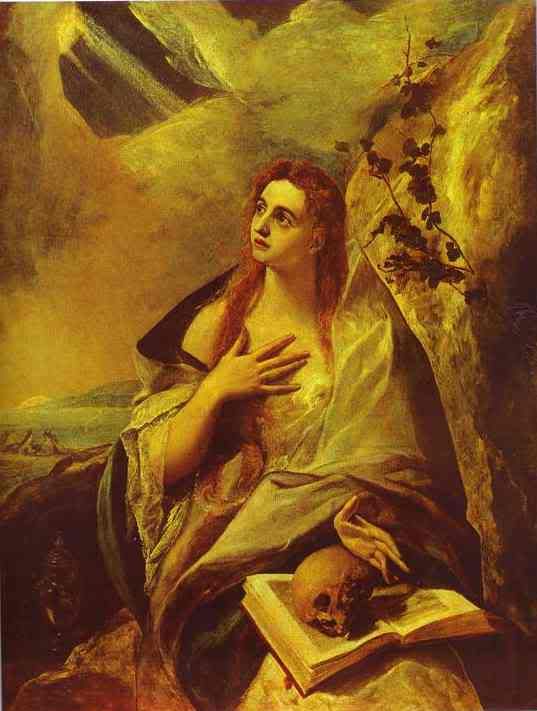
Today, July 22, we celebrate the feast day of Saint Mary Magdalene (dates unknown, first century), friend and disciple of Jesus, honored woman of Scripture, Penitent, and “Apostle of the Apostles.” What we know of the life of this saintly woman comes directly from Scripture:


1After this, Jesus traveled about from one town and village to another, proclaiming the good news of the kingdom of God. The Twelve were with him, 2and also some women who had been cured of evil spirits and diseases: Mary (called Magdalene) from whom seven demons had come out; 3Joanna the wife of Cuza, the manager of Herod's household; Susanna; and many others. These women were helping to support them out of their own means. (Luke 8: 1-3)

From this passage in Luke, we understand that Mary was offering support—possibly financial support, as well as tending to basic needs-- of Jesus and His disciples. She further is described as having been exorcised of seven demons, although some scholars belief this to be a description of illness (mental), rather than an indication of a past sinful life. In either case, it is clear that the grace of the Lord, through the love of Jesus Christ, healed Saint Mary Magdalene.

Despite being mentioned by name in all the Gospels, Biblical scholars are divided on the identity of Mary Magdalene throughout the Bible. In the sixth century, Pope Saint Gregory the Great conflated Mary Magdalene with the nameless woman who washed Christ's feet with her tears (Luke 7:36-50):

36Now one of the Pharisees invited Jesus to have dinner with him, so he went to the Pharisee's house and reclined at the table. 37When a woman who had lived a sinful life in that town learned that Jesus was eating at the Pharisee's house, she brought an alabaster jar of perfume, 38and as she stood behind him at his feet weeping, she began to wet his feet with her tears. Then she wiped them with her hair, kissed them and poured perfume on them.


39When the Pharisee who had invited him saw this, he said to himself, "If this man were a prophet, he would know who is touching him and what kind of woman she is—that she is a sinner."


40Jesus answered him, "Simon, I have something to tell you."


"Tell me, teacher," he said.


41"Two men owed money to a certain moneylender. One owed him five hundred denarii, and the other fifty. 42Neither of them had the money to pay him back, so he canceled the debts of both. Now which of them will love him more?"


43Simon replied, "I suppose the one who had the bigger debt canceled."


"You have judged correctly," Jesus said.


44Then he turned toward the woman and said to Simon, "Do you see this woman? I came into your house. You did not give me any water for my feet, but she wet my feet with her tears and wiped them with her hair. 45You did not give me a kiss, but this woman, from the time I entered, has not stopped kissing my feet. 46You did not put oil on my head, but she has poured perfume on my feet. 47Therefore, I tell you, her many sins have been forgiven—for she loved much. But he who has been forgiven little loves little."


48Then Jesus said to her, "Your sins are forgiven."


49The other guests began to say among themselves, "Who is this who even forgives sins?"


50Jesus said to the woman, "Your faith has saved you; go in peace." (Luke 7: 36-50)

Pope Saint Gregory the Great also identified Mary Magdalene as Mary of Bethany, sister of Martha and Lazarus (Luke 10:38-42):

38As Jesus and his disciples were on their way, he came to a village where a woman named Martha opened her home to him. 39She had a sister called Mary, who sat at the Lord's feet listening to what he said. 40But Martha was distracted by all the preparations that had to be made. She came to him and asked, "Lord, don't you care that my sister has left me to do the work by myself? Tell her to help me!"


41"Martha, Martha," the Lord answered, "you are worried and upset about many things, 42but only one thing is needed. Mary has chosen what is better, and it will not be taken away from her." (Luke 10:38-42)


Combining these Scriptures into the same figure gives the Church, and indeed the faithful, a powerful figure of repentance and spiritual renewal. Saint Mary Magdalene is at once a reformed prostitute—a penitent. She is identified as the first contemplative, sitting at the feet of Christ. She is one of the very few who stayed with Christ at the Crucifixion. And as we know from the Gospel of Saint John, Mary was chosen by the Lord to be the first witness to the Resurrection. For this, she has earned the title: the Apostle to the Apostles.
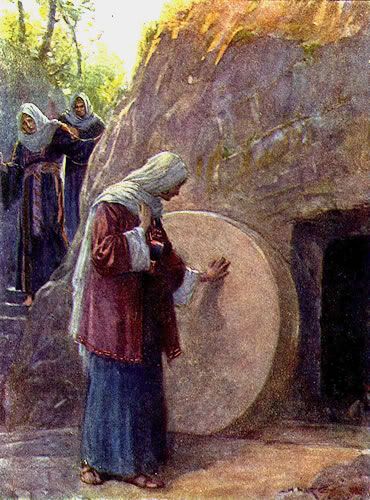
1 Early on the first day of the week, while it was still dark, Mary Magdalene went to the tomb and saw that the stone had been removed from the entrance. 2So she came running to Simon Peter and the other disciple, the one Jesus loved, and said, "They have taken the Lord out of the tomb, and we don't know where they have put him!"


10Then the disciples went back to their homes, 11but Mary stood outside the tomb crying. As she wept, she bent over to look into the tomb 12and saw two angels in white, seated where Jesus' body had been, one at the head and the other at the foot.


13They asked her, "Woman, why are you crying?"


"They have taken my Lord away," she said, "and I don't know where they have put him." 14At this, she turned around and saw Jesus standing there, but she did not realize that it was Jesus.


15"Woman," he said, "why are you crying? Who is it you are looking for?"


Thinking he was the gardener, she said, "Sir, if you have carried him away, tell me where you have put him, and I will get him."


16Jesus said to her, "Mary."


She turned toward him and cried out in Aramaic, "Rabboni!" (which means Teacher).


17Jesus said, "Do not hold on to me, for I have not yet returned to the Father. Go instead to my brothers and tell them, 'I am returning to my Father and your Father, to my God and your God.' "


18Mary Magdalene went to the disciples with the news: "I have seen the Lord!" And she told them that he had said these things to her. (John 20: 1-2; 10-18)


Pope Saint Gregory the Great said of Saint Mary Magdalene in a homily: “When Mary Magdalene came to the tomb and did not find the Lord’s body, she thought it had been taken away and so informed the disciples. After they came and saw the tomb, they too believed what Mary had told them. The text then says: “The disciples went back home,” and it adds: “but Mary wept and remained standing outside the tomb.” We should reflect on Mary’s attitude and the great love she felt for Christ; for though the disciples had left the tomb, she remained. She was still seeking the one she had not found, and while she sought she wept; burning with the fire of love, she longed for him who she thought had been taken away. And so it happened that the woman who stayed behind to seek Christ was the only one to see him. For perseverance is essential to any good deed, as the voice of truth tell us: 'Whoever perseveres to the end will be saved.'”

After Jesus ascended into heaven, Saint Mary Magdalene continued to be a vibrant and powerful witness to the people who knew her of the life transforming power of our Lord, God, and Savior Jesus Christ. She is thought to have worked under both Saints Peter and Paul, in Rome and Ephesus during that time. Tradition holds that fourteen years after Our Lord's death, she was put in a boat by the Jews without sails or oars along with Saints Lazarus and Martha, Saint Maximinus (who had baptized her), Saint. Sidonius ("the man born blind"), her maid Sera, and the body of Saint Anne, the mother of the Blessed Virgin. Per Holy Legend, these holy men and women were sent drifting out to sea and miraculously landed on the shores of Southern France, where Mary spent the rest of her life as a contemplative hermitess in a cave known as Sainte-Baume. She is said to have fasted so rigorously that angels delivered the Holy Eucharist to her as her only sustenance. Reportedly dying at age 72, Saint Mary was transported miraculously by nine angels, just before she died, to the oratory of Saint Maximinus (in Aix), where she received the last sacraments.

The relics of Mary Magdalene were interred in the oratory of Saint Maximinus, and later (approximately 745) translated to Vezelay (to protect them from Saracen invaders). In the thirteenth century, the relics were re-interred at the Dominican convent at the hermitage on La Sainte-Baume. During the French Revolution, the relics were secured in a sarcophagus sent by Pope Clement VIII, and were not re-consecrated until 1814, when the church on La Saint-Baume was restored. In 1822, the grotto at La Saint-Baume was re-consecrated, the head of this holy saint interred at the chapel. La Saint-Baume remains a vibrant center of pilgrimage for the faithful.

Saint Bede asserted that "what Magdalene once did, remains the type of what the whole Church does, and of what every perfect soul must ever do." Saint Mary Magdalene is an example of profound repentance and forgiveness. Her life, explained through the Holy Scriptures, reminds us of the mystery of Christianity—the absolute transition from sinfulness to sanctity possible through the grace of God. We pray today, on the feast of this Apostle of the Apostles, that we may undergo a miraculous transformation in our own lives, washed clean and made holy, repentant and joyful in the light of Christ!


Father,
your Son first entrusted to Mary Magdalene
the joyful news of His resurrection.
By her prayers and example
may we proclaim Christ as our living Lord
and one day see Him in glory,
for he lives and reigns with you and the Holy Spirit,
one God, for ever and ever. Amen.

 
Praise be to Thee, O Christ, Creator, Redeemer, and Savior,Of heaven and earth and seas, of angels and of menWhom we confess to be both God and Man,Who didst come in order to save sinners,Thyself without sin, taking the appearance of sin.


Among this poor flock, Thou didst visit the Canaanite woman and Mary Magdalene.


From the same table Thou didst nourish the one with the crumbs of the Divine Word, the other with Thy inebriating cup.


While Thou art seated at the typical feast in the house of Simon the Leper.


The Pharisee murmurs, while the woman weeps, conscious of her guilt.

The sinner despises his fellow-sinner, Thou, sinless one hearest the prayer of the penitent, cleanses her from stains, lovest her so as to make her beautiful.

She embraces the feet of her Lord, washes them with her tears, dries them with her hair: washing and wiping them, she anoints them with sweet ointment, and covers them with kisses.


Such, O Wisdom of the Father, is the banquet that delights Thee!


Though born of a Virgin, Thou cost not disdain to be touched by a sinful woman.


The Pharisee invited Thee but it is Mary that gives Thee a feast.


Thou forgivest much to her that loves much, and that falls not again into sin.

From seven devils cost Thou free her by Thy sevenfold Spirit.

To her, when Thou risest from the dead, Thou showest Thyself first of all.

By her, O Christ. Thou cost designate the Gentile Church, the stranger whom Thou callest to the children's table;


Who, at the feast of the Law and at the feast of grace, is despised by the pride of Pharisees, and harassed by leprous heresy.


Thou knowest what manner of woman she is, it is because she is a sinner that she touches Thee, and because she longs for pardon.


What could she have, poor sick one, without receiving it, and without the physician assisting her?


O King of kings, rich unto all, save us, wash away all the stains of our sins, O Thou the hope and glory of the saints. Amen.


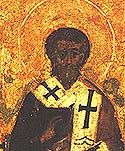
February 16, 2013: Saint Onesimus, the "Saved Slave"

Posted by Jacob


Today, February 16, we celebrate the feast day of Saint Onesimus, the “Saved Slave” (died 68, also know as Saint Onesimus of Byzantium and the Holy Apostle Onesimus).  Saint Onesimus was a slave to Philemon who was converted by Saint Paul. Onesimus had stolen from Philemon, and was forced to flee for safety.  He sought out Saint Paul, who was being held captive in Rome.  There, Saint Paul received him with kindness and love, helping him realize that his theft was wrong.  Not only did Onesimus repent for his crimes, he accepted the Christian faith and was baptized by Saint Paul.

Filled with the Holy Spirit, Onesimus was sent back to Philemon accompanied by a beautiful letter penned by the imprisoned saint.  In Paul’s Epistle to Philemon, he makes a strong case for Philemon to grant Onesimus his freedom, so that he might accompany Paul and preach the Gospel as a disciple. 

1 Paul, a prisoner of Jesus Christ, and Timothy our brother, unto Philemon our dearly beloved, and fellow laborer,
2 And to our beloved Apphia, and Archippus our fellow soldier, and to the church in thy house:
3 Grace to you, and peace, from God our Father and the Lord Jesus Christ.
I thank my God, making mention of thee always in my prayers,
Hearing of thy love and faith, which thou hast toward the Lord Jesus, and toward all saints;
6 That the communication of thy faith may become effectual by the acknowledging of every good thing which is in you in Christ Jesus.
7 For we have great joy and consolation in thy love, because the bowels of the saints are refreshed by thee, brother.
8 Wherefore, though I might be much bold in Christ to enjoin thee that which is convenient,
9 Yet for love's sake I rather beseech thee, being such an one as Paul the aged, and now also a prisoner of Jesus Christ.
10 I beseech thee for my son Onesimus, whom I have begotten in my bonds:
11 Which in time past was to thee unprofitable, but now profitable to thee and to me:
12 Whom I have sent again: thou therefore receive him, that is, mine own bowels:
13 Whom I would have retained with me, that in thy stead he might have ministered unto me in the bonds of the gospel:
14 But without thy mind would I do nothing; that thy benefit should not be as it were of necessity, but willingly.
15 For perhaps he therefore departed for a season, that thou shouldest receive him for ever;
16 Not now as a servant, but above a servant, a brother beloved, specially to me, but how much more unto thee, both in the flesh, and in the Lord?
17 If thou count me therefore a partner, receive him as myself.
18 If he hath wronged thee, or oweth thee ought, put that on mine account;
19 I Paul have written it with mine own hand, I will repay it: albeit I do not say to thee how thou owest unto me even thine own self besides.
20 Yea, brother, let me have joy of thee in the Lord: refresh my bowels in the Lord.
21 Having confidence in thy obedience I wrote unto thee, knowing that thou wilt also do more than I say.
22 But withal prepare me also a lodging: for I trust that through your prayers I shall be given unto you.
23 There salute thee Epaphras, my fellow prisoner in Christ Jesus;
24 Marcus, Aristarchus, Demas, Lucas, my fellow laborers.
25 The grace of our Lord Jesus Christ be with your spirit. Amen.

Philemon, for his part, forgave Onesimus, and he promptly returned to his spiritual father in prison.  Thereafter, he faithfully served Saint Paul, and among his many deeds, bore Paul’s Epistle to the Colossians on its journey of faith.

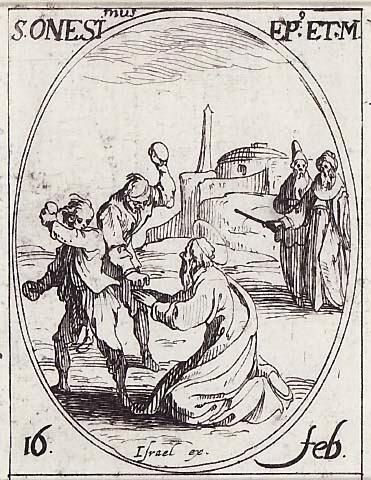
Saint Onesimus, as recorded by Saint Jerome and other Church fathers, became a zealous preacher of the Gospel throughout the region, eventually succeeding Saint Timothy as bishop of Ephesus.  There he preached frequently and ardently, inflamed with love and the Holy Spirit.  His preaching, of course, attracted the attention of the authorities, and during the persecutions under Emperor Trajan, he was arrested and taken in chains to Rome.  There, he was imprisoned for 18 days, during which time he was encouraged to recant his faith.  When he refused, his legs and thighs were broken with bludgeons, and he was subsequently stoned to death.  Following his death, his head was separated from his body with a sword, and local Christians buried him in a silver coffin.

The life of Saint Onesimus is one that holds great lessons for us as Christians.  Paul brings Onesimus to the faith through gentle love and support, coupled with firm teachings grounded in Christian virtue:  to truly become free, one must repent and ask forgiveness for sinful behavior.  And with that freedom, the soul can grow and flourish into a great vehicle of God’s love and grace, illustrated by the life of Onesimus and the many he brought to Christ.


God of liberty, through Saint Paul the Apostle you brought your servant Saint Onesimus to spiritual and temporal freedom; liberate us, we pray, so that we may be equipped to serve you fully.  We ask this through Christ, our Lord and Savior.  Amen.

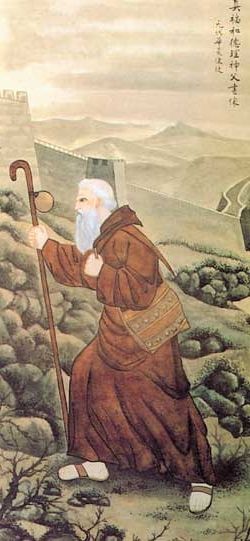
January 11: John the Gardener, Servant of God

Posted by Jacob


Today, January 11, we celebrate the feast day of John the Gardener, Servant of God (died 1501).  We don’t know much about John, with the exception that he was gracious, self-sacrificing, and served others without reserve.  He truly labored in the garden of the Lord, converting many and leading them along the paths of love and Gospel truth.

John’s life was never easy.  He was born into an extremely poor family in Portugal.  While still a child, John was orphaned, and gathered enough food for himself to survive by begging from door to door.  He eventually found work as a shepherd, having walked and begged into neighboring Spain.  Even as a child, whatever he earned from his hard days in the fields, he shared with those more needy than himself. 

In his young adulthood, John encountered two Franciscans while on a journey.  Impressed by his simple kindness, charitable spirit, and joyous disposition (despite what had clearly been a hard life), the friars invited him to come and work at their friary in Salamanca.  John readily accepted and upon arrival was assigned to the garden.  There, he was instructed to assist the brother with gardening duties.  No task was too menial or difficult for John.  He never complained, and instead, found joy in each task.

Before long, John entered the Franciscan Order, committing himself to a rigorous schedule of prayer and meditation, near-constant fasting, and tireless service to the poor.   In addition, he continued to tend the garden, growing the most beautiful flowers for the alter of the Lord, and earning himself the nickname, “the Gardener.”

John was sought out for advice, guidance, and spiritual direction by many, including businessmen, princes, and other important persons.  He was gifted with the gift of prophecy and could read the hearts of men, and therefore offered loving and intimate guidance, leading all toward the goodness of the Lord.  His most frequent advice was for those who sought his help to forgive—even when it was difficult-- as this was a pleasing penance to the Lord.

John predicted his own death, January 11, 1501. His legacy in service and truth reminds us that to be great in the eyes of the Lord we need only love each other, simply and joyously.

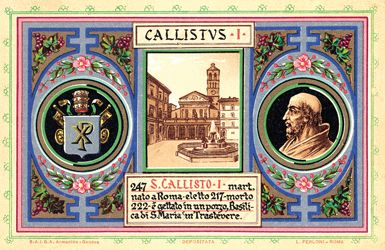
October 14: Pope Saint Callistus I

Posted by Jacob

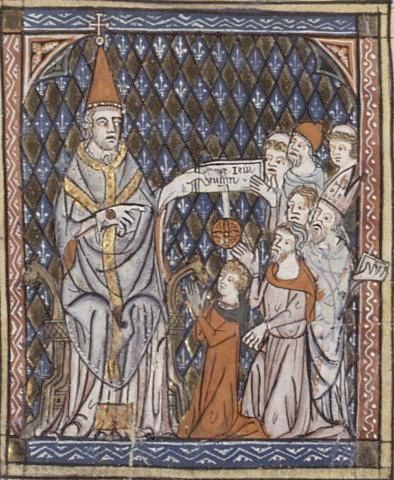
Today, October 14, we celebrate the feast of Saint Callistus I (died 223), Pope, Defender of the Holy Trinity, and Martyr of the Church. As the sixteenth pope, his most important acts were to decree that grave sinners and lapsed Christians – those who folded in the face of martyrdom – were to be allowed to return to Communion after having repented and performed penance. He also decreed that, contrary to Roman law, there were no barriers to marriage between different social classes, and that where Church law and civil law clash, Church law takes precedence. While little is recorded about him in Church records—and those that survive were written by a sworn enemy—many scholars view Pope Saint Callistus I as one of the greatest popes in early Church history.


Callistus was born to a Christian slave owned by Carpophorus, a Christian in the household of Caesar in second-century Rome. He was placed in charge of a Christian bank which went broke after many of the citizens monies were loaned to failed to pay them back. Knowing that he would suffer blame for the bank’s failure, Callistus fled the city, but was caught and returned to his owner. While he wasn’t a thief, he was still sentenced to the treadmill, then later to the tin mines where he slaved many years. Eventually, along with other Christians, he was later ransomed and returned to Rome, becoming a free man. Pope Saint Zephyrinus selected Callistus to oversee the Roman public burial grounds in Rome, today known as the Cemetery of Saint Callistus. He was eventually made a deacon, and then elevated to archdeacon. In this role, Callistus was responsible for the administration of the Church's property, the oversight of clergy, and organization of the burial of martyrs in the catacombs on the Apian Way. During his time, the Church began to build churches, which though destroyed during the various persecutions, were eventually rebuilt.

Eighteen years after having his freedom purchased, Callistus succeeded Zephyrinus as pontiff, the sixteenth pope. As pope he regulated the discipline of the sacrament of penance, ruling that penitent sinners were welcome in church. He defended the faith against the Adoptionist and Modalist heresies regarding the Holy Trinity and the Person of Jesus Christ. Regarding forgiveness of sinners, Pope Callistus, more aligned with the sentiments of Jesus, saw the Church as a place for continuously reclaiming the repentant sinner. He was, on more than one occasion, accused of heresy—especially in regards to his proclamations regarding penance and Communion, and marriage across economic classes. His leadership of the Church put him in conflict with Roman civil law, but he stated that in matters concerning the Church and the sacraments, Church law always trumped civil law. While he had many critics, Pope Saint Callistus I taught what the Church has taught for centuries, including today.

Pope Saint Callistus I is held to have initiated a practice in the Church known as Ember (meaning four times per year) Days, to bring down blessings on each season of the year. Within the liturgical year, the Church designated a group of three days which were set aside for fast and abstinence. This observation occurred four times during the course of the liturgical year. The practice, which was observed for centuries, has since faded.

During the pontificate of Saint Callistus, the reign of Alexander Severus began, who actively engaged in persecution of Christians. Callistus was forced to take shelter in the poor quarters of Rome, hiding from authorities. Calipodius, a priest who would be martyred, appeared to him, saying: “Father, take courage; the hour of the reward is approaching; your crown will be proportionate to your sufferings.” Soon afterwards Callistus was discovered, and the house in which he was hiding was guarded by soldiers who received the order to allow no food to enter it for days. After this initial starvation, Saint Callistus was martyred. With a rock suspended from his neck, he was thrown from a window into a well in 223. His body was recovered by the faithful, and he is entombed in a cemetery along the Via Aurelia.

While we do not know much of Pope Saint Callistus I, it is clear that he embraced the teachings of Christ, was generous and forgiving in dealing with sinners, believed in the principles of copious redemption, and espoused the still-held Church teachings that mercy restores to love. His writings—especially encouraging letters—remain, encouraging us today to look to Christ for instruction in the ways we treat others; to not judge based upon past deeds; to forgive and be merciful as the Lord forgives and is merciful.


God of mercy,
hear the prayers of Your people
that we may be helped by St. Callistus,
whose martyrdom we celebrate with joy.
We ask this through our Lord Jesus Christ Your Son,
who lives and reigns with You and the Holy Spirit,
one God, for ever and ever . Amen.


The First Epistle of Pope Saint Callistus I:


Callistus, archbishop of the Church Catholic in the city of Rome, to Benedictus, our brother and bishop, greeting in the Lord.


By the love of the brotherhood we are bound, and by our apostolic rule we are constrained, to give answer to the inquiries of the brethren, according to what the Lord has given us, and to furnish them with the authority of the seal of the apostles.


I. Fasting, which ye have learned to hold three times in the year among us, we decree now to take place, as more suitable, in four seasons; so that even as the year revolves through four seasons, we too may keep a solemn fast quarterly in the four seasons of the year. And as we are replenished with corn, and wine, and oil for the nourishment of our bodies, so let us be replenished with fasting for the nourishment of our souls, in accordance with the word of the prophet Zechariah, who says,


"The word of the Lord came to me, saying, Thus saith the Lord of hosts, As I thought to punish you, when your fathers provoked me to wrath, and I repented not; so again have I thought in these days to do well unto Jerusalem, and to the house of Judah: fear ye not. These are the things that ye shall do: Speak ye every man the truth to his neighbor; judge the truth and the judgment of peace in your gates; and let none of you imagine evil in your hearts against his neighbor, and love no false oath: for all these are things that I hate, saith the Lord of hosts. And the word of the Lord of hosts came unto me, saying, Thus saith the Lord of hosts, The fast of the fourth month, and the fast of the fifth, and the fast of the seventh, and the fast of the tenth, shall be to the house of the Lord joy and gladness, and cheerful feasts; only love the truth and peace, saith the Lord of hosts."


In this, then, we ought to be all of one mind, so that, according to apostolic teaching, we may all say the same thing, and that there be no divisions among us. Let us then be perfect in the same mind, and in the same judgment; in ready zeal for which work we congratulate ourselves on having your affection as our partner. For it is not meet for the members to be at variance with the head; but, according to the testimony of sacred Scripture, all the members should follow the head. It is matter of doubt, moreover, to no one, that the church of the apostles is the mother of all the churches, from whose ordinances it is not right that you should deviate to any extent. And as the Son of God came to do the Father's will, so shall ye fulfill the will of your mother, which is the Church, the head of which, as has been stated already, is the church of Rome. Wherefore, whatsoever may be done against the discipline of this church, without the decision of justice, cannot on any account be permitted to be held valid.


II. Moreover, let no one take up an accusation against a doctor (teacher), because it is not right for sons to find fault with fathers, nor for slaves to wound their masters. Now, all those whom they instruct are sons of doctors; and as sons ought to love their fathers after the flesh, so ought they to love their spiritual fathers. For he does not live rightly who does not believe rightly, or who reprehends fathers, or calumniates them. Doctors therefore, who are also called fathers, are rather to be borne with than reprehended, unless they err from the true faith. Let no one, consequently, accuse a doctor by writing (per scripta); neither let him answer to any accuser, unless he be one who is trustworthy and recognized by law, and who leads also a life and conversation free from reproach. For it is a thing unworthy that a doctor should reply to a foolish and ignorant person, and one who leads a reprehensible life, according to the man's folly; as Scripture says, Answer not a fool according to his folly. He does not live rightly who does not believe rightly. He means nothing evil who is faithful. If anyone is faithful (a believer), let him see to it that he make no false allegations, nor lay a snare for any man. The faithful man acts always in faith; and the unfaithful man plots cunningly, and strives to work the ruin of those who are faithful, and who live in piety and righteousness, because like seeks like. The unfaithful man is one dead in the living body. And on the other hand, the discourse of the man of faith guards the life of his hearers. For as the Catholic doctor, and especially the priest of the Lord, ought to be involved in no error, so ought he to be wronged by no machination or passion. Holy Scripture indeed says, Go not after thy lusts, but refrain thyself from thine appetites; and we must resist many allurements of this world, and many vanities, in order that the integrity of a true continence may be obtained, whereof the first blemish is pride, the beginning of transgression and the origin of sin; for the mind with lustful will knows neither to abstain nor to give itself to piety. No good man has an enemy except in the wicked, who are permitted to be such only in order that the good man may be corrected or exercised through their means. Whatever, therefore, is faultless is defended by the Church Catholic. Neither for prince, nor for any one who observes piety, is it lawful to venture anything contrary to the divine injunctions. Consequently an unjust judgment, or an unjust decision (diffinitio), instituted or enforced by judges under the fear or by the command of a prince, or any bishop or person of influence, cannot be valid. The religious man ought not to hold it enough merely to refrain from entering into the enmities of others, or increasing them by evil speech, unless he also make it his study to extinguish them by good speech. Better is a humble confession in evil deeds, than a proud boasting in good deeds. Moreover, all who live the blessed life, choose rather to run that course in the proper estate of peace and righteousness, than to involve themselves in the avenging pains of our sins. For I am mindful that I preside over the Church under the name of him whose confession was honored by our Lord Jesus Christ, and whose faith ever destroys all errors. And I understand that I am not at liberty to act otherwise than to expend all my efforts on that cause in which the well-being of the universal Church is at stake (infestatur). I hope, too, that the mercy of God will so favor us, that, with the help of His clemency, every deadly disease may be removed, God Himself expelling it, and that whatever may be done wholesomely, under His inspiration and help, may be accomplished to the praise of thy faith and devotion. For all things cannot otherwise be safe, unless, as far as pertains to the service of the divine office, sacerdotal authority upholds them. Given on the 21st day of November in the consulship of the most illustrious Antoninus and Alexander.


Year 2: Day 287 of 365
Prayer Intentions: Forgiveness; Mercy; Acceptance of all.
Requested Intentions: Successful work placement, continued health (A); Grace and healing for a family (P); Healing of a father (M); Academic success for son, employment for husband and brother (B); Freedom from anxiety and panic attacks (R); Health and healing in preparation for surgery (C); Healing of a chronic illness (P); Safety of a family during storms (A); Successful home ownership (P); Healing of a marriage (M); Employment for a husband, blessings for a marriage (E); Successful examinations for a daughter, healing of a relationships (V); Blessing for a family (V); Healing of baby girl M and all children suffering (M); Special intentions (R); Business success, peace, health (E); Conversion and deliverance of those who suffer, increase in vocations (M); Financial security and safe housing (M); For a daughter (K); Conversion of a family, deliverance of the souls in Purgatory (S); Successful marriage (A); Health, safety, grace, success of a building project (A); Successful treatment and recovery from cancer (D); Clear speech for a child (C); Conversion of a family (A); Successful employment (S); For the healing of impaired vision (F); For a couple experiencing difficulties (L); Successful employment after finishing college (M); Mother’s health (A); Financial security, freedom from anxiety (S).

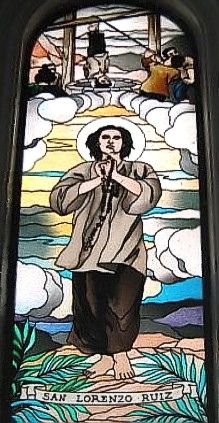
September 28: Saint Lorenzo Ruiz

Posted by Jacob

"That I will never do, because I am a Christian, and I shall die for God, and for him I will give many thousands of lives if I had them. And so, do with me as you please."

(Saint Lorenzo Ruiz, when government officials asked, "If we grant you life, will you renounce your faith?)

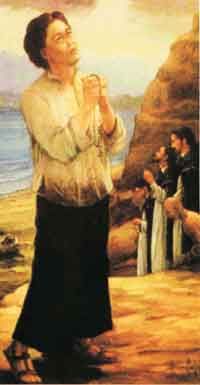
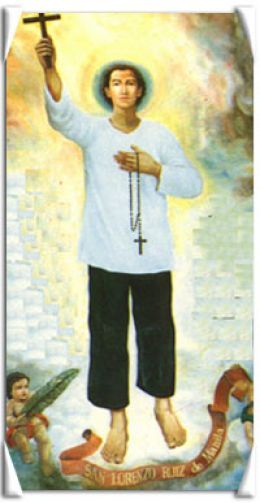
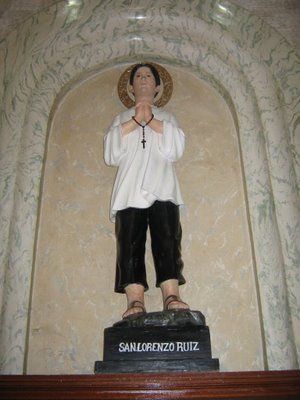
Today, September 28 we celebrate the feast day of Saint Lorenzo Ruiz (1600-1637), Dominican missionary, the first saint of the Philippines, and the first Filipino martyred for the faith. Saint Lorenzo experienced difficulty in his early life, and may have fallen victim to sin. However, he turned to the Lord, realizing it is never too late for forgiveness. He embraced his faith, approached his role as missionary with zeal, and gave his life for the encouragement of others. Pope John Paul II described him as the "most improbable of saints" during his canonization ceremony.

Lorenzo was born in Binondo (Manila), Philippines, the son of a Chinese father and a Filipino mother. As both his parents were Christians, he was raised in the faith, learning both Chinese and Tagalog from his parents, and Spanish from the Dominican friars with whom he served Mass as an altar boy. As he grew, Lorenzo demonstrated constancy and piety, and turned his steady demeanor into profession, transcribing documents in calligraphy.

Lorenzo entered the Confraternity of the Holy Rosary as a Dominican, and from this young age demonstrated a loving devotion to Our Blessed Mother. Well educated and accomplished, he later married and with his wife, produced three children (two sons and one daughter).

Saint Lorenzo’s peaceful life was shattered when he was accused of murder. Little is known about this event, but it is clear that he suffered from his implication in a crime that resulted in the death of a fellow man. It is said in the Dominican record that Lorenzo was sought by the authorities on account of a homicide to which he was present or which was attributed to him."

To avoid the death penalty, which was what surely awaited him, Lorenzo took refuge with a Dominican missionary party which was departing for Japan. Fully aware of the violent persecution that was sweeping across the island country, Lorenzo embraced his chance to work as a missionary for the Lord. Along with Dominican priests Antonio Gonzalez, Guillermo Courtet, and Miguel de Aozaraza, and a Japanese priest, Shiwozuka de la Cruz, the set sail for Okinawa.

Despite having the opportunity to contemplate the difficulties that lie ahead, and to even continue sailing past Japan, Lorenzo disembarked the ship with his companions. It was not long before they were discovered as missionaries, arrested, and tried. Together, the brave martyrs underwent the most horrific of tortures—initially, they were forced to consume large quantities of water, and then through the application of solid boards to their stomachs, their torturers forced the water from their noses and ears, causing incredible pain as well as the sensation of drowning.

The holy men, Lorenzo included, refused to recant their faith, proclaiming the name of the Lord as loudly as they could in such discomfort. After several days of torture—including bamboo needles being inserted under their fingernails—the Dominican superior, Father Antonio, died in agony. Each of the remaining men endured torture, as well as their own moments of spiritual crisis.

Lorenzo, for example, implored of his interpreter, "I would like to know if, by apostatizing, they will spare my life." The interpreter was noncommittal, and as time continued, Lorenzo found himself filled with the Holy Spirit, no longer afraid, and became bold in his proclamations of the Christian faith. Existing documents attest that the Japanese promised him a safe trip back home where he could be reunited with his loved ones, but Ruiz staunchly chose to remain faithful to his religion.

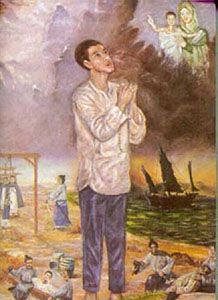
Eventually, the remaining men were martyred, hung upside down in earthen pits. One hung, boards were fitted around their waist, with stones place atop them to increase pressure. They were tightly bound to slow circulation and prevent a speedy death. Lorenzo died after a period of three days. Those left alive were beheaded. Saint Lorenzo’s body was cremated and his ashes thrown into the sea. He and fifteen companions, martyred in the same persecution, were beatified by Pope John Paul II in 1981 and elevated to sainthood in1987 in Rome.

"The Lord gives us saints at the right time and God waited 350 years to give us this saint," Pope John Paul II said of Saint Lorenzo Ruiz. "It is the heroism which he demonstrated as a lay witness to the faith... which is very important in today's world. The witness of San Lorenzo is the testimony we need of courage without measure to show us that it is possible. Faith and life for Lorenzo was synonymous and inseparable. Life without faith would have been without value...he proved that sanctity and heroism are there for anybody and the final victory is made to size for each one of us."


Prayer to St. Lorenzo Ruiz

O MOST MERCIFUL and almighty God,
You bestowed as gift to
Lorenzo Ruiz
The strength to withstand
The overpowering forces of death
For the sake of his faith in You.


Through his prayers,
Help us to follow his example
By overcoming all life's trials
And eventually, increase
Our hope and love in You.


O St. Lorenzo Ruiz,
You brought honor to your country,
Having been a level-headed
And prudent father of the family,
A witness of Christ in your life
Until your death.


We present all our petitions
To God through your help
So that by our actions,
We may know more and love more
Jesus our Lord and Savior.


We humbly implore
Your intercession O dear
St. Lorenzo,
For the infinite glory of God

And in honor of your triumph
As a martyr of Christ
And defender of Christianity.
Amen.


Year 2: Day 271 of 365
Prayer Intentions: Forgiveness; Courage to move past our sins and serve the Lord
Requested Intentions: Business success, peace, health (E); Conversion and deliverance of those who suffer, increase in vocations (M); Financial security and safe housing (M); For a daughter (K); Conversion of a family, deliverance of the souls in Purgatory (S); Successful marriage (A); Health, safety, grace, success of a building project (A); Successful treatment and recovery from cancer (D); Clear speech for a child (C); Conversion of a family (A); Successful employment (S); For the healing of impaired vision (F); For a couple experiencing difficulties (L); Successful employment after finishing college (M); Mother’s health (A); Financial security, freedom from anxiety (S); For a son and cousins (L); Peace and civility (B); Successful examination results (D); Safety of family, strength, courage, wisdom (C); For the souls of a departed father and brother, finding of a suitable marriage partner (R); Successful pilgrimage, deepening of prayer life (R); Restoration of health (J); Restoration of health (S); Freedom from pride (A); For children and marriage (M); For the birth of a healthy baby (Y); For personal family intentions, for the sick, poor, hungry, and homeless (G); Financial security and peace (J); Grace, peace, and obedience to the will of God in a marriage (H); Successful and blessed marriage for sin, freedom from anxiety for husband, spiritual contentedness for family (N); Employment and health for a husband (B); Recovery and health of a mother (J); For a family to grow closer to the Church, salvation for all children (D); Successful employment (L); Successful employment (S); Renewal of faith life (A); Support for an intended marriage, health for friend and aunt (J); Mental health assistance for son (G); Freedom from illness (S); Successful employment (C).

August 14: Saint Maximilian Mary Kolbe

Posted by Jacob

"Hatred is not a creative force: only love is."


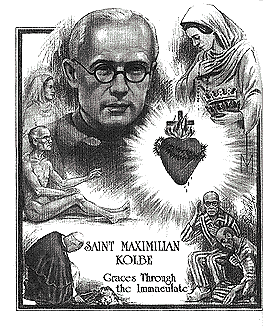
Today, August 15, we celebrate the feast day of Saint Maximilian Mary Kolbe (1894-1941), martyr of the faith, and founder of the Militia of the Immaculata, a group devoted and consecrated to Our Blessed Mother. During his life, Saint Maximilian founded and grew the largest religious community in Europe, assisting those in need, speaking out against the tyranny of war, and aiding thousands of Jews escape persecution during the Second World War. His commitment to the rights and dignity of all, as filtered through his zeal for the Lord and devotion to Mary, allowed him to achieve great works while alive, and the crown of martyrdom in death.

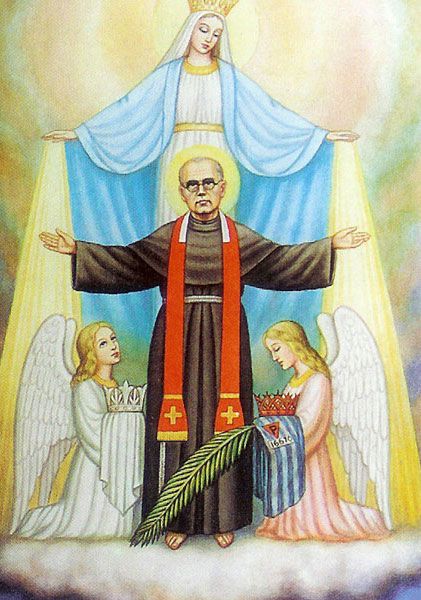
In the words of John Paul II, “Maximilian prepared for this definitive sacrifice by following Christ from the first years of his life in Poland. From these years comes the mysterious vision of two crowns – one white and one red. From these our saint does not choose. He accepts them both. From the years of his youth, in fact, Maximilian was filled with great love of Christ and the desire for martyrdom.”

Born into a poor family in Russian-occupied Poland in 1894, Raymond (his given name) was a boisterous and difficult child. His mother famously—in exasperation—asked of him, “what is going to become of you?” Raymond’s life changed dramatically around the age of 12 when, when he made his First Holy Communion at the Church of the Assumption of Mary. At that time, the young boy was graced with a vision of the Blessed Virgin Mary which was to change his life. In recounting the vision, Raymond said:

“I asked the Mother of God what was to become of me. Then she came to me holding two crowns, one white, the other red. She asked if I was willing to accept either of these crowns. The white one meant that I should persevere in purity, and the red that I should become a martyr. I said that I would accept them both.”

His mother, in her memoirs, wrote of the event:

"I knew ahead of time, based on an extraordinary event that took place in his infancy, that Maximilian would die a martyr. I just don't recall if it took place before or after his first confession. Once I did not like one of his pranks and I reproached him for it: ‘My son, what ever will become of you?!’ Later, I did not think of it again, but I noticed that the boy had changed so radically, he was hardly recognizable. We had a small altar hidden between two dressers before which he used to often retire without being noticed and he would pray there crying. In general, he had a conduct superior to his age, always recollected and serious and when he prayed he would burst into tears. I was worried, thinking he had some sort of illness so I asked him: ‘Is there anything wrong? You should share everything with your mommy!’ Trembling with emotion and with his eyes flooded in tears, he shared: ‘Mama, when you reproached me, I pleaded with the Blessed Mother to tell me what would become of me. At Church I did the same; I prayed the same thing again. So then the Blessed Mother appeared to me holding in her hands two crowns: one white the other red. She looked at me with tenderness and asked me if I wanted these two crowns. The white one signified that I would preserve my purity and the red that I would be a martyr. I answered that I accepted them...(both of them). Then the Virgin Mary looked at me with sweetness and disappeared.’ The extraordinary change in the boys' behavior testified to me the truth of what he related. He was fully conscious and as he spoke to me, with his face radiating; it showed me his desire to die a martyr.”

At age 13, Raymond and his elder brother illegally crossed the border so that they could enter the Franciscan Fathers Seminary in the polish city of Lvov, which was at that time occupied by Austria. There he took the name Maximilian Maria, to demonstrate his love and devotion to the Blessed Mother. He traveled to Krakow and Rome, continuing his studies, earning a doctorate in theology. He completed his religious studies in Rome, and was ordained a priest at age 24.

During his time in Rome, Maximilian witnessed increased opposition to papal authority, and various attacks on the Church from both within and without. Devoted to the Immaculate Conception, he believed that the Church should be more militant in its cooperation with Divine Grace for the advancement of the Catholic Faith. Moved by this devotion and conviction, in 1917 he founded a movement called, "The Militia of the Immaculata" whose members consecrated themselves to the Blessed Virgin Mary and whose purpose would be to fight, through all the morally valid means available, for the building of the Reign of God in the whole world. In his own words, the movement would have "a global vision of catholic life under a new form that consists in a union with the Immaculata.” The means of consecration was accomplished through the Immaculata Prayer, penned by the saint.

The Immaculata friars utilized the most modern printing and administrative techniques in publishing catechetical and devotional tracts, a daily newspaper with a circulation of 230,000 and a monthly magazine, named “Knight of the Immaculata” with a circulation of over one million. This magazine was oriented to promote knowledge, love, and service to the Blessed Mother in the conversion of souls.

Following his ordination, Maximilian returned to a now liberated Poland, and founded the monastery of Niepokalanów near Warsaw, a seminary, a radio station and several other organizations and publications. Niepokalanów became the largest religious community of its time—with nearly 800 brothers living in a “city of the Immaculata.” The monastery and seminary were joined with homes for the poor and sick, a hospital, living quarters, radio station, printing presses and distribution centers, and stores. Among the inhabitants of Niepokalanów were doctors, dentists, farmers, mechanics, tailors, builders, printers, gardeners, shoemakers, cooks. The “city” was entirely self-supporting. Through their work, the people of Poland were converted to Catholicism. Years later, after the war, the Polish bishops sent an official letter to the Holy See claiming that Father Kolbe's magazine had prepared the Polish nation to endure and survive the horrors of the war that was soon to follow.

Saint Maximilian was not content to build only one city for Mary, however. In 1931, after the Pope solicited missionaries, he offered himself as a volunteer to travel to Japan where he founded a new city of the Immaculata ("Mugenzai No Sono") and published in Japanese the magazine, "Knight of the Immaculata" ("Seibo No Kishi"). He further founded a monastery at the outskirts of Nagasaki, which remains prominent in the Roman Catholic Church in Japan. Built on the “wrong side” of a mountain, according to Shinto beliefs, the monastery miraculously survived the atomic bomb blast which devastated Nagasaki during the Second World War. Had he built the monastery on the preferred side of mountain as he was advised, his work and all of his fellow monks would have been destroyed.

Having contracted Tuberculosis as a child, Maximilian was frequently sick as he grew older. His already frail constitution weakened and he was frequently racked by violent headaches and covered with abscesses. He bore his suffering with patient endurance, but could not remain quiet about the approaching war in Europe. He became active as a radio amateur, with Polish call letters SP3RN, vilifying Nazi activities through his reports. The many publications of the Immaculata also spoke out against war and the growing disrespect for human dignity.

When the Germans invaded Poland in September of 1939, Father Kolbe realized that his monastery—like everything else-- would soon be taken over. He sent most of the friars home, warning them not to join the underground resistance, but to preserve their lives for God. Niepokalanów was ransacked, including the monastery where he lived, and Maximilian, accompanied by 40 other friars, were transported to a holding camp in Germany, and later to one in Poland. He is remembered as having said at the moment of arrest: “Courage, my sons. Don’t you see that we are leaving on a mission? They pay our fare in the bargain. What a piece of good luck! The thing to do now is to pray well in order to win as many souls as possible. Let us, then, tell the Blessed Virgin that we are content, and that she can do with us anything she wishes”

The friars were released and allowed to return to the monastery in December of 1939. Niepokalanów became a refugee camp for thousands of Poles and Jews seeking escape from Nazi persecution. The friars shared everything they had with the refugees and the monastery became a universal shelter of brotherhood. For this reason, Father Kolbe and his friars soon came under suspicion by the Gestapo. Furthermore, German citizenship had been extended to Maximilian—as a journalist, publisher, and intellectual of advanced degree. However, he had declined to accept the offer, which infuriated German authorities and roused their suspicions further. To incriminate him, he was permitted one final printing of the "Knight of Mary Immaculate" in December of 1940. It was in this issue that Father Maximilian wrote:

“The real conflict is inner conflict. Beyond armies of occupation and the catacombs of concentration camps, there are two irreconcilable enemies in the depth of every soul: good and evil, sin and love. And what use are victories on the battle-field if we ourselves are defeated in our innermost personal selves?”

Two months later, in February 2941, Father Kolbe was again arrested—this time on charges of aiding Jews and participating in the Polish underground which stood in resistance to the Nazi regime. Maximilian was sent to the infamous Pawiak prison in German-occupied Warsaw, and subsequently to Auschwitz. There, he was given the prison number 16670, and was singled out for special ill treatment.

On June 15, 1941, he managed to write a letter to his mother, which was smuggled out of the camp. It read:

"Dear Mama, At the end of the month of May I was transferred to the camp of Auschwitz. Everything is well in my regard. Be tranquil about me and about my health, because the good God is everywhere and provides for everything with love. It would be well that you do not write to me until you will have received other news from me, because I do not know how long I will stay here. Cordial greetings and kisses, affectionately. Raymond."

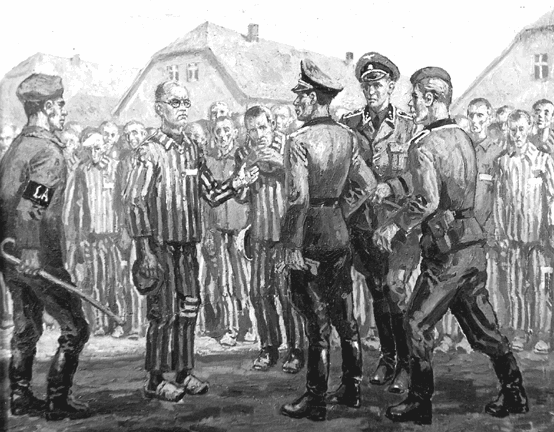
During his time at Auschwitz, Saint Maximilian remained true in his devotion to Our Blessed Mother, doing all that he could to ease the burdens, struggles, and suffering of his fellow prisoners. At night, he moved from bunk to bunk, saying: "I am a Catholic priest. Can I do anything for you?" A prisoner later recalled how he and several other men often crawled across the floor at night to be near the bed of Father Kolbe, to make their confessions and ask for consolation. Father Kolbe pleaded with his fellow prisoners to forgive their persecutors and to overcome evil with good. When he was beaten by the guards, he never cried out. Instead, he prayed for his tormentors.

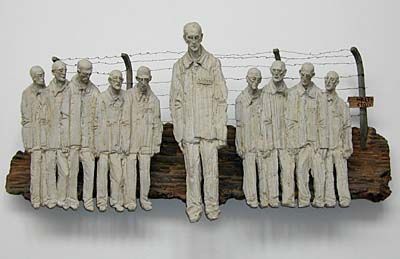
At that time, to discourage escapes, the guards at Auschwitz had a rule that if a man escaped (or attempted to escape), ten men would be killed in retaliation. In July 1941, a man from Kolbe's bunker was believed to have escaped (although it was later discovered that he had drowned in one of the camp latrines). Ten men were selected to die in the most horrific manner—the ten would be placed in a “starvation chamber” where they would suffer without food or drink for two weeks. At the end of that time, if any survived, they would be executed by having carbolic acid injected into their veins.

One of the ten men selected, Franciszek Gajowniczek, sobbed upon being pulled out of formation: "My poor wife. My poor children - what will they do?" Maximilian stepped silently forward, took off his cap, and standing before the commandant, said, "I am a Catholic priest. Let me take his place. I am old. He has a wife and children."

The Nazi commandant asked, "What does this Polish pig want?"

Father Kolbe pointed with his hand to the condemned Franciszek Gajowniczek and repeated "I am a Catholic priest from Poland; I would like to take his place, because he has a wife and children."

Mr. Gajowniczek would later recall:

"I could only thank him with my eyes. I was stunned and could hardly grasp what was going on. The immensity of it: I, the condemned, am to live and someone else willingly and voluntarily offers his life for me - a stranger. Is this some dream?


I was put back into my place without having had time to say anything to Maximilian Kolbe. I was saved. And I owe to him the fact that I could tell you all this. The news quickly spread all round the camp. It was the first and the last time that such an incident happened in the whole history of Auschwitz.


For a long time I felt remorse when I thought of Maximilian. By allowing myself to be saved, I had signed his death warrant. But now, on reflection, I understood that a man like him could not have done otherwise. Perhaps he thought that as a priest his place was beside the condemned men to help them keep hope. In fact he was with them to the to the last.'”

Father Kolbe, along with the other victims, were left to starve in Building 13. Maximilian Kolbe encouraged the others with prayers, psalms, and meditations on the Passion of Christ. After the two weeks, only four remained alive. The cell was needed for more victims so the camp executioner came in and injected a lethal dose of carbolic acid into the left arm of each of the four dying men. Kolbe was the only one still fully conscious. With a prayer on his lips, the last prisoner raised his arm for the executioner.

Bruno Borgowiec, a fellow prisoner assigned to give services to that bunker, gave a personal testimony about Maximilian Kolbe’s death to his parish priest before he died in 1947:

"The ten condemned to death went through terrible days. From the underground cell in which they were shut up there continually arose the echo of prayers and canticles. The man in-charge of emptying the buckets of urine found them always empty. Thirst drove the prisoners to drink the contents. Since they had grown very weak, prayers were now only whispered. At every inspection, when almost all the others were now lying on the floor, Father Kolbe was seen kneeling or standing in the center as he looked cheerfully in the face of the SS men. Father Kolbe never asked for anything and did not complain, rather he encouraged the others, saying that the fugitive might be found and then they would all be freed. One of the SS guards remarked: ‘this priest is really a great man. We have never seen anyone like him.’ Two weeks passed in this way. Meanwhile one after another they died, until only Father Kolbe was left. This the authorities felt was too long. The cell was needed for new victims. So one day they brought in the head of the sick-quarters, a German named Bock, who gave Father Kolbe an injection of carbolic acid in the vein of his left arm. Father Kolbe, with a prayer on his lips, himself gave his arm to the executioner. Unable to watch this I left under the pretext of work to be done. Immediately after the SS men had left I returned to the cell, where I found Father Kolbe leaning in a sitting position against the back wall with his eyes open and his head drooping sideways. His face was calm and radiant."

Father Maximilian Mary Kolbe was 47 years old when he was executed, on the vigil of the Feast of the Assumption of Our Lady. His body was burned in the crematorium on the following day, the Feast of the Assumption. He had stated years earlier: “I would like to be reduced to ashes for the cause of the Immaculata, and may this dust be carried over the whole world, so that nothing would remain.”

Pope John Paul II, in his homily at the canonization of Maximilian Mary Kolbe, proclaimed the character and steadfastness of a man who believed in the supreme value of every human life:

“’Greater Love has no man than this that a man lay down his life for his friends.’ (John 15:13). From today on, the Church desires to address as “Saint” a man who was granted the grace of carrying out these words of the Redeemer in an absolutely literal manner.” For towards the end of July, 1941, when the camp commander ordered the prisoners destined to die of starvation to fall in line, this man-Maximilian Mary Kolbe spontaneously came forward and declared himself ready to go to death in the place of one of them. This readiness was accepted and, after more than two weeks of torment caused by starvation, Father Maximilian’s life was ended with a lethal injection on August 14, 1941.”

The life and works of Saint Maximilian Mary Kolbe are hard to imagine. His suffering and death are remarkable, and impossible to comprehend. They seem as events of the distant past, when in fact these things happened only 70 years ago. Since that time, genocide and other forms of disrespect for the dignity of human lives have continued unabated across the world. Saint Maximilian found his strength through devotion and consecration to Our Blessed Mother—the refuge of sinners, advocate for mankind, mediatrix of grace, and co-redemptrix of the world. Through his love for Mary, he urged aggressive promotion of the love of Christ on earth, to build a kingdom of God. We each are called to action, to confront the evils of the world, and to stand up for the dignity and respect of every human life!


Selected Quotations from Saint Maximilian Mary Kolbe:

"God sends to us the one who personifies his love: Mary, the spouse of the Spirit - a spirit of maternal love - immaculate, all beautiful, spotless, even though she is our sister, a true daughter of the human race."
"Sanctity is not a luxury but it is an obligation, and is not difficult."

“The most deadly poison of our times is indifference. And this happens, although the praise of God should know no limits. Let us strive, therefore, to praise Him to the greatest extent of our powers.”

“For Jesus Christ I am prepared to suffer still more.”
“No one in the world can change truth. What we can do and should do is seek it and serve it when it is found."

"God dwells in our midst, in the Blessed Sacrament of the altar."

"He remains among us until the end of the world. He dwells on so many altars, though so often offended and profaned."

"The culmination of the Mass is not the consecration, but Communion."
"You come to me and unite Yourself intimately to me under the form of nourishment. Your Blood now runs in mine, Your Soul, Incarnate God, co penetrates mine, giving courage and support. What miracles! Who would have ever imagined such!"

"If angels could be jealous of men, they would be so for one reason: Holy Communion."


Gracious God, you filled your priest and martyr, Saint Maximilian Kolbe, with zeal for souls and love for his neighbor. Through the prayer of this devoted servant of Mary Immaculate, grant that in our efforts to serve others for your glory we too may become like Christ your Son, who loved his own in the world even to the end, and now lives and reigns with you and the Holy Spirit, one God, for ever and ever. Amen.


Year 2: Day 226 of 365
Prayer Intentions: Respect for the dignity of all human life.
Requested Intentions: For personal family intentions, for the sick, poor, hungry, and homeless (G); Financial security and peace (J); Grace, peace, and obedience to the will of God in a marriage (H); Successful and blessed marriage for sin, freedom from anxiety for husband, spiritual contentedness for family (N); Employment and health for a husband (B); Recovery and health of a mother (J); For a family to grow closer to the Church, salvation for all children (D); Successful employment (L); Successful employment (S); Renewal of faith life (A); Support for an intended marriage, health for friend and aunt (J); Mental health assistance for son (G); Freedom from illness (S); Successful employment (C); Financial assistance and employment (B); For a family’s intentions (T); Successful examination results (B); Healing of a friend with cancer, for all those who help others (B); Healing and love (L); Grace and healing (V); Healing of a heart, consecration of a marriage (M); Health of a family, intentions of apostolate (H); For repentance (J); For a family in trouble (R); Healing, successful relationships for son, financial success (J); Success of a company (L); For a religious society (J); Healing of a husband, strength as a faithful caregiver (D); Healing of a son (T); Financial security, Healing and guidance (M); Healing of a heart and relationship (V); Employment for daughter (J); For a marriage that glorifies the Lord (K); Resolution of family situation, parents’ health (A); Positive results (C); For a son’s employment, faith, and relationships (S).