Why pray the Rosary every day for a year?


Each time the Blessed Virgin has appeared-- whether it be to Saint Bernadette Soubirous at Lourdes; to Lucia, Jacinta, and Francisco at Fatima; or to Mariette Beco at Banneux-- she has asserted the importance, saving grace, and power of praying the Holy Rosary on a daily basis. Based upon her words, the Rosary is penance and conversion for sinners, a pathway to peace, an end to war, and a powerful act of faith in Jesus Christ. Pope Paul VI presented the Rosary as a powerful means to reach Christ "not merely with Mary but indeed, insofar as this is possible to us, in the same way as Mary, who is certainly the one who thought about Him more than anyone else has ever done."

To show us how this is done, perhaps no one has been more eloquent than the great Cardinal Newman, who wrote: "The great power of the Rosary consists in the fact that it translates the Creed into Prayer. Of course, the Creed is already in a certain sense a prayer and a great act of homage towards God, but the Rosary brings us to meditate again on the great truth of His life and death, and brings this truth close to our hearts. Even Christians, although they know God, usually fear rather than love Him. The strength of the Rosary lies in the particular manner in which it considers these mysteries, since all our thinking about Christ is intertwined with the thought of His Mother, in the relations between Mother and Son; the Holy Family is presented to us, the home in which God lived His infinite love."


As Mary said at Fatima, "Jesus wants to use you to make Me known and loved. He wishes to establish the devotion to My Immaculate Heart throughout the world. I promise salvation to whoever embraces it; these souls will be dear to God, like flowers put by Me to adorn his throne."


March 31, 2013: Easter Sunday: Resurrection, Recognition, Rebirth

Posted by Jacob


Today, Easter Sunday, we celebrate with great joy the Resurrection of Our Lord, Jesus Christ! Alleluia! The Resurrection of the Lord is also the first Glorious Mystery of the Holy Rosary. We can imagine that Our Blessed Mother, Mary, having been foretold of His birth by an angel, conceived of the Holy Spirit, and suffered with Him as he died on the cross, knew that Her Son, Our Lord, was unlike any other. Her heart—the heart of a mother—died with Christ, but like ourselves, was reborn in the Resurrection!


We, like Christ, die a thousand times in sin, rising again in the forgiveness of Our Lord. Monsignor Romano Guardini writes, “This dying and entombing of the old self is a constant process within us through every struggle against evil, through every conquest of self, through every suffering which is bravely borne, through every sacrifice of love and charity. But through this dying of the old self, the resurrection of the new man is also accomplished.” We are reminded on Easter Sunday that our own lives must be those of conversion and resurrection. That our daily pain and struggle against sin brings us closer to the newness of life. After the pain of Good Friday, and the silent waiting of Holy Saturday, we find the love and forgiveness of the Lord on Easter morning.


1On the first day of the week, very early in the morning, the women took the spices they had prepared and went to the tomb. 2They found the stone rolled away from the tomb, 3but when they entered, they did not find the body of the Lord Jesus. 4While they were wondering about this, suddenly two men in clothes that gleamed like lightning stood beside them. 5In their fright the women bowed down with their faces to the ground, but the men said to them, "Why do you look for the living among the dead? 6He is not here; he has risen! Remember how he told you, while he was still with you in Galilee: 7'The Son of Man must be delivered into the hands of sinful men, be crucified and on the third day be raised again.' " 8Then they remembered his words.


9When they came back from the tomb, they told all these things to the Eleven and to all the others. 10It was Mary Magdalene, Joanna, Mary the mother of James, and the others with them who told this to the apostles. 11But they did not believe the women, because their words seemed to them like nonsense. 12Peter, however, got up and ran to the tomb. Bending over, he saw the strips of linen lying by themselves, and he went away, wondering to himself what had happened.

13Now that same day two of them were going to a village called Emmaus, about seven miles from Jerusalem. 14They were talking with each other about everything that had happened. 15As they talked and discussed these things with each other, Jesus himself came up and walked along with them; 16but they were kept from recognizing him.


17He asked them, "What are you discussing together as you walk along?"
They stood still, their faces downcast. 18One of them, named Cleopas, asked him, "Are you only a visitor to Jerusalem and do not know the things that have happened there in these days?"


19"What things?" he asked.

"About Jesus of Nazareth," they replied. "He was a prophet, powerful in word and deed before God and all the people. 20The chief priests and our rulers handed him over to be sentenced to death, and they crucified him; 21but we had hoped that he was the one who was going to redeem Israel. And what is more, it is the third day since all this took place. 22In addition, some of our women amazed us. They went to the tomb early this morning 23but didn't find his body. They came and told us that they had seen a vision of angels, who said he was alive. 24Then some of our companions went to the tomb and found it just as the women had said, but him they did not see."

25He said to them, "How foolish you are, and how slow of heart to believe all that the prophets have spoken! 26Did not the Christ have to suffer these things and then enter his glory?" 27And beginning with Moses and all the Prophets, he explained to them what was said in all the Scriptures concerning himself.

28As they approached the village to which they were going, Jesus acted as if he were going farther. 29But they urged him strongly, "Stay with us, for it is nearly evening; the day is almost over." So he went in to stay with them.
30When he was at the table with them, he took bread, gave thanks, broke it and began to give it to them. 31Then their eyes were opened and they recognized him, and he disappeared from their sight. 32They asked each other, "Were not our hearts burning within us while he talked with us on the road and opened the Scriptures to us?"


33They got up and returned at once to Jerusalem. There they found the Eleven and those with them, assembled together 34and saying, "It is true! The Lord has risen and has appeared to Simon." 35Then the two told what had happened on the way, and how Jesus was recognized by them when he broke the bread. (Luke 24:1-35)

Jesus is risen, just as He told the disciples He would. Of course, they did not quite understand. More interestingly, they didn’t recognize Him. He was mistaken for a traveler and a gardener. He was mistaken for just an ordinary man. And only when He revealed himself, only when the disciples were given reason to search their hearts and view Him with opened eyes, did they perceive the presence of the Lord.

That may be the message of Easter. The Lord resides within each one of us. He resides in you. He resides in me. Through the Resurrection, we are able to find him both within ourselves and within those we come in contact with. And finding Him there, we are called to live lives of His love, peace, and forgiveness—with ourselves, and with all those we come in contact with. During Lent we embrace penance and self-denial. In the newness of Easter, we offer the all-encompassing love, acceptance and forgiveness, first to ourselves (as Christ is there waiting for us in our hearts!) and then to others. Through the Resurrection we are made new, we are changed, we are blessed. Through the Resurrection we are filled with the grace of God and the Holy Spirit. Through the Resurrection we recognize the Lord in our lives, in our bodies, in our neighbors.


Easter Sunday reminds us to have hearts of conversion and transformation. It reminds us that Jesus Christ, Our Lord, is within each of us—all we have to do is recognize Him there. And it reminds us that our beliefs, the very core of our faith, is the Resurrection. Without belief in the Resurrection, we are nothing. But by believing, we become members of the Body of Christ, His Church on earth, and we revel in the promise of everlasting love!


12But if it is preached that Christ has been raised from the dead, how can some of you say that there is no resurrection of the dead? 13If there is no resurrection of the dead, then not even Christ has been raised. 14And if Christ has not been raised, our preaching is useless and so is your faith. 15More than that, we are then found to be false witnesses about God, for we have testified about God that he raised Christ from the dead. But he did not raise him if in fact the dead are not raised. 16For if the dead are not raised, then Christ has not been raised either. 17And if Christ has not been raised, your faith is futile; you are still in your sins. 18Then those also who have fallen asleep in Christ are lost. 19If only for this life we have hope in Christ, we are to be pitied more than all men.


20But Christ has indeed been raised from the dead, the first fruits of those who have fallen asleep. 21For since death came through a man, the resurrection of the dead comes also through a man. (1 Corinthians 15: 12-21)


Alleluia! Alleluia!

March 30, 2013: Holy Saturday: Waiting in Silence

Posted by Jacob

Holy Saturday.

The bleakest of days.

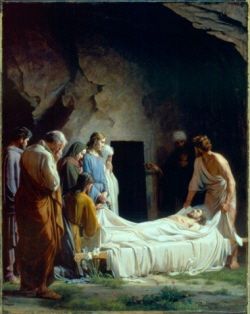
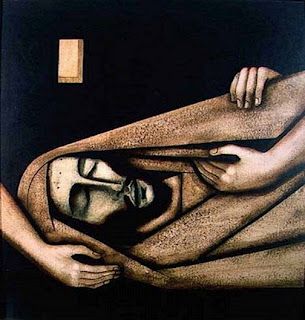
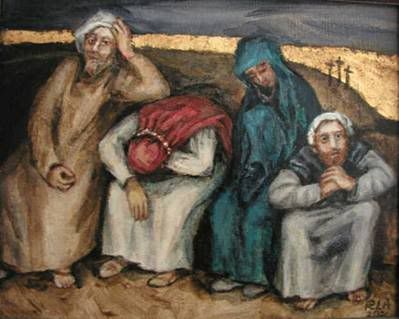
Holy Saturday marks the day after. It is the day that the disciples of Jesus stood in shock, in horror, in guilt, in sadness, in utter desolation. It was a day of mourning, of fear, and of silence-- complete silence, as if the entire world had gone quiet. As if the Lord, Himself, had grown silent.

For the disciples, it was a day of hopelessness. All that they had hoped in, all that they had believed, all that they had expected to come to pass had died on a cross. They were deserted. They didn’t know what would happen next. They were afraid.

And they waited.

The first disciples of Jesus didn’t have the hope-giving knowledge that we do. They didn’t know what was about to transpire, how the world was to be changed forever. It is this knowledge that we have that allows us to continue on, to hope, to look forward to the glorious new day about to dawn.

But the disciples sat in disbelief and grief. They no longer had anything to hope in. They sat in silence, hearts broken, lives shattered.

Today, we know the truth. We know that the Lord answered their silence with the most profound of words- Resurrection. We know that by tomorrow, the tomb will be empty and Jesus will have risen in glorious triumph over death. And yet, like the first disciples, we remain silent all too often in our lives. We lose hope all too often. We despair all too often. We turn away from the promise of Christ all too often.

And on Holy Saturday we are reminded of this. Good Friday reminds us that our loving God died for our sins and saved us. Holy Saturday reminds us that despite this, we lose faith and turn from God every day in small ways. And Easter Sunday reminds us that God continues to love us, regardless of our sins. He is our light in the time of darkness, our comfort in the time of pain, our hope in the time of loneliness, fear, and despair.

Tomorrow, like the disciples of Christ, we will run joyfully to the empty tomb. But today, Holy Saturday, we are called to sit in our pain. We are called to sit in our loneliness, taking final stock of our lives prior to the dawning of Easter. We are called to pause, while the entire world groans in the pain and suffering of uncertainty and loss. We are called to wait, in silence, for the coming of Our Lord.


22We know that the whole creation has been groaning as in the pains of childbirth right up to the present time. 23Not only so, but we ourselves, who have the first fruits of the Spirit, groan inwardly as we wait eagerly for our adoption as sons, the redemption of our bodies. 24For in this hope we were saved. But hope that is seen is no hope at all. Who hopes for what he already has? 25But if we hope for what we do not yet have, we wait for it patiently.


26In the same way, the Spirit helps us in our weakness. We do not know what we ought to pray for, but the Spirit himself intercedes for us with groans that words cannot express. 27And he who searches our hearts knows the mind of the Spirit, because the Spirit intercedes for the saints in accordance with God's will. (Romans 8: 22-27)


March 29, 2013: Seven Last Words:Surrender

Posted by Jacob


In the days leading up to today, Good Friday, I have been meditating on the Seven Last Words of Christ.


Lent is a time of solemn contemplation of the Passion of Christ. We may choose to meditate, contemplate, or pray on His suffering for us. One way in which me might do this is through devotion to His Seven Last Words—the seven final phrases uttered by Christ as recounted in the Gospels. These Seven Last Words of the Passion of Christ are understood only in light of the true one Word of Life and Resurrection—the phrases uttered by Jesus before His death take on new life and new meaning following the glory of His resurrection. We sit with the pain and loss of crucifixion during Lent, but look forward to the brightness of new life on Easter.


The Seven Last Words

1. “Forgive them, for they know not what they do.” (Luke 23:34) (link)
2. “Today you will be with me in Paradise.” (Luke 23:43) (link)
3. “Woman, Behold your Son. Behold your mother.” (John 19:26-27) (link)
4. “My God, my God, why have you forsaken me” (Mark 15:34) (link)
5. “I thirst.” (John 19:29) (link)
6. “It is finished.” (John 19:30) (link)
7. “Father, into your hands I commend my spirit.” (Luke 23:46)


“Father, into your hands I commend my spirit.” (Luke 23:46)

The first four statements of Jesus on the cross fill us with a sense of the beginning of something, the becoming of the kingdom. We start with the fact that we are forgiven, continue to the experience of happiness, of paradise, even today, and recount the rebirth of the family of God, here on earth—all at the foot of the cross! We are left with a profound sense of hope, in spite of the pain and desolation of the crucifixion, and then reminded of the Lord’s unending longing for us. We are, in His love, perfectly unfinished, awaiting His grace to complete us on the last day.

Jesus has been scourged, crowned with thorns, mocked and humiliated. He has carried an unbearably heavy cross up a steep mountain in the blistering heat. He has had his hands and feet nailed to a cross, and has hung upon it for three hours. He has done all of these things willingly, and without complaint. He has done all of these things for us.
And then he says, “Father, into your hands I commend my spirit."
44It was now about the sixth hour, and darkness came over the whole land until the ninth hour, 45for the sun stopped shining. And the curtain of the temple was torn in two. 46Jesus called out with a loud voice, "Father, into your hands I commit my spirit." When he had said this, he breathed his last. (Luke 23: 44-46)

Jesus died as He lived, in complete obedience to His Father. He died in perfect love and perfect trust in His Father. He died with a prayer on His lips, a prayer for His Father:
5 Into your hands I commit my spirit;
redeem me, O LORD, the God of truth. (Psalm 31:5)

We live in a world where we are taught not to trust people, where our anxiety consumes us despite general assurances of safety and comfort. We are doubtful and disobedient. We like to be in control.

Jesus joyful cry on the cross stands in sharp contrast to our daily lives. He was joyful because His work was done, and He was going home to be with His Father. To rest in Him, as He rests in each one of us. It is in His joy, and at such a cost, that the full measure of Jesus’ trust in His Father’s plan, the full measure of Jesus’ obedience to God’s will becomes perfectly clear. He was going home to rest, as His Father willed it.

We are called to that same rest, eventually in eternity, but in our present lives on earth as well. We are slow to give up our control, to lay down our burdens of anxiety, but that is what the Lord wishes us to do. That is what Father Romanus Cessario declares to be “the only option” for living—the perfect commitment to the will of God. We are reminded of this every time we participate in the Holy Eucharist, when the celebrant raises the transformed body and blood of Jesus Christ high above the alter in an act of surrender. And in the moment, we are called to enact that own surrender in our lives.

Jesus gave his life. The world came to a sudden end. And then, after what must have seemed like an eternity, the world was reborn in the Resurrection. He has already suffered through the worst of what could ever possibly happen to the earth. In return, we must trust that our daily trials and tribulations will be met with the same rebirth, the same Easter, the same Resurrection—granted to us by our heavenly Father.

Trust.


Obedience.


Surrender.

For many of us, more difficult words have never been spoken. We wish to remain in control. We forget the gift that obedience to the Lord is—peace, love, rest in Him (and He in us!). As Saint Teresa of Avila said, “ I know the power obedience has of making things easy which seem impossible.”

The Lord has called us to Himself. He has loved us so gladly that He gave His only Son that we might live. He calls us to live for Him, to love Him, to center ourselves in Him, to rest in Him. On this, the holiest day of our year, we surrender. And in surrendering, we are victorious. We gain the unending love, grace, and peace of God Our Father, Our Lord Jesus Christ, and the Holy Spirit. Suddenly, surrender doesn’t seem so bad.


Prayer of Surrender to the Lord (Saint Ignatius of Loyola)
"Take, O Lord, and receive my entire liberty, my memory, my understanding and my whole will. All that I am and all that I possess You have given me. I surrender it all to You to be disposed of according to Your will. Give me only Your love and Your grace; with these I will be rich enough, and will desire nothing more. Amen.


Easter: Resurrection, Redemption, and New Life

Posted by Jacob

Today, Easter Sunday, we celebrate with great joy the Resurrection of Our Lord, Jesus Christ! Alleluia! The Resurrection of the Lord is also the first Glorious Mystery of the Holy Rosary. We can imagine that Our Blessed Mother, Mary, having been foretold of His birth by an angel, conceived of the Holy Spirit, and suffered with Him as he died on the cross, knew that Her Son, Our Lord, was unlike any other. Her heart—the heart of a mother—died with Christ, but like ourselves, was reborn in the Resurrection!


We, like Christ, die a thousand times in sin, rising again in the forgiveness of Our Lord. Monsignor Romano Guardini writes, “This dying and entombing of the old self is a constant process within us through every struggle against evil, through every conquest of self, through every suffering which is bravely borne, through every sacrifice of love and charity. But through this dying of the old self, the resurrection of the new man is also accomplished.” We are reminded on Easter Sunday that our own lives must be those of conversion and resurrection. That our daily pain and struggle against sin brings us closer to the newness of life. After the pain of Good Friday, and the silent waiting of Holy Saturday, we find the love and forgiveness of the Lord on Easter morning.


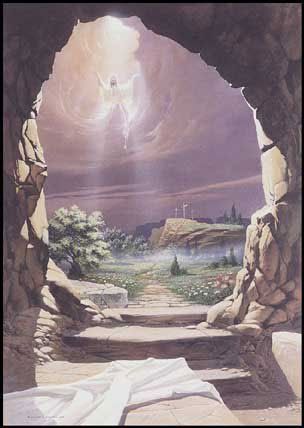
1On the first day of the week, very early in the morning, the women took the spices they had prepared and went to the tomb. 2They found the stone rolled away from the tomb, 3but when they entered, they did not find the body of the Lord Jesus. 4While they were wondering about this, suddenly two men in clothes that gleamed like lightning stood beside them. 5In their fright the women bowed down with their faces to the ground, but the men said to them, "Why do you look for the living among the dead? 6He is not here; he has risen! Remember how he told you, while he was still with you in Galilee: 7'The Son of Man must be delivered into the hands of sinful men, be crucified and on the third day be raised again.' " 8Then they remembered his words.


9When they came back from the tomb, they told all these things to the Eleven and to all the others. 10It was Mary Magdalene, Joanna, Mary the mother of James, and the others with them who told this to the apostles. 11But they did not believe the women, because their words seemed to them like nonsense. 12Peter, however, got up and ran to the tomb. Bending over, he saw the strips of linen lying by themselves, and he went away, wondering to himself what had happened.

13Now that same day two of them were going to a village called Emmaus, about seven miles from Jerusalem. 14They were talking with each other about everything that had happened. 15As they talked and discussed these things with each other, Jesus himself came up and walked along with them; 16but they were kept from recognizing him.


17He asked them, "What are you discussing together as you walk along?"
They stood still, their faces downcast. 18One of them, named Cleopas, asked him, "Are you only a visitor to Jerusalem and do not know the things that have happened there in these days?"


19"What things?" he asked.

"About Jesus of Nazareth," they replied. "He was a prophet, powerful in word and deed before God and all the people. 20The chief priests and our rulers handed him over to be sentenced to death, and they crucified him; 21but we had hoped that he was the one who was going to redeem Israel. And what is more, it is the third day since all this took place. 22In addition, some of our women amazed us. They went to the tomb early this morning 23but didn't find his body. They came and told us that they had seen a vision of angels, who said he was alive. 24Then some of our companions went to the tomb and found it just as the women had said, but him they did not see."

25He said to them, "How foolish you are, and how slow of heart to believe all that the prophets have spoken! 26Did not the Christ have to suffer these things and then enter his glory?" 27And beginning with Moses and all the Prophets, he explained to them what was said in all the Scriptures concerning himself.

28As they approached the village to which they were going, Jesus acted as if he were going farther. 29But they urged him strongly, "Stay with us, for it is nearly evening; the day is almost over." So he went in to stay with them.
30When he was at the table with them, he took bread, gave thanks, broke it and began to give it to them. 31Then their eyes were opened and they recognized him, and he disappeared from their sight. 32They asked each other, "Were not our hearts burning within us while he talked with us on the road and opened the Scriptures to us?"


33They got up and returned at once to Jerusalem. There they found the Eleven and those with them, assembled together 34and saying, "It is true! The Lord has risen and has appeared to Simon." 35Then the two told what had happened on the way, and how Jesus was recognized by them when he broke the bread. (Luke 24:1-35)

Jesus is risen, just as He told the disciples He would. Of course, they did not quite understand. More interestingly, they didn’t recognize Him. He was mistaken for a traveler and a gardener. He was mistaken for just an ordinary man. And only when He revealed himself, only when the disciples were given reason to search their hearts and view Him with opened eyes, did they perceive the presence of the Lord.

That may be the message of Easter. The Lord resides within each one of us. He resides in you. He resides in me. Through the Resurrection, we are able to find him both within ourselves and within those we come in contact with. And finding Him there, we are called to live lives of His love, peace, and forgiveness—with ourselves, and with all those we come in contact with. During Lent we embrace penance and self-denial. In the newness of Easter, we offer the all-encompassing love, acceptance and forgiveness, first to ourselves (as Christ is there waiting for us in our hearts!) and then to others. Through the Resurrection we are made new, we are changed, we are blessed. Through the Resurrection we are filled with the grace of God and the Holy Spirit. Through the Resurrection we recognize the Lord in our lives, in our bodies, in our neighbors.


Easter Sunday reminds us to have hearts of conversion and transformation. It reminds us that Jesus Christ, Our Lord, is within each of us—all we have to do is recognize Him there. And it reminds us that our beliefs, the very core of our faith, is the Resurrection. Without belief in the Resurrection, we are nothing. But by believing, we become members of the Body of Christ, His Church on earth, and we revel in the promise of everlasting love!


12But if it is preached that Christ has been raised from the dead, how can some of you say that there is no resurrection of the dead? 13If there is no resurrection of the dead, then not even Christ has been raised. 14And if Christ has not been raised, our preaching is useless and so is your faith. 15More than that, we are then found to be false witnesses about God, for we have testified about God that he raised Christ from the dead. But he did not raise him if in fact the dead are not raised. 16For if the dead are not raised, then Christ has not been raised either. 17And if Christ has not been raised, your faith is futile; you are still in your sins. 18Then those also who have fallen asleep in Christ are lost. 19If only for this life we have hope in Christ, we are to be pitied more than all men.


20But Christ has indeed been raised from the dead, the first fruits of those who have fallen asleep. 21For since death came through a man, the resurrection of the dead comes also through a man. (1 Corinthians 15: 12-21)


Alleluia! Alleluia!


He is not here! He is risen from the grave. Alleluia!

Posted by Jacob


He is not here!
He is risen from the grave.
Alleluia!

Wishing you all a Blessed and Joy-filled Easter!

"Sepulcher:" A Poem for Holy Saturday

Posted by Jacob


“SEPULCHER” 
 George Herbert

Oh blessed body!  Whither art thou thrown?
No lodging for thee, but a cold hard stone?
So many hearts on earth, and yet not one
                                      Receive thee?


Sure there is room within our hearts good store;
For they can lodge transgressions by the score:
Thousands of trifling things dwell there, yet out of door
                                      They leave thee.

But that which shows them large, shows them unfit.
Whatever sin did this pure rock commit,
Which holds thee now?   Who hath indicted it
                                      Of murder?

Where our hard hearts have took up stones to brain thee,
And missing this, most falsely did arraign thee;
Only these stones in quiet entertain thee,
                                      And order.

And as of old, the law by heav’nly art,
Was writ in stone;  so thou, which also art
The letter of the word, find’st no fit heart
                                      To hold thee.

Yet do we still persist as we began,
And so should perish, but that nothing can,
Though it be cold, hard, foul, from loving man
                                      Withhold thee.


Holy Saturday: Waiting in Silence

Posted by Jacob

Holy Saturday.

The bleakest of days.

Holy Saturday marks the day after. It is the day that the disciples of Jesus stood in shock, in horror, in guilt, in sadness, in utter desolation. It was a day of mourning, of fear, and of silence-- complete silence, as if the entire world had gone quiet. As if the Lord, Himself, had grown silent.

For the disciples, it was a day of hopelessness. All that they had hoped in, all that they had believed, all that they had expected to come to pass had died on a cross. They were deserted. They didn’t know what would happen next. They were afraid.

And they waited.

The first disciples of Jesus didn’t have the hope-giving knowledge that we do. They didn’t know what was about to transpire, how the world was to be changed forever. It is this knowledge that we have that allows us to continue on, to hope, to look forward to the glorious new day about to dawn.

But the disciples sat in disbelief and grief. They no longer had anything to hope in. They sat in silence, hearts broken, lives shattered.

Today, we know the truth. We know that the Lord answered their silence with the most profound of words- Resurrection. We know that by tomorrow, the tomb will be empty and Jesus will have risen in glorious triumph over death. And yet, like the first disciples, we remain silent all too often in our lives. We lose hope all too often. We despair all too often. We turn away from the promise of Christ all too often.

And on Holy Saturday we are reminded of this. Good Friday reminds us that our loving God died for our sins and saved us. Holy Saturday reminds us that despite this, we lose faith and turn from God every day in small ways. And Easter Sunday reminds us that God continues to love us, regardless of our sins. He is our light in the time of darkness, our comfort in the time of pain, our hope in the time of loneliness, fear, and despair.

Tomorrow, like the disciples of Christ, we will run joyfully to the empty tomb. But today, Holy Saturday, we are called to sit in our pain. We are called to sit in our loneliness, taking final stock of our lives prior to the dawning of Easter. We are called to pause, while the entire world groans in the pain and suffering of uncertainty and loss. We are called to wait, in silence, for the coming of Our Lord.


22We know that the whole creation has been groaning as in the pains of childbirth right up to the present time. 23Not only so, but we ourselves, who have the first fruits of the Spirit, groan inwardly as we wait eagerly for our adoption as sons, the redemption of our bodies. 24For in this hope we were saved. But hope that is seen is no hope at all. Who hopes for what he already has? 25But if we hope for what we do not yet have, we wait for it patiently.


26In the same way, the Spirit helps us in our weakness. We do not know what we ought to pray for, but the Spirit himself intercedes for us with groans that words cannot express. 27And he who searches our hearts knows the mind of the Spirit, because the Spirit intercedes for the saints in accordance with God's will. (Romans 8: 22-27)


The Fifth Sorrowful Mystery: The Crucifixion of Our Lord

Posted by Jacob

Today, Good Friday, Jesus continues His steady march toward death, bringing us ever closer to forgiveness and new life. On the eve of His suffering, Holy Thursday, Jesus had celebrated the Passover with His disciples, and then taken Peter, James, and John with Him to the garden of Gethsemane. There, He prayed in agony until His arrest.


Jesus has been tried and condemned to death. He has been mocked and painfully scourged. He has endured the humiliation of a mock coronation, designed to make Him less than human, but only succeeding in elevating His divinity. He has carried our burdens on the long way of pain to Golgotha.

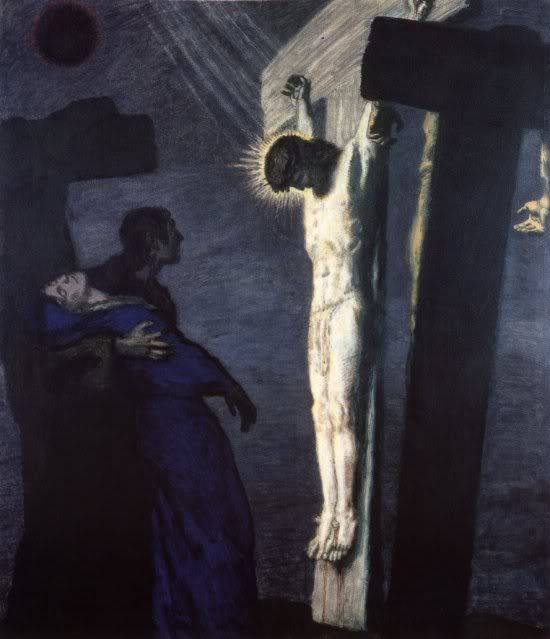
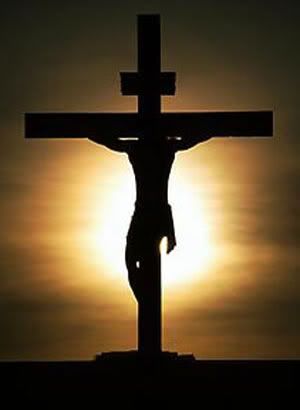
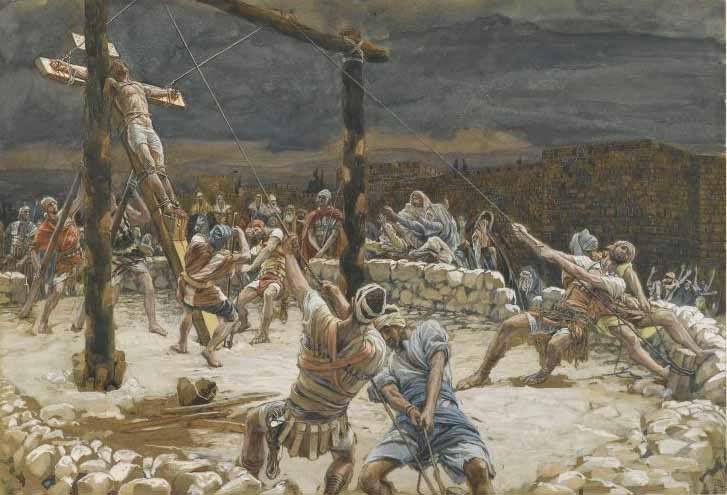
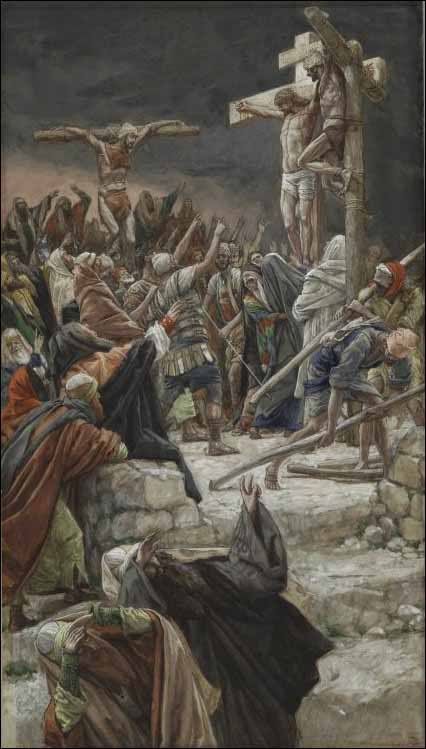
And then Our Lord was crucified.  The Fifth Sorrowful Mystery of the Holy Rosary.


28Later, knowing that all was now completed, and so that the Scripture would be fulfilled, Jesus said, "I am thirsty." 29A jar of wine vinegar was there, so they soaked a sponge in it, put the sponge on a stalk of the hyssop plant, and lifted it to Jesus' lips. 30When he had received the drink, Jesus said, "It is finished." With that, he bowed his head and gave up his spirit.


31Now it was the day of Preparation, and the next day was to be a special Sabbath. Because the Jews did not want the bodies left on the crosses during the Sabbath, they asked Pilate to have the legs broken and the bodies taken down. 32The soldiers therefore came and broke the legs of the first man who had been crucified with Jesus, and then those of the other. 33But when they came to Jesus and found that he was already dead, they did not break his legs. 34Instead, one of the soldiers pierced Jesus' side with a spear, bringing a sudden flow of blood and water. 35The man who saw it has given testimony, and his testimony is true. He knows that he tells the truth, and he testifies so that you also may believe. 36These things happened so that the scripture would be fulfilled: "Not one of his bones will be broken,"37and, as another scripture says, "They will look on the one they have pierced." (John 19: 28-37)

Over the course of this Lenten season, I have meditated on the Seven Last Words of Christ, which has taken me through the moments of His crucifixion. And I have addressed the pain, the sorrow, the torture, and the agony in those posts, all portions of the crucifixion that can not be forgotten. As I write this post, I feel it nearly impossible to summarize my thoughts, but feel drawn not to the sadness of the cross, but to the gift that it holds for each of us.

Jesus, in the moments leading up to His death—a death which He clearly died for us—is still thinking of others. He comforts His mother and the disciple whom He loved, he offers redemption to the “good thief,” He draws us all to Himself in His suffering, reaching into the darkest void of sin and death, and converting it to an unending well of grace. In His death, Jesus creates a new world, a reborn world, a world where sin no longer has the power it usurped in the Garden of Eden.

And as the world is reborn, so, too are we. We are freed from the burdens of sin that we carry in our own personal Via Delarosa. We need only look within ourselves, contemplating our own suffering, and we see the joyful sacrifice of the Lord on the cross—He who suffered for us, did so willingly, freely, joyfully. He ransomed us from slavery.

He set us free.


The Fourth Sorrowful Mystery: The Way of the Cross

Posted by Jacob

Today, Good Friday, Jesus continues His steady march toward death, bringing us ever closer to forgiveness and new life. On the eve of His suffering, Holy Thursday, Jesus had celebrated the Passover with His disciples, and then taken Peter, James, and John with Him to the garden of Gethsemane. There, He prayed in agony until His arrest.


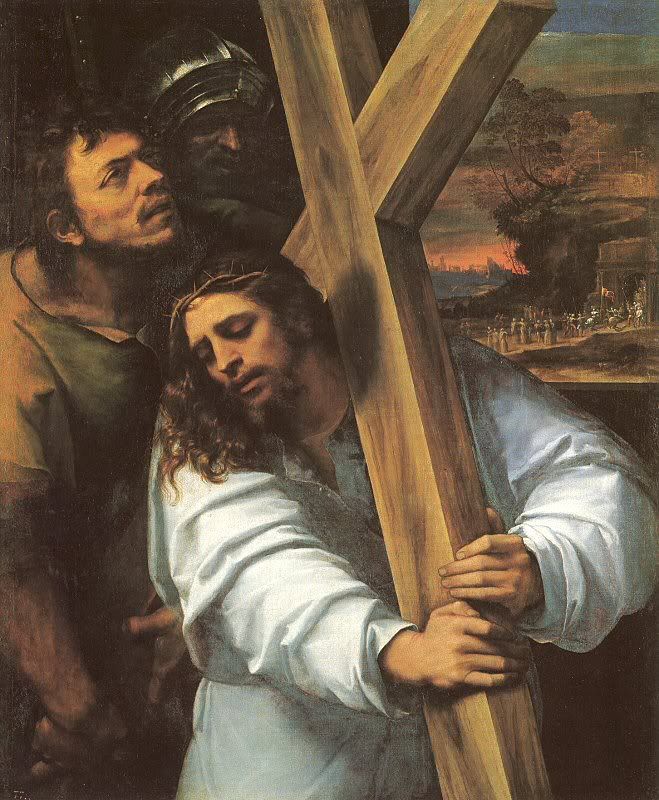
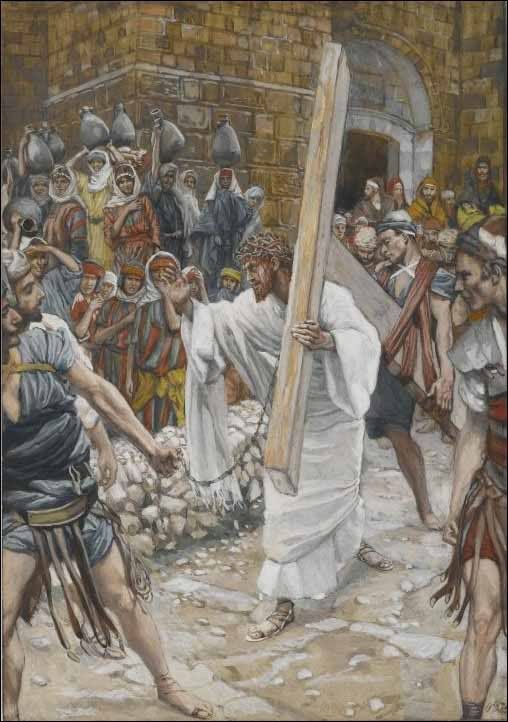
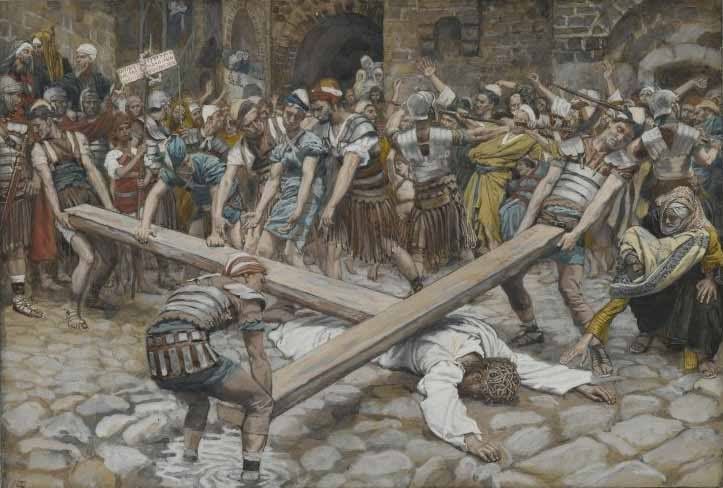
Jesus has been tried and condemned to death. He has been mocked and painfully scourged. He has endured the humiliation of a mock coronation, designed to make Him less than human, but only succeeding in elevating His divinity. And now, He must endure the Way of the Cross, the Fourth Sorrowful Mystery of the Holy Rosary.


16Finally Pilate handed him over to them to be crucified.
So the soldiers took charge of Jesus. 17Carrying his own cross, he went out to the place of the Skull (which in Aramaic is called Golgotha). (John 19: 16-17)


Saint Luke, in his Gospel, tells us a bit more about Jesus' journey along the Via Delarosa.
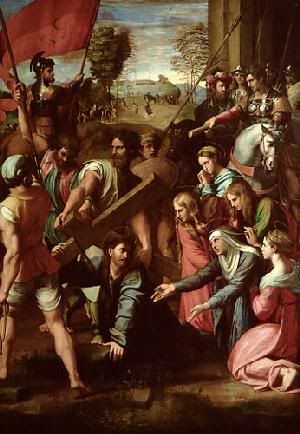
26As they led him away, they seized Simon from Cyrene, who was on his way in from the country, and put the cross on him and made him carry it behind Jesus. 27A large number of people followed him, including women who mourned and wailed for him. 28Jesus turned and said to them, "Daughters of Jerusalem, do not weep for me; weep for yourselves and for your children. 29For the time will come when you will say, 'Blessed are the barren women, the wombs that never bore and the breasts that never nursed!' 30Then " 'they will say to the mountains, "Fall on us!"
and to the hills, "Cover us!"’ 31For if men do these things when the tree is green, what will happen when it is dry?" (Luke 19: 26-31)

The Way of the Cross, The Way of Sadness, the Via Delarosa.

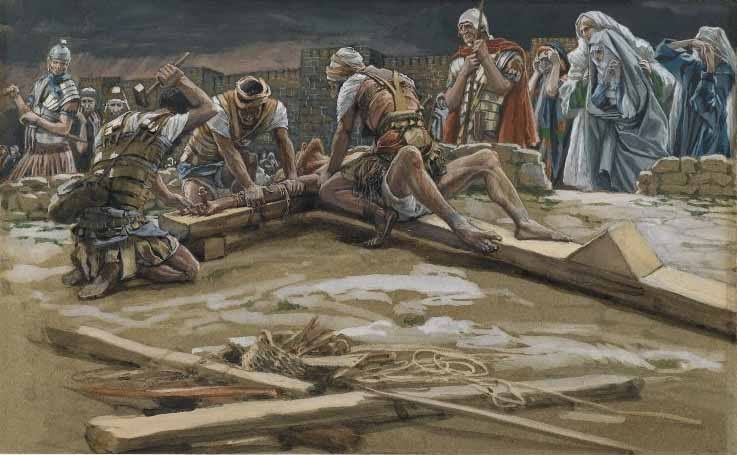
Jesus, taking upon Himself all the sins of the world, all the sadness and pain of those around Him, climbs to Golgotha. His burden is enormous—not the crossbar of the cross, which physically would have been too heavy for Him following the vicious scourging, but the spiritual and emotional burden he bore for us. Everything that Jesus carried up that hill, surrounded by the triumphant Romans, observed by the confused citizens, was marked by the stain of sin—rendered cumbersome, unwieldy, heavy. Too heavy for us. But not too heavy for He who loved us.

We can’t even begin to imagine the heaviness of His burden, or the heaviness of His steps. Each step brought Him closer to His final torment, His final torture, His human death. But each step also brought Him closer to the completion of His mission of love and forgiveness for us. This is clear, that even in the midst of the shadow of pain and sin that hung over Him on his long walk to the cross, He is thinking of us. Jesus stops to comfort the women of Jerusalem. “Weep not for me,” He says, “But for yourselves and your children.” He is predicting the final judgment. He is still, on His way to His death, calling those He is sacrificing for to repentance-- just as He continues to call us to repentance today.

Luke tells us in his Gospel that Jesus had some help. A man from the crowd, who theologians tell us becomes a respected elder in the earliest Christian church along with his sons following the crucifixion, is conscripted to assist Jesus. He lightens the load of Christ in a physical way, even if for just a moment. We are called to do the same for others, in our daily lives. And in doing for others, we are doing for Jesus.


The footsteps of Christ are heavy… And for us, we too dread the final steps of His journey to Golgotha. We walk with Him, on the streets of Jerusalem that are wet with His blood. We know what awaits Him. And we know what awaits us on Good Friday.

And then the hopelessness, desolation, and waiting of Holy Saturday.

But through our faith, through the love that the Lord has for us, we also know what awaits us on Easter morning. Even as we prepare for the horror of the crucifixion, we set our eyes firmly on the dawn of forgiveness, for that is the only thing that gives us the strength to continue on.