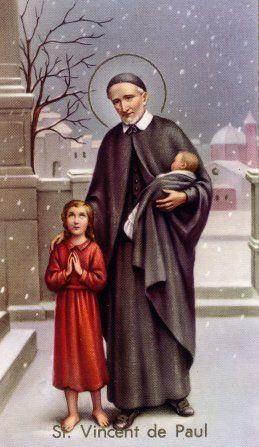
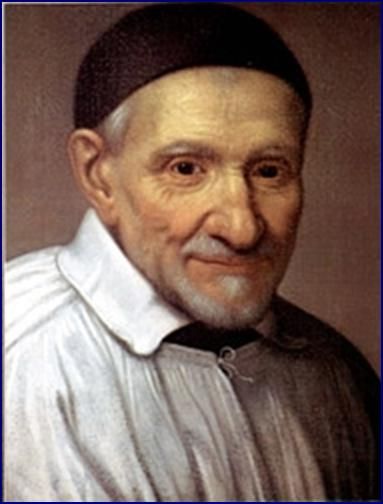
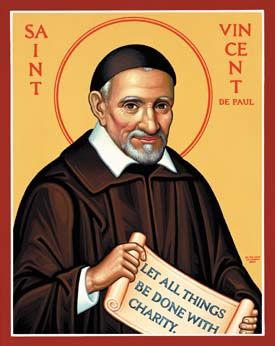
Today, September 27, we celebrate the feast day of Saint Vincent de Paul (1581-1660), founder of the Congregation of the Mission, and servant to his fellow man. Saint Vincent is a model of Christian charity, caring for all, and revolutionizing the mission work of the Church. Truly modeling his life on that of Christ, Saint Vincent placed himself at the feet of the poor, assisting in their need, but more importantly, recognizing the sanctity and dignity of every human life.
Below, from the excerpts of the writings of Saint Vincent De Paul, “To Serve the Poor is to Serve Jesus.”
Even though the poor are often rough and unrefined, we must not judge them from external appearances nor from the mental gifts they seem to have received. On the contrary, if you consider the poor in the light of faith, then you will observe that they are taking the place of the Son of God who chose to be poor.
Although in his passion he almost lost the appearance of a man and was considered a fool by the Gentiles and a stumbling block by the Jews, he showed them that his mission was to preach to the poor: He sent me to preach the good news to the poor. We also ought to have this same spirit and imitate Christ’s actions, that is, we must take care of the poor, console them, help them, support their cause.
Since Christ willed to be born poor, he chose for himself disciples who were poor. He made himself the servant of the poor and shared their poverty. He went so far as to say that he would consider every deed which either helps or harms the poor as done for or against himself. Since God surely loves the poor, he also loves those who love the poor. For when one person holds another dear, he also includes in his affection anyone who loves or serves the one he loves. That is why we hope that God will love us for the sake of the poor. So when we visit the poor and needy, we try to understand the poor and weak. We sympathise with them so fully that we can echo Paul’s words: I have become all things to all men.
Therefore, we must try to be stirred by our neighbors’ worries and distress. We must beg God to pour into our hearts sentiments of pity and compassion and to fill them again and again with these dispositions.
It is our duty to prefer the service of the poor to everything else and to offer such service as quickly as possible. If a needy person requires medicine or other help during prayer time, do whatever has to be done with peace of mind. Offer the deed to God as your prayer. Do not become upset or feel guilty because you interrupted your prayer to serve the poor. God is not neglected if you leave him for such service. One of God’s works is merely interrupted so that another can be carried out. So when you leave prayer to serve some poor person, remember that this very service is performed for God. Charity is certainly greater than any rule. Moreover, all rules must lead to charity. Since she is a noble mistress, we must do whatever she commands. With renewed devotion, then, we must serve the poor, especially outcasts and beggars. They have been given to us as our masters and patrons.
Why pray the Rosary every day for a year?
Each time the Blessed Virgin has appeared-- whether it be to Saint Bernadette Soubirous at Lourdes; to Lucia, Jacinta, and Francisco at Fatima; or to Mariette Beco at Banneux-- she has asserted the importance, saving grace, and power of praying the Holy Rosary on a daily basis. Based upon her words, the Rosary is penance and conversion for sinners, a pathway to peace, an end to war, and a powerful act of faith in Jesus Christ. Pope Paul VI presented the Rosary as a powerful means to reach Christ "not merely with Mary but indeed, insofar as this is possible to us, in the same way as Mary, who is certainly the one who thought about Him more than anyone else has ever done."
To show us how this is done, perhaps no one has been more eloquent than the great Cardinal Newman, who wrote: "The great power of the Rosary consists in the fact that it translates the Creed into Prayer. Of course, the Creed is already in a certain sense a prayer and a great act of homage towards God, but the Rosary brings us to meditate again on the great truth of His life and death, and brings this truth close to our hearts. Even Christians, although they know God, usually fear rather than love Him. The strength of the Rosary lies in the particular manner in which it considers these mysteries, since all our thinking about Christ is intertwined with the thought of His Mother, in the relations between Mother and Son; the Holy Family is presented to us, the home in which God lived His infinite love."
As Mary said at Fatima, "Jesus wants to use you to make Me known and loved. He wishes to establish the devotion to My Immaculate Heart throughout the world. I promise salvation to whoever embraces it; these souls will be dear to God, like flowers put by Me to adorn his throne."
Today, September 27, we celebrate the feast day of Saint Vincent de Paul (1581-1660), founder of the Congregation of the Mission, and servant to his fellow man. Saint Vincent is a model of Christian charity, caring for all, and revolutionizing the mission work of the Church. Truly modeling his life on that of Christ, Saint Vincent placed himself at the feet of the poor, assisting in their need, but more importantly, recognizing the sanctity and dignity of every human life.
Saint Vincent was born into a peasant farming family in Pouy, France. A highly intelligent youth, he excelled at academics, and sought the priesthood primarily for social advancement and monetary gain. At that time, escaping the peasant life was difficult, and entering a religious order was one of the only manners in which to change one’s station in life.
Vincent spent four years with the Franciscan friars in Acq, France, and excelled at his education. He supported himself through tutoring the children of the wealthy, and was ordained a priest at the young age of 19. Shortly thereafter, he was captured by Turkish pirates, and sold into slavery, where he remained for several years. He eventually converted one of his owners to Christianity, and later escaped.
Returning to France, Vincent was assigned to a small parish. Having begun his ministry with less than pure intentions and motives, the Lord sought to change Vincent’s heart. Spending time with those who lived in poverty, with little education, Vincent was shocked to discover how his fellow man was being forced to live. He was able to empathize with them, given his own imprisonment. Moreover, he learned how little that his congregation knew of their faith, and began preaching the importance of confession and repentance.
He believed in the virtue of action and he loved to use this succinct motto: “Action is our entire task.” He would then add that “Perfection does not come from ecstasy but rather from doing the will of God.” However, he recommended long prayer and meditation before action so that one could come to recognize the divine will. Above all, this man of action was a man of prayer and deep spirituality: “You must have an inner life, everything must tend in that direction. If you lack this, you lack everything.”
Selected Quotations of Saint Vincent de Paul:
However great the work that God may achieve by an individual, he must not indulge in self-satisfaction. He ought rather to be all the more humbled, seeing himself merely as a tool which God has made use of.
The Church teaches us that mercy belongs to God. Let us implore Him to bestow on us the spirit of mercy and compassion, so that we are filled with it and may never lose it. Only consider how much we ourselves are in need of mercy.
Extend your mercy towards others, so that there can be no one in need whom you meet without helping. For what hope is there for us if God should withdraw His Mercy from us?
Free your mind from all that troubles you; God will take care of things. You will be unable to make haste in this (choice) without, so to speak, grieving the heart of God, because he sees that you do not honor him sufficiently with holy trust. Trust in him, I beg you, and you will have the fulfillment of what your heart desires.
Human nature grows tired of always doing the same thing, and it is God’s will that this because of the opportunity of practicing two great virtues. The first is perseverance, which will bring us to our goal. The other is steadfastness, which overcomes the difficulties on the way.
We should strive to keep our hearts open to the sufferings and wretchedness of other people, and pray continually that God may grant us that spirit of compassion which is truly the spirit of God.
Humility and charity are the two master-chords: one, the lowest; the other, the highest; all the others are dependent on them. Therefore it is necessary, above all, to maintain ourselves in these two virtues; for observe well that the preservation of the whole edifice depends on the foundation and the roof.
As it is most certain that the teaching of Christ cannot deceive, if we would walk securely, we ought to attach ourselves to it with greatest confidence and to profess openly that we live according to it, and not to the maxims of the world, which are all deceitful. This is the fundamental maxim of all Christian perfection.
We have never so much cause for consolation, as when we find ourselves oppressed by sufferings and trials; for these make us like Christ our Lord, and this resemblance is the true mark of our predestination.
Perfection consists in one thing alone, which is doing the will of God. For, according to Our Lord’s words, it suffices for perfection to deny self, to take up the cross and to follow Him. Now who denies himself and takes up his cross and follows Christ better than he who seeks not to do his own will, but always that of God? Behold, now, how little is needed to become as Saint? Nothing more than to acquire the habit of willing, on every occasion, what God wills.
He who allows himself to be ruled or guided by the lower and animal part of his nature, deserves to be called a beast rather than a man
Whoever wishes to make progress in perfection should use particular diligence in not allowing himself to be led away by his passions, which destroy with one hand the spiritual edifice which is rising by the labors of the other. But to succeed well in this, resistance should be begun while the passions are yet weak; for after they are thoroughly rooted and grown up, there is scarcely any remedy.
The first step to be taken by one who wishes to follow Christ is, according to Our Lord’s own words, that of renouncing himself - that is, his own senses, his own passions, his own will, his own judgment, and all the movements of nature, making to God a sacrifice of all these things, and of all their acts, which are surely sacrifices very acceptable to the Lord. And we must never grow weary of this; for if anyone having, so to speak, one foot already in Heaven, should abandon this exercise, when the time should come for him to put the other there, he would run much risk of being lost.
We ought to deal kindly with all, and to manifest those qualities which spring naturally from a heart tender and full of Christian charity; such as affability, love and humility. These virtues serve wonderfully to gain the hearts of men, and to encourage them to embrace things that are more repugnant to nature.
It ought to be considered a great misfortune, not only for individuals, but also for Houses and Congregations, to have everything in conformity with their wishes; to go on quietly, and to suffer nothing for the love of God. Yes, consider it certain that a person or a Congregation that does not suffer and is applauded by all the world is near a fall.
Even though the poor are often rough and unrefined, we must not judge them from external appearances nor from the mental gifts they seem to have received. On the contrary, if you consider the poor in the light of faith, then you will observe that they are taking the place of the Son of God who chose to be poor. Although in his passion he almost lost the appearance of a man and was considered a fool by the Gentiles and a stumbling block by the Jews, he showed them that his mission was to preach to the poor: “He sent me to preach the good news to the poor.” We also ought to have this same spirit and imitate Christ’s actions, that is, we must take care of the poor, console them, help them, support their cause. Since Christ willed to be born poor, he chose for himself disciples who were poor. He made himself the servant of the poor and shared their poverty. He went so far as to say that he would consider every deed which either helps or harms the poor as done for or against himself. Since God surely loves the poor, he also love whose who love the poor. For when on person holds another dear, he also includes in his affection anyone who loves or serves the one he loves. That is why we hope that God will love us for the sake of the poor. So when we visit the poor and needy, we try to be understanding where they are concerned. We sympathize with them so fully that we can echo Paul’s words: “I have become all things to all men.” Therefore, we must try to be stirred by our neighbors’ worries and distress. It is our duty to prefer the service of the poor to everything else and to offer such service as quickly as possible. Charity is certainly greater than any rule. Moreover, all rules must lead to charity. With renewed devotion, then, we must serve the poor, especially outcasts and beggars. They have been given to us as our masters and patrons.
Dear Saint Vincent de Paul, the mere mention of your name suggests a litany of your virtues: humility, zeal, mercy, self-sacrifice. It also recalls your many foundations: Works of Mercy, Congregations, Societies. And the Church gratefully remembers your promotion of the priesthood. Inspire all Charitable Workers, especially those who minister to the poor - both the spiritually and the materially poor. Amen.
Day 270 of 365
Prayer Intentions: Eyes opened to those around us in need; Hearts of Charity, modeled after Christ.
Requested Intentions: Successful outcome of court case and employment (L); For guidance and righteous love (K); Restoration of a relationship (H); For successful employment (I); For a daughter’s successful relationship (M); For a relationship sanctified by God (M); For health of father; For canonization of Pope John Paul II (A); For the conversion of a family (L); For the ill (A); For the health of a family (I); For a father’s successful surgery and recovery (G); For those who are ill, and their caretakers (D); For the safety of a sister who is traveling (A); Recovery of mother with cancer (R); Successful acquisition of a visa (T); Restoration of a marriage (A); For employment and health of mother (G); Successful employment (M); Restoration of a family, End to brother's addiction, Successful marriage (R); Employment (I); Successful recovery of a mother; for all stroke victims (D); Successful return to the faith (A); Emotional, physical, and financial healing (D); Diagnosis and recovery (A); For a successful relationship (J); Those suffering from depression (J); Successful adoption (S); Healing of a father battling cancer (S).
Saint Vincent was born into a peasant farming family in Pouy, France. A highly intelligent youth, he excelled at academics, and sought the priesthood primarily for social advancement and monetary gain. At that time, escaping the peasant life was difficult, and entering a religious order was one of the only manners in which to change one’s station in life.
Vincent spent four years with the Franciscan friars in Acq, France, and excelled at his education. He supported himself through tutoring the children of the wealthy, and was ordained a priest at the young age of 19. Shortly thereafter, he was captured by Turkish pirates, and sold into slavery, where he remained for several years. He eventually converted one of his owners to Christianity, and later escaped.
Returning to France, Vincent was assigned to a small parish. Having begun his ministry with less than pure intentions and motives, the Lord sought to change Vincent’s heart. Spending time with those who lived in poverty, with little education, Vincent was shocked to discover how his fellow man was being forced to live. He was able to empathize with them, given his own imprisonment. Moreover, he learned how little that his congregation knew of their faith, and began preaching the importance of confession and repentance.He could have never predicted the response of his parishioners. Lines for confession stretched out the doors of the parish chapel, and the faithful waited for hours to pour out their hearts to Saint Vincent. More than anything, they hungered for the Gospel, and for priests to minister to their basic needs (as well as their spiritual needs). In 1626, Vincent and three priests pledged to, in his own words, "Aggregate and associate to ourselves and to the aforesaid work to live together as a Congregation…and to devote ourselves to the salvation of the poor country folk.” With that, The Congregation of Priests of the Mission (the Lazarists) was established. With Saint Louise de Marillac, he similarly founded the Congregation of the Daughters of Charity.
The congregations Saint Vincent established spread quickly throughout France, largely due to he and his fellow founders’ travel and preaching efforts. Membership grew, and the congregations started social and community justice organizations committed to helping the poor, sick, unemployed, imprisoned, and uneducated. Saint Vincent worked tirelessly to bring dignity and justice to the destitute, enslaved, abandoned, forgotten, and ignored. The more society looked down upon an individual, the more Saint Vincent became his servant. His basic vision was simply that the Good News of Jesus Christ should be announced to the poor through word and service.
Within his lifetime, the Congregation of the Mission had spread throughout the world, and chapters remain active today in all corners of the globe. At his funeral, it was declared that Saint Vincent had “transformed the face of the Church.”
Saint Vincent de Paul knew how to make his work responsive to all kinds of misery, whether physical or moral, determined to remedy it and finding an appropriate solution for every situation. He was the initiator of assistance to abandoned children, to prisoners, victims of catastrophe, refugees, and housebound invalid. Bending himself to the pattern of his model, Jesus Christ, he place himself at the service of the poor, “who are our lords and our masters.” He taught that true charity does not consist only of distributing alms, but of helping the abject to regain their dignity and independence.
He believed in the virtue of action and he loved to use this succinct motto: “Action is our entire task.” He would then add that “Perfection does not come from ecstasy but rather from doing the will of God.” However, he recommended long prayer and meditation before action so that one could come to recognize the divine will. Above all, this man of action was a man of prayer and deep spirituality: “You must have an inner life, everything must tend in that direction. If you lack this, you lack everything.”Selected Quotations of Saint Vincent de Paul:
However great the work that God may achieve by an individual, he must not indulge in self-satisfaction. He ought rather to be all the more humbled, seeing himself merely as a tool which God has made use of.
We must love our neighbor as being made in the image of God and as an object of His love.
The Church teaches us that mercy belongs to God. Let us implore Him to bestow on us the spirit of mercy and compassion, so that we are filled with it and may never lose it. Only consider how much we ourselves are in need of mercy.
Extend your mercy towards others, so that there can be no one in need whom you meet without helping. For what hope is there for us if God should withdraw His Mercy from us?
The most powerful weapon to conquer the devil is humility. For, as he does not know at all how to employ it, neither does he know how to defend himself from it.
Free your mind from all that troubles you; God will take care of things. You will be unable to make haste in this (choice) without, so to speak, grieving the heart of God, because he sees that you do not honor him sufficiently with holy trust. Trust in him, I beg you, and you will have the fulfillment of what your heart desires.
It is our duty to prefer the service of the poor to everything else and to offer such service as quickly as possible. If a needy person requires medicine or other help during prayer time, do whatever has to be done with peace of mind. Offer the deed to God as your prayer…. Charity is certainly greater than any rule. Moreover, all rules must lead to charity.
Human nature grows tired of always doing the same thing, and it is God’s will that this because of the opportunity of practicing two great virtues. The first is perseverance, which will bring us to our goal. The other is steadfastness, which overcomes the difficulties on the way.
We should strive to keep our hearts open to the sufferings and wretchedness of other people, and pray continually that God may grant us that spirit of compassion which is truly the spirit of God.
Humility and charity are the two master-chords: one, the lowest; the other, the highest; all the others are dependent on them. Therefore it is necessary, above all, to maintain ourselves in these two virtues; for observe well that the preservation of the whole edifice depends on the foundation and the roof.
As it is most certain that the teaching of Christ cannot deceive, if we would walk securely, we ought to attach ourselves to it with greatest confidence and to profess openly that we live according to it, and not to the maxims of the world, which are all deceitful. This is the fundamental maxim of all Christian perfection.
We have never so much cause for consolation, as when we find ourselves oppressed by sufferings and trials; for these make us like Christ our Lord, and this resemblance is the true mark of our predestination.
Perfection consists in one thing alone, which is doing the will of God. For, according to Our Lord’s words, it suffices for perfection to deny self, to take up the cross and to follow Him. Now who denies himself and takes up his cross and follows Christ better than he who seeks not to do his own will, but always that of God? Behold, now, how little is needed to become as Saint? Nothing more than to acquire the habit of willing, on every occasion, what God wills.
He who allows himself to be ruled or guided by the lower and animal part of his nature, deserves to be called a beast rather than a man
Whoever wishes to make progress in perfection should use particular diligence in not allowing himself to be led away by his passions, which destroy with one hand the spiritual edifice which is rising by the labors of the other. But to succeed well in this, resistance should be begun while the passions are yet weak; for after they are thoroughly rooted and grown up, there is scarcely any remedy.
The first step to be taken by one who wishes to follow Christ is, according to Our Lord’s own words, that of renouncing himself - that is, his own senses, his own passions, his own will, his own judgment, and all the movements of nature, making to God a sacrifice of all these things, and of all their acts, which are surely sacrifices very acceptable to the Lord. And we must never grow weary of this; for if anyone having, so to speak, one foot already in Heaven, should abandon this exercise, when the time should come for him to put the other there, he would run much risk of being lost.
We ought to deal kindly with all, and to manifest those qualities which spring naturally from a heart tender and full of Christian charity; such as affability, love and humility. These virtues serve wonderfully to gain the hearts of men, and to encourage them to embrace things that are more repugnant to nature.
It ought to be considered a great misfortune, not only for individuals, but also for Houses and Congregations, to have everything in conformity with their wishes; to go on quietly, and to suffer nothing for the love of God. Yes, consider it certain that a person or a Congregation that does not suffer and is applauded by all the world is near a fall.
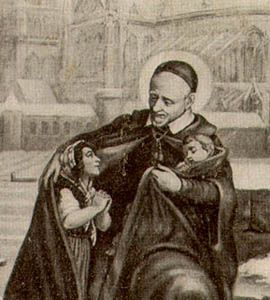
Even though the poor are often rough and unrefined, we must not judge them from external appearances nor from the mental gifts they seem to have received. On the contrary, if you consider the poor in the light of faith, then you will observe that they are taking the place of the Son of God who chose to be poor. Although in his passion he almost lost the appearance of a man and was considered a fool by the Gentiles and a stumbling block by the Jews, he showed them that his mission was to preach to the poor: “He sent me to preach the good news to the poor.” We also ought to have this same spirit and imitate Christ’s actions, that is, we must take care of the poor, console them, help them, support their cause. Since Christ willed to be born poor, he chose for himself disciples who were poor. He made himself the servant of the poor and shared their poverty. He went so far as to say that he would consider every deed which either helps or harms the poor as done for or against himself. Since God surely loves the poor, he also love whose who love the poor. For when on person holds another dear, he also includes in his affection anyone who loves or serves the one he loves. That is why we hope that God will love us for the sake of the poor. So when we visit the poor and needy, we try to be understanding where they are concerned. We sympathize with them so fully that we can echo Paul’s words: “I have become all things to all men.” Therefore, we must try to be stirred by our neighbors’ worries and distress. It is our duty to prefer the service of the poor to everything else and to offer such service as quickly as possible. Charity is certainly greater than any rule. Moreover, all rules must lead to charity. With renewed devotion, then, we must serve the poor, especially outcasts and beggars. They have been given to us as our masters and patrons.
Dear Saint Vincent de Paul, the mere mention of your name suggests a litany of your virtues: humility, zeal, mercy, self-sacrifice. It also recalls your many foundations: Works of Mercy, Congregations, Societies. And the Church gratefully remembers your promotion of the priesthood. Inspire all Charitable Workers, especially those who minister to the poor - both the spiritually and the materially poor. Amen.
Day 270 of 365
Prayer Intentions: Eyes opened to those around us in need; Hearts of Charity, modeled after Christ.
Requested Intentions: Successful outcome of court case and employment (L); For guidance and righteous love (K); Restoration of a relationship (H); For successful employment (I); For a daughter’s successful relationship (M); For a relationship sanctified by God (M); For health of father; For canonization of Pope John Paul II (A); For the conversion of a family (L); For the ill (A); For the health of a family (I); For a father’s successful surgery and recovery (G); For those who are ill, and their caretakers (D); For the safety of a sister who is traveling (A); Recovery of mother with cancer (R); Successful acquisition of a visa (T); Restoration of a marriage (A); For employment and health of mother (G); Successful employment (M); Restoration of a family, End to brother's addiction, Successful marriage (R); Employment (I); Successful recovery of a mother; for all stroke victims (D); Successful return to the faith (A); Emotional, physical, and financial healing (D); Diagnosis and recovery (A); For a successful relationship (J); Those suffering from depression (J); Successful adoption (S); Healing of a father battling cancer (S).
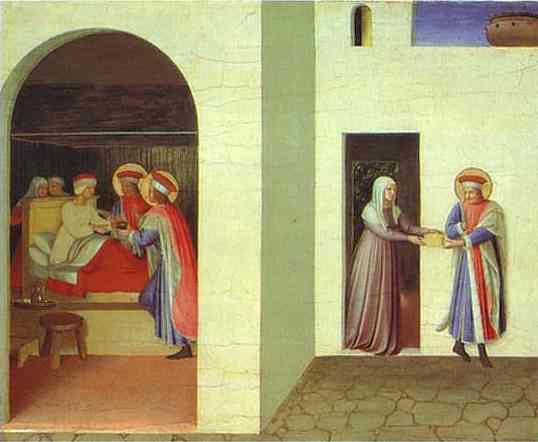
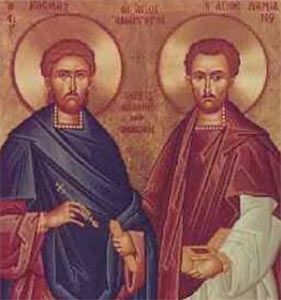
Today, September 26, we celebrate the feast of Saints Cosmas and Damian (died 283), Christian doctors, patron saints of physicians and pharmacists, and martyrs for the faith. Of learned skill in medicine, brothers Cosmas and Damian helped those in need our of Christian charity and love, never accepting payment in return. For this reason, they are often referred to as anargyroi, meaning "the silverless" or “the moneyless.” Through their deep love and charity, they brought many to Christ. Numerous miracles of healing, including that of Emperor Justinian, are attributed to their powerful intercession.
Little is known of the true history of Saints Cosmas and Damian, but the legend that has come down to us is of very early origin. According to the legend, they were twin brothers, born in Arabia, who studied in Syria and became skilled physicians. They were supposed to have lived on the Aegean Sea, practicing on the gulf of Iskanderun in Cilicia, in what is now Turkey. Since they were prominent Christians, they were among the first arrested when the great persecution under Diocletian began. Lysias, the governor of Cilicia, ordered their arrest as “Christians who cured various illnesses and delivered possessed persons in the name of the one called Christ; they do not permit others to go to the temple to honor the gods by sacrifices.”
Upon questioning, the twins (along with their three brothers Anthimus, Leontius, and Euprepius), refused to recant their faith. Standing boldly before the governor, they stated, “We have done evil to no one. We are not involved with the magic or sorcery of which you accuse us. We treat the infirm by the power of our Lord and Savior Jesus Christ and we take no payment for rendering aid to the sick, because our Lord commanded His disciples: Freely have you received, freely give.”
This enraged Cilicia, and he ordered them tortured and executed. In response, they prayed, “We rejoice, Lord, to follow the path of Your commandments, as in the midst of immense riches; and even though we walk through the valley of the shadow of death, we fear no evil.” Saints Cosmas and Damian remained constant under all forms of torture, and miraculously, suffered no injury from water, fire, air, nor on the cross raked with iron hooks. They were finally beheaded with the sword, and their bodies were carried to Syria and buried at Cyrrhus.
The remains of the martyrs were buried in the city of Cyrus in Syria; the Emperor Justinian I (527-565) sumptuously restored the city in their honor. Having been cured of a dangerous illness by the intercession of Cosmas and Damian, Justinian, in gratitude for their aid, rebuilt and adorned their church at Constantinople, and it became a celebrated place of pilgrimage. In Rome, Pope Felix IV (526-530) erected a church in their honor, the mosaics of which are still among the most valuable art remains of the city.
Saints Cosmas and Damian were not only ideal Christians by their practice of medicine without fee, they also symbolized God's blessing upon the art of healing and respect for science, which is an important part of Christian tradition. We pray today that we may be as charitable and loving as Saints Cosmas and Damian, and that through their intercession, we may be steadfast in our faith.
Lord,
we honor the memory of Saints Cosmas and Damian.
Accept our grateful praise
for raising them to eternal glory
and for giving us your fatherly care.
We ask this through our Lord Jesus Christ, Your Son,
who lives and reigns with You and the Holy Spirit,
one God, for ever and ever. Amen.
From the Golden Legend:
Cosmas and Damian were brethren germane, that is of one father and of one mother, and were of the city Egea, and born of a religious mother named Theodora. They were learned in the art of medicine, and of leechcraft, and received so great grace of God that they healed all maladies and languors, not only of men but also cured and healed beasts. And did all for the love of God without taking of any reward.
When Lysias heard of their rekonwn he made them to be called before him, and demanded their names and their country. And then the holy martyrs said: Our names be Cosmo and Damian, and we have three other brethren which be named Antimas, Leontius, and Euprepius. Our country is Arabia, but Christian men know not fortune.
Then the proconsul or judge commanded them that they should bring forth their brethren, and that they should all together do sacrifice to the idols. And when in no wise they would do sacrifice, but despised the idols, he commanded they should be sore tormented in the hands and feet. And when they despised his torments, he commanded them to be bound with a chain and thrown into the sea, but they were anon delivered by the angel of our Lord, and taken out of the sea, and came again tofore the judge.
And when the judge saw them, he said: Ye overcome our great gods by your enchantments; ye despise the torments and make the sea peaceable. Teach ye me your witchcraft, and in the name of the god Adrian, I shall follow you.
And anon as he had said this two devils came and beat him greatly in the visage, and he crying said: “O ye good men, I pray you that ye pray for me to our Lord.” And they then prayed for him and anon the devils departed.
Then the judge said: Lo! ye may see how the gods had indignation against me, because I thought to have forsaken them, but I shall not suffer my gods to be blasphemed.
And then he commanded them to be cast into a great fire, but anon the flame sprang far from them and slew many of them that stood by. And then they were commanded to be put on a torment named eculee [the rack], but they were kept by the angel of our Lord, and the tormentors tormented them above all men, and yet were they taken off without hurt or grief, and so came all whole tofore the judge.
Then the judge commanded the three to be put in prison, and made Cosmo and Damian to be crucified, and to be stoned of the people, but the stones returned to them that threw them, and hurt and wounded many of them. Then the judge, replenished with woodness, made the three brethren to stand by the cross, and commanded that four knights should shoot arrows to Cosmo and Damian, but the arrows returned and hurt many, and did no harm to the martyrs. And when the judge saw that, he was confused in all things, he was anguishous unto the death, and did do behead all five brethren together.
Then the Christian men doubted of the word that St. Cosmo had said, that his brother should not be buried with him, and as they thought thereon there came a voice which cried and said: They be all of one substance, bury them all together in one place. And they suffered death under Diocletian about the year of our Lord two hundred and eighty-seven.
Then let us pray unto these holy martyrs to be our succour and help in all our hurts, blechures and sores, and that by their merits after this life we may come to everlasting bliss in heaven. Amen.
Day 269 of 365
Prayer Intentions: Charity and Love; Steadfast endurance.
Requested Intentions: Restoration of a relationship (H); For successful employment (I); For a daughter’s successful relationship (M); For a relationship sanctified by God (M); For health of father; For canonization of Pope John Paul II (A); For the conversion of a family (L); For the ill (A); For the health of a family (I); For a father’s successful surgery and recovery (G); For those who are ill, and their caretakers (D); For the safety of a sister who is traveling (A); Recovery of mother with cancer (R); Successful acquisition of a visa (T); Restoration of a marriage (A); For employment and health of mother (G); Successful employment (M); Restoration of a family, End to brother's addiction, Successful marriage (R); Employment (I); Successful recovery of a mother; for all stroke victims (D); Successful return to the faith (A); Emotional, physical, and financial healing (D); Diagnosis and recovery (A); For a successful relationship (J); Those suffering from depression (J); Successful adoption (S); Healing of a father battling cancer (S).
Little is known of the true history of Saints Cosmas and Damian, but the legend that has come down to us is of very early origin. According to the legend, they were twin brothers, born in Arabia, who studied in Syria and became skilled physicians. They were supposed to have lived on the Aegean Sea, practicing on the gulf of Iskanderun in Cilicia, in what is now Turkey. Since they were prominent Christians, they were among the first arrested when the great persecution under Diocletian began. Lysias, the governor of Cilicia, ordered their arrest as “Christians who cured various illnesses and delivered possessed persons in the name of the one called Christ; they do not permit others to go to the temple to honor the gods by sacrifices.”
Upon questioning, the twins (along with their three brothers Anthimus, Leontius, and Euprepius), refused to recant their faith. Standing boldly before the governor, they stated, “We have done evil to no one. We are not involved with the magic or sorcery of which you accuse us. We treat the infirm by the power of our Lord and Savior Jesus Christ and we take no payment for rendering aid to the sick, because our Lord commanded His disciples: Freely have you received, freely give.”
This enraged Cilicia, and he ordered them tortured and executed. In response, they prayed, “We rejoice, Lord, to follow the path of Your commandments, as in the midst of immense riches; and even though we walk through the valley of the shadow of death, we fear no evil.” Saints Cosmas and Damian remained constant under all forms of torture, and miraculously, suffered no injury from water, fire, air, nor on the cross raked with iron hooks. They were finally beheaded with the sword, and their bodies were carried to Syria and buried at Cyrrhus.
The remains of the martyrs were buried in the city of Cyrus in Syria; the Emperor Justinian I (527-565) sumptuously restored the city in their honor. Having been cured of a dangerous illness by the intercession of Cosmas and Damian, Justinian, in gratitude for their aid, rebuilt and adorned their church at Constantinople, and it became a celebrated place of pilgrimage. In Rome, Pope Felix IV (526-530) erected a church in their honor, the mosaics of which are still among the most valuable art remains of the city.
Saints Cosmas and Damian were not only ideal Christians by their practice of medicine without fee, they also symbolized God's blessing upon the art of healing and respect for science, which is an important part of Christian tradition. We pray today that we may be as charitable and loving as Saints Cosmas and Damian, and that through their intercession, we may be steadfast in our faith.
Lord,
we honor the memory of Saints Cosmas and Damian.
Accept our grateful praise
for raising them to eternal glory
and for giving us your fatherly care.
We ask this through our Lord Jesus Christ, Your Son,
who lives and reigns with You and the Holy Spirit,
one God, for ever and ever. Amen.
From the Golden Legend:
Cosmas and Damian were brethren germane, that is of one father and of one mother, and were of the city Egea, and born of a religious mother named Theodora. They were learned in the art of medicine, and of leechcraft, and received so great grace of God that they healed all maladies and languors, not only of men but also cured and healed beasts. And did all for the love of God without taking of any reward.
When Lysias heard of their rekonwn he made them to be called before him, and demanded their names and their country. And then the holy martyrs said: Our names be Cosmo and Damian, and we have three other brethren which be named Antimas, Leontius, and Euprepius. Our country is Arabia, but Christian men know not fortune.
Then the proconsul or judge commanded them that they should bring forth their brethren, and that they should all together do sacrifice to the idols. And when in no wise they would do sacrifice, but despised the idols, he commanded they should be sore tormented in the hands and feet. And when they despised his torments, he commanded them to be bound with a chain and thrown into the sea, but they were anon delivered by the angel of our Lord, and taken out of the sea, and came again tofore the judge.
And when the judge saw them, he said: Ye overcome our great gods by your enchantments; ye despise the torments and make the sea peaceable. Teach ye me your witchcraft, and in the name of the god Adrian, I shall follow you.
And anon as he had said this two devils came and beat him greatly in the visage, and he crying said: “O ye good men, I pray you that ye pray for me to our Lord.” And they then prayed for him and anon the devils departed.
Then the judge said: Lo! ye may see how the gods had indignation against me, because I thought to have forsaken them, but I shall not suffer my gods to be blasphemed.
And then he commanded them to be cast into a great fire, but anon the flame sprang far from them and slew many of them that stood by. And then they were commanded to be put on a torment named eculee [the rack], but they were kept by the angel of our Lord, and the tormentors tormented them above all men, and yet were they taken off without hurt or grief, and so came all whole tofore the judge.
Then the judge commanded the three to be put in prison, and made Cosmo and Damian to be crucified, and to be stoned of the people, but the stones returned to them that threw them, and hurt and wounded many of them. Then the judge, replenished with woodness, made the three brethren to stand by the cross, and commanded that four knights should shoot arrows to Cosmo and Damian, but the arrows returned and hurt many, and did no harm to the martyrs. And when the judge saw that, he was confused in all things, he was anguishous unto the death, and did do behead all five brethren together.
Then the Christian men doubted of the word that St. Cosmo had said, that his brother should not be buried with him, and as they thought thereon there came a voice which cried and said: They be all of one substance, bury them all together in one place. And they suffered death under Diocletian about the year of our Lord two hundred and eighty-seven.
Then let us pray unto these holy martyrs to be our succour and help in all our hurts, blechures and sores, and that by their merits after this life we may come to everlasting bliss in heaven. Amen.
Day 269 of 365
Prayer Intentions: Charity and Love; Steadfast endurance.
Requested Intentions: Restoration of a relationship (H); For successful employment (I); For a daughter’s successful relationship (M); For a relationship sanctified by God (M); For health of father; For canonization of Pope John Paul II (A); For the conversion of a family (L); For the ill (A); For the health of a family (I); For a father’s successful surgery and recovery (G); For those who are ill, and their caretakers (D); For the safety of a sister who is traveling (A); Recovery of mother with cancer (R); Successful acquisition of a visa (T); Restoration of a marriage (A); For employment and health of mother (G); Successful employment (M); Restoration of a family, End to brother's addiction, Successful marriage (R); Employment (I); Successful recovery of a mother; for all stroke victims (D); Successful return to the faith (A); Emotional, physical, and financial healing (D); Diagnosis and recovery (A); For a successful relationship (J); Those suffering from depression (J); Successful adoption (S); Healing of a father battling cancer (S).
This weekend, we celebrate the feast of Our Lady of Ransom, also known as Our Lady of Mercy (September 24). This feast is linked to a devotion spread by the Order of Mercedarians, in which we recognize Our Blessed Mother as ransom for captives. Like her Blessed Son, Jesus, through the grace and intercession of Mary, we are ransomed from sin, and freed to live in the gracious light of Christ.
The history of devotion to Mary, Our Lady of Ransom, begins with Saint Peter Nolasco. Born in Languedoc in 1189, Saint Peter entered religious life at 25, and devoted himself to acts of charity. Given the historical backdrop at the time, when many Christian soldiers and faithful had been captured by the Moors and were being held in prison, Saint Peter began establishing an Order that would focus on the ransom and redemption of captives—what would become the Mercedarian Order
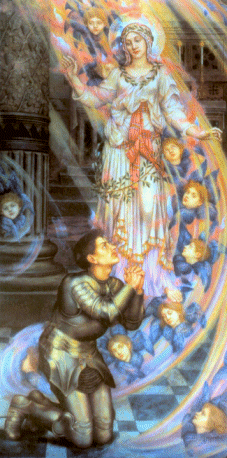
On August 1, 1218, Our Blessed Mother appeared to Saint Peter, to his confessor, Saint Raymund of Pennafort, and to the king, and through these three servants of God gave weight and approval to the Order that Saint Peter had conceived, establishing a work of the most perfect charity, the redemption of captives.
Our Blessed Mother first appeared to Saint Peter, declaring that she desired the establishment of a religious order bearing the name “Her Mercy.” As instructed by the Blessed Virgin, the order would deliver captives, and if needed, offer themselves in their place. Both Saint Raymund of Pennafort and the king of Aragon, James I, had similar visions, establishing Saint Peter Nolasco as the founder of this order.
According to the Constitutions, Mercedarians were 'to visit and to free Christians who are in captivity and in power of the Saracens or of other enemies of our Law… By this work of mercy… all the brothers of this Order, as sons of true obedience, must always be gladly disposed to give up their lives, if it is necessary, as Jesus Christ gave up His for us.' This is known as the Fourth Vow of the Order, in addition to poverty, chastity and obedience of the Augustinian Rule.
Established in Spain, and approved by Pope Gregory IX under the name “Our Lady of Mercy for the Ransom of Captives” (the Mercedarians), the Order spread rapidly due to the watchful grace of Our Blessed Mother. Its growth was increased as the charity and piety of its members was observed; they very often followed Her directive to give themselves up to voluntary slavery when necessary, to aid the good work. Famous among those willing to give themselves up for their captives was Saint Raymond Nonnatus.
The development of the order was immediate and widespread throughout France, England, Germany, Portugal, and Spain. As the Moors were driven back, new convents of Mercy were established at Montpellier, Perpignan, Toulouse, and Vich. Columbus brought some members of the Order of Mercy with him to America, and they founded houses in Mexico, Cuba, Brazil, Peru, Chile, and Ecuador, and took an active part in the conversion of the Indians. Toward the end of the 18th century, the Mercedarians erected houses for the training of missionaries, and in the beginning of the 19th century they undertook elementary teaching in their convents. The mother-house is in Rome, Italy.
It is credibly estimated that the Order ransomed 490,736 slaves between the years 1218 and 1632. An even greater achievement was the conversion of thousands in captivity, and steeling them against the sufferings of a cruel martyrdom for the faith. Protestant historian, Bonet-Maury, records that no expedition sent into the Barbary States by the powers of Europe or America equaled "the moral effect produced by the ministry of consolation, peace and abnegation, going even to the sacrifice of liberty and life, which was exercised by the humble sons of Saints John of Martha, Peter Nolasco, and Vincent de Paul."
Today, we are called to continue the good work of the Mercedarians, as requested by Our Blessed Mother. We are confronted with the captivity of sin every day—in our own lives, as well as those we come into contact with. Through the spread of our faith, our personal prayers and penances, we ask Our Blessed Mother—Our Lady of Ransom—to ease the sufferings of others, breathing the lightness of freedom into their lives, and casting off the shackles of sin!
God, who through the most glorious Mother of thy Son didst vouchsafe to increase thy Church with a new offspring for the redemption of thy Christian people: grant, we beseech thee, that like as we on this day do honor her for the work of her institution, so by her merits and intercession, we may be delivered from all our iniquities and the bondage of the devil. We ask this, as we ask all things, through Our Lord Jesus Christ. Amen.
Day 268 of 365
Prayer Intentions: Freedom from the sins that weigh us down.
Requested Intentions: Restoration of a relationship (H); For successful employment (I); For a daughter’s successful relationship (M); For a relationship sanctified by God (M); For health of father; For canonization of Pope John Paul II (A); For the conversion of a family (L); For the ill (A); For the health of a family (I); For a father’s successful surgery and recovery (G); For those who are ill, and their caretakers (D); For the safety of a sister who is traveling (A); Recovery of mother with cancer (R); Successful acquisition of a visa (T); Restoration of a marriage (A); For employment and health of mother (G); Successful employment (M); Restoration of a family, End to brother's addiction, Successful marriage (R); Employment (I); Successful recovery of a mother; for all stroke victims (D); Successful return to the faith (A); Emotional, physical, and financial healing (D); Diagnosis and recovery (A); For a successful relationship (J); Those suffering from depression (J); Successful adoption (S); Healing of a father battling cancer (S).
The history of devotion to Mary, Our Lady of Ransom, begins with Saint Peter Nolasco. Born in Languedoc in 1189, Saint Peter entered religious life at 25, and devoted himself to acts of charity. Given the historical backdrop at the time, when many Christian soldiers and faithful had been captured by the Moors and were being held in prison, Saint Peter began establishing an Order that would focus on the ransom and redemption of captives—what would become the Mercedarian Order
On August 1, 1218, Our Blessed Mother appeared to Saint Peter, to his confessor, Saint Raymund of Pennafort, and to the king, and through these three servants of God gave weight and approval to the Order that Saint Peter had conceived, establishing a work of the most perfect charity, the redemption of captives.
Our Blessed Mother first appeared to Saint Peter, declaring that she desired the establishment of a religious order bearing the name “Her Mercy.” As instructed by the Blessed Virgin, the order would deliver captives, and if needed, offer themselves in their place. Both Saint Raymund of Pennafort and the king of Aragon, James I, had similar visions, establishing Saint Peter Nolasco as the founder of this order.
According to the Constitutions, Mercedarians were 'to visit and to free Christians who are in captivity and in power of the Saracens or of other enemies of our Law… By this work of mercy… all the brothers of this Order, as sons of true obedience, must always be gladly disposed to give up their lives, if it is necessary, as Jesus Christ gave up His for us.' This is known as the Fourth Vow of the Order, in addition to poverty, chastity and obedience of the Augustinian Rule.
Established in Spain, and approved by Pope Gregory IX under the name “Our Lady of Mercy for the Ransom of Captives” (the Mercedarians), the Order spread rapidly due to the watchful grace of Our Blessed Mother. Its growth was increased as the charity and piety of its members was observed; they very often followed Her directive to give themselves up to voluntary slavery when necessary, to aid the good work. Famous among those willing to give themselves up for their captives was Saint Raymond Nonnatus.
The development of the order was immediate and widespread throughout France, England, Germany, Portugal, and Spain. As the Moors were driven back, new convents of Mercy were established at Montpellier, Perpignan, Toulouse, and Vich. Columbus brought some members of the Order of Mercy with him to America, and they founded houses in Mexico, Cuba, Brazil, Peru, Chile, and Ecuador, and took an active part in the conversion of the Indians. Toward the end of the 18th century, the Mercedarians erected houses for the training of missionaries, and in the beginning of the 19th century they undertook elementary teaching in their convents. The mother-house is in Rome, Italy.
It is credibly estimated that the Order ransomed 490,736 slaves between the years 1218 and 1632. An even greater achievement was the conversion of thousands in captivity, and steeling them against the sufferings of a cruel martyrdom for the faith. Protestant historian, Bonet-Maury, records that no expedition sent into the Barbary States by the powers of Europe or America equaled "the moral effect produced by the ministry of consolation, peace and abnegation, going even to the sacrifice of liberty and life, which was exercised by the humble sons of Saints John of Martha, Peter Nolasco, and Vincent de Paul."
Today, we are called to continue the good work of the Mercedarians, as requested by Our Blessed Mother. We are confronted with the captivity of sin every day—in our own lives, as well as those we come into contact with. Through the spread of our faith, our personal prayers and penances, we ask Our Blessed Mother—Our Lady of Ransom—to ease the sufferings of others, breathing the lightness of freedom into their lives, and casting off the shackles of sin!Day 268 of 365
Prayer Intentions: Freedom from the sins that weigh us down.
Requested Intentions: Restoration of a relationship (H); For successful employment (I); For a daughter’s successful relationship (M); For a relationship sanctified by God (M); For health of father; For canonization of Pope John Paul II (A); For the conversion of a family (L); For the ill (A); For the health of a family (I); For a father’s successful surgery and recovery (G); For those who are ill, and their caretakers (D); For the safety of a sister who is traveling (A); Recovery of mother with cancer (R); Successful acquisition of a visa (T); Restoration of a marriage (A); For employment and health of mother (G); Successful employment (M); Restoration of a family, End to brother's addiction, Successful marriage (R); Employment (I); Successful recovery of a mother; for all stroke victims (D); Successful return to the faith (A); Emotional, physical, and financial healing (D); Diagnosis and recovery (A); For a successful relationship (J); Those suffering from depression (J); Successful adoption (S); Healing of a father battling cancer (S).
"Walsingham, 'in thee is built New Nazareth'
Where shall be held in a memorial
The great joy of my salutation,
First of my joys, their foundation and origin
Root of mankind's gracious redemption,
When Gabriel gave me this news:
To be a Mother through humility
And God's Son conceive in virginity.
O England, you have great cause to be glad
For you are compared to the Promised Land, Zion
You are called in every realm and region
The Holy Land, Our Lady's Dowry.
In you is built new Nazareth,
A house to the honor of the Queen of Heaven
And her most glorious Salutation
When Gabriel said at Old Nazareth,
Ave, This same joy shall here be daily and for ever remembered."
(From the Pynson Ballad, c.1470)
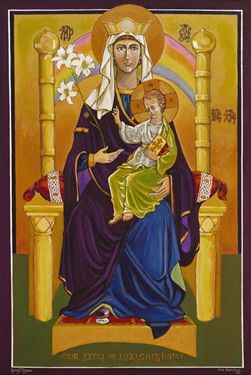
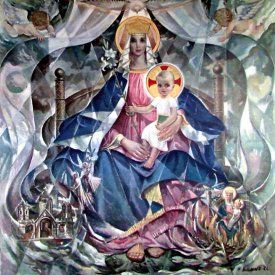
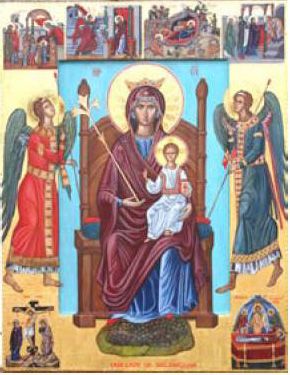
Today, September 24, we celebrate the feast day of Our Lady of Walsingham, one of the many titles and devotions to Our Blessed Mother. Located in England, pilgrims visit the shrine of Our Lady of Walsingham to contemplate the great mystery of the Incarnation.... that moment when God emptied Himself and became man, took flesh in the womb of Mary. At Walsingham, the New Nazareth, Mary asks that Christians remember the great act of love when the Creator embraced his creatures. At Walsingham, too, devotion to Mary is a call to unity and to world peace. Every Thursday, a candle is lit before the statue of Our Lady as a reminder to all, residents and pilgrims alike, to pray for Christian unity. This is in keeping with the message of the reconciliation of all things in Christ, which this shrine has proclaimed for over 900 years. Near to the Catholic shrine are an Anglican shrine to Our Lady, a Methodist Chapel, and a Greek Orthodox Church. Pilgrims to the Roman Catholic shrine are encouraged to visit these in a spirit of Christian unity and love.
Devotion to Our Lady of Walsingham began in the eleventh century when Mary, the Mother of God, appeared to a Saxon noblewoman, Richeldis de Faverches. Her husband, the Lord of the Manor of Walsingham Parva, had previously died, leaving her a young widow with a son named Geoffrey. At this time in history, there was a great deal of interest in the Holy Land and people undertook long and often dangerous pilgrimages there. Christian armies were soon to be engaged in a number of Crusades to liberate the holy sites from Muslim control and it is believed that Geoffrey eventually joined one of those Crusades as an expression of his Christian faith.
For Lady Richeldis, however, despite the tragedy of the loss of her husband, she devoted herself to cheerful prayer and good works… and her devotion to the Christian faith was rewarded by a vision in the year 1061. In her vision, she was taken “in spirit” by Mary to be shown the house in Nazareth where Gabriel had announced the news of the birth of Jesus. Our Blessed mother asked that Richeldis build an exact replica of that house in Walsingham. This is how Walsingham became known as England's Nazareth. Our Lady gave Richeldis three reasons that the structure should be built: 1) for the honor of Mary, 2) as a place where all who sought Mary could find succor, and 3) as a memorial of the great joy of the Angelic Salutation.
Lady Richeldis was graced with the same vision three times, and eventually hired construction workers and began construction. However, the project ran into difficulties with land selection, and unaccustomed to construction, Lady Richeldis had difficulty communicating to the workers the specifications of the project. Discouraged, she spent the night keeping a vigil of prayer and in the morning, upon the arrival of the workers, discovered that Our Blessed Mother had sent angels to complete the project.
Upon the death of Lady Richeldis, Geoffrey inherited the land, and eventually bequeathed it to an Augustinian order who built a priory to house the simple wooden structure that Mary had asked to be built. This priory became the focus of pilgrimages, and grew in wealth and size due to the patronage of the faithful royals Henry III, Edward II, Edward III, Henry IV, Edward IV, and Henry VII. Unfortunately, Henry VIII, eventually brought about its destruction in 1538. The pilgrimages to Walsingham were suspended during the time of Catholic persecution in England, but were kept alive in secret by the faithful, to return upon the granting of religious freedom to Catholics. Today, pilgrimage to Walsingham is a regular part of Christian life in the British Isles.
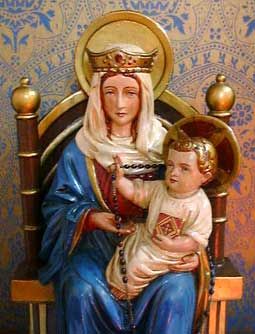
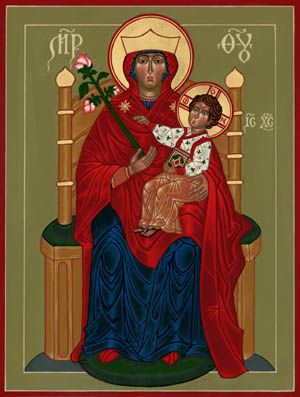
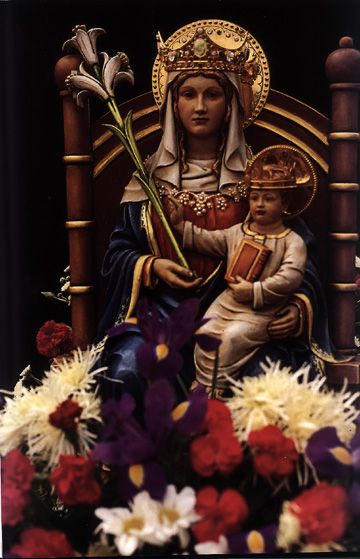
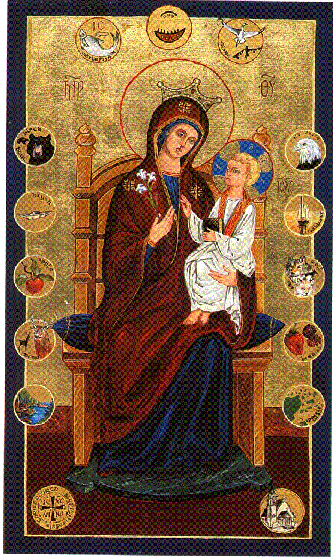
The statue present at Walsingham today, commemorating the visions of Lady Richeldis, was modeled after the seal of Walsingham priory, a medieval seal preserved in the British museum. (The previous statue was destroyed by Henry VIII). It depicts Mary as a mother, crowned in the Saxon style, and seated on the throne of wisdom. She is herself a throne for Christ, her Son, who is represented holding the Gospels as if to present them to the world. Mary is holding the three-fold lily-scepter of virginity. Her right hand points to Christ. The child extends his arm in a double gesture of blessing and protection of his mother. Each part of the statue is rich in symbolism, such as the seven rings on the throne which stand for the sacraments. The crown for today's statue is used only on special occasions. It was made from gifts from all over the world. It is made from 18 carat gold and contains 116 precious stones including 71 diamonds.
The Archbishop of Canterbury, Dr. Rowan Williams, gave the sermon at the National Pilgrimage to Walsingham in 2004. In his message, he noted:
”For centuries, Christians have kept coming back to the idea that what happens in Mary is what has to happen to some degree in each of us. She, uniquely and once for all, says a yes so complete that her entire material life is changed by the coming of God to her; God's everlasting gift of himself that is the Son, the Word, emerges from her to begin that life which will change everything in creation. But we are called to the same job, to give God room so that we may be changed, so that the eternal Word will live in us and speak and act in love to others. Only so are we 'magnified', given our full dignity and splendor--not by rushing around in panic defending ourselves and standing on our dignity, but by being still enough to reflect and absorb the light flowing from God the Holy Trinity, something so wonderful that it can put into perspective the fears and pettinesses that we think are real life, and silence us for a moment, letting true life in.”
Today, Walsingham continues its ancient ministry to all who truly seek God. It struggles to establish a deep interior life of prayer, and strives to spread its spirit abroad to all people. Walsingham exists in the spirit of Nazareth -- loving service to all, deep interior peace based on obedience to the will of God in all things, joy in being the least in the household of God's Church in order that God, and not us, receive the glory. Our Blessed Mother, in emptying herself to the Lord, that she might be filled with His presence, reminds us that the joy and sacrifice of the Annunciation and Incarnation are not reserved solely for her—but that we each share in these precious gifts and moments through the living of our faith! Pray for us, Our Lady of Walsingham!
Blessed Lady of Walsingham, win for us those gifts of the Holy Spirit which inspired the early Church with courage and power. Let us share your joy in the Annunciation, and your devotion to the great mystery of the Incarnation.
Day 267 of 365
Prayer Intentions: The living of our faith and joy in the Incarnation
Requested Intentions: Restoration of a relationship (H); For successful employment (I); For a daughter’s successful relationship (M); For a relationship sanctified by God (M); For health of father; For canonization of Pope John Paul II (A); For the conversion of a family (L); For the ill (A); For the health of a family (I); For a father’s successful surgery and recovery (G); For those who are ill, and their caretakers (D); For the safety of a sister who is traveling (A); Recovery of mother with cancer (R); Successful acquisition of a visa (T); Restoration of a marriage (A); For employment and health of mother (G); Successful employment (M); Restoration of a family, End to brother's addiction, Successful marriage (R); Employment (I); Successful recovery of a mother; for all stroke victims (D); Successful return to the faith (A); Emotional, physical, and financial healing (D); Diagnosis and recovery (A); For a successful relationship (J); Those suffering from depression (J); Successful adoption (S); Healing of a father battling cancer (S).
Where shall be held in a memorial
The great joy of my salutation,
First of my joys, their foundation and origin
Root of mankind's gracious redemption,
When Gabriel gave me this news:
To be a Mother through humility
And God's Son conceive in virginity.
O England, you have great cause to be glad
For you are compared to the Promised Land, Zion
You are called in every realm and region
The Holy Land, Our Lady's Dowry.
In you is built new Nazareth,
A house to the honor of the Queen of Heaven
And her most glorious Salutation
When Gabriel said at Old Nazareth,
Ave, This same joy shall here be daily and for ever remembered."
(From the Pynson Ballad, c.1470)
Today, September 24, we celebrate the feast day of Our Lady of Walsingham, one of the many titles and devotions to Our Blessed Mother. Located in England, pilgrims visit the shrine of Our Lady of Walsingham to contemplate the great mystery of the Incarnation.... that moment when God emptied Himself and became man, took flesh in the womb of Mary. At Walsingham, the New Nazareth, Mary asks that Christians remember the great act of love when the Creator embraced his creatures. At Walsingham, too, devotion to Mary is a call to unity and to world peace. Every Thursday, a candle is lit before the statue of Our Lady as a reminder to all, residents and pilgrims alike, to pray for Christian unity. This is in keeping with the message of the reconciliation of all things in Christ, which this shrine has proclaimed for over 900 years. Near to the Catholic shrine are an Anglican shrine to Our Lady, a Methodist Chapel, and a Greek Orthodox Church. Pilgrims to the Roman Catholic shrine are encouraged to visit these in a spirit of Christian unity and love.
Devotion to Our Lady of Walsingham began in the eleventh century when Mary, the Mother of God, appeared to a Saxon noblewoman, Richeldis de Faverches. Her husband, the Lord of the Manor of Walsingham Parva, had previously died, leaving her a young widow with a son named Geoffrey. At this time in history, there was a great deal of interest in the Holy Land and people undertook long and often dangerous pilgrimages there. Christian armies were soon to be engaged in a number of Crusades to liberate the holy sites from Muslim control and it is believed that Geoffrey eventually joined one of those Crusades as an expression of his Christian faith.
For Lady Richeldis, however, despite the tragedy of the loss of her husband, she devoted herself to cheerful prayer and good works… and her devotion to the Christian faith was rewarded by a vision in the year 1061. In her vision, she was taken “in spirit” by Mary to be shown the house in Nazareth where Gabriel had announced the news of the birth of Jesus. Our Blessed mother asked that Richeldis build an exact replica of that house in Walsingham. This is how Walsingham became known as England's Nazareth. Our Lady gave Richeldis three reasons that the structure should be built: 1) for the honor of Mary, 2) as a place where all who sought Mary could find succor, and 3) as a memorial of the great joy of the Angelic Salutation.
Lady Richeldis was graced with the same vision three times, and eventually hired construction workers and began construction. However, the project ran into difficulties with land selection, and unaccustomed to construction, Lady Richeldis had difficulty communicating to the workers the specifications of the project. Discouraged, she spent the night keeping a vigil of prayer and in the morning, upon the arrival of the workers, discovered that Our Blessed Mother had sent angels to complete the project.
Upon the death of Lady Richeldis, Geoffrey inherited the land, and eventually bequeathed it to an Augustinian order who built a priory to house the simple wooden structure that Mary had asked to be built. This priory became the focus of pilgrimages, and grew in wealth and size due to the patronage of the faithful royals Henry III, Edward II, Edward III, Henry IV, Edward IV, and Henry VII. Unfortunately, Henry VIII, eventually brought about its destruction in 1538. The pilgrimages to Walsingham were suspended during the time of Catholic persecution in England, but were kept alive in secret by the faithful, to return upon the granting of religious freedom to Catholics. Today, pilgrimage to Walsingham is a regular part of Christian life in the British Isles.
The statue present at Walsingham today, commemorating the visions of Lady Richeldis, was modeled after the seal of Walsingham priory, a medieval seal preserved in the British museum. (The previous statue was destroyed by Henry VIII). It depicts Mary as a mother, crowned in the Saxon style, and seated on the throne of wisdom. She is herself a throne for Christ, her Son, who is represented holding the Gospels as if to present them to the world. Mary is holding the three-fold lily-scepter of virginity. Her right hand points to Christ. The child extends his arm in a double gesture of blessing and protection of his mother. Each part of the statue is rich in symbolism, such as the seven rings on the throne which stand for the sacraments. The crown for today's statue is used only on special occasions. It was made from gifts from all over the world. It is made from 18 carat gold and contains 116 precious stones including 71 diamonds.
The Archbishop of Canterbury, Dr. Rowan Williams, gave the sermon at the National Pilgrimage to Walsingham in 2004. In his message, he noted:
”For centuries, Christians have kept coming back to the idea that what happens in Mary is what has to happen to some degree in each of us. She, uniquely and once for all, says a yes so complete that her entire material life is changed by the coming of God to her; God's everlasting gift of himself that is the Son, the Word, emerges from her to begin that life which will change everything in creation. But we are called to the same job, to give God room so that we may be changed, so that the eternal Word will live in us and speak and act in love to others. Only so are we 'magnified', given our full dignity and splendor--not by rushing around in panic defending ourselves and standing on our dignity, but by being still enough to reflect and absorb the light flowing from God the Holy Trinity, something so wonderful that it can put into perspective the fears and pettinesses that we think are real life, and silence us for a moment, letting true life in.”
Today, Walsingham continues its ancient ministry to all who truly seek God. It struggles to establish a deep interior life of prayer, and strives to spread its spirit abroad to all people. Walsingham exists in the spirit of Nazareth -- loving service to all, deep interior peace based on obedience to the will of God in all things, joy in being the least in the household of God's Church in order that God, and not us, receive the glory. Our Blessed Mother, in emptying herself to the Lord, that she might be filled with His presence, reminds us that the joy and sacrifice of the Annunciation and Incarnation are not reserved solely for her—but that we each share in these precious gifts and moments through the living of our faith! Pray for us, Our Lady of Walsingham!
Blessed Lady of Walsingham, win for us those gifts of the Holy Spirit which inspired the early Church with courage and power. Let us share your joy in the Annunciation, and your devotion to the great mystery of the Incarnation.
Day 267 of 365
Prayer Intentions: The living of our faith and joy in the Incarnation
Requested Intentions: Restoration of a relationship (H); For successful employment (I); For a daughter’s successful relationship (M); For a relationship sanctified by God (M); For health of father; For canonization of Pope John Paul II (A); For the conversion of a family (L); For the ill (A); For the health of a family (I); For a father’s successful surgery and recovery (G); For those who are ill, and their caretakers (D); For the safety of a sister who is traveling (A); Recovery of mother with cancer (R); Successful acquisition of a visa (T); Restoration of a marriage (A); For employment and health of mother (G); Successful employment (M); Restoration of a family, End to brother's addiction, Successful marriage (R); Employment (I); Successful recovery of a mother; for all stroke victims (D); Successful return to the faith (A); Emotional, physical, and financial healing (D); Diagnosis and recovery (A); For a successful relationship (J); Those suffering from depression (J); Successful adoption (S); Healing of a father battling cancer (S).
Subscribe to:
Posts (Atom)