Why pray the Rosary every day for a year?


Each time the Blessed Virgin has appeared-- whether it be to Saint Bernadette Soubirous at Lourdes; to Lucia, Jacinta, and Francisco at Fatima; or to Mariette Beco at Banneux-- she has asserted the importance, saving grace, and power of praying the Holy Rosary on a daily basis. Based upon her words, the Rosary is penance and conversion for sinners, a pathway to peace, an end to war, and a powerful act of faith in Jesus Christ. Pope Paul VI presented the Rosary as a powerful means to reach Christ "not merely with Mary but indeed, insofar as this is possible to us, in the same way as Mary, who is certainly the one who thought about Him more than anyone else has ever done."

To show us how this is done, perhaps no one has been more eloquent than the great Cardinal Newman, who wrote: "The great power of the Rosary consists in the fact that it translates the Creed into Prayer. Of course, the Creed is already in a certain sense a prayer and a great act of homage towards God, but the Rosary brings us to meditate again on the great truth of His life and death, and brings this truth close to our hearts. Even Christians, although they know God, usually fear rather than love Him. The strength of the Rosary lies in the particular manner in which it considers these mysteries, since all our thinking about Christ is intertwined with the thought of His Mother, in the relations between Mother and Son; the Holy Family is presented to us, the home in which God lived His infinite love."


As Mary said at Fatima, "Jesus wants to use you to make Me known and loved. He wishes to establish the devotion to My Immaculate Heart throughout the world. I promise salvation to whoever embraces it; these souls will be dear to God, like flowers put by Me to adorn his throne."


The Second Sorrowful Mystery: The Scourging at the Pillar

Posted by Jacob

Today, Good Friday, Jesus continues His steady march toward death, bringing us ever closer to forgiveness and new life. On the eve of His suffering, Holy Thursday, Jesus had celebrated the Passover with His disciples, and then taken Peter, James, and John with Him to the garden of Gethsemane. There, He prayed in agony until His arrest.


We all know the story of the mock trial, of Pilate’s pronouncement, of the crowds screaming for the release of Barabas. We know of His condemnation, and we know of His grace and acceptance. At this point, His own desires obedient to His Father, Jesus is ready to finish His mission on earth. All that stands between Him and the eternal comfort of heaven is brutal torture and the weight of the world’s sinfulness. Jesus literally carried the weight of the world with Him to Calvary.

Apart from the humiliation of the trial, the first of these brutal tortures was the Scourging at the Pillar, the Second Sorrowful Mystery of the Rosary.

1Then Pilate took Jesus and had him scourged. (John 19:1)


Historically, at that time, those who were sentenced to crucifixion were first flogged or scourged. They were tied to a low pillar, stripped, generally bent over, and beat mercilessly with a whip, drawing blood, and weakening them so that they could more easily be affixed to their cross. In this way, this initial humiliation was only part and parcel of the final humiliation Christ endured for us in dying like a criminal.

In considering the Passion of Christ, we must be ever aware of the considerable physical, bodily pain that the Lord endured for us in His humanity. But one could guess that this physical pain, felt in every fiber of the Lords’ body, paled in comparison to the mental and spiritual blows being delivered upon Him by our sins.

And yet He continues on, through the mockery and indignation of His “coronation,” trudging up the hill to His crucifixion. We are reminded in our own times of pain that Jesus understands. He has already endured more than we have, can, or could. His suffering was so that we would not have to repeat it. His suffering was pure, in sacrifice for our sins. When we suffer with Him, His purity of intent enters into us, and we are supported, uplifted, renewed.

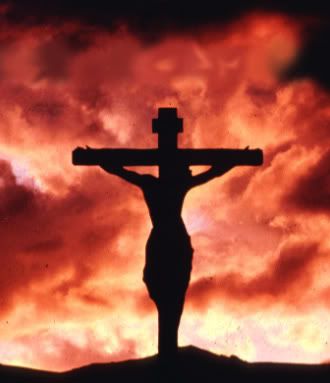
Good Friday: From the Perspective of the Cross

Posted by Jacob


I had power all
His foes to fell,
but yet I stood fast.

Then the young hero prepared Himself,
That was Almighty God,
Strong and firm of mood,
He mounted the lofty cross
courageously in the sight of many,
when He willed to redeem mankind.

I trembled when the hero embraced me,
yet dared I not bow down to earth,
fall to the bosom of the ground,
but I was compelled to stand fast.

A cross was I reared,
I raised the powerful King
The Lord of the heavens,
I dared not fall down.

They pierced me with dark nails,
on me are the wounds visible.

Cynewulf's "Dream of the Rood"


One Bread, One Body: The Institution of the Holy Eucharist

Posted by Jacob


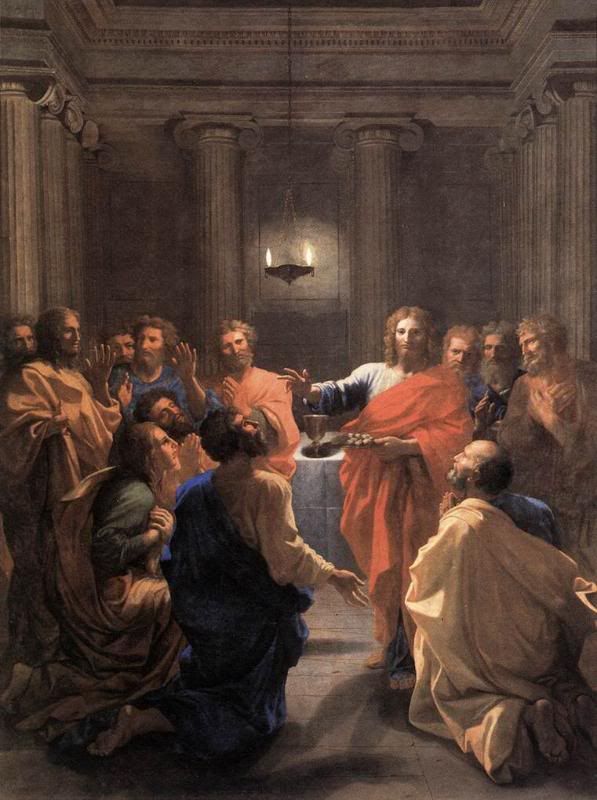
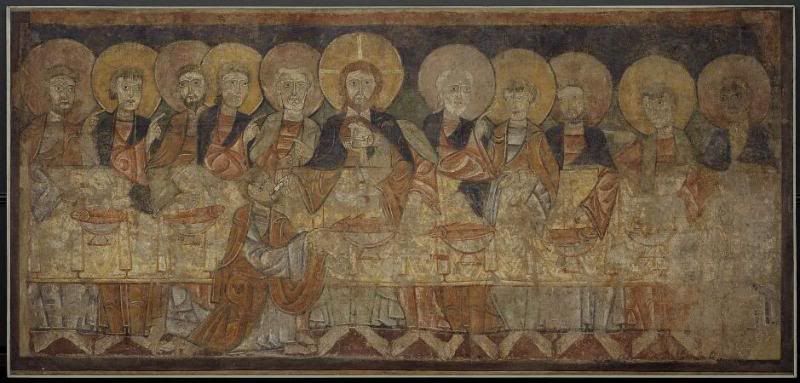
Today, Holy Thursday, we celebrate the Mass of the Lord’s Supper, and the Institution of the Holy Eucharist—the Fifth Luminous Mystery of the Holy Rosary. When Jesus and his disciples gathered in the Upper Room on the eve of His Passion, many things occurred. The Lord washed the feet of His disciples, calling them “friends.” He predicted betrayal on the part of Peter. He let Judas know that he was aware of his treachery. He reminded them about love: 34"A new command I give you: Love one another. As I have loved you, so you must love one another. 35By this all men will know that you are my disciples, if you love one another." (John 13: 34-35). He celebrated the Passover in their presence.


The Last Supper was a moment of love, a stunning moment of self-giving prior to the pain, sorrow, and sacrifice that Jesus would endure for us.  In that moment of love, Jesus instituted the Holy Eucharist, which we continue to celebrate as the Body of Christ.
22While they were eating, Jesus took bread, gave thanks and broke it, and gave it to his disciples, saying, "Take it; this is my body."


23Then he took the cup, gave thanks and offered it to them, and they all drank from it.


24"This is my blood of the covenant, which is poured out for many," he said to them. 25"I tell you the truth, I will not drink again of the fruit of the vine until that day when I drink it anew in the kingdom of God." (Mark 14: 22-25)


In consecrating the bread and wine he presented for His disciples, Jesus accomplished two tasks. First, He literally and physically became the Bread of Life for us, as He first preached, recorded in the Gospel of John:
35Then Jesus declared, "I am the bread of life. He who comes to me will never go hungry, and he who believes in me will never be thirsty. 36But as I told you, you have seen me and still you do not believe. 37All that the Father gives me will come to me, and whoever comes to me I will never drive away. 38For I have come down from heaven not to do my will but to do the will of him who sent me. 39And this is the will of him who sent me, that I shall lose none of all that he has given me, but raise them up at the last day. 40For my Father's will is that everyone who looks to the Son and believes in him shall have eternal life, and I will raise him up at the last day."


53Jesus said to them, "I tell you the truth, unless you eat the flesh of the Son of Man and drink his blood, you have no life in you. 54Whoever eats my flesh and drinks my blood has eternal life, and I will raise him up at the last day. 55For my flesh is real food and my blood is real drink. 56Whoever eats my flesh and drinks my blood remains in me, and I in him. 57Just as the living Father sent me and I live because of the Father, so the one who feeds on me will live because of me. 58This is the bread that came down from heaven. Your forefathers ate manna and died, but he who feeds on this bread will live forever." (John 6: 35-40, 53-58)


But secondly, we all became the Body of Christ. By partaking in the Eucharist, we “acknowledge the body” as Saint Paul wrote to the Corinthians:

27Therefore, whoever eats the bread or drinks the cup of the Lord in an unworthy manner will be guilty of sinning against the body and blood of the Lord. 28A man ought to examine himself before he eats of the bread and drinks of the cup. 29For anyone who eats and drinks without recognizing the body of the Lord eats and drinks judgment on himself. (1 Corinthians 11: 27-29)


In participating in the Eucharist, we receive the generous gift of life from our Savior, but we also are called to give generously to one another—to love one another as Christ, Himself, has loved us. In becoming the body of Christ, we enter into communion not only with Him, but with the Father, and with each other—a powerful agape, participation in the mystery and divinity of Jesus, one body in His name.
16Is not the cup of thanksgiving for which we give thanks a participation in the blood of Christ? And is not the bread that we break a participation in the body of Christ? 17Because there is one loaf, we, who are many, are one body, for we all partake of the one loaf. (1 Corinthians 10:16-17)


In the Eucharist we are called home to the Lord, while remaining in community with each other. We are made one with the Word of God, incarnate, living and tangible. We are renewed in our faith and experience the divinity of Christ. We share in His mystery.  We are forgiven. And we are loved.


The Book of Job: Reflections on Suffering

Posted by Jacob

As we begin our Lenten journey, we look to the Book of Job as a model of suffering and repentance. In reading Job, we must be prepared to challenge ourselves with some hard questions, and to sit quietly with some even more difficult answers.  The lessons of Job remind us that reward and punishment, as we imagine to be fair and just, do not always correspond to that of the Lord.  Job further reminds us that suffering is real, purposeful, and important to not only our humanity, but to our redemption and salvation.

Below, an excerpt from a thoughful article on the Book of Job, written by Larry J. Walters:

Written by an unknown author, possibly the most ancient literary account in the Bible, the Book of Job is a mixture of divine and human wisdom that addresses a major life issue: Why do righteous people suffer undeservedly? The Book of Job is also a prime example of Hebrew wisdom literature3 that labors with the concept of theodicy, which is a defense of the integrity of the justice and righteousness of God in light of the evil, injustice, and undeserved suffering in the world. Some writers have suggested that theodicy is the theme of the Book of Job. If this is so,then the emphasis of the book is not totally on the man Job and his suffering, though he and his suffering are certainly central, but also on God Himself and His relationship to His supreme creation.


Job therefore is a book dealing with human suffering, even though the suffering of the innocent does not encompass the author's entire purpose. It is also more than an ancient play written to portray the absurdities of life, the weaknesses of man, and the prominence of the sovereignty of God. The Book of Job shows that the sufferer can question and doubt, face the hard questions of life with faith, maintain an unbroken relationship with a loving God, and still come to a satisfactory resolution for personal and collective injustice and undeserved suffering. These observations need to be addressed not only within the context of the suffering by the righteous man Job, but also because many believers today suffer and can identify with Job. As Andersen points out, "the problem of suffering, human misery, or the larger sum of evil in all its forms is a problem only for the person who believes in one God who is all-powerful and all-loving." Suffering, then, is the prominent issue that forces a consideration of the deeper questions posed by this concept, especially as it affects the lives of those who have a loving, intimate relationship with the true and living God. All the questions that relate to God, man, and Satan-justice and injustice, sovereignty and freedom, innocence and guilt, good and evil, blessing and cursing-are interwoven within the context of undeserved suffering.


The Book of Job, and its presentation of undeserved suffering, therefore, serves as a dependable, useful model for the believer of any generation in dealing with the problem of theodicy. Is God to be held to a strict set of regulations based on human interpretations of His relationship with mankind? How does the Book of Job handle this question and its connection with undeserved suffering, while still demanding faith in an omnipotent, sovereign, and loving God? …


Job is truly a wisdom book. The basic concept of wisdom has always been connected with skill and "know-how," for "wisdom was the art of achieving," and the "emphasis was on competence." Wisdom challenges readers to discover the "know-how" presented in the book so that they might achieve competence in dealing with the questions of suffering. From the Book of Job readers can learn how to challenge the false concepts related to suffering and how to maintain a loving and meaningful relationship, in the midst of suffering, with the sovereign God. Only God "understands the way to [wisdom] and he alone knows where it dwells" (Job 28:23, NIV).

Walters, L.J. "Reflections on Suffering from the Book of Job," BIBLIOTHECA SACRA 154 (October-December 1997): 436-51.

Ash Wednesday: Suffering of Love

Posted by Jacob

“Remember that you are dust, and unto dust you shall return.”


Today, February 22, we enter the solemn Lenten season of preparation and repentance. Ash Wednesday reminds us in a dramatic manner of our inevitable death—that our mortal bodies will fail and return to the dust from which they originated. But in this way, despite our medical advances, we are more importantly reminded that we can not triumph over death without the help of He who literally triumphed over death. When Jesus emerged from His tomb two thousand years ago, He freed us from the chains of death, inviting us to live in His glory with Him. Without that sacrifice—without that invitation—we would literally turn to dust, our mortal bodies ravaged by time and earthly emptiness.

Lent is a period of preparation—we prepare ourselves to meet Jesus, to follow Him with all that we have. We take stock and inventory of our lives, and bring from the darkness those areas of sin and failing which we can improve upon. Lent is not simply about choosing something to “give up.” Lent is about opening up ourselves to our Lord—repenting, and engaging in acts of prayer and penance, not only for ourselves but for all those in need.  Lent is a time of deeply personal conversion-- the physicality of fasting and penance should not distract us from this season's true goal: internal growth and movement toward Our God.

Biblically, ashes were a symbol of one’s repentance and wrongdoing. To put ashes upon oneself was a clear signal to those who witnessed it that one was a person of faith who had sinned against the Lord. The recognition and repentance can be viewed in much the same manner today, as we place the ashes on our foreheads in witness of the Gospel to the world, and recognition of our shortcomings. As we go about our days, with the mark of Christ on our foreheads, not only do we bear witness to the saving power of Christ to those around us, but we literally identify ourselves as the “walking dead” without His intercession.

Throughout this Lenten season, I will be meditating and reflecting on the book of Job, an "instructional manual" for patient suffering, for love, and for finding joy in all that the Lord gives-- including difficulty and harship.  At the end of his trials and suffering, although he stayed true in his faith in the Lord, Job repented in dust and ashes for his sinfulness.
1 Then Job replied to the LORD :
2 "I know that you can do all things;
no plan of yours can be thwarted.
3 You asked, 'Who is this that obscures my counsel without knowledge?'
Surely I spoke of things I did not understand,
things too wonderful for me to know.
4 "You said, 'Listen now, and I will speak;
I will question you,
and you shall answer me.'
5 My ears had heard of you
but now my eyes have seen you.
6 Therefore I despise myself
and repent in dust and ashes." (Job 42:1-6)


And as we know, the Lord forgave Job and bestowed on him countless blessings, just as the Lord does for us with the great gift of the Resurrection.

Lent is a time of solemn contemplation of the Passion of Christ. We may choose to meditate, contemplate, or pray on His suffering for us. We may further contemplate the sufferings of His Blessed Mother throughout her live, recognizing the suffering she endured borne out of her great love for Jesus. In this tradition, we are encouraged to find our joy during Lent—a joy borne out of penance and prayer based in our own love for the Lord. As written in the Rule of Saint Benedict: “The season of Lent is: "to offer in the joy of the Holy Spirit, of our own accord a measure of service...Less food, drink, sleep, speech, merriment, and with the joy of spiritual desire await holy Easter." We are called to deep, personal conversion during Lent—and this conversion begins in love and joy, through the practice of repentance and penance.

I pray you each experience a profoundly enriching Lenten season, moving closer to the Lord with every step we take toward the glory of Easter!

Blessed are you, O Lord our God, the all-holy one, who gives us life and all things. As we go about our lives, the press of our duties and activities often leads us to forget your presence and your love. We fall into sin and fail to live out the responsibilities that you have entrusted to those who were baptized into your Son.


In this holy season, help us to turn our minds and hearts back to you. Lead us into sincere repentance and renew our lives with your grace. Help us to remember that we are sinners, but even more, help us to remember your loving mercy.


As we live through this Ash Wednesday, may the crosses of ashes that mark our foreheads be a reminder to us and to those we meet that we belong to your Son. May our worship and prayer and penitence this day be sustained throughout these 40 days of Lent. Bring us refreshed and renewed to the celebration of Christ’s resurrection at Easter.


We ask this through your Son, Jesus Christ, who lives and reigns with you and the Holy Spirit for ever and ever. Amen.