Why pray the Rosary every day for a year?


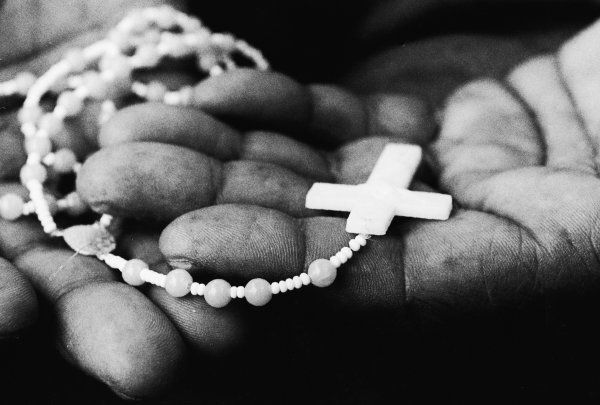
Each time the Blessed Virgin has appeared-- whether it be to Saint Bernadette Soubirous at Lourdes; to Lucia, Jacinta, and Francisco at Fatima; or to Mariette Beco at Banneux-- she has asserted the importance, saving grace, and power of praying the Holy Rosary on a daily basis. Based upon her words, the Rosary is penance and conversion for sinners, a pathway to peace, an end to war, and a powerful act of faith in Jesus Christ. Pope Paul VI presented the Rosary as a powerful means to reach Christ "not merely with Mary but indeed, insofar as this is possible to us, in the same way as Mary, who is certainly the one who thought about Him more than anyone else has ever done."

To show us how this is done, perhaps no one has been more eloquent than the great Cardinal Newman, who wrote: "The great power of the Rosary consists in the fact that it translates the Creed into Prayer. Of course, the Creed is already in a certain sense a prayer and a great act of homage towards God, but the Rosary brings us to meditate again on the great truth of His life and death, and brings this truth close to our hearts. Even Christians, although they know God, usually fear rather than love Him. The strength of the Rosary lies in the particular manner in which it considers these mysteries, since all our thinking about Christ is intertwined with the thought of His Mother, in the relations between Mother and Son; the Holy Family is presented to us, the home in which God lived His infinite love."


As Mary said at Fatima, "Jesus wants to use you to make Me known and loved. He wishes to establish the devotion to My Immaculate Heart throughout the world. I promise salvation to whoever embraces it; these souls will be dear to God, like flowers put by Me to adorn his throne."


Blessed Mariam Thresia Chiramel Mankidiyan, Servant of God

Posted by Jacob


“I do strongly believe that God will not ask us to suffer anything beyond our capacity.”

“You must have the awareness that you are in the presence of God.”

“Don't talk too much. What is the advantage of it? You talk as if you were honest and just. Only God knows the inside and outside.”

“Death will catch hold of us like a thief. Nobody knows at what age and when it happens.. When we die, we have to leave everything here on earth.”

“Love one another; help one another.”

"Suffer all the difficulties patiently and without murmuring."


Today, June 6, we celebrate the feast day of Blessed Mariam Thresia Chiramel Mankidiyan (also known as Mother Maria Theresa Chiramel, 1876-1926), Servant of God, foundress of the Congregation of the Holy Family, mystic, and visionary.  Mother Mariam Theresa is the fifth person from India to be beatified.  James Pazhayattil, Bishop of Irinjalakuda, said of her: “One of the five servants of God who are beatified by Pope John Paul II on April 9 could be a "lookalike" of Mother Teresa of Calcutta. Besides the name of baptism, Teresa, have in common not only the foundation of a religious congregation: one of the Missionaries of Charity, the other of the Holy Family, but most of all they both have distinguished service to the disadvantaged: the poor , the sick, the outcast, the dying. Both Mariam Thresia Chiramel Mankidiyan of Kerala and Mother Teresa of Calcutta sacrificed themselves for others, with a preferential love for the poorest of the poor and so practicing the evangelical virtue of charity in heroic degree.”

Born Thresia, the third of five children, in the village of Puthenchira (Trichur District), Kerala, India, the future Servant of God was called at an early age to devote her life to the Lord.  Although her family was once rich and noble, they had fallen on harder times, been forced to sell their property, and lived in poverty. Thresia’s father began drinking heavily, and the family suffered the injustices of poverty and prejudice.  Thresia, as a child, turned to the Blessed Mother, praying the Rosary several times each day, and fasting in the likeness of suffering Christ.  Despite her mother’s encouragement to eat, given that she had grown quite thin, Thresia persisted in her suffering for the salvation of the world, fasting four times per week, and consecrated herself and her virginity to the Lord

When Thresia was just twelve, her mother died, and she was forced to withdraw from elementary school.  While she longed to leave her life, now the caretaker of the family, and retire to a quiet life of prayer and contemplation, this was not to be possible.  Rather, she spent hours praying in the community Church, cleaning and decorating the altar.  She devoted herself to helping the poor, sick, and lonely of the parish.  She risked herself and her health to minister to the abandoned, specifically those with leprosy and small pox, who had no one else to care for them.  Despite the family’s poverty, she took in orphaned children, taking extra work to pay for their care.

Thresia and three young companions could be found working among those in need, taking to the streets against custom that women should be accompanied by men when leaving the home.  They formed a life of prayer and service, and placed their trust in the Holy Family of Jesus, Mary, and Joseph.  Around this time, Thresia began experiencing visions of the Holy Family, which guided her work.  She prayed for the conversion of sinners, fasted, and urged all toward repentance.  Following a vision of the Blessed Virgin, Thresia requested that all began referring to her as Mariam Thresia, at the request of the Holy Mother.

Mariam was also gifted with mystical and miraculous experiences.  She received several mystical gifts like prophecy, healing, aura of light, and sweet odor. She experienced frequent ecstasies and levitations. On Fridays, townspeople would gather to see Mariam Thresia lifted high and hanging in the form of a crucifix on the wall of her room.  She also bore the stigmata, which she kept secret from all, not wishing further attention. Mariam was further visited upon and tormented by demons throughout her life.  She humbly submitted to exorcisms, but also fully embraced the suffering of her temptations, offering suffering for those who sinned. 

In 1913, Mariam Thresia was permitted to build a prayer house, that she and her companions moved into.  They led a life of prayer and austere penance like hermits but continued to visit the sick and help the poor and the needy irrespective of religion or caste. The new religious order was consecrated the Congregation of the Holy Family (C.H.F.) and Mariam Thresia was appointed its first Superior.

The new congregation grew under the guidance and nurturance of Mother Mariam Thresia.  She built, in less than twelve years, three new convents, two schools, two hostels, a study house, and an orphanage.  Today, the Congregation of the Holy Family has 1584 professed Sisters, serving in Kerala, in the mission areas of North India, in Germany, Italy, and Ghana, with a total of 176 houses in 7 provinces and 119 novices.

Mother Mariam Thresia died in 1926, at the age of 50, from a wound suffered after being struck by a falling object.  Numerous miracles of healing followed her death, and she was beatified in 2000 by Pope John Paul II.

From the Beatification Homily of Pope John Paul II:

"Unless a wheat grain falls on the ground and dies, it remains only a single grain; but if it dies it yields a rich harvest" (Jn 12: 24). From childhood, Mariam Thresia Mankidiyan knew instinctively that God's love for her demanded a deep personal purification. Committing herself to a life of prayer and penance, Sr Mariam Thresia's willingness to embrace the Cross of Christ enabled her to remain steadfast in the face of frequent misunderstandings and severe spiritual trials. The patient discernment of her vocation eventually led to the foundation of the Congregation of the Holy Family, which continues to draw inspiration from her contemplative spirit and love of the poor.


Convinced that "God will give eternal life to those who convert sinners and bring them to the right path" (Letter 4 to her Spiritual Father), Sister Mariam devoted herself to this task by her visits and advice, as well as by her prayers and penitential practice. Through Bl. Mariam Thresia's intercession, may all consecrated men and women be strengthened in their vocation to pray for sinners and draw others to Christ by their words and example.


Saints Joseph Mkasa, Charles Lwanga, & 20 Martyrs of Uganda

Posted by Jacob

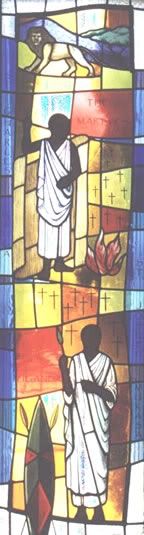
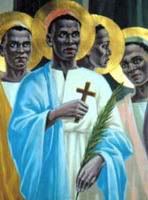
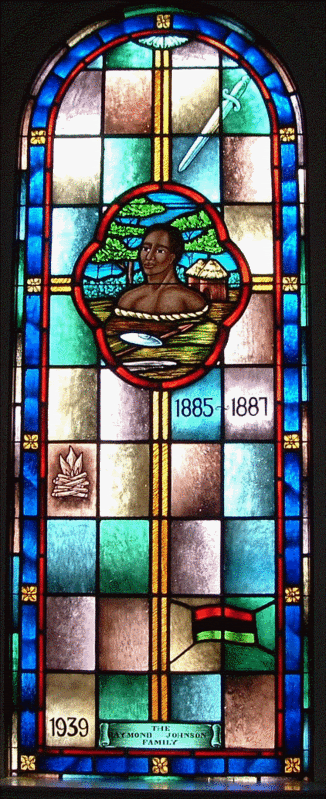
Today, June 3, we celebrate the feast day of Saints Joseph Mkasa, Charles Lwanga and 20 martyrs of Uganda (died 1886). These relatively modern-day saints and martyrs—mostly children—died for their faith with joy, as observed by witnesses of their martyrdom. Their courage and conviction reminds us that unquestioning trust in the Lord and the faith of a child are attributes to aspire to, even in the midst of our “adult” priorities, worries, and preoccupations.

The birth of the Church in Africa was built on the lives of courageous martyrs for the faith, whose death was the “spark” of the flames of Christian love. Missionaries spread the word of God, and often paid with their lives. The task of evangelizing quickly fell to the newly converted, who undertook the preaching of the Gospel with love and zeal. It is to another African from centuries before the deaths of the Ugandan martyrs, Tertullian (160–225), to whom we owe the aphorism “the blood of the martyrs is the seed of the Church.” For many Ugandan Christians, the seed of their Church is the blood of these 22 young men.

Today, the Catholic Church thrives in Uganda, but this was not always the case. In 1879, a French Catholic missionary group—the Society of Missionaries in Africa (also known locally as “the White Fathers”)—reached Uganda, and received permission from then-king Mutesa to live and evangelize in Uganda. Along with this group, King Mutesa authorized a Protestant and Muslim group of missionaries as well, all of whom worked, preached, and taught their faiths. The members and staff of the royal court became highly sought-after converts, and upon Mutesa’s successor seizing the throne, many of the royal court had already embraced Christianity. The struggle for power created a violent and dangerous atmosphere for the nation’s fledging Christians.

The newly ascended king—King Mwanga (the son of Mutesa, who had ruthlessly deposed his father)—was both violent and paranoid himself. He ruled his court through fear and coercion, and his pages—mostly youth—were under constant threat of his temper and sadistic tendencies. The Christians at Mwanga’s court struggled to protect the youth from their ruler, who began looking for opportunities to force them to renounce their faith (due to fears that the Church was gaining too much power, threatening his unstable monarchy).

Upon the martyrdom of the leader of the Christian community—Saint Joseph Mkasa—the instruction and safekeeping of the youth of the royal court fell to Charles Lwanga. Joseph had courageously stood up to the king, condemning his execution of a Protestant missionary. The king, who had previously considered Joseph a friend (after he had saved his life from a poisonous viper with his bare hands), ordered him bound and burnt alive. He was fueled by the advice of his trusted advisors, who repeatedly stated that Joseph’s allegiance lay with “another king”—the King God of the Christians. Prior to death, Joseph forgave the king, pleading the case of the children. He stated to the executioner, “A Christian who gives his life for God is not afraid to die. Tell Mwanga, that he has condemned me unjustly, but I forgive him with all my heart.” The executioner was so impressed with Mukasa that he beheaded him swiftly before tying him to the stake and burning his body. His powerful witness inspired what happened next.

Charles Lwanga picked up where Joseph had left off, organizing prayer meetings for the youth of the court, and generally keeping them out of the king’s hands. This, however, aroused the paranoia and suspicion of Mwanga, who after ruthless questioning of one of the pages, determined that religious instruction was poisoning the minds of the youth and preventing them from acquiescing to his orders. The youth, no more than 13, informed the king of his teacher’s name-- Denis Ssebuggwawo—who the king promptly had executed by sticking a spear through his throat.

Religious instruction and prayer was forbidden at the court following that incident, but the Christians—on fire for their faith—were unable to be deterred. When little changed, King Mwanga ordered the royal court sealed-- no one could come or go, except the royal executioners whom he had summoned. He gathered all the attendants in the throne room, dividing them into two groups: Christian and non-Christian. He stated, “Those who do not pray stand by me, those who do pray stand over there." In all 20 young men and boys chose the “Christian” group. When Mwanga asked them if they intended to remain Christian, they gave a joyful affirmation, and were promptly sentenced to death. With death imminent, Charles Lwanga baptized those youth ready for baptism, in preparation for their ascent to heaven.

The 20 boys and young men were ordered on a 37 mile march to the place of execution—a journey which would take them past the home of the White Fathers who greeted them on the road, offering absolution. The missionaries would later remark that the boys were laughing and talking on their way to death, filled with joy at their imminent journey to heaven, and filled with the courage of the Lord. Of primary notice was a 13 year old youth, Kizito (one who had been baptized shortly before by Lwanga), who also drew the attention of the guards. He, and two companions, were killed upon the road. His companions, Andrew Kagwa, a local chief—had converted many to Christianity, and Matthias Murumba, an assistant judge, raising the ire of the counselor in charge of the execution party. When the counselor described what he was going to do with Matthias, he mocked the men, saying, "No doubt his god will rescue him." Matthias answered peacefully, "Yes, God will rescue me. But you will not see how he does it, because he will take my soul and leave you only my body." Matthias was cut up on the road and left to die with Andrew and Kizito -- it took him at least three days to slowly bleed to death from his injuries.

Upon arrival at the place of execution—Namugongo—the now 17 prisoners were locked up for 8 days while a large funeral pyre was constructed. During that time, the martyrs prayed and sang together, relishing in the love of God. On June 3rd, before turning their attention to the main group of prisoners, the executioners put Charles Lwanga to death on a small pyre on the hill above the execution place. He was wrapped in a reed mat, with a slave yoke on his neck, and was forced to arrange his funeral pyre himself. To increase his suffering, the fire was first lit under his feet and legs. These were burnt to charred bones before the flames were allowed to reach the rest of his body. Taunted by the executioner, Charles replied: "You are burning me, but it is as if you are pouring water over my body." He then remained quietly praying. Just before the end, he cried out in a loud voice "Katonda! (My God!).”

Following his death, the remaining youth were tightly wrapped in reed mats, had their feet removed, and were burnt alive in a large funeral pyre. Among those who perished was Mbaga, the son of the chief executioner, who had converted to Christianity and resisted his father’s pleas to renounce his faith. The youth died calling on the name of Jesus and proclaiming, "You can burn our bodies, but you cannot harm our souls."

Also among the martyrs was a soldier, converted to Christianity, James Buzabaliawo. When sentenced to death by the king, the brave soldier joyfully stated, "Goodbye, then. I am going to Heaven, and I will pray to God for you." On his way to death, he passed by one of the White Fathers, Father Lourdel, who recorded many of the events leading up to the execution. Upon sensing the sadness of the White Father, James smiled, pointed to heaven, and stated, "Why are you so sad? This is nothing to the joys you have taught us to look forward to."

The twenty-two Roman Catholics martyrs celebrated on June 3 include:

Achilles Kiwanuka
Adolphus Ludigo-Mukasa
Ambrose Kibuuka
Anatoli Kiriggwajjo
Andrew Kaggwa
Antanansio Bazzekuketta
Bruno Sserunkuuma
Charles Lwanga
Denis Ssebuggwawo
Gonzaga Gonza
Gyavira
James Buuzabalyawo
John Maria Muzeeyi
Joseph Mukasa Balikuddembe
Kizito
Luka Baanabakintu
Matia Mulumba
Mbaga Tuzinde
Mugagga
Mukasa Kiriwawanvu
Noa Mawaggali
Ponsiano Ngondwe

Along with these brave men were eleven Anglican and Protestant martyrs. The martyrs at Namugongo were not Mwanga’s only victims. Dozens more Christians were killed in the surrounding countryside, and some of those who had taught the faith were singled out for special retribution. Many of their names are lost to history, but their sacrifice for the faith is remembered.

Following these deaths, missionaries working in Uganda were expelled, and forbidden to re-enter the country until King Mwanga’s death. However, fueled by the courageous deaths of the martyrs, underground Christianity spread throughout the country, and upon the return of missionaries, an active faith community emerged.

Pope Paul VI spoke of the faith legacy of the Ugandan martyrs in his homily celebrating their canonization:

"The African martyrs add another page to the martyrology – the Church’s roll of honor – an occasion both of mourning and of joy. This is a page worthy in every way to be added to the annals of that Africa of earlier which we, living in this era and being men of little faith, never expected to be repeated.


In earlier times there occurred those famous deeds, so moving to the spirit, of the martyrs of Scilli, of Carthage, and of that “white robed army” of Utica commemorated by Saint Augustine and Prudentius; of the martyrs of Egypt so highly praised by Saint John Chrysostom, and of the martyrs of the Vandal persecution. Who would have thought that in our days we should have witnessed events as heroic and glorious?


Who could have predicted to the famous African confessors and martyrs such as Cyprian, Felicity, Perpetua and – the greatest of all – Augustine, that we would one day add names so dear to us as Charles Lwanga and Matthias Mulumba Kalemba and their 20 companions? Nor must we forget those members of the Anglican Church who also died for the name of Christ.


These African martyrs herald the dawn of a new age. If only the mind of man might be directed not toward persecutions and religious conflicts but toward a rebirth of Christianity and civilization!


Africa has been washed by the blood of these latest martyrs, the first of this new age (and, God willing, let them be the last, although such a holocaust is precious indeed). Africa is reborn free and independent.


The infamous crime by which these young men were put to death was so unspeakable and so expressive of the times. It shows us clearly that a new people needs a moral foundation, needs new spiritual customs firmly planted, to be handed down to posterity. Symbolically, this crime also reveals that a simple and rough way of life – enriched by many fine human qualities yet enslaved by its own weakness and corruption – must give way to a more civilized life wherein the higher expressions of the mind and better social conditions prevail.”


O God, by whose providence the blood of the martyrs is the seed of the Church: Grant that we who remember before you the blessed martyrs of Uganda, may, like them, be steadfast in our faith in Jesus Christ, to whom they gave obedience, even unto death, and by their sacrifice brought forth a plentiful harvest; through Jesus Christ our Lord, who lives and reigns with you and the Holy Spirit, one God, for ever and ever.


Saint Blandina and the Martyrs of Lyon

Posted by Jacob


Today, we celebrate the feast day of Saint Blandina (162-177) and the martyrs of Lyons, France.  As described in the Roman Martyrology: “At Lyons in Gaul, the holy martyrs Pothinus, bishop, Sanctus, deacon, Vetius Epagathus, Maturus, Ponticus, Biblis, Attalus, Alexander, and Blandina, with many others. Their mighty and repeated contests are confirmed by a letter written from the Church of Lyons to the Churches of Asia and Phrygia, in the reign of Marcus Aurelius Antoninus and Lucius Verus. Among these martyrs was Saint Blandina, who though weaker because of her sex, more feeble in body, and less spirited because of her servile state, underwent more prolonged and sharper trials. However, her courage did not fail, and when her throat was cut, she followed to Heaven the other martyrs whom she had encouraged to victory.”

Saint Blandia was slave to a Christian family, caring for the young girls of the household.  Having witnessed the Gospel from the family she worked for, Blandina converted to Christianity, despite the violent oppression and persecution of Christians at the hands of Roman emperor Marcus Aurelius.  During his reign, the fanaticism of the occupants of Lyon had been fanned like flames, and many harassed and mistreated their Christian neighbors, identifying them to the authorities, and handing them over to the Roman governor of the region.  Among those identified were Saint Pothinus (also celebrated today), the bishop of Lyons, Saint Irenaeus (a priest who had been sent to Lyons by Saint Polycarp), and Saint Blandina.

The accused were imprisoned, and left to starve for some time, prior to being brought before the imperial legate.  All those imprisoned, including Blandina’s Christian mistress, feared for her life, as she was of slight frame, frail, and of gentle spirit.  Knowing that torture was to be their lot, they encouraged her to recant her faith, so as to save herself, but she refused.  In the end, Saint Blandina withstood the most horrific and painful of tortures with joy, all the while offering encouragement to her companions.  It is said that her executioners eventually became exhausted from their efforts, and grew to respect her quiet courage and steadfast response to every question or accusation levied against her: "I am a Christian, and we commit no wrongdoing."

Saint Blandina and her companions were accused of cannibalism, a twisted interpretation of the practice of receiving the Eucharist. The legate, wishing to extract confessions from the accused, continued to offer new and barbaric tortures, eventually beheading those of Roman citizenship (as per the emperor’s decree).  However, those who were not citizens, including Blandina, could continue to be tortured. 


Saint Blandina was taken to the town’s amphitheater, known as the Amphitheater of the Three Gauls, at the time of the town’s public games.  She was tied to a rough stake and wild beasts were set upon her.  However, they did not touch her, and rather laid at her feet. She was left for several days, with the animals loose beside her, but they never harmed or attacked her.  During this time, she was forced to watch her companions tortured and killed, the last among them her younger brother.  As the last of the martyrs, she was scourged, burned upon a hot grate over coals, bound in a net and thrown before a wild steer who trampled her.  Following these tortures, Saint Blandina was killed with a dagger, ending her suffering, and earning her the crown of martyrdom.

Her mangled body was placed on display for six days, and following this indignity, was thrown into the Tiber River so as to prevent local Christians from burying it.  Miraculously, however, her relics were delivered by the Lord to the faithful for enshrinement, and were interred in a local church.

Saint Eusebius recorded a letter, sent by some Christian survivors in Lyons.  In this letter, it was written: 

"But the whole wrath of the populace, and governor, and soldiers was aroused exceedingly against Sanctus, the deacon from Vienne, and Maturus, a late convert, yet a noble combatant, and against Attalus, a native of Pergamos where he had always been a pillar and foundation, and Blandina, through whom Christ showed that things which appear mean and obscure and despicable to men are with God of great glory, through love toward him manifested in power, and not boasting in appearance. For while we all trembled, and her earthly mistress, who was herself also one of the witnesses, feared that on account of the weakness of her body, she would be unable to make bold confession, Blandina was filled with such power as to be delivered and raised above those who were torturing her by turns from morning till evening in every manner, so that they acknowledged that they were conquered, and could do nothing more to her. And they were astonished at her endurance, as her entire body was mangled and broken; and they testified that one of these forms of torture was sufficient to destroy life, not to speak of so many and so great sufferings. But the blessed woman, like a noble athlete, renewed her strength in her confession; and her comfort and recreation and relief from the pain of her sufferings was in exclaiming, 'I am a Christian, and there is nothing vile done by us.'

Maturus, therefore, and Sanctus and Blandina and Attalus were led to the amphitheatre to be exposed to the wild beasts, and to give to the heathen public a spectacle of cruelty, a day for fighting with wild beasts being specially appointed on account of our people. Both Maturus and Sanctus passed again through every torment in the amphitheatre, as if they had suffered nothing before, or rather, as if, having already conquered their antagonist in many contests, they were now striving for the crown itself. They endured again the customary running of the gauntlet and the violence of the wild beasts, and everything which the furious people called for or desired, and at last, the iron chair in which their bodies being roasted, tormented them with the fumes. And not with this did the persecutors cease, but were yet more mad against them, determined to overcome their patience. But even thus they did not hear a word from Sanctus except the confession which he had uttered from the beginning. These, then, after their life had continued for a long time through the great conflict, were at last sacrificed, having been made throughout that day a spectacle to the world, in place of the usual variety of combats.

But Blandina was suspended on a stake, and exposed to be devoured by the wild beasts who should attack her. And because she appeared as if hanging on a cross, and because of her earnest prayers, she inspired the combatants with great zeal. For they looked on her in her conflict, and beheld with their outward eyes, in the form of their sister, him who was crucified for them, that he might persuade those who believe on him, that every one who suffers for the glory of Christ has fellowship always with the living God. As none of the wild beasts at that time touched her, she was taken down from the stake, and cast again into prison. She was preserved thus for another contest, that, being victorious in more conflicts, she might make the punishment of the crooked serpent irrevocable; and, though small and weak and despised, yet clothed with Christ the mighty and conquering Athlete, she might arouse the zeal of the brethren, and, having overcome the adversary many times might receive, through her conflict, the crown incorruptible.

After all these, on the last day of the contests, Blandina was again brought in, with Ponticus, a boy about fifteen years old. They had been brought every day to witness the sufferings of the others, and had been pressed to swear by the idols. But because they remained steadfast and despised them, the multitude became furious, so that they had no compassion for the youth of the boy nor respect for the sex of the woman. Therefore they exposed them to all the terrible sufferings and took them through the entire round of torture, repeatedly urging them to swear, but being unable to effect this; for Ponticus, encouraged by his sister so that even the heathen could see that she was confirming and strengthening him, having nobly endured every torture, gave up the ghost. But the blessed Blandina, last of all, having, as a noble mother, encouraged her children and sent them before her victorious to the King, endured herself all their conflicts and hastened after them, glad and rejoicing in her departure as if called to a marriage supper, rather than east to wild beasts. And, after the scourging, after the wild beasts, after the roasting seat, she was finally enclosed in a net, and thrown before a bull. And having been tossed about by the animal, but feeling none of the things which were happening to her, on account of her hope and firm hold upon what had been entrusted to her, and her communion with Christ, she also was sacrificed. And the heathen themselves confessed that never among them had a woman endured so many and such terrible tortures. 
But not even thus was their madness and cruelty toward the saints satisfied. For incited by the Wild Beast, wild and barbarous tribes were not easily appeased, and their violence found another peculiar opportunity in the dead bodies. For, through their lack of manly reason, the fact that they had been conquered did not put them to shame, but rather the more enkindled their wrath as that of a wild beast, and aroused alike the hatred of governor and people to treat us unjustly; that the Scripture might be fulfilled: 'He that is lawless, let him be lawless still, and he that is righteous, let him be righteous still.' For they cast to the dogs those who had died of suffocation in the prison, carefully guarding them by night and day, lest any one should be buried by us. And they exposed the remains left by the wild beasts and by fire, mangled and charred, and placed the heads of the others by their bodies, and guarded them in like manner from burial by a watch of soldiers for many days. And some raged and gnashed their teeth against them, desiring to execute more severe vengeance upon them; but others laughed and mocked at them, magnifying their own idols, and imputed to them the punishment of the Christians. Even the more reasonable, and those who had seemed to sympathise somewhat, reproached them often, saying, 'Where is their God, and what has their religion, which they have chosen rather than life, profited them?' So various was their conduct toward us; but we were in deep affliction because we could not bury the bodies. For neither did night avail us for this purpose, nor did money persuade, nor entreaty move to compassion; but they kept watch in every way, as if the prevention of the burial would be of some great advantage to them.
The bodies of the martyrs, having thus in every manner been exhibited and exposed for six days, were afterward burned and reduced to ashes, and swept into the Rhone by the wicked men, so that no trace of them might appear on the earth. And this they did, as if able to conquer God, and prevent their new birth; 'that,' as they said, 'they may have no hope of a resurrection, through trust in which they bring to us this foreign and new religion, and despise terrible things, and are ready even to go to death with joy. Now let us see if they will rise again, and if their God is able to help them, and to deliver them out of our hands.'"



Amphitheater at Lyon.  The pillar visible is a memorial to the Martyrs of Lyon.

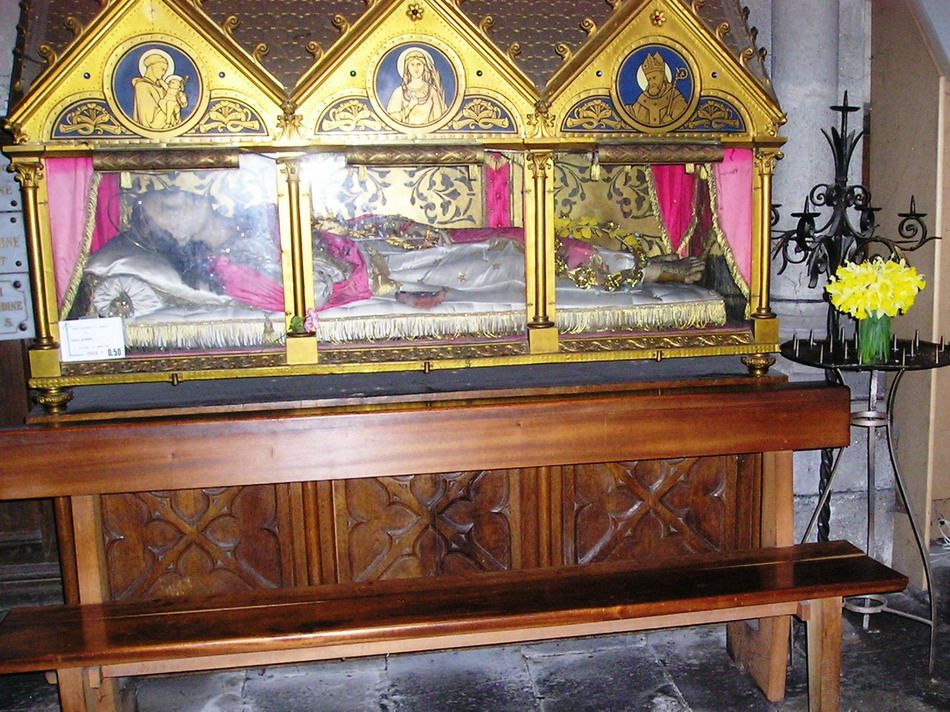
Relics of Saint Blandina


The life and courage of Saint Blandina and the Martyrs of Lyon inspire us today to gladly and profoundly profess our faith.  We pray today for the courage and strength to live our Gospel lives for the world, never shying away from the truth of Jesus Christ, and His message of peace, hope, and love.

A Prayer for Strength and Courage

My Lord God, through whom strength is made perfect in weakness, 
I pray to you, give me the strength I need.
You have said, that to your children who have no might, you will increase strength. 
I am weak. Bless me with a measure of strength, as may be sufficient for me.
When I am tempted by evil, deliver me, by granting me the power to overcome it. 
When my daily work is too hard for me, give me the strength to be able to do it.
If my burden oppresses me beyond my bearing, lighten my load, that my strength may be equal to it.
You have helped many, I beg you to help me.
Thank you my Lord. Amen. 

June 1: Saint Fortunatus of Spoleto, Model of Charity

Posted by Jacob


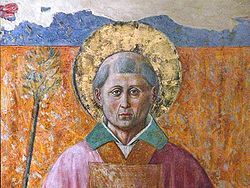
Today, June 1, we celebrate the feast day of Saint Fortunatus of Spoleto (also known as Saint Fortunatus of Territet, fourth century).  As described in the Roman Martyrology, “At Montefalco in Umbria, Saint Fortunatus, a priest renowned for his virtues and his miracles.”

The Acts of Saint Fortunatus were recorded in the seventh century, by a priest named Audelaus, based upon the verbal account of a venerable priest named Firmino.  According to this record, Fortunatus was a priest of the church of Turrita, near the Umbrian town of Montefalco, Italy.  He was a caretaker for the many valuables of the Church—specifially, the poor, and he brought them the deepest and most profound mysteries of the Church alongside the charity that he was keen to offer them in Jesus' name.

Although he was a priest, this offered him barely enough money to live upon, and so as well as tending to his priestly flock, Saint Fortunatus is remembered for also working as a farmer, living off the land he tilled, and sharing all he could tend and raise with those in need.  He is frequently described as driving cattle with a small stick, stopping to distribute all he owned the poor.

One particular legend recounts how while tilling the earth one day, Saint Fortunatus discovered two dull coins, seemingly worth very little.  Thanking God, and slipping the coins in his pocket, he continued his work until sunset, certain and confident that the Lord would inspire him as to how to use the newly discovered currency.  As the sun set, Saint Fortunatus began driving his cattle home.  Upon the road, the saintly man met a poor beggar, and reaching into his pocket discovered that the dull coins had been transformed into radiant gold.  Rather than keep the coins, he quickly gave them away to the beggar, overcoming his own avarice.  In this manner, Saint Fortunatus demonstrates how to overcome greed, converting wealth and desire into love for those in need.

Upon his death, it is said that he was buried in a field called the “Agellus,” which he had frequently tended.  The rod that he had used to dive his oxen miraculously flowered and grew into a majestic tree, when stuck into the ground following his death.  He is often depicted holding a rod which appears to be flowering at its tip.

It is said that 20 years following the death of Saint Fortunatus, Saint Severus stopped at his grave en route to Ravenna where he was to stand trial.  Praying for the intercession of the saint, he was acquitted and returned to build a church on the spot of Fortunatus’ burial.  The church was consecrated on August 8, 422, by Bishop Spes of Spoleto, and the relics of the saint were translated to its altar.

While we know little about the life of Saint Fortunatus, we recognize in him the calling to the path of service that the Lord provided, and the refinement of his own sins through the grace of God and practice of charity.  We look to Saint Fortuantus as a reminder and inspiration that we, too, are called to share what we have with those in need, that regardless of our current struggles, there are those in worse situations, and that through our charitable works, we radiate the love of God on earth for all to see.

We pray, today, for the inspiration of Saint Fortuatus, that we may live lives of charity and love for all we encounter.


Our Catholic Act of Charity

O my God, I love you above all things with my whole heart and soul because you are all good  and worthy of all my love.

I love my neighbor as myself for the love of you.

I forgive all who have injured me and ask pardon of all whom I have injured. Amen. 


Prayer for Selflessness

O Dearly beloved Word of God, teach me to be generous, to serve Thee as Thou dost deserve, to give without counting the cost, to fight without fretting at my wounds, to labor without seeking rest, to spend myself without looking for any reward other than that of knowing that I do Thy holy will. Amen.


Prayer for Charitable Heart

O my Jesus, Thou who art very Love,
enkindle in my heart that Divine Fire
which consumes the Saints and transforms them into Thee.

O Lord our God,
we offer Thee our hearts
united in the strongest and most sincere love of brotherhood;
we pray that Jesus in the Blessed Sacrament
may be the daily food of our souls and bodies;
that Jesus may be established as the center of our affections,
even as He was for Mary and Joseph.
Finally, O Lord, may sin never disturb our union on earth;
and may we be eternally united in heaven with Thee
and Mary and Joseph and with all Thy Saints.

Amen.

Friday Prayer Requests

Posted by Jacob

Please join me in praying for those intentions submitted by readers over the past week.  Together, we raise our voices in prayer.

"And pray in the Spirit on all occasions with all kinds of prayers and requests. With this in mind, be alert and always keep on praying for all the saints." (Ephesians 6:18)

 "Do not be anxious about anything, but in everything, by prayer and petition, with 
thanksgiving, present your requests to God." (Philippians 4:6)


Financial assistance, Restoration of a relationship (E, Nigeria); For blessings and health upon a family, for peace, for occupational success (K, Algeria); For health for a couple, for the blessings of a family (Y, South Africa); For continued increase in devotion and return to the community of faith (L, USA); Blessings upon a couple preparing for marriage (L, USA-NE);  Restoration of a failed marriage (M, India); Occupational success, financial security, continued blessings and the true conversion of faith (G, India); Expedient immigration, end to legal and financial difficulties, occupational success, health (K, India); For a son suffering from depression (L, France); Healing upon a couple, blessings of conception (D, Philippines); Financial support, health and healing, end to anxiety and difficulties, blessings for a family (E, Indonesia); Blessings, healing, and safe return upon an abducted brother (N, Zimbabwe).


"Hear my prayer, O God; listen to the words of my mouth." (Psalm 54:2)
 
"If you believe, you will receive whatever you ask for in prayer." (Matthew 21:22)