Why pray the Rosary every day for a year?


Each time the Blessed Virgin has appeared-- whether it be to Saint Bernadette Soubirous at Lourdes; to Lucia, Jacinta, and Francisco at Fatima; or to Mariette Beco at Banneux-- she has asserted the importance, saving grace, and power of praying the Holy Rosary on a daily basis. Based upon her words, the Rosary is penance and conversion for sinners, a pathway to peace, an end to war, and a powerful act of faith in Jesus Christ. Pope Paul VI presented the Rosary as a powerful means to reach Christ "not merely with Mary but indeed, insofar as this is possible to us, in the same way as Mary, who is certainly the one who thought about Him more than anyone else has ever done."

To show us how this is done, perhaps no one has been more eloquent than the great Cardinal Newman, who wrote: "The great power of the Rosary consists in the fact that it translates the Creed into Prayer. Of course, the Creed is already in a certain sense a prayer and a great act of homage towards God, but the Rosary brings us to meditate again on the great truth of His life and death, and brings this truth close to our hearts. Even Christians, although they know God, usually fear rather than love Him. The strength of the Rosary lies in the particular manner in which it considers these mysteries, since all our thinking about Christ is intertwined with the thought of His Mother, in the relations between Mother and Son; the Holy Family is presented to us, the home in which God lived His infinite love."


As Mary said at Fatima, "Jesus wants to use you to make Me known and loved. He wishes to establish the devotion to My Immaculate Heart throughout the world. I promise salvation to whoever embraces it; these souls will be dear to God, like flowers put by Me to adorn his throne."


February 18, 2013: Saint Giovanni of Fiesole, "Fra Angelico"

Posted by Jacob

Today, February 18, we celebrate the feast day of the saint of Christian artists, Blessed John of Fiesole (1387-1455), or Fra Angelico as he came to be known.

Guido di Pietro was born in Tuscany, in a small village outside Florence in 1387. Early in his life, his parents recognized their son’s artistic talent and capabilities. He, along with his brother, was sent to the Dominican monastery at Fiesole to study painting. While there, he joined the Dominican Order in 1407, taking the name John (Giovanni). He worked tirelessly, illustrating illuminated manuscripts, with John explaining his painting as a way in which he could “preach the Love of God.” Throughout his artistic career—one which art historians have labeled “perfect”—he never painted a picture that didn’t address Christian themes. It is further said that he never picked up a paintbrush without having first prayed.

As his gifts became more and more apparent, John was commissioned to do paintings and frescoes in Florence and Rome, including the Chapel of the Holy Sacrament at Saint Peter’s Basilica in the Vatican (later destroyed). His brother, also having joined the Dominican Order, often acted as his assistant. Able to capture the adoration and sublime love for Christ on the faces of those he painted, John of Fiesole became known Fra Giovanni Angelico (Brother John, the Angelic One). His life and work were recognized to be pure, inspired, and from God. He is remembered for a pious, but simple, heart and is credited with saying: “He who does Christ’s work must stay with Christ always.”

Many of Saint John of Fiesole’s most famous works are painted in the cells of the former monastery of Saint Marco in Florence. He and his brother painted approximately fifty frescos that are at once the expression of and a guide to the spiritual life of the community. “Many of the frescos are in the friars' cells and were intended as aids to devotion; with their immaculate coloring, their economy in drawing and composition, and their freedom from the accidents of time and place, they attain a sense of blissful serenity” (from WebMuseum, Paris).
Fra Angelico died while staying at a Dominican convent in Rome, having painted that day. His epitaph (translated) reads:

When singing my praise, don't liken my talents to those of Apelles.
Say, rather, that, in the name of Christ, I gave all I had to the poor.
The deeds that count on Earth are not the ones that count in Heaven.
I, Giovanni, am the flower of Tuscany.


John Paul II said of Fra Angelico at his beatification in 1982, that his work was “the fruit of that highest harmony which flowed from the combination of a holy life and creative power.”

Fra Giovanni Angelico painted incredibly beautiful and poignant pictures from the lives of Christ, the Blessed Virgin, and the saints (some of which are pictured below). His every brushstroke, and indeed, his every breath, came from God and glorified God. He used his talents—art—to bring the message of salvation to the world. In contemplating the life of this talented artist, we are called to look inward to our own gifts. However small they may seem to us, they are precious gifts and abilities given to us from the Lord. When we choose to use them, we do so in honor of our Maker, and through their display, glorify the magnificence of creation. How might we use our gifts to glorify the Lord and serve each other during Lent?


Annunciation (1439-1443)


Nativity (1439-1443)


Crucified Christ with Saint John the Evangelist, the Virgin, and Saints Dominic and Jerome (1439-1443)


Lamentation (1439-1443)


Noli Me Tangere (Do not touch Me) (1439-1443)


February 18, 2013: Our Lady of Lourdes, The Third Apparition

Posted by Jacob

We continue our re-publishing of previous posts chronicling the miraculous unfolding of events that took place at Lourdes in 1858. Our Lady of Lourdes, pray for us!

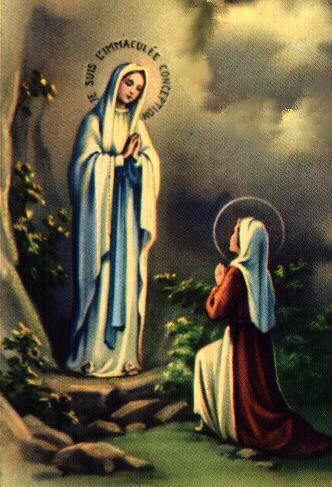
Our Blessed Mother appeared for the third time to Bernadette Soubirous on February 18. As you may recall, Bernadette was a simple girl, uneducated in the way of the Catechism, but deeply faithful despite countless hardships. We know that she carried a Rosary with her at all times, but prior to the visits from Our Blessed Mother, had not yet mastered all the prayers. Beginning on February 11, 1858, The Blessed Virgin appeared to Saint Bernadette a total of 18 times in Lourdes, France. The final visitation occurred on July 16, 1858. Since that time, hundreds of millions of pilgrims have visited Lourdes, with crowds reaching 40,000 on average during busier times of year. Over 60 miraculous cures have been recorded in the grotto where the Blessed Virgin appeared, or due to the curative properties of the spring which appeared during the apparitions.


Our Blessed Lady of Lourdes


Following the second apparition of Mary in the grotto as Massabielle on February 14, Bernadette’s mother had forbidden her to return, as the small community had begun to gossip about the already beleaguered family. However, the talk had attracted the attention of one of the town’s wealthier residents, Jeanne-Marie Milhet. As it just so happened, Bernadette’s mother worked for Madame Milhet doing washing and mending from time to time. When her employer pressed her to allow Bernadette to return to the grotto with her, Bernadette’s mother had no choice but to give in. On February 18, Bernadette, accompanied by Madame Milhet and a companion, visited the grotto. Madame Milhet believed that the woman visiting Bernadette was a deceased friend, known for her piety in the village.

Upon arriving at the grotto, Bernadette fell to her knees and began praying the Rosary, joined by the others. She was immediately graced by the appearance of the beautiful lady, and informed the others. They could not see her, however, and were disappointed. Upon finishing the Rosary, again during which Our Blessed Mother prayed concurrently, but without words, Bernadette approached the vision, extending her hands which contained a pen and paper. Despite being unable to read or write, she had been coached by Madame Milhet to ask for a written name.

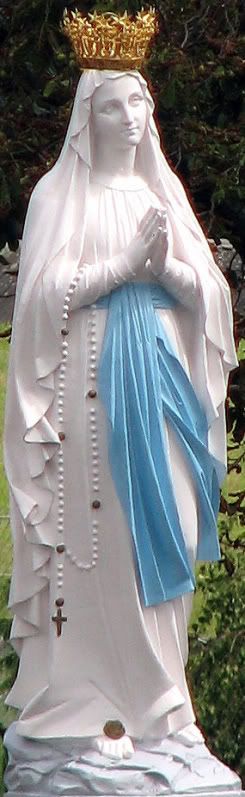
“Would you be kind enough to write your name down?” Bernadette inquired, again afraid. The beautiful young lady, clothed in white with a blue sash and yellow roses on her feet, smiled gently and spoke for the first time. She said, “It is not necessary. What I have to say to you does not need to be written down.” Surprisingly, she answered Bernadette in the local dialect in which she had been spoken to. Still smiling, she inquired of Bernadette, “Would you have the kindness to come here for a fortnight?” (In this case, fifteen days). In this case, however, she used formal language, the first time anyone had spoken to Bernadette in that manner.  In that moment, Bernadette reported that the Blessed Virgin looked at her "as one person looks at another person"-- as a person worthy of love, respect, and human dignity.

Bernadette, joy overcoming fear, promised that she would. Our Blessed Mother replied with a promise of her own. “I do not promise to make you happy in this life, but in the other.” She then disappeared.

Bernadette reported to her companions that she was most sure that it was not Madame Milhet’s deceased friend who she was conversing with. Together they returned to town, with Bernadette recounting the events of the day to her mother, and gaining permission to return to the grotto for the next fifteen days. The others who had accompanied her reported that Bernadette had been entranced, speaking aloud, but receiving no replies that were audible to the onlookers. Interest in the story continued to grow throughout the small town. Bernadette would return to the grotto each day, as promised, and during that time would be blessed by the presence of Our Blessed Mother.


O Brilliant star of purity,

Mary Immaculate,
Our Lady of Lourdes,
glorious assumption,
triumphant in your coronation,
show unto us the mercy of the Mother of God,
Virgin Mary,
Queen and Mother,
be our comfort, hope, strength,
and consolation. Amen.

Our Lady of Lourdes, pray for us.
Saint Bernadette, pray for us.

February 16, 2013: Saint Onesimus, the "Saved Slave"

Posted by Jacob


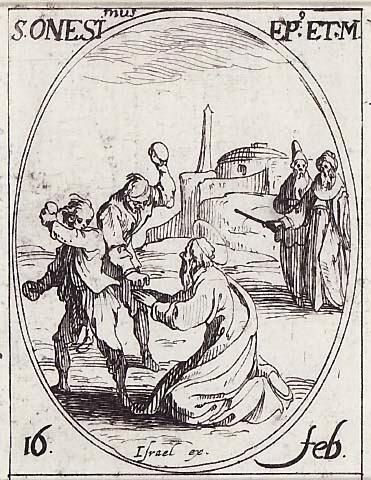
Today, February 16, we celebrate the feast day of Saint Onesimus, the “Saved Slave” (died 68, also know as Saint Onesimus of Byzantium and the Holy Apostle Onesimus).  Saint Onesimus was a slave to Philemon who was converted by Saint Paul. Onesimus had stolen from Philemon, and was forced to flee for safety.  He sought out Saint Paul, who was being held captive in Rome.  There, Saint Paul received him with kindness and love, helping him realize that his theft was wrong.  Not only did Onesimus repent for his crimes, he accepted the Christian faith and was baptized by Saint Paul.

Filled with the Holy Spirit, Onesimus was sent back to Philemon accompanied by a beautiful letter penned by the imprisoned saint.  In Paul’s Epistle to Philemon, he makes a strong case for Philemon to grant Onesimus his freedom, so that he might accompany Paul and preach the Gospel as a disciple. 

1 Paul, a prisoner of Jesus Christ, and Timothy our brother, unto Philemon our dearly beloved, and fellow laborer,
2 And to our beloved Apphia, and Archippus our fellow soldier, and to the church in thy house:
3 Grace to you, and peace, from God our Father and the Lord Jesus Christ.
I thank my God, making mention of thee always in my prayers,
Hearing of thy love and faith, which thou hast toward the Lord Jesus, and toward all saints;
6 That the communication of thy faith may become effectual by the acknowledging of every good thing which is in you in Christ Jesus.
7 For we have great joy and consolation in thy love, because the bowels of the saints are refreshed by thee, brother.
8 Wherefore, though I might be much bold in Christ to enjoin thee that which is convenient,
9 Yet for love's sake I rather beseech thee, being such an one as Paul the aged, and now also a prisoner of Jesus Christ.
10 I beseech thee for my son Onesimus, whom I have begotten in my bonds:
11 Which in time past was to thee unprofitable, but now profitable to thee and to me:
12 Whom I have sent again: thou therefore receive him, that is, mine own bowels:
13 Whom I would have retained with me, that in thy stead he might have ministered unto me in the bonds of the gospel:
14 But without thy mind would I do nothing; that thy benefit should not be as it were of necessity, but willingly.
15 For perhaps he therefore departed for a season, that thou shouldest receive him for ever;
16 Not now as a servant, but above a servant, a brother beloved, specially to me, but how much more unto thee, both in the flesh, and in the Lord?
17 If thou count me therefore a partner, receive him as myself.
18 If he hath wronged thee, or oweth thee ought, put that on mine account;
19 I Paul have written it with mine own hand, I will repay it: albeit I do not say to thee how thou owest unto me even thine own self besides.
20 Yea, brother, let me have joy of thee in the Lord: refresh my bowels in the Lord.
21 Having confidence in thy obedience I wrote unto thee, knowing that thou wilt also do more than I say.
22 But withal prepare me also a lodging: for I trust that through your prayers I shall be given unto you.
23 There salute thee Epaphras, my fellow prisoner in Christ Jesus;
24 Marcus, Aristarchus, Demas, Lucas, my fellow laborers.
25 The grace of our Lord Jesus Christ be with your spirit. Amen.

Philemon, for his part, forgave Onesimus, and he promptly returned to his spiritual father in prison.  Thereafter, he faithfully served Saint Paul, and among his many deeds, bore Paul’s Epistle to the Colossians on its journey of faith.

Saint Onesimus, as recorded by Saint Jerome and other Church fathers, became a zealous preacher of the Gospel throughout the region, eventually succeeding Saint Timothy as bishop of Ephesus.  There he preached frequently and ardently, inflamed with love and the Holy Spirit.  His preaching, of course, attracted the attention of the authorities, and during the persecutions under Emperor Trajan, he was arrested and taken in chains to Rome.  There, he was imprisoned for 18 days, during which time he was encouraged to recant his faith.  When he refused, his legs and thighs were broken with bludgeons, and he was subsequently stoned to death.  Following his death, his head was separated from his body with a sword, and local Christians buried him in a silver coffin.

The life of Saint Onesimus is one that holds great lessons for us as Christians.  Paul brings Onesimus to the faith through gentle love and support, coupled with firm teachings grounded in Christian virtue:  to truly become free, one must repent and ask forgiveness for sinful behavior.  And with that freedom, the soul can grow and flourish into a great vehicle of God’s love and grace, illustrated by the life of Onesimus and the many he brought to Christ.


God of liberty, through Saint Paul the Apostle you brought your servant Saint Onesimus to spiritual and temporal freedom; liberate us, we pray, so that we may be equipped to serve you fully.  We ask this through Christ, our Lord and Savior.  Amen.

February 15, 2013: Saints Faustinus and Jovita, Brothers in Christ

Posted by Jacob


Today, February 15, we celebrate the feast day of Saint Faustinus and Jovita (died 121), brothers, and martyrs for the faith.  As recorded in the Roman Martyrology:  “At Brescia, in the time of Emperor Hadrian, the birthday of the holy martyrs Faustinus and Jovita, who received the triumphant crown of martyrdom after many glorious combats for the faith of Christ. “

Faustinus and Jovita were born into nobility, and were raised in the faith.  They became known for their faith and acts of charity, as well as their great love for study and religion. The brothers inspired each other and helped each other grow deeper in the faith, supporting and nurturing the flame of Christ’s love within their love for each other. As they aged, they became known for their zealous preaching of Christianity throughout Brescia (Lombardy), the place of their birth.  Inseparable, they did not shrink from their calling to preach the Gospel, even after Christians began being persecuted during the reign of Emperor Adrian. They maintained their faith with vigor and zeal, and in doing so, brought the wrath of the emperor down upon them.

Faustinus as ordained a priest by the Bishop of Brescia, and Jovita served as his deacon.  During Mass one day, they were seized by army officers, and commanded to offer sacrifice and worship to the pagan gods, including the sun.  Faustinus replied that the two would only worship the living God, Christ, who created the sun to give light to the world. 

The temple to which they were brought was adorned with bright, golden statues of the sun god, brilliant in the light, surrounded by golden rays.  Saint Jovita, gazing at the statue, cried aloud, “Yes, we adore the God reigning in heaven, who created the sun. And you, vain statue, turn black, to the shame of those who adore you!”  At his very words, the statue turned black.  The emperor, thoroughly irritated, ordered it cleaned, but when the pagan priests touched the statue, it crumbled into ash.

Immediately sentenced to death, the brothers were sent to the amphitheatre to be viciously mauled and devoured by lions, but as with other saintly men and women condemned to death, the lions laid down by their feet, docile.  After several attempts, the men were thrown into a dark cell, kept without food and water for days, but angels of the Lord appeared to them, ministering to their health and providing them strength and joy for their torture.

Thrown into a large pit of fire, the flames parted and they were not burnt.  Many witnesses were converted to Christ during these, their acts of faith.  Frustrated, the emperor ordered their heads removed, finally successful in earning the brothers their golden martyrs’ crowns.

Saints Faustinus and Jovita are honored as the chief patrons of Brescia, and their relics are located in the ancient church bearing their name.

O God, who year by year dost gladden us by the solemnity of Thy holy martyrs Faustinus and Jovita, mercifully grant that we, who rejoice in their merits, may be inspired by their examples. Amen.

February 14, 2013: Our Lady of Lourdes: The Second Apparition

Posted by Jacob

We continue our re-publishing of previous posts chronicling the miraculous unfolding of events that took place at Lourdes in 1858.  Our Lady of Lourdes, pray for us!


Today, February 14, marks the anniversary of the second apparition of Our Lady of Lourdes to Bernadette Soubirous. Beginning on February 11, 1858, The Blessed Virgin appeared to Saint Bernadette a total of 18 times in Lourdes, France. The final visitation occurred on July 16, 1858. Since that time, hundreds of millions of pilgrims have visited Lourdes, with crowds reaching 40,000 on average during busier times of year. Over 60 miraculous cures have been recorded in the grotto where the Blessed Virgin appeared, or due to the curative properties of the spring which appeared during the apparitions.

As you may recall, following the first apparition, Bernadette’s mother forbade her to return to the holy grotto at Massabielle, and for three days, Bernadette complied with her mother’s wishes. However, on the fourth day, she felt called to the grotto. In her writings, Bernadette wrote, “Something inside me drew me there.” Having persuaded her mother to let her go, she returned to the grotto along with some other children. Bernadette armed herself with holy water, believing that if she threw the water at the vision, she would know whether it was from God. Her simple belief: if the vision was Godly, all would be well. If the vision was from elsewhere, the holy water would make the lady go away.

Similar to the initial visitation, the beautiful lady appeared in a nook on the rock face of the grotto. She was dressed in the same manner—a white dress with a blue sash, golden roses in each foot, and a Rosary draped over her arm. Bernadette threw the holy water on the vision, and Our Lady smiled. In fact, the more water Bernadette threw, the more she “smiled, bowed, and gestured.” Our Lady of Lourdes remained silent, and eventually disappeared after Bernadette again prayed the Rosary. The other children who accompanied her reported seeing nothing. Bernadette was so enraptured by the vision of Mary that she was unable to be moved from the spot. Her friends ran back to town, finding an adult, who physically carried her from the grotto.

Her mother, already dependent on the small town for odd jobs to support the family, was afraid of scandal. Following word of her daughter’s strange behavior, she forbade Bernadette from returning to the grotto, this time intending to enforce her rule.

The Blessed Mother appeared to Saint Bernadette eighteen times, bringing a message of prayer, penance, poverty, and participation. She said, “Penance. Penance. Penance. Pray for Sinners.” She picked the most humble of messengers, truly showing that we are all equal in the eyes of the Lord. Between today and July 16, we will journey with Saint Bernadette as we encounter Our Blessed Mother through her eyes, memories, and words.

Since my pilgrimage to Lourdes, I have incorporated a prayer I learned there into my daily Rosary (following the Fatima prayer). I thought I might share it here:

O Holy Virgin, in the midst of your days of glory, do not forget the sorrows of this earth.
Cast a merciful gaze upon those who are suffering,
struggling against difficulty, with their lips pressed constantly against life’s bitter cup.
Have pity on those who love each other and are separated.
Have pity on our rebellious hearts.
Have pity on our weak faith.
Have pity on those we love.
Have pity on those who weep, on those pray, on those who fear.
Grant hope and peace to all.
Amen.