Why pray the Rosary every day for a year?


Each time the Blessed Virgin has appeared-- whether it be to Saint Bernadette Soubirous at Lourdes; to Lucia, Jacinta, and Francisco at Fatima; or to Mariette Beco at Banneux-- she has asserted the importance, saving grace, and power of praying the Holy Rosary on a daily basis. Based upon her words, the Rosary is penance and conversion for sinners, a pathway to peace, an end to war, and a powerful act of faith in Jesus Christ. Pope Paul VI presented the Rosary as a powerful means to reach Christ "not merely with Mary but indeed, insofar as this is possible to us, in the same way as Mary, who is certainly the one who thought about Him more than anyone else has ever done."

To show us how this is done, perhaps no one has been more eloquent than the great Cardinal Newman, who wrote: "The great power of the Rosary consists in the fact that it translates the Creed into Prayer. Of course, the Creed is already in a certain sense a prayer and a great act of homage towards God, but the Rosary brings us to meditate again on the great truth of His life and death, and brings this truth close to our hearts. Even Christians, although they know God, usually fear rather than love Him. The strength of the Rosary lies in the particular manner in which it considers these mysteries, since all our thinking about Christ is intertwined with the thought of His Mother, in the relations between Mother and Son; the Holy Family is presented to us, the home in which God lived His infinite love."


As Mary said at Fatima, "Jesus wants to use you to make Me known and loved. He wishes to establish the devotion to My Immaculate Heart throughout the world. I promise salvation to whoever embraces it; these souls will be dear to God, like flowers put by Me to adorn his throne."


July 23, 2013: Saint Phocas the Gardener

Posted by Jacob

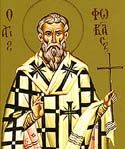
Today, July 23, we celebrate the feast day of Saint Phocas the Gardener of Sinope (died 303), Martyr for the faith. Saint Phocas is considered the patron saint of gardeners, as despite being quite poor himself, spent his time growing crops to feed those who were hungry. His charity and care for others—even the soldiers who were dispatched to execute him—remind us of our call to social justice, service, and care for our fellow man.


Saint Phocas was a Christian gardener, who lived at Sinope on the Black Sea, in Paphiagonia (modern-day Turkey). He earned his living by cultivating a garden near the city gate, where he spent his days in quiet prayer and contemplation while he tilled his soil and created a beautiful green space. Despite his own poverty, he shared whatever he grew with those who were poorer than he, and opened his home to poor travelers who had no place to stay. Over time, through his quiet witness, he became known readily as a pious Christian man, and attracted the attention of the pagan Roman authorities during the persecution of Christians under Emperor Diocletian.

Roman soldiers were dispatched to find and arrest him. Having traveled a long way, the solders arrived in Sinope tired and hungry, and found themselves at the door of a kindly man who offered them food and lodging. Unaware this was the man they were charged with capturing, they accepted his gracious offer, speaking throughout dinner of the mission they were on. Once his soon-to-be-captors were asleep, Phocas spent the evening in prayer, outside the home, while digging his own grave.

In the morning, after feeding the soldiers breakfast, Phocas led them to his grave and confirmed his identity. When they were aghast and hesitated to execute him as ordered, he encouraged them to complete their task and behead him. Eventually, the soldiers did as commanded, and Saint Phocas was beheaded, earning the golden crown of the Martyrs.

The soldiers, with deep respect, buried the holy martyr Phocas in the grave that he had prepared in the garden. The place of his burial was glorified by miracles, and later a church was built there. Saint Phocas is venerated as a patron saint of both gardeners and mariners. Phocas is the Greek word for "seal,” which may explain his patronage of sailors and mariners. A sailors' custom was to serve Phocas a portion of every meal; this was called "the portion of Saint Phocas." This portion was bought by one of the voyagers and the price was deposited in the hands of the captain. When the ship came into port, the money was distributed among the poor, in thanksgiving to their benefactor for their successful voyage.

Saint Phocas remains a reminder of our duty as Christians to espouse virtuous charity: complete selfless concern for the good of others, regardless of whether we like them or not, and regardless of what we will get in return. We pray today for the strength and obedience to live loving and charitable lives.

Keep me, O God, from pettiness; let me be large in thought, in word, in deed. Let me be done with fault-finding and self-seeking. May I put away all pretense and meet everyone face to face without self-pity and without prejudice. May I never be hasty in judgment and always generous. Let me take time for all things. Make me grow calm, serene and gentle. Teach me to put into action my better impulses, straightforward and unafraid. Grant that I may realize it is the little things of life that create differences and that in the big things of life we are one. And, O Lord God, let me not forget to be kind! Amen.

July 22, 2013: Saint Mary Magdalene

Posted by Jacob

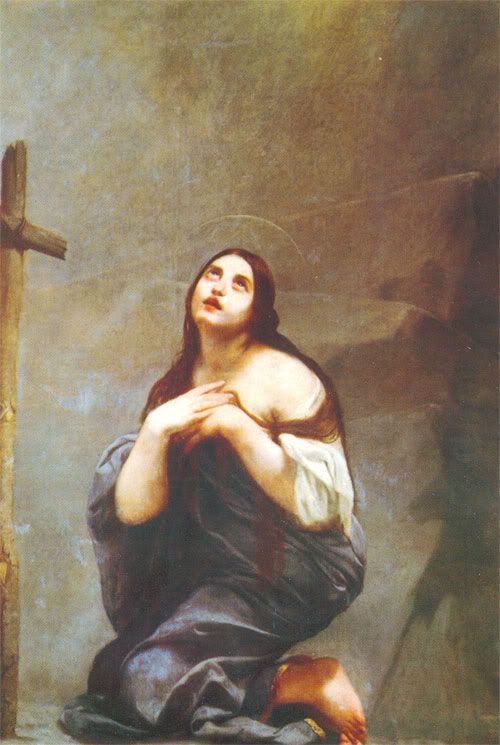
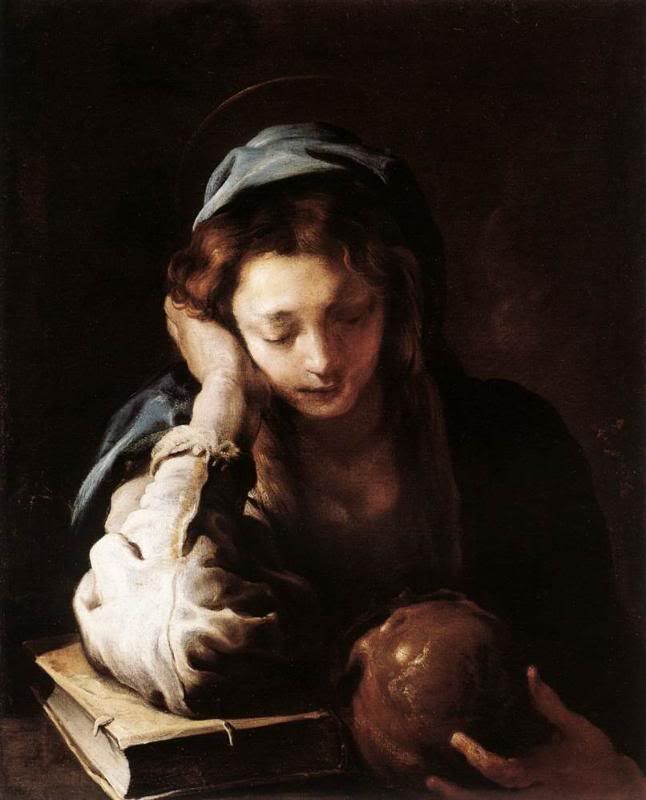
Today, July 22, we celebrate the feast day of Saint Mary Magdalene (dates unknown, first century), friend and disciple of Jesus, honored woman of Scripture, Penitent, and “Apostle of the Apostles.” What we know of the life of this saintly woman comes directly from Scripture:


1After this, Jesus traveled about from one town and village to another, proclaiming the good news of the kingdom of God. The Twelve were with him, 2and also some women who had been cured of evil spirits and diseases: Mary (called Magdalene) from whom seven demons had come out; 3Joanna the wife of Cuza, the manager of Herod's household; Susanna; and many others. These women were helping to support them out of their own means. (Luke 8: 1-3)

From this passage in Luke, we understand that Mary was offering support—possibly financial support, as well as tending to basic needs-- of Jesus and His disciples. She further is described as having been exorcised of seven demons, although some scholars belief this to be a description of illness (mental), rather than an indication of a past sinful life. In either case, it is clear that the grace of the Lord, through the love of Jesus Christ, healed Saint Mary Magdalene.

Despite being mentioned by name in all the Gospels, Biblical scholars are divided on the identity of Mary Magdalene throughout the Bible. In the sixth century, Pope Saint Gregory the Great conflated Mary Magdalene with the nameless woman who washed Christ's feet with her tears (Luke 7:36-50):

36Now one of the Pharisees invited Jesus to have dinner with him, so he went to the Pharisee's house and reclined at the table. 37When a woman who had lived a sinful life in that town learned that Jesus was eating at the Pharisee's house, she brought an alabaster jar of perfume, 38and as she stood behind him at his feet weeping, she began to wet his feet with her tears. Then she wiped them with her hair, kissed them and poured perfume on them.


39When the Pharisee who had invited him saw this, he said to himself, "If this man were a prophet, he would know who is touching him and what kind of woman she is—that she is a sinner."


40Jesus answered him, "Simon, I have something to tell you."


"Tell me, teacher," he said.


41"Two men owed money to a certain moneylender. One owed him five hundred denarii, and the other fifty. 42Neither of them had the money to pay him back, so he canceled the debts of both. Now which of them will love him more?"


43Simon replied, "I suppose the one who had the bigger debt canceled."


"You have judged correctly," Jesus said.


44Then he turned toward the woman and said to Simon, "Do you see this woman? I came into your house. You did not give me any water for my feet, but she wet my feet with her tears and wiped them with her hair. 45You did not give me a kiss, but this woman, from the time I entered, has not stopped kissing my feet. 46You did not put oil on my head, but she has poured perfume on my feet. 47Therefore, I tell you, her many sins have been forgiven—for she loved much. But he who has been forgiven little loves little."


48Then Jesus said to her, "Your sins are forgiven."


49The other guests began to say among themselves, "Who is this who even forgives sins?"


50Jesus said to the woman, "Your faith has saved you; go in peace." (Luke 7: 36-50)

Pope Saint Gregory the Great also identified Mary Magdalene as Mary of Bethany, sister of Martha and Lazarus (Luke 10:38-42):

38As Jesus and his disciples were on their way, he came to a village where a woman named Martha opened her home to him. 39She had a sister called Mary, who sat at the Lord's feet listening to what he said. 40But Martha was distracted by all the preparations that had to be made. She came to him and asked, "Lord, don't you care that my sister has left me to do the work by myself? Tell her to help me!"


41"Martha, Martha," the Lord answered, "you are worried and upset about many things, 42but only one thing is needed. Mary has chosen what is better, and it will not be taken away from her." (Luke 10:38-42)


Combining these Scriptures into the same figure gives the Church, and indeed the faithful, a powerful figure of repentance and spiritual renewal. Saint Mary Magdalene is at once a reformed prostitute—a penitent. She is identified as the first contemplative, sitting at the feet of Christ. She is one of the very few who stayed with Christ at the Crucifixion. And as we know from the Gospel of Saint John, Mary was chosen by the Lord to be the first witness to the Resurrection. For this, she has earned the title: the Apostle to the Apostles.
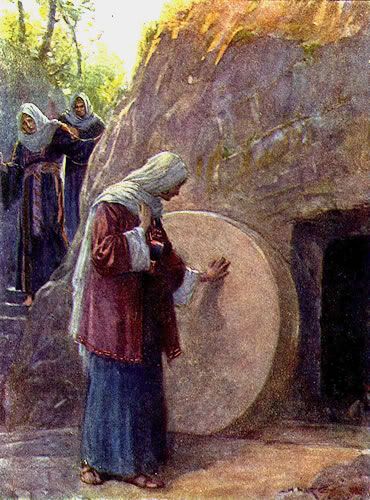
1 Early on the first day of the week, while it was still dark, Mary Magdalene went to the tomb and saw that the stone had been removed from the entrance. 2So she came running to Simon Peter and the other disciple, the one Jesus loved, and said, "They have taken the Lord out of the tomb, and we don't know where they have put him!"


10Then the disciples went back to their homes, 11but Mary stood outside the tomb crying. As she wept, she bent over to look into the tomb 12and saw two angels in white, seated where Jesus' body had been, one at the head and the other at the foot.


13They asked her, "Woman, why are you crying?"


"They have taken my Lord away," she said, "and I don't know where they have put him." 14At this, she turned around and saw Jesus standing there, but she did not realize that it was Jesus.


15"Woman," he said, "why are you crying? Who is it you are looking for?"


Thinking he was the gardener, she said, "Sir, if you have carried him away, tell me where you have put him, and I will get him."


16Jesus said to her, "Mary."


She turned toward him and cried out in Aramaic, "Rabboni!" (which means Teacher).


17Jesus said, "Do not hold on to me, for I have not yet returned to the Father. Go instead to my brothers and tell them, 'I am returning to my Father and your Father, to my God and your God.' "


18Mary Magdalene went to the disciples with the news: "I have seen the Lord!" And she told them that he had said these things to her. (John 20: 1-2; 10-18)


Pope Saint Gregory the Great said of Saint Mary Magdalene in a homily: “When Mary Magdalene came to the tomb and did not find the Lord’s body, she thought it had been taken away and so informed the disciples. After they came and saw the tomb, they too believed what Mary had told them. The text then says: “The disciples went back home,” and it adds: “but Mary wept and remained standing outside the tomb.” We should reflect on Mary’s attitude and the great love she felt for Christ; for though the disciples had left the tomb, she remained. She was still seeking the one she had not found, and while she sought she wept; burning with the fire of love, she longed for him who she thought had been taken away. And so it happened that the woman who stayed behind to seek Christ was the only one to see him. For perseverance is essential to any good deed, as the voice of truth tell us: 'Whoever perseveres to the end will be saved.'”

After Jesus ascended into heaven, Saint Mary Magdalene continued to be a vibrant and powerful witness to the people who knew her of the life transforming power of our Lord, God, and Savior Jesus Christ. She is thought to have worked under both Saints Peter and Paul, in Rome and Ephesus during that time. Tradition holds that fourteen years after Our Lord's death, she was put in a boat by the Jews without sails or oars along with Saints Lazarus and Martha, Saint Maximinus (who had baptized her), Saint. Sidonius ("the man born blind"), her maid Sera, and the body of Saint Anne, the mother of the Blessed Virgin. Per Holy Legend, these holy men and women were sent drifting out to sea and miraculously landed on the shores of Southern France, where Mary spent the rest of her life as a contemplative hermitess in a cave known as Sainte-Baume. She is said to have fasted so rigorously that angels delivered the Holy Eucharist to her as her only sustenance. Reportedly dying at age 72, Saint Mary was transported miraculously by nine angels, just before she died, to the oratory of Saint Maximinus (in Aix), where she received the last sacraments.

The relics of Mary Magdalene were interred in the oratory of Saint Maximinus, and later (approximately 745) translated to Vezelay (to protect them from Saracen invaders). In the thirteenth century, the relics were re-interred at the Dominican convent at the hermitage on La Sainte-Baume. During the French Revolution, the relics were secured in a sarcophagus sent by Pope Clement VIII, and were not re-consecrated until 1814, when the church on La Saint-Baume was restored. In 1822, the grotto at La Saint-Baume was re-consecrated, the head of this holy saint interred at the chapel. La Saint-Baume remains a vibrant center of pilgrimage for the faithful.

Saint Bede asserted that "what Magdalene once did, remains the type of what the whole Church does, and of what every perfect soul must ever do." Saint Mary Magdalene is an example of profound repentance and forgiveness. Her life, explained through the Holy Scriptures, reminds us of the mystery of Christianity—the absolute transition from sinfulness to sanctity possible through the grace of God. We pray today, on the feast of this Apostle of the Apostles, that we may undergo a miraculous transformation in our own lives, washed clean and made holy, repentant and joyful in the light of Christ!


Father,
your Son first entrusted to Mary Magdalene
the joyful news of His resurrection.
By her prayers and example
may we proclaim Christ as our living Lord
and one day see Him in glory,
for he lives and reigns with you and the Holy Spirit,
one God, for ever and ever. Amen.

 
Praise be to Thee, O Christ, Creator, Redeemer, and Savior,Of heaven and earth and seas, of angels and of menWhom we confess to be both God and Man,Who didst come in order to save sinners,Thyself without sin, taking the appearance of sin.


Among this poor flock, Thou didst visit the Canaanite woman and Mary Magdalene.


From the same table Thou didst nourish the one with the crumbs of the Divine Word, the other with Thy inebriating cup.


While Thou art seated at the typical feast in the house of Simon the Leper.


The Pharisee murmurs, while the woman weeps, conscious of her guilt.

The sinner despises his fellow-sinner, Thou, sinless one hearest the prayer of the penitent, cleanses her from stains, lovest her so as to make her beautiful.

She embraces the feet of her Lord, washes them with her tears, dries them with her hair: washing and wiping them, she anoints them with sweet ointment, and covers them with kisses.


Such, O Wisdom of the Father, is the banquet that delights Thee!


Though born of a Virgin, Thou cost not disdain to be touched by a sinful woman.


The Pharisee invited Thee but it is Mary that gives Thee a feast.


Thou forgivest much to her that loves much, and that falls not again into sin.

From seven devils cost Thou free her by Thy sevenfold Spirit.

To her, when Thou risest from the dead, Thou showest Thyself first of all.

By her, O Christ. Thou cost designate the Gentile Church, the stranger whom Thou callest to the children's table;


Who, at the feast of the Law and at the feast of grace, is despised by the pride of Pharisees, and harassed by leprous heresy.


Thou knowest what manner of woman she is, it is because she is a sinner that she touches Thee, and because she longs for pardon.


What could she have, poor sick one, without receiving it, and without the physician assisting her?


O King of kings, rich unto all, save us, wash away all the stains of our sins, O Thou the hope and glory of the saints. Amen.


July 21, 2013: Saint Lawrence of Brindisi, Doctor of the Church

Posted by Jacob

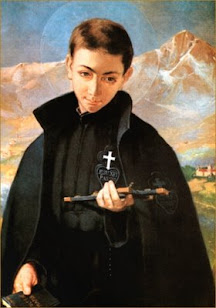
Today, July 21, we celebrate the feast day of Saint Lawrence of Brindisi (1559-1619), Doctor of the Church. One of the most famous Capuchin preachers and theologians of the sixteenth century, Saint Lawrence is renowned for his complete and thorough refutation of the doctrines of Martin Luther. Like his spiritual father, Saint Francis of Assisi, Saint Lawrence embodied a deep devotion to the Our Blessed Mother, Mary, and was among the first to write on all aspects of theology that concerns the Blessed Virgin. Proclaimed a Doctor of the Church in 1959 by Pope John XXIII, the writings of Saint Lawrence remain a treasure of the faith today, particularly those expounding upon the majesty and importance of the Virgin Mother of Christ (for examples, see here and here).


Born Julius Caesar at Brindisi in Naples, Lawrence received his saint’s name upon entering the Capuchins at age 16, following his education by Franciscans at the Venice College of Saint Mark. A gifted scholar, Saint Lawrence learned and mastered Hebrew, Greek, German, Bohemian, Spanish, and French, as well as his native Italian. Able to read Scriptures in the languages they were originally written in, he further excelled at theological studies, and during his education was recognized for his piety and abilities to interpret and explain both Scripture and Church doctrine.

As a member of the Capuchins, following his ordaining, he became known for his extraordinary sermons, specifically on the Mother of God. He was dispatched by the pope to establish Capuchin houses throughout Germany and northern Europe, founding friaries at Prague, Vienna, and Gorizia (modern provinces of Bohemia, Austria, and Styria). Lawrence further served as chaplain to the Christian soldiers defending Hungary against the invading Muslims, organizing the troops, and leading them into battle. Despite being greatly outnumbered, Saint Lawrence—through his ardent faith—convinced the generals to lead the troops into battle. He is largely regarded as being responsible for the Christian victory, and the repulsion of the Muslim invaders. Further, as founder of the Catholic League, he rallied Christian leaders from Germany, Hungary, and Spain to defend Christians on the European continent.

Saint Lawrence is also remembered for his compassion for the poor, sick, and needy. At age 33 he was elected minister-general of the Capuchins, after which he visited every friary in the thirty-four provinces of the order across Europe, directing the work of over nine thousand brothers. His combination of brilliance, human compassion and administrative skill allowed him to carry out his duties with great success. Instrumental in the Catholic Restoration, he attended and facilitated the Council of Trent, described by Pope Benedict XV as having earned "a truly distinguished place among the most outstanding men ever raised up by Divine Providence to assist the Church in time of distress."

Saint Lawrence is also remembered for his sanctity and miracle working. While he was Provincial Superior of his order he cured a blind man in front of many witnesses. At the court of Philip III of Spain he cured a woman who was paralyzed. Once while stopping with some companions at an inn a rowdy customer began to ridicule the friars. Getting no reaction he resorted to blasphemy and even mocked the crucifix that the saint was wearing. “To vindicate the honor of this cross which you have blasphemed, may God punish you!” Immediately the man dropped dead to the floor before the stunned diners. Finally, at Milan, there was a young boy covered with sores and so deformed that he could not remove his head from his left shoulder while his right arm was held fast to his chest. After receiving a blessing from Father Lawrence the boy’s wounds dried up and his head and limbs were set free in the sight of family and neighbors. His Masses often lasted six to ten hours, the longest taking sixteen hours. One witness observed him levitate three feet above the floor for an hour and a half while celebrating the Holy Sacrifice of the Mass.

Saint Lawrence fell ill while traveling between Italy and Spain on a mission of mercy, and passed away in Lisbon exactly 60 years to the date of his birth. His body was buried in the church of the Poor Clares at Villafranca del Bierzo in Spain. As a Doctor of the Church, his legacy in prolific writing remains, as well as his ardent faith and courage in defense of the Lord.

Selected Quotations from Saint Lawrence of Brindisi:

"For the word of God is a light to the mind and a fire to the will. It enables man to know God and to love him. And for the interior man who lives by the Spirit of God through grace, it is bread and water…For the soul is a spiritual treasure of merits yielding an abundance of gold and precious stones. Against the hardness of heart that persists in wrongdoing, it acts as a hammer. Against the world, the flesh and the devil it serves as a sword that destroys all sin."
"God is love, and all his operations proceed from love. Once he wills to manifest that goodness by sharing his love outside himself, then the Incarnation becomes the supreme manifestation of his goodness and love and glory. So, Christ was intended before all other creatures and for his own sake. For him all things were created and to him all things must be subject, and God loves all creatures in and because of Christ. Christ is the first-born of every creature, and the whole of humanity as well as the created world finds its foundation and meaning in him. Moreover, this would have been the case even if Adam had not sinned.”


Lord,
for the glory of your name and the salvation of souls
you gave Lawrence of Brindisi
courage and right judgment.

By prayers
Help us to know what we should do
and give us the courage to do it.


We ask this through our Lord Jesus Christ, your Son,
who lives and reigns with you ad the Holy Spirit,
one God, for ever and ever. Amen.


July 20, 2013: Saint Margaret of Antioch

Posted by Jacob

Today, July 20, we celebrate the feast day of Saint Margaret of Antioch (died 304), Virgin of the Church, and martyr for the faith. As with other early saints, much of what we know of Saint Margaret may be the stuff of pious legend, embroidered with medieval fantasy, somewhat “far-fetched” by today’s scientific standards. Stripping away the dragons, however, we are left with a young woman, committed to Christ, obedient to her calling, who suffered and died for her faith… and those “facts” are enough to inspire us today.


Saint Margaret was born in Antioch (modern day Turkey) near the end of the third century. Margaret’s father was a pagan priest and her mother died when Margaret was very young. Her nurse, a pious Christian woman, raised Margaret, instructing her in the Christian faith against her father’s wishes. When this betrayal was discovered, Margaret’s father disowned her, and she left the home, continuing to live with her nurse. Before the age of 10, Margaret consecrated herself to Jesus, pledging to remain a virgin, a pure bride of Christ.

Margaret spent her days in prayer and contemplation, tending sheep in the fields. One bright day, a local Roman prefect, Olybrius, observed her during her prayer, and was taken by her delicate beauty. He attempted to court her, but she refused his advances. In retaliation, he accused her of being a Christian, which was forbidden at that time under the reign of Emperor Diocletian. Christians were actively persecuted upon discovery, and Margaret, who did not deny the charge, was no exception. She was brought to trial, to which she offered no defense, and was sentenced to execution upon refusing to offer sacrifices to the pagan gods.

While imprisoned, Margaret is said to have been visited by the Devil, in the form of a hideous, scaly dragon. Holy legend tells us that the dragon, offended by her faith and purity, swallowed her whole. However, the crucifix that Margaret carried with her so irritated his throat, that she was coughed up, indigestible due to her faith, unharmed. Following her emergence from the demon, the dragon transformed into a handsome young man, whom Margaret immediately attacked, resisting his charms. Throwing him to the ground, she exclaimed, “Proud demon, lie prostrate beneath a woman’s foot!” foreshadowing the triumph of the Blessed Virgin over Satan. For this reason, due to her delivery from the belly of the beast, it is believed that Margaret is the patron saint of pregnancy, labor, and childbirth. She is considered one of the Fourteen Holy Helpers, assisting in safe delivery of children.

Multiple attempts were made to martyr Margaret, but each time her prayers kept her safe. First, she was set afire, but remained miraculously unharmed. Next, she was boiled in a large cauldron, and again, emerged unscathed. Finally, at approximately age 15, Saint Margaret was beheaded, the name of Christ upon her lips until the final moment of her life.

Following her death, Saint Margaret is believed to have visited with Saint Joan of Arc, one of the heavenly voices that assisted Joan in her holy mission in France. At her trial, Saint Joan said: "Saint Michael, when he came to me, told me that Saint Catherine and Saint Margaret would come to me and that I should act by their advice, that they were bidden to lead me in what I had to do and that I should believe in what they would say to me and that it was by God's order."

Saint Margaret’s body was buried at Antioch, but her remains were taken translated to Italy where they were divided between shrines in Montefiascone and Venice. She remains a popular saint today throughout Europe, with a common belief that those who read and spread her story will receive an eternal crown in heaven. She is also invoked frequently by women during childbirth, whom she promised to pray for following her encounter with Satan.

Fantastical though it may be, Saint Margaret of Antioch was a young woman who resisted the temptations of the world. Remaining pure in body, spirit, and faith, she went to her death with a confidence far beyond her years, remaining true to the Lord. Whether she physically battled with the Devil, we can be certain that she did so spiritually each day, and in the end, triumphed over him, receiving the martyr’s crown, and taking her rightful place in heaven with the saints.


Jesus, Lover of chastity, Mary, Mother most pure, and Joseph, chaste guardian of the Virgin, to you I come at this hour, begging you to plead with God for me. I earnestly wish to be pure in thought, word and deed in imitation of your own holy purity.


Obtain for me, then, a deep sense of modesty which will be reflected in my external conduct. Protect my eyes, the windows of my soul, from anything that might dim the luster of a heart that must mirror only Christlike purity.


And when the "Bread of Angels becomes the Bread of me" in my heart at Holy Communion, seal it forever against the suggestions of sinful pleasures.


Heart of Jesus, Fount of all purity, have mercy on us.


Amen.

Pre-Mission Prayer Requests & Guatemalan Rosary Construction

Posted by Jacob

I leave this evening for my week-long trip to the Guatemalan highlands to serve those in need, build our international Catholic community of faith, and distribute some of the reader-donated Rosaries that I have been able to repair:


... as well as some of the mission-style Rosaries built by our Rosary Construction Mission (and funded by your donations!):


I humbly ask that you pray for myself and my travelling companions during our week of prayer, service, and community!


Prayer Requests:  July

While I am travelling, please join me in lifting the following intentions  submitted through this blog, to Our Lord and Savior, through the intercession of Our Blessed Mother:

For love; Professional advancement (O, United Kingdom); Healing of a grandmother, academic success (O, Nigeria); Protection, sale or property, true conversion (E, Oman); Healing and recovery (A, Philippines); For a sister to find employment (P, South Africa); Reunification of a son and family (T, USA); Blessings upon children, successful employment (C, Philippines); Successful conception, financial security, true conversion, love (P, USA-PA); For a son suffering with mental illness (B, USA); For an end to depression (B, United Kingdom); Health, protection, Successful employment, A relationship blessed by God (K, Spain); Successful resolution of a difficult situation for son (M, USA-OH); Safety and protection during travels (A, USA-MN); Repose of a departed wife’s soul, financial security, strength and courage (J, USA-CA); Healing of an ill father (M, USA-TX).